
Interview
Microsoft Interview Questions and Process: The Complete Guide (2026)
Microsoft interview questions explained: reported rounds, what each evaluates, difficulty, timelines, a 30-day plan, and focused preparation advice.
Microsoft interview questions commonly span an online coding test, live coding rounds, low-level design, system design for experienced roles, and a behavioural or hiring-manager discussion. Reported accounts describe a genuinely mixed loop: coding matters, but design carries real weight across separate rounds. Prepare both your implementation reasoning and your ability to explain technical decisions from past work. Microsoft's interview kit holds 181 mapped DSA questions, nine low-level design problems, and six system design problems evidenced at Microsoft.
The precise sequence varies by team, location and seniority, so treat this as the reported shape of the loop rather than a fixed company policy. Confirm the format, level expectations and timings with your recruiter.
The Microsoft interview process at a glance
| Stage | Format | Commonly reported shape | What it screens for |
|---|---|---|---|
| Recruiter call | Introductory discussion | Role, team and experience conversation | Motivation, background and fit |
| Online assessment | Timed HackerRank test | Two algorithm questions reported | Coding fundamentals and speed |
| Live coding rounds | Engineer-led coding interviews | Two to three rounds, commonly 45–60 minutes | Problem solving, communication and complexity |
| Low-level design | Design discussion | Class design, fundamentals and project depth | Modelling, abstraction and clean engineering |
| System design | Architecture discussion | Experienced roles, commonly SDE-2+ | Scale, trade-offs and technical judgement |
| Hiring-manager round | Project and behavioural discussion | May include a past-project design prompt | Ownership, collaboration and level fit |
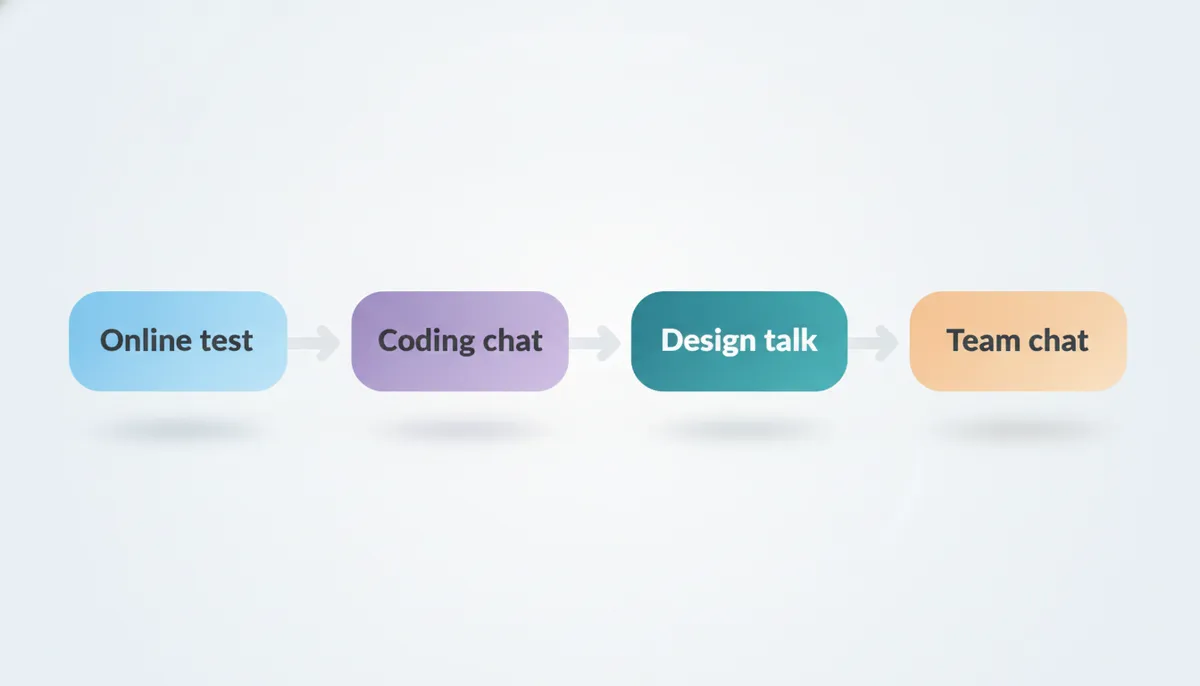
The reported loop is often described as four to five interview stages after the initial contact, with design expectations increasing at experienced levels. The useful preparation mindset is not “coding first, design later”. It is to build a repeatable approach for each format, because each interviewer is looking at a different part of your engineering judgement.
Round 1 — recruiter call and online assessment
The recruiter conversation is usually the first opportunity to understand the role. Use it well. Ask which level the team is hiring for, whether the loop includes a system design round, what language options are supported, and whether any domain knowledge is relevant. Those answers should alter your preparation plan.
Candidate reports commonly describe a HackerRank online assessment with two algorithm questions. This is a timed filter, so recognition speed matters. The aim is to identify the problem shape quickly, choose an appropriate data structure, write a correct solution, and leave enough time to test edge cases.
Expect familiar coding-interview territory: arrays, strings, hash maps, trees, graphs, recursion, sorting, binary search and dynamic programming. You do not need a trick for every problem. You need a disciplined way to turn an unfamiliar prompt into a known pattern.
The DSA Patterns Sheet is free to browse and groups practice around those recurring shapes. For the underlying skill, read how to identify the right DSA pattern in a coding interview.
💡 Pro tip: Do not spend the opening minutes coding. Restate the input, identify constraints, and say what would make a brute-force solution too slow. That short pause often prevents the much longer mistake of implementing the wrong approach.
Rounds 2 and 3 — live coding interviews
Reported Microsoft loops include two to three coding rounds, often lasting 45 to 60 minutes. These are not simply online-assessment questions with an audience. Your interviewer can see how you react to ambiguity, whether you communicate trade-offs, and how you recover when an initial idea does not work.
The coding prompt may start with a straightforward task and add constraints: larger input, a follow-up feature, memory restrictions, or an alternative implementation. That structure tests whether you can evolve a solution rather than memorise one.
What the round screens for:
- Problem framing: Do you clarify assumptions before solving?
- Data-structure choice: Can you explain why a map, queue, heap or graph fits?
- Complexity reasoning: Do you know the time and space cost of your approach?
- Implementation quality: Is your code readable, modular and testable?
- Communication: Can another engineer follow your reasoning throughout?
A strong answer usually has a visible sequence: clarify, propose a baseline, improve it, state complexity, implement, then test. Narrating that sequence makes your judgement assessable. Silent coding makes even good reasoning difficult to credit.
Practise that spoken structure, not just solutions. The guide to explaining your thought process clearly in coding interviews gives a practical framework for doing it without sounding rehearsed.
✅ Do: Test normal cases, empty input, boundary values and repeated values aloud.
❌ Don’t: Treat a correct-looking first draft as finished without walking through it.
Round 4 — low-level design and engineering fundamentals
The low-level design round is where Microsoft’s process can surprise candidates who prepared only for LeetCode-style prompts. Reported accounts describe a 45–60 minute discussion that may open with a short background conversation and a brief CS-fundamentals or project deep-dive before moving into design.
This round is about making a small system understandable, maintainable and ready for change. You may be asked to identify entities, define their responsibilities, describe interactions, choose interfaces, and explain how the design would absorb a new requirement.
The interviewer is not looking for every textbook pattern. They are looking for judgement about when an abstraction is useful. A clean model with well-placed responsibilities is stronger than a diagram full of factories, observers and interfaces that do not solve a real problem.
Prepare to discuss:
- class responsibilities and object relationships;
- composition versus inheritance;
- interfaces where behaviour genuinely varies;
- validation, error handling and testability;
- concurrency or persistence considerations where relevant;
- core CS foundations, including the parts of your past work you claim to own.
The Low Level Design Sheet is free to browse and helps you practise turning requirements into working object models. For clarity on the boundary between design rounds, see low-level design vs high-level design: what interviews actually expect.
The kind of design problem evidenced at Microsoft rewards a practical answer: first make the core flow work, then explain how you would extend it. Avoid beginning with a perfect hierarchy before you understand the required behaviour.
Round 5 — system design for experienced roles
Candidate reports describe a separate system design round for experienced roles, commonly SDE-2 and above. This is distinct from low-level design. Instead of classes and methods, the conversation moves to services, storage, data flow, reliability, capacity and operational trade-offs.
A good answer starts with scope. Ask what the system must do, who uses it, what scale matters, and what is explicitly out of scope. Then move from a simple end-to-end design to the components that deserve deeper attention.
Interviewers commonly screen for whether you can:
- turn vague product requirements into a technical boundary;
- identify the highest-risk bottleneck rather than explaining every component equally;
- make trade-offs explicit around consistency, latency, cost and reliability;
- reason about failure modes, observability and evolution;
- communicate the design in a clear, structured order.
Do not jump directly to a catalogue of distributed-systems terms. A system design conversation is stronger when every component has a reason to exist. If you introduce caching, queues, replication or partitioning, connect it to a concrete load, availability or latency problem.
The System Design Sheet is free to browse for architecture practice. If you want a focused example of structured trade-off discussion, how to design a rate limiter is a useful walkthrough.
The Microsoft-specific round: design a feature from your own project
Microsoft’s most distinctive reported ritual is the hiring-manager or “as appropriate” discussion in which the candidate is asked to high-level design a feature from their own past project.
This changes the preparation task. You cannot rely on a memorised URL shortener or generic social feed design. You need to know your own work deeply enough to reconstruct a design decision under questioning.
Choose two projects from your experience and prepare each at three levels:
- The context: What customer or engineering problem existed?
- Your contribution: What did you personally decide, build or change?
- The design: What components were involved, what alternatives did you reject, and what would you improve now?
Expect follow-ups that expose vague ownership: Why did you choose that datastore? What was the failure mode? How did you measure success? What would happen if traffic increased? What part did you implement yourself?
The strongest candidates do not pretend every decision was perfect. They show mature judgement by naming the constraints they faced and explaining what they learned after launch. This past-project feature discussion is especially important because it joins technical depth with credibility: it tests whether your résumé reflects work you can genuinely defend.
Use an AI mock interview to rehearse project stories aloud. Treat it as a design conversation, not a presentation. Invite interruptions and practise returning to the central point.
Is the Microsoft interview hard?
Yes, mainly because it is broad rather than because every coding question is unusually obscure.
The loop requires competence in timed DSA, live communication, low-level design, system design at experienced levels, and behavioural discussion. Candidates who are excellent at coding puzzles can still struggle when they must explain an object model or defend a technical decision from their own work. Conversely, experienced engineers can underestimate the speed and precision expected in the coding rounds.
How many rounds are there? Reported accounts describe an online assessment followed by a loop of roughly four to five stages, including coding, design and hiring-manager conversations. The exact count is level- and team-dependent.
How long does it take? The research does not establish a reliable end-to-end Microsoft timeline. Scheduling, team needs and location can all affect it, so ask your recruiter for the expected window rather than planning around a generic estimate.
The hardest part is usually switching contexts. You may solve an algorithmic problem in one round, model an extensible set of objects in the next, then discuss your project history with a hiring manager. Your preparation should include those transitions.
A 30-day Microsoft preparation plan
Week 1 — build coding-pattern speed
Focus on arrays, hashing, two pointers, sliding windows, binary search, recursion, trees and graphs. Solve fewer problems more deliberately: identify the pattern before coding, state complexity, then test edge cases.
Use in-browser code practice for short timed sessions. If graphs are a weak area, review graph traversal patterns for DFS and BFS before returning to mixed practice.
Week 2 — make low-level design concrete
Practise taking a short requirement and producing entities, interactions and a small working implementation. Start without a timer. Your goal is to learn where responsibilities belong and how to explain choices simply.
Review CS fundamentals alongside design. Be ready to discuss trade-offs in language features, storage, networking and concurrency when they connect naturally to your answer. The free sheets are useful reference material; your real progress comes from implementing and explaining designs yourself.
Week 3 — add system design and project depth
For experienced roles, practise one architecture discussion every few days. Use a repeatable structure: requirements, scale assumptions, core data flow, bottlenecks, trade-offs and failure modes.
At the same time, prepare your past-project stories. Draw a simple architecture for each project, list difficult decisions, and write down questions a sceptical hiring manager could ask. Rehearse answers aloud until they are specific without becoming overlong.
Week 4 — simulate the loop
Alternate timed coding, low-level design, system design and behavioural practice. Run at least one session where you explain every decision from the opening clarification to the final test case.
Work through Microsoft's interview kit during this week to focus your practice on the company-mapped material. Keep your final days light: review mistakes, practise your project discussion, and avoid trying to learn an entirely new framework at the last moment.
💡 Pro tip: Build a short “decision log” after each practice session. Record one choice you made, why you made it, what alternative you rejected, and what you would change. That is exactly the language design and hiring-manager rounds reward.
Frequently asked questions
What types of Microsoft interview questions should I expect?
Reported loops include DSA coding, low-level design, system design for experienced roles, CS-fundamentals discussion and behavioural questions about projects, ownership and collaboration.
Does Microsoft have an online assessment?
Candidate reports commonly describe a HackerRank online assessment with two algorithm questions. Confirm the current format with your recruiter.
How many coding rounds does Microsoft have?
Reported accounts describe two to three coding rounds, commonly lasting 45–60 minutes each. Team and level can change the final loop.
Does Microsoft ask low-level design questions?
Yes, candidate reports commonly describe a dedicated low-level design round. It may also include CS-fundamentals questions or a project deep-dive.
Is system design required for Microsoft SDE-1 roles?
A separate system design round is most commonly reported for experienced roles, including SDE-2 and above. Early-career candidates should still understand basic design trade-offs.
What is the hiring-manager round like?
It is a behavioural and project-depth discussion. Reported accounts also describe being asked to high-level design a feature from your own past project.
How should I prepare for Microsoft coding rounds?
Practise recognising common DSA patterns, explaining your approach before implementation, stating complexity, and testing edge cases aloud under time pressure.
What should I revise for Microsoft low-level design?
Revise object-oriented modelling, interfaces, responsibilities, extension points, testability and the CS fundamentals that support your design choices.
Is Microsoft’s interview harder than a standard coding interview?
It is challenging because it assesses multiple skills: coding speed, communication, design judgement and project ownership. The breadth is often more difficult than any single round.
Where to start
The most effective Microsoft preparation is balanced preparation. Do not let strong DSA practice become a reason to postpone design, and do not let architecture study replace timed implementation practice.
Start with Microsoft's interview kit for 181 mapped DSA questions, nine low-level design problems, and six system design problems evidenced at Microsoft. Use the free-to-browse DSA, low-level design and system design sheets to strengthen individual gaps, then rehearse the full conversation in an AI mock interview.
Interview processes change, and reported experiences are not a company-published specification. Confirm your loop details with your recruiter, then prepare for the skills that remain consistent: clear reasoning, sound engineering judgement and credible ownership of your work.
Topics
Related on Thita
Your next step
Practise with AI mock interviews
A spoken interview that asks follow-up questions, runs your code and ends with a written report.