
Interview
Mock Coding Interview Online, With an Editor and No Partner Needed
Practise coding interviews online with a live voice AI, a code editor that runs your code, and adaptive follow-ups—no partner or scheduling required.
Searching for a mock coding interview online with editor sounds straightforward. You want a realistic problem, somewhere to write and run code, and an interviewer who asks the awkward follow-up questions that turn a familiar problem into a real interview.
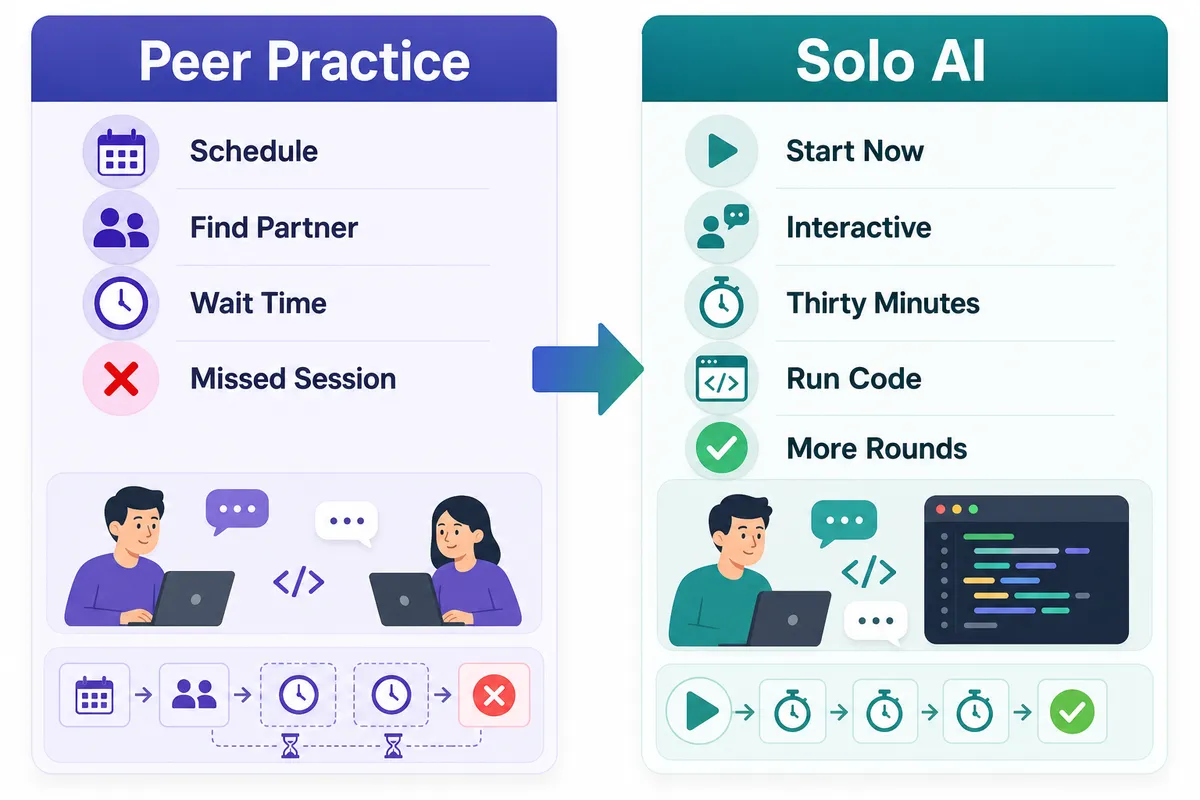
But many top results offer only part of that experience. Some are excellent peer-matching services, but require another candidate to accept a slot and show up. Others provide a shared code editor, but it stays empty until you bring your own partner. Still others are judges with timers, not interviews.
That is why a live AI coding interview with an editor can be useful: you can start alone, speak through your approach, write working code, run it, and respond to follow-ups without coordinating calendars first.
The problem with peer practice is rarely motivation. It is scheduling. You may be ready to practise at 11pm after work, while your assigned partner is busy, cancels, has a different language preference, or wants to practise a completely different level of question. A solo mock coding interview removes that friction without removing the interview format.
The real failure mode of peer coding practice: coordination
Peer mock interviews can be genuinely valuable. A thoughtful partner can spot unclear communication, ask surprising questions, and bring the unpredictability of a real human conversation. Platforms such as Pramp are built around that strength: two candidates meet in a shared editor and take turns interviewing one another.
The catch is that the quality of the practice depends on two people being available, prepared, and compatible at the same time.
That sounds minor until you build a preparation routine around it. A 45-minute mock may require:
- Finding a partner at your experience level
- Picking a time across work, classes, or time zones
- Agreeing on a programming language
- Deciding who interviews first
- Hoping neither person cancels
- Hoping the interviewer knows how to probe beyond the prepared prompt
None of these steps makes you better at coding interviews. They are all overhead.
For candidates with an interview next week, that overhead matters. Consistency beats the occasional perfect session. If you can practise four realistic coding rounds in a week because they begin immediately, that may be more useful than booking one excellent peer session that never happens.
⚠️ Important: A shared editor is not automatically an interview environment. If the format depends on another person joining, it is still a scheduled activity. That can be worthwhile, but it is not the same as being able to begin practice whenever you have thirty minutes free.
A practice coding interview alone should not mean silently solving a question in a blank text editor. The useful version is still interactive: you explain, make decisions under time pressure, run code, debug failures, and answer follow-ups.
What a realistic solo coding interview needs
A coding problem alone is not automatically coding interview practice with editor support. Practice becomes closer to the real thing when several elements happen together.
First, you need a problem with enough ambiguity to discuss. Real interviewers do not usually hand you a perfectly specified challenge and disappear. They expect you to clarify inputs, constraints, edge cases, and expected output.
Second, you need to think out loud. You should be able to say why a hash map fits, why a two-pointer approach is valid, or why recursion may create an avoidable stack-depth risk. This is not filler. Interviewers use your explanation to understand whether you are reasoning or recalling.
Third, the editor must be real. You should be able to write code, compile and run it, inspect output, and fix what fails. A polished discussion of an algorithm is not enough if your code has a missing base case or an off-by-one error.
Finally, the interviewer needs to react. If you finish a brute-force solution, the next question should not be a generic “good job”. It should be closer to: “Can you reduce the memory use?”, “What changes if the input is streamed?”, or “How would you test this before shipping it?”
That is the difference between completing an exercise and practising an interview.
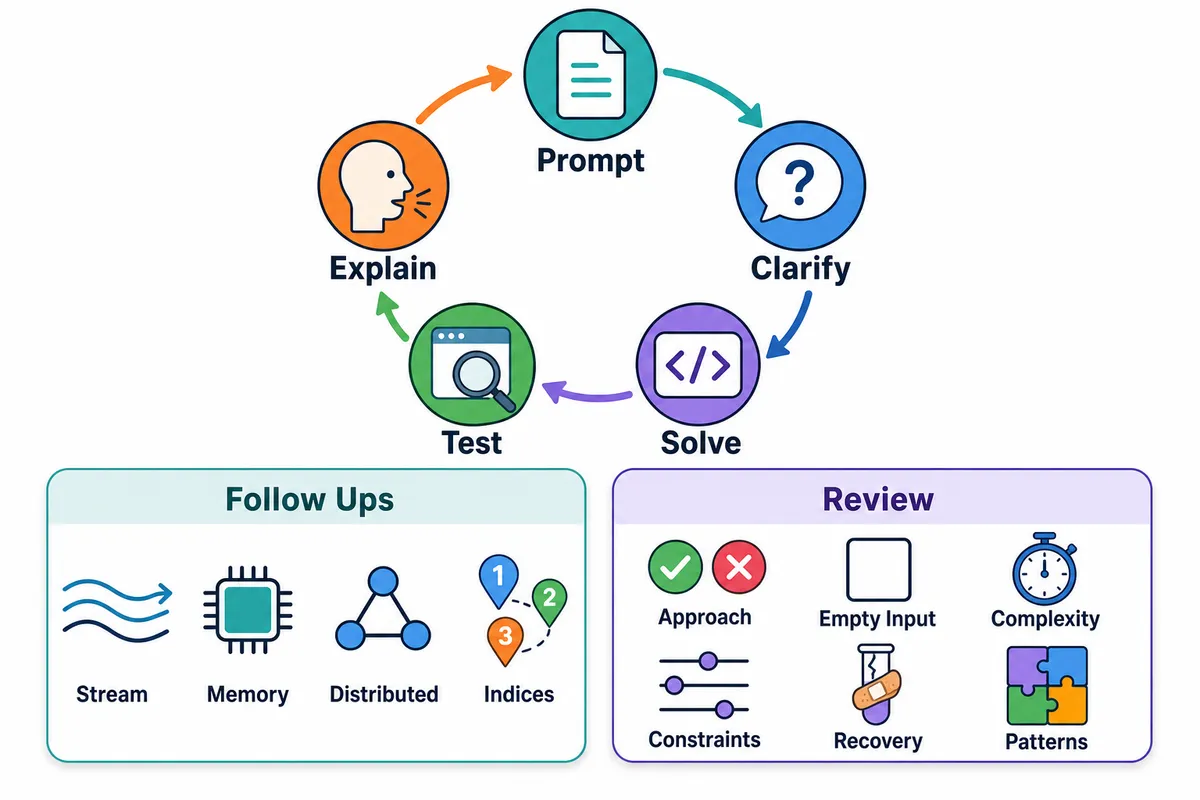
For a solo mock coding interview, the ideal loop is:
- Receive a problem and clarify it aloud.
- Describe a simple first approach.
- Improve it where needed.
- Write code in an editor.
- Run it against examples and edge cases.
- Diagnose mistakes under pressure.
- Handle follow-up questions based on your actual solution.
- Review both the code and the communication afterwards.
If one of those pieces is missing, the practice can still be useful. It is simply training a narrower skill.
Why a code editor that runs your code matters
A coding interview can expose a gap between knowing an approach and implementing it correctly. You might recognise that a problem uses sliding window, for example, but still mishandle duplicate values, move the left pointer too early, or return the wrong boundary.
That is why execution matters.
An editor that compiles and runs code lets you discover errors in the same moment you would face them during an actual coding round. You see a failing case, form a hypothesis, explain the fix, and make the change while the clock is moving.
This trains abilities that passive problem review does not:
- Translating an idea into correct syntax and control flow
- Testing boundary conditions before declaring success
- Recovering without panic when the output is wrong
- Explaining a debugging decision aloud
- Recognising when a correct-looking approach is not actually correct
For more guidance on the gap between solving questions and interview performance, read how interviewers judge problem-solving skills in live coding rounds.
💡 Pro Tip: Deliberately make one small mistake during practice. Use an incorrect loop bound or miss an edge case, run the code, and narrate your debugging process. This feels artificial at first, but it rehearses one of the most stressful moments in a real interview.
A good practice environment should let you practise in six languages: Python, C++, Java, JavaScript, Go and C#. The best choice is usually the language you can write fluently while explaining your decisions, rather than the language that looks most impressive on paper.
What you gain by practising without a partner
The biggest benefit of an AI-led interview is availability. It can be 20 minutes before a recruiter call, early in the morning, or late at night after your workday. You do not need to ask anyone for a favour or wait for a match.
That availability changes your preparation behaviour.
Instead of treating mock interviews as rare events, you can use them as regular repetitions. You can practise a short coding screen on Monday, a system design interview on Wednesday, and behavioural questions on Friday. Frequent exposure makes the interview format less novel.
With Thita’s live voice AI interviews, you can work through DSA rounds in a real code editor that compiles and runs your code, then move into system design, low-level design, machine coding, behavioural, product management, data science, AI/ML, CS fundamentals, or resume-based interviews.
The resume-based option is particularly useful when your background needs explanation. A candidate returning after a career break, moving from services to product companies, or interviewing for a non-technical role may need practice discussing projects and decisions from their own CV, not another generic array problem.
ai. The practical advantage is not that AI makes human practice irrelevant. It is that you can get more realistic repetitions between human sessions.
Here is what solo practice can give you particularly well:
✅ Do use it for volume. Repetition improves your pacing, your opening clarification questions, and your ability to explain trade-offs without rambling.
✅ Do use it for targeted weaknesses. If graph problems make you freeze, practise graph rounds repeatedly rather than waiting for a peer who happens to choose one.
✅ Do use it before a human mock. Arrive at a peer session already warmed up, with clearer language and fewer basic implementation errors.
✅ Do review what happened after each session. Track whether the issue was algorithm selection, implementation, testing, communication, or time management.
What you lose without a human partner
Being fair matters here: AI practice is not identical to a strong human mock interview.
A good human interviewer can react in unexpected ways. They may misunderstand part of your explanation, challenge an assumption you thought was obvious, ask about a production concern not included in the prompt, or simply create more social pressure than an automated session.
Humans also offer domain context. An experienced backend engineer might challenge your caching choice. A mobile engineer may notice an API trade-off. A hiring manager can tell you that your answer sounds technically correct but too vague for the level you are targeting.
Those are meaningful benefits. If you have access to a trusted mentor, a well-prepared peer, or an engineer who understands your target role, schedule human mocks too.
❌ Don't replace every human conversation with AI practice if your interview process includes collaborative discussion, stakeholder communication, or senior-level design judgement.
❌ Don't assume a smooth AI session proves you are ready. You still need to practise in conditions that make you slightly uncomfortable.
The strongest preparation plan is usually blended:
- Use solo AI sessions for frequent, structured practice.
- Use code problems independently to build pattern recognition.
- Use human mocks periodically for social pressure and unpredictable discussion.
- Use post-session review to turn every failure into a specific next action.
If you are unsure how to balance those pieces, mock interviews can be used more effectively for faster improvement when they are part of a deliberate weekly plan rather than a last-minute event.
How to practise coding interview alone without making it too easy
The danger of practising alone is not the absence of a partner. It is giving yourself too many escapes.
When a question gets difficult, it is easy to look up the pattern, restart the timer, skip the explanation, or quietly rewrite half the solution. Those habits make practice feel productive while avoiding the conditions that interviews test.
Create a little structure instead.
Set a realistic time limit
Use 35 to 45 minutes for a typical coding round. Reserve the first five minutes for clarification and approach, not immediate typing. If you begin coding before you can explain the plan, pause and reset.
Speak before you write
State your brute-force approach first. Then explain why it may be too slow, what data structure could help, and what complexity you expect. This creates a record of your reasoning and prevents silent trial-and-error from becoming your default.
Run more than the example
Examples are rarely enough. Test empty inputs, one-item inputs, repeated values, already sorted data, reverse-sorted data, and large values where relevant. Explain why each test matters.
Invite follow-ups
After a working solution, ask yourself what an interviewer could reasonably change. Could the data arrive as a stream? Could memory be constrained? Could the input be distributed? Could the function need to return indices rather than values?
For help making your spoken reasoning clearer, see how to think out loud in coding interviews with real examples.
Review failures by category
Do not write “messed up hash map question” in your notes. Be precise:
- Chose the right approach but implemented it incorrectly
- Missed the empty input case
- Could not explain complexity confidently
- Started coding before clarifying constraints
- Failed to recover after a test case broke
- Did not recognise the intended pattern quickly enough
Specific notes create specific practice goals.
When to choose a peer mock instead
Choose a human or peer mock when you need to test yourself against a real person’s reactions. This is especially valuable if you tend to over-explain, become quiet when challenged, or struggle to ask clarifying questions naturally.
A peer session can also be better for practising interviewer empathy. Taking turns as interviewer teaches you what good answers sound like and reveals why vague explanations are difficult to evaluate.
Use a scheduled peer format when:
- You have a reliable partner who prepares seriously
- You want feedback on presence, pacing, and interpersonal communication
- You are preparing for a senior or collaborative design interview
- You want to experience genuinely unpredictable questioning
- You need practice interviewing others as well as being interviewed
Use a solo AI interview when:
- You need a session now, not next week
- Your schedule changes often
- You want repeated practice on one weak area
- You need a code editor and execution in one place
- You want adaptive follow-ups without relying on someone else’s availability
Neither format has to win completely. The useful question is: what skill do you need to train today?
Frequently asked questions
Can I do a mock coding interview online without a partner? Yes. A solo mock coding interview can include a live voice AI interviewer, a code editor, code execution, timed prompts, and follow-up questions. You can begin when you are ready instead of coordinating with another candidate.
Does Thita.ai provide a code editor that runs code? Yes. Thita.ai includes a real editor that compiles and runs code during DSA interview practice. You can practise in six languages: Python, C++, Java, JavaScript, Go and C#.
Is a solo mock coding interview useful for real interviews? It is useful for building repetition in explaining, coding, testing, debugging, and handling follow-ups. It works best alongside occasional human mock interviews for interpersonal pressure and unpredictable discussion.
How is this different from solving problems on LeetCode? A judged problem and a coding interview train overlapping but different skills. Interview practice adds verbal reasoning, clarification, time pressure, follow-up questions, and recovery after mistakes.
Do I need to schedule an AI coding interview? No. You can start a session when you have time. This is the main advantage over peer-matching formats that depend on another participant being available.
Can I practise more than DSA coding rounds? Yes. Thita.ai offers system design on a canvas that the AI evaluates, low-level design, machine coding, behavioural, product management, data science, AI/ML, CS fundamentals, and resume-based interviews.
Should I still do human mock interviews? Yes, if you can access a thoughtful interviewer or committed peer. Human mocks provide social pressure, domain experience, and less predictable reactions. AI practice helps you get more repetitions between those sessions.
Start practising when you are actually free
You should not have to wait for a stranger to accept a calendar invite before you can prepare for an interview. If you need a mock coding interview online with an editor, real code execution, live voice interaction, and adaptive follow-ups, start with a session you can take today.
Practise a live AI coding interview on Thita.ai and use it to rehearse the complete loop: clarify the problem, explain the approach, write code, run it, debug it, and answer what comes next.
If you are hiring rather than interviewing, visit interviews.thita.ai.
Topics
Related on Thita
Your next step
Practise with AI mock interviews
A spoken interview that asks follow-up questions, runs your code and ends with a written report.