
Interview
Ola Interview Questions and Process: The Complete Guide (2026)
A full breakdown of Ola's SDE interview process — the HackerRank assessment, machine coding round, values evaluation, timelines and a 30-day prep plan.
Ola's engineering loop is balanced in a way that catches candidates who over-specialise. There is a machine coding round, which most people expect from an Indian product company — but algorithmic problem solving remains the single largest component of what is actually evaluated, and there is a values dimension that carries real weight rather than being a closing formality.
Prep guidance for Ola commonly suggests splitting study time roughly half toward data structures and algorithms, a fifth toward system design, a fifth toward behavioural and values, and the remainder toward computer science fundamentals. That split is a useful planning anchor, and it is a noticeably different shape from the design-first loops at comparable companies.
This guide covers each round and how to prepare. To practise the design rounds, Ola's interview kit holds four low-level design problems attributed to the company, each with a worked editorial and AI-evaluated practice.
The process at a glance
| # | Round | Format | What it screens |
|---|---|---|---|
| 1 | Online assessment | Timed coding, commonly on HackerRank | Baseline algorithmic ability |
| 2 | Machine coding | Build a working system under a clock | Design under pressure, code quality |
| 3 | Problem solving / data structures | Live coding with an engineer | Algorithmic depth, complexity reasoning |
| 4 | Hiring manager | Project depth, values | Ownership, judgement, alignment |
| 5 | HR | Fit and logistics | Communication, expectations |
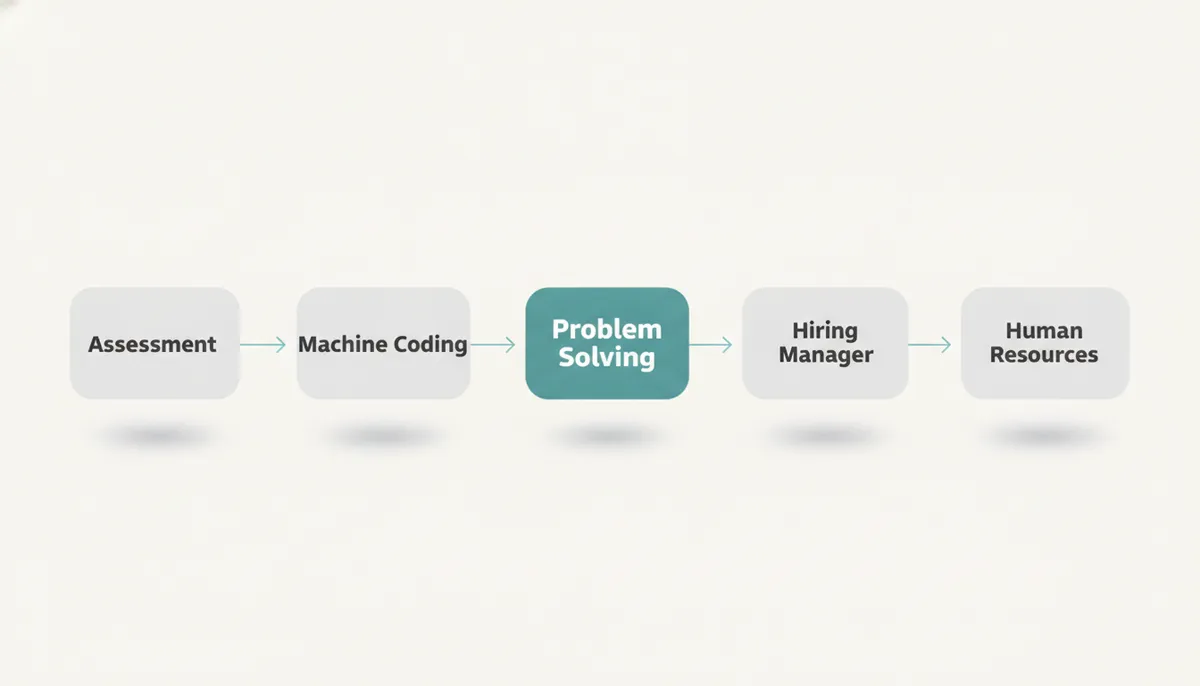
Round counts and order vary by level and team. Confirm the sequence with your recruiter.
Round 1 — the online assessment
A timed coding assessment, commonly administered on HackerRank. Reported topics sit squarely in standard interview territory: arrays and strings, hash maps, and cache-style data structure design such as a least-recently-used cache.
That last one is worth calling out, because an LRU cache is a genuine hybrid — part data structure knowledge, part small design exercise. Being able to implement one cleanly, from memory, with the right underlying structures, is a reasonable proxy for whether you are ready for this round.
Pattern recognition is what makes this comfortable. The DSA Patterns Sheet is free to browse and organises problems by the pattern each tests, and how to identify the right DSA pattern covers the recognition skill. Timed in-browser code practice with real execution builds the implementation fluency the clock demands.
💡 Pro Tip: Implement an LRU cache from scratch, without looking anything up, before your assessment. It appears often enough in reported accounts to be worth having in your fingers rather than your notes.
Round 2 — machine coding
A build round: one under-specified problem, a clock, running code expected at the end. In-memory state, your choice of language, no framework or database, and something demonstrating the flows.
What gets marked, roughly in order: it works; there is a real domain model rather than one procedural block; each class does one thing; the design extends cleanly against the obvious next requirement; and the code reads well.
Given Ola's product surface, natural problem territory includes matching and dispatch, pricing that varies by conditions, trip state machines, and driver or vehicle allocation — problems where entities have lifecycle and rules that clearly change over time. That last property is the signal to look for: wherever requirements plainly branch, that is where an interface belongs.
⚠️ Important: Get the core flow running early, then improve its structure. The most common failure in any machine coding round is arriving at the end with nothing that executes.
The free Low Level Design Sheet builds the vocabulary this round assumes, and design patterns for interviews covers the idioms.
Round 3 — problem solving and data structures
A live algorithmic round with an engineer, harder than the assessment, and here your process is marked as much as your answer.
Clarify the problem before coding. State the approach and its complexity before typing. Narrate the choice when you pick between two approaches. Notice your own edge cases. Being nudged is normal; being carried is not. Our guides on what interviewers look for in live coding rounds and explaining your thought process clearly cover the mechanics.
This round, together with the assessment, is why algorithmic preparation should still take the largest share of your time despite the machine coding round existing.
Round 4 — hiring manager, and the values dimension
Project depth plus an explicit values component, which reported accounts describe as carrying meaningful weight — roughly a fifth of the overall evaluation in the commonly cited prep split.
That is high enough to prepare for deliberately rather than improvise. What it means in practice:
- Ownership stories with specifics. Not "we shipped the feature" but what you personally decided, and what you did when it went wrong.
- Judgement under constraint. Ola operates in a low-margin, high-volume, operationally messy domain. Stories about trade-offs made with incomplete information land better than stories where everything went to plan.
- Working with people who disagreed with you. How you handled it, and what you concluded afterwards.
Prepare two or three projects you can discuss for ten minutes each without notes, and rehearse them aloud. A behavioural mock interview is a reasonable way to practise if you have nobody to run them with.
Is the Ola interview hard?
Moderate, and broad rather than deep.
No single round is exceptionally difficult — the assessment is standard, the machine coding round is a normal build exercise, the algorithmic round is a fair step up. What makes the loop selective is breadth: you need genuine algorithmic ability, real design competence, and a considered account of your own work, and weakness in any one of the three shows.
The candidates who struggle are usually those who prepared for one shape of round. The split-time guidance exists precisely because the loop rewards balance.
How many rounds? Typically four to five stages, varying by level and team.
How long does it take? Commonly two to four weeks end to end.
A 30-day preparation plan
Weighted to match the loop rather than split evenly.
Weeks 1 and 2 — algorithms, half your time. Core patterns for recognition speed. Implement the classic structure-design problems from scratch, LRU cache included. Timed practice throughout.
Week 3 — design. Class-level design vocabulary, then two problems on a clock with running code at the end. The four low-level design problems evidenced at Ola are the most directly relevant set. If system design applies at your level, add reading on caching, queues and consistency from the free System Design Sheet.
Week 4 — values and rehearsal. Write out your project stories properly and say them aloud. Then one algorithmic mock, one machine coding mock, one behavioural. Keep light algorithmic practice running so the earlier rounds stay sharp.
The fundamentals slice nobody plans for
The commonly cited preparation split for Ola leaves around a tenth of the time for computer science fundamentals. That is a small share, and it is the share candidates almost always drop entirely — which is a mistake, because it is the cheapest part of the loop to prepare and the most awkward to improvise.
What tends to come up:
Operating systems. Processes against threads, context switching, deadlock conditions, how concurrency actually behaves. These surface naturally whenever you discuss a design that shares state, which is most designs. The free operating systems sheet covers the ground quickly.
Databases. Indexing and what it costs on writes, transactions and isolation levels, the difference between normalising for correctness and denormalising for read performance. Any design discussion involving storage can turn into this. The free DBMS sheet is the fast route.
Networking. What actually happens across a request, why latency behaves the way it does, retries and timeouts. Relevant to any system with more than one moving part — see the free computer networks sheet.
Why the small slice matters more than its size suggests: these questions rarely arrive as a dedicated round. They arrive as follow-ups inside a design discussion — "what happens if two requests do this at once?", "why is that query slow?" — where a confident, correct answer visibly raises the interviewer's assessment, and a vague one visibly lowers it.
An evening on each is enough to stop them being a liability. Given how little time it takes, skipping it is poor economics.
Frequently asked questions
How many rounds does Ola have for SDE roles? Typically an online assessment, a machine coding round, a live problem-solving round, a hiring manager round and an HR round.
What platform is the assessment on? Commonly HackerRank in reported accounts. Confirm with your recruiter.
What topics appear in the assessment? Standard interview material — arrays, strings, hash maps, and cache-style structure design such as an LRU cache.
Does Ola have a machine coding round? Yes, as a distinct round. It is a build exercise producing running code, judged largely on design quality.
How should I split my preparation time? Prep guidance commonly cited for Ola suggests roughly half on data structures and algorithms, a fifth on system design, a fifth on behavioural and values, and the remainder on computer science fundamentals.
How much do values count? Enough to prepare for. Reported guidance puts the behavioural and values component at around a fifth of the overall evaluation.
Do I need system design for SDE-1? Class-level design, yes — the machine coding round examines it directly. Architecture-level design becomes more prominent at senior levels.
How long does the process take? Commonly two to four weeks, varying by team and hiring urgency.
Are computer science fundamentals tested in a dedicated round? Rarely as their own round. They surface as follow-up questions inside design and coding discussions — concurrency, indexing, retries — where a confident answer noticeably strengthens the interviewer's assessment.
Can I use my own IDE for the machine coding round? Usually yes. Use whatever you are fastest in, and confirm the setup with your recruiter before the day.
Is an LRU cache really likely to come up? It appears often enough across reported accounts to be worth having in your fingers rather than your notes. More usefully, it is a fair proxy for readiness: if you can implement one cleanly from scratch, with the right underlying structures and correct eviction, you are broadly at the level this assessment expects.
Where to start
Ola's loop rewards balance, so the most common mistake is preparing entirely for one round. Give algorithms the largest share, but do not arrive at the machine coding round having never built anything on a clock — and do not treat the values conversation as something to improvise.
Open Ola's interview kit for the four low-level design problems evidenced at Ola, each with an editorial and AI-evaluated practice. Use the free DSA Patterns Sheet for the algorithmic rounds and an AI mock interview to rehearse both the design and behavioural stages.
Interview processes change. Confirm round structure and timings with your recruiter, and check Ola's careers site for current openings.
Topics
Related on Thita
Your next step
Practise with AI mock interviews
A spoken interview that asks follow-up questions, runs your code and ends with a written report.