
Interview
Oracle Coding Interview Questions: Patterns and Round Guide (2026)
Prepare for Oracle coding interview questions with a pattern-led guide to the online test, live DSA, CS fundamentals, lighter design, and behavioural rounds.
Oracle coding interview questions are best prepared as pattern families, not as a disconnected list of prompts. The useful headline is the mix: Oracle’s reported loop combines algorithmic coding with computer-science fundamentals, then adds a lighter system-design discussion and a behavioural evaluation. That means fast pattern recognition matters, but so does explaining trade-offs in operating systems, databases, and networking.
Oracle’s interview kit holds 82 mapped DSA questions and one low-level design problem evidenced at Oracle. Use it to build depth in the coding material, then practise explaining your reasoning as clearly as you implement it.
Reported accounts describe a process that can vary by product team, level, and location. Database and cloud teams may probe SQL, distributed systems, and performance more deeply than other teams. Treat the structure below as a practical preparation model, then confirm your own loop with the recruiter.
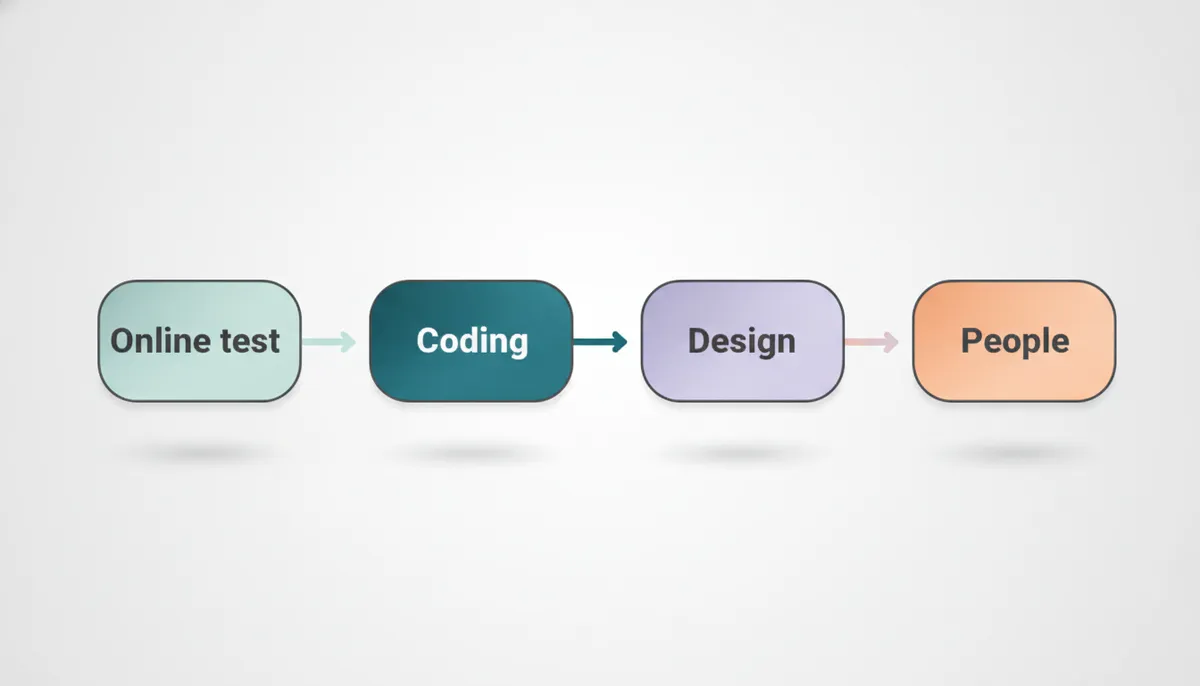
Oracle’s coding interview shape at a glance
Candidate reports commonly describe this sequence:
| Stage | Common format | What it is likely to test |
|---|---|---|
| Recruiter screen | Initial conversation | Role fit, experience, availability |
| Online test | Reported HackerRank assessment | Coding fundamentals and implementation |
| Technical screens | Live coding and discussion | DSA, complexity, CS fundamentals |
| Virtual onsite | Coding, design, behavioural, hiring manager | Applied problem solving and communication |
| Offer process | References before written offer | Professional history and fit |
The exact number of conversations is not fixed. What is consistent in reported accounts is the technical emphasis: interviewers look beyond whether your code reaches the correct output. They also examine whether you can choose an appropriate data structure, justify complexity, handle awkward inputs, and connect implementation decisions to systems knowledge.
For preparation, this creates a simple priority order:
- Build recognition speed for common DSA patterns.
- Refresh the CS fundamentals that explain why an approach works.
- Rehearse system-design communication without treating it like a giant architecture exercise.
- Prepare specific behavioural stories with clear personal ownership.
The difficulty mix: standard patterns, rigorous explanation
Oracle is commonly reported as DSA- and CS-fundamentals-heavy rather than dominated by elaborate architecture design. That distinction matters.
A candidate can know the standard solution to a graph or array problem and still struggle if they cannot explain memory behaviour, database indexing, network boundaries, or the cost of a design choice. Conversely, spending all your time on senior-level distributed architecture can leave the main coding bar underprepared.
The coding difficulty is less about obscure tricks and more about reliable execution under observation. Expect familiar foundations to recur in different disguises:
- arrays and strings that become hashing or frequency-counting problems;
- ordered inputs that invite two pointers, sorting, or binary search;
- interval-style inputs that reward sorting and merging;
- trees and graphs that require a clear traversal choice;
- dependencies that call for topological reasoning;
- stateful optimisation that points towards dynamic programming;
- cache or lookup requirements where the data structure matters as much as the algorithm.
The fastest candidates do not merely remember solutions. They recognise the clues in the wording, state a hypothesis, test it against an example, and discard it quickly if it does not fit.
That is why pattern-led preparation is more useful than drilling random topics. The free-to-browse DSA Patterns Sheet groups problems by the underlying method, helping you connect signals such as “contiguous range”, “sorted search space”, or “dependency order” to an approach.
For a deeper framework, read how to identify the right DSA pattern in a coding interview. The goal is not to label every prompt perfectly. It is to reach a credible first approach quickly enough to leave time for implementation, testing, and explanation.
The online test: recognition speed before perfection
Reported accounts describe a HackerRank online assessment with a two-tier shape. The exact content can differ by team, but this stage is where recognition speed becomes most visible.
Recognition speed means seeing the structure of a problem before you become attached to a slow or overly complicated solution. It is the difference between reading an input, identifying that it is a sliding-window problem, and spending too long trying nested loops because they are easier to write first.
Build a repeatable sequence for every timed problem:
Read for constraints first. Constraints are often the strongest hint. Large input sizes make brute force unlikely; sorted data may make binary search or two pointers plausible; repeated membership checks suggest a hash-based structure.
Name the brute-force baseline. Say it internally or write it down. A baseline gives you something concrete to improve and makes complexity reasoning easier.
Look for the operation that repeats. Are you repeatedly checking membership, moving a boundary, revisiting states, or traversing neighbours? The repeated operation often identifies the pattern.
Choose the simplest adequate structure. A hash map, queue, stack, heap, set, or adjacency list should have a clear job. Do not add structures merely because they are familiar.
Reserve time to test. Empty inputs, one-element inputs, duplicate values, disconnected components, and boundary indices are common sources of avoidable errors.
Timed work is a separate skill. Use in-browser code practice to practise producing clean solutions with feedback, but do not wait until the final week to introduce a timer. Start with generous limits, then reduce them as pattern recognition improves.
💡 Pro tip: When you finish early, do not immediately submit. Re-read your loop bounds, initialise a small example by hand, and check whether your complexity matches the stated constraints.
Live coding: make the reasoning visible
Technical phone screens and onsite coding rounds commonly move beyond answer-checking. An interviewer is evaluating how you work with an ambiguous prompt, how you react to a follow-up, and whether your code reflects the approach you described.
A strong live-coding answer usually has five visible parts:
- Clarify the input, output, and assumptions.
- Walk through a small example.
- Describe the baseline and its limitation.
- Present the chosen approach and complexity.
- Implement, test, and narrate important decisions.
This is not performance theatre. It lets the interviewer distinguish a candidate who understands the solution from one who has seen a similar prompt before. It also gives them opportunities to redirect you before a wrong assumption becomes expensive.
Use plain language while coding. “I need constant-time membership checks, so I’ll keep seen values in a set” is clearer than silently opening an editor and hoping the code explains itself. If you revise your approach, say why: “This version repeats work across overlapping subproblems, so I’m going to store prior results.”
The same principle applies to follow-ups. Do not treat a changed constraint as proof that your original answer failed. Treat it as a new design requirement. Explain what breaks, identify the bottleneck, and alter only the part of the solution that needs to change.
For more on the communication side, what interviewers actually look for in live coding rounds is a useful companion guide. It covers the small habits that make a technically sound answer easier to assess.
CS fundamentals: the differentiator many candidates neglect
Oracle’s reported emphasis on OS, DBMS, and networking means a DSA answer may lead naturally into a fundamentals discussion. This should not be intimidating: the aim is usually applied understanding, not textbook recitation.
Operating systems
Refresh processes versus threads, scheduling, memory allocation, virtual memory, deadlocks, synchronisation, and file I/O. Be able to connect concepts to real consequences.
For example, if you propose concurrent work, explain what shared state exists and how you would protect it. If you mention caching, be ready to discuss memory limits and invalidation. If performance matters, distinguish CPU-bound from I/O-bound work.
The Operating Systems Sheet is free to browse and gives you a structured way to revise these foundations.
Databases and SQL
Database-oriented teams may probe SQL, indexing, transactions, normalisation, query performance, and consistency. The important habit is trade-off reasoning: why an index helps one access pattern but adds write cost; why a transaction boundary matters; when a denormalised read model might be worth the complexity.
Practise describing a schema in terms of entities, keys, relationships, queries, and expected scale. The free-to-browse DBMS Sheet can help organise that revision.
Networks and distributed systems
Know the practical basics: HTTP, TCP and UDP, DNS, load balancing, latency, retries, timeouts, and caching. If a design needs to communicate across services, discuss what can fail and what the caller should do next.
The free Computer Networks Sheet is useful for refreshing the vocabulary without losing sight of application-level consequences.
System design and low-level design: prepare proportionately
Reported accounts describe system design at Oracle, but lighter than at many FAANG peers. For most candidates, that means you should prepare to reason clearly about a modest service or product component rather than attempting to memorise a sprawling architecture diagram.
Start with requirements. Identify core users, actions, data, expected traffic, and the reliability or latency concern that matters most. Then move through a sensible sequence:
- define the API or core interactions;
- identify data entities and storage needs;
- sketch the main request path;
- discuss scaling or failure concerns;
- make trade-offs explicit.
For low-level design, focus on responsibility boundaries, readable names, interfaces where behaviour genuinely varies, and a small testable implementation. Oracle’s interview kit includes the low-level design problem evidenced at Oracle alongside its mapped coding material.
The free-to-browse System Design Sheet is a useful place to rehearse system vocabulary and trade-offs. If you are unsure how much depth your level needs, how much system design is enough for SDE-1 versus SDE-2 interviews explains how expectations tend to change.
Avoid two opposite mistakes: dismissing design entirely because coding is the larger technical component, or allowing design preparation to crowd out timed DSA practice.
The behavioural and hiring-manager conversations
The behavioural round is reported to probe integrity and ethics more explicitly than many peers. Generic answers are commonly reported to perform poorly, so prepare concrete stories rather than abstract statements about teamwork or ownership.
Choose stories that show:
- a decision made under uncertainty;
- a disagreement handled constructively;
- a mistake you acknowledged and corrected;
- a time you protected quality, privacy, or customer trust;
- a project where you can separate your contribution from the team’s.
Use a simple story structure: context, responsibility, action, outcome, and reflection. Spend most of the time on your own decisions. “We improved reliability” is weak without explaining what you noticed, what you proposed, and how you measured the result.
Practise these answers aloud. An AI mock interview can help you rehearse follow-ups, tighten vague phrasing, and get comfortable defending a decision rather than reciting a memorised script.
A focused preparation plan
First phase: pattern foundations. Work through arrays, hashing, two pointers, sliding windows, binary search, trees, graphs, recursion, and dynamic programming. After every problem, write down the clue that should have triggered the pattern.
Second phase: implementation reliability. Revisit familiar patterns under a timer. Focus on edge cases, variable naming, and complexity explanations. Read graph traversal patterns with DFS and BFS if traversals still feel like separate techniques rather than a family of choices.
Third phase: fundamentals integration. Pair coding sessions with OS, database, and networking revision. For each coding solution, ask one systems question: where would memory become a concern, how would data be stored, or what happens if a dependency is slow?
Final phase: interview simulation. Alternate a timed coding session, a design discussion, and a behavioural rehearsal. In each coding session, speak your reasoning aloud. In each design session, begin with requirements instead of drawing components immediately.
The aim is not to cover every possible topic. It is to make your strongest methods reliable under the format Oracle commonly reports.
Frequently asked questions
Does Oracle ask DSA questions?
Reported accounts describe coding rounds with a strong DSA component. Prepare common pattern families, complexity analysis, and clean implementation rather than relying on memorised answers.
What patterns should I prioritise for Oracle coding interview questions?
Prioritise hashing, two pointers, sliding windows, binary search, trees, graphs, recursion, and dynamic programming. The best sequence depends on your current gaps, but recognition speed across these families is more valuable than collecting unrelated solutions.
Is the Oracle online test difficult?
It is commonly reported as a meaningful coding filter. Difficulty varies, but time pressure makes pattern recognition, implementation accuracy, and edge-case testing especially important.
Does Oracle ask operating-systems questions?
Reported accounts describe CS-fundamentals discussion covering operating systems, databases, and networking. Prepare applied explanations, not definitions alone.
Should I prepare SQL for an Oracle interview?
Yes, particularly if the role is connected to database or cloud products. Be ready to discuss schema design, indexing, transactions, query performance, and trade-offs.
Is system design important at Oracle?
System design is commonly reported as part of the loop, though lighter than at some peer companies. Prepare a structured approach to requirements, data, APIs, reliability, and trade-offs.
How should I prepare for the behavioural round?
Use specific stories about ownership, judgement, conflict, mistakes, and integrity. Explain your personal actions and what you learned, rather than relying on generic teamwork claims.
Do Oracle interviews vary by team?
Yes. Candidate reports describe team variation, with database and cloud teams often probing SQL, distributed systems, and performance in greater depth.
What should I do if I get stuck in a live coding round?
State the baseline approach, identify its bottleneck, and ask to test your interpretation with an example. Staying communicative is much stronger than silently trying random alternatives.
Build your Oracle preparation around patterns
Oracle’s reported interview mix rewards candidates who can solve standard coding problems quickly, explain their choices clearly, and connect DSA decisions to CS fundamentals. Treat every practice problem as both an implementation exercise and an explanation exercise.
Open Oracle’s interview kit to practise the 82 mapped DSA questions and one low-level design problem evidenced at Oracle. Combine that work with the free sheets for fundamentals, then use an AI mock interview to rehearse the live coding, design, and behavioural conversations that turn preparation into interview performance.
Topics
Related on Thita
Your next step
Practise with AI mock interviews
A spoken interview that asks follow-up questions, runs your code and ends with a written report.