
Interview
Palantir Technologies Interview Questions and Process: The Complete Guide (2026)
Understand Palantir Technologies interview questions, reported rounds, Decomposition and Learning/Re-engineering, difficulty, and a 30-day preparation plan.
Palantir Technologies interview questions are commonly reported to span a recruiter screen, a technical screen, a virtual onsite, and a hiring-manager conversation. The distinctive part is the onsite: reported accounts describe a Decomposition round, where you turn an ambiguous problem into a workable plan, and a Learning/Re-engineering round, where you make sense of an unfamiliar codebase. Prepare coding fundamentals, but also practise clarifying uncertainty, explaining decisions, and improving existing systems. Palantir Technologies's interview kit contains five mapped DSA questions for company-focused coding practice.
Candidate reports are useful signals rather than a published hiring specification. The precise sequence and emphasis can vary by team, so confirm your interview format with the recruiter. Still, the reported shape gives you a clear preparation priority: show that you can reason well when neither the prompt nor the code is perfectly tidy.
The process at a glance
| Stage | Reported format | What it screens for | How to prepare |
|---|---|---|---|
| Recruiter screen | Initial conversation | Role fit, motivation, communication | Explain your experience and interests clearly |
| Technical screen | Technical discussion or coding | Core problem solving and coding fluency | Narrate your reasoning and test edge cases |
| Virtual onsite | Technical interviews with reported Palantir-specific exercises | Structured thinking, engineering judgement, adaptability | Practise ambiguity, code reading and design discussion |
| Hiring manager | Experience and collaboration discussion | Ownership, impact and team fit | Prepare detailed project stories |
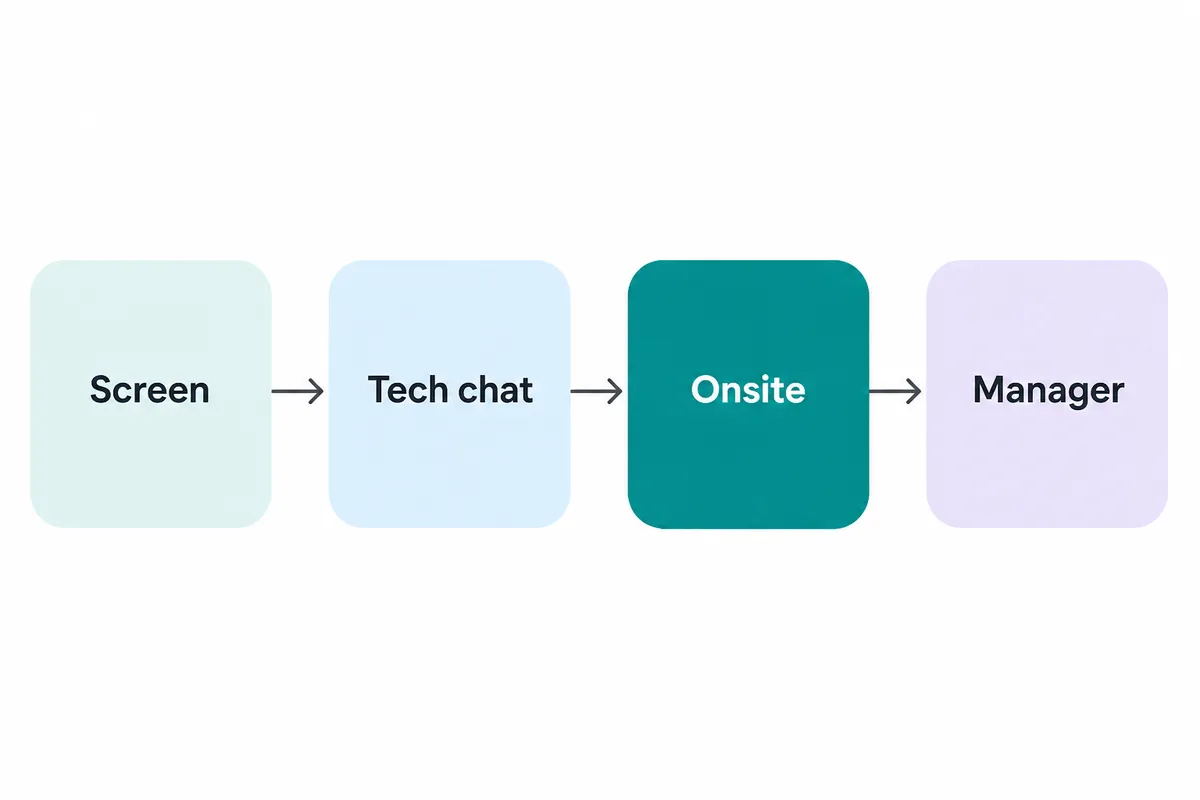
The table is intentionally broad. Reporting identifies the overall stages and the two named onsite exercises, but it does not support treating every candidate’s process as an identical script. Prepare for the shape, then ask the recruiter what the team expects.
Recruiter screen — make your story coherent
The recruiter screen commonly establishes practical details, your background, the broad role area and why you are interested in Palantir Technologies. It is also the first test of whether you can communicate a complicated technical history without losing the listener.
Prepare a concise answer to “tell me about yourself” that connects the work you have done with the work you want next. Avoid reciting your CV in date order. Instead, identify a technical theme: perhaps building internal tools, improving data-heavy systems, working with users who have urgent operational needs, or making a difficult workflow more reliable.
Motivation answers are stronger when they contain evidence. You do not need to know every product detail, but you should be able to explain why complex data, practical decision-making and real-world constraints interest you. Connect that answer to a project, customer problem or engineering environment you have experienced.
What this stage screens for: clarity, seriousness, communication and plausible role fit.
A useful preparation exercise is to end every project summary with a decision you personally made. “We improved performance” is vague. “I found the slow path, changed the data-access approach and measured the result” gives the listener a concrete signal of ownership.
Technical screen — make the interviewer part of your reasoning
Reported accounts describe a technical screen before the onsite. Its detailed format can vary, but expect a conversation that tests whether you can reason about a problem, write or discuss sound code, and communicate while under pressure.
For coding preparation, focus on a repeatable process:
- Clarify the input, output and constraints.
- Describe a direct solution first.
- State the time and space complexity.
- Improve the approach only where the trade-off is worthwhile.
- Test ordinary, boundary and awkward cases.
The DSA Patterns Sheet is free to browse and helps build pattern recognition: what feature of a prompt suggests hashing, traversal, binary search or dynamic programming? Use it alongside Palantir Technologies's interview kit to practise the coding material mapped to the company.
The common live-coding failure is hidden reasoning. If you silently examine options and type only the final approach, the interviewer cannot assess how you got there. Speak in short checkpoints: “I want to establish whether duplicates are possible”; “the direct version repeats this lookup”; or “I will test empty input before I finish.”
Read what interviewers actually look for in live coding interviews and how to explain your thought process clearly in coding interviews for practical ways to make that narration natural.
Virtual onsite — the reported Palantir Technologies difference
The virtual onsite is where the reported Palantir Technologies process becomes less conventional. Candidate accounts describe exercises that reward structured thought in incomplete or changing situations, not only a polished answer to a neat puzzle.
Coding ability still matters. But the onsite also examines how you define a problem, decide what to prioritise, explain trade-offs and adapt when an interviewer changes an assumption. Before the onsite, practise turning vague prompts into an explicit working model:
- State the outcome in one sentence.
- Identify the users, systems or data involved.
- List assumptions that need confirmation.
- Describe the smallest useful version.
- Name the likely next requirement that could change the design.
This preparation directly supports the two named exercises reported in Palantir Technologies loops.
The Decomposition round — create structure from ambiguity
The Decomposition round is the most company-specific part of the reported process. Candidate reports describe a vague, high-level problem that you break into data models, API contracts and logic flow. Requirements may shift as the discussion develops, so the goal is not to defend your first interpretation. It is to show that you can build a useful structure while recognising uncertainty.
Start by restating the result you believe is needed. Then ask questions that could genuinely alter the design:
- Who uses the system or workflow?
- What action must be reliable?
- Which information is authoritative?
- What can be delayed, retried or handled manually?
- What changes if the scale or user need grows?
Next, decompose the work. Identify core entities and their state. Draw boundaries between components. Define the important inputs and outputs. Explain the main flow before adding edge cases or optional features. This makes your reasoning inspectable and gives the interviewer clear points to challenge.
A strong answer does not begin with an enormous architecture diagram. It moves from problem framing to a minimal flow, then adds detail where risk demands it. When a new requirement appears, explain what changes: “That changes ownership of this state,” or “I would preserve the interface but introduce this additional path.”
What it screens for: ambiguity handling, prioritisation, modelling, API thinking, communication and engineering judgement.
What weak answers do: start implementation before defining the goal; make silent assumptions; add patterns without a reason; or treat changed requirements as a contradiction instead of a normal part of engineering.
The exercise is related to design discussion, but it is not simply a generic architecture prompt. Structure is as important as the components you choose. Low-level design vs high-level design: what interviews actually expect explains the distinction, while the Low Level Design Sheet and System Design Sheet are free to browse for deeper practice.
The Learning/Re-engineering round — understand before changing
The other distinctive reported exercise is the Learning/Re-engineering round. Candidate reports describe working with an unfamiliar repository of several hundred lines, then reasoning about its behaviour and how to improve or modify it.
This is different from producing clean code from an empty editor. Much of real engineering begins with code written by someone else. You need to find the entry point, follow data flow, distinguish intended behaviour from accidental behaviour, and identify the smallest safe change.
Practise code reading deliberately. Open an unfamiliar project, or revisit a project you have not touched for months, and answer these questions before making changes:
- What does this code appear to do?
- Where does input enter and output leave?
- Which module owns each piece of state?
- What assumptions does the code make?
- Where could a bug be hiding?
- What test would establish current behaviour?
When proposing a re-engineering step, explain the risk as well as the benefit. Do not stop at “I would refactor this.” Name what the change improves, what could break, and how you would verify compatibility. Separating parsing from business logic, for example, may make testing easier, but existing callers and error handling still need protection.
What it screens for: code comprehension, debugging instinct, safe change management, technical communication and the ability to learn quickly.
The crucial mindset is to resist rewriting everything. A candidate who identifies a narrow improvement, justifies it and verifies it usually demonstrates better judgement than one who redesigns an entire repository without first understanding it.
Use in-browser code practice to maintain implementation fluency, but add code reading to your routine. The reported Palantir Technologies process makes that habit unusually valuable.
Hiring manager conversation — show ownership, not just participation
The hiring-manager conversation commonly tests the substance behind your CV. Prepare for detailed follow-up questions about projects you have worked on: how you made a decision, handled disagreement, responded to failure and measured success.
Choose examples with real tension. A project that went perfectly is often less useful than one where a requirement changed, a system failed, a deadline tightened or stakeholders disagreed. Structure each story around context, your responsibility, the decision, the trade-off and the result.
Be precise about ownership. “We built” can accurately describe a team outcome, but follow it with “my part was”. That distinction gives the interviewer a clear picture of your level without forcing repeated probing.
Practise aloud with an AI interview, especially if you tend to over-explain implementation details or under-explain the decision-making behind them.
Is the Palantir Technologies interview hard?
Yes, but its difficulty is broader than coding-question difficulty alone.
The coding portion demands data structures, complexity reasoning and correct implementation. The reported Decomposition and Learning/Re-engineering rounds add another challenge: showing how you work when the prompt is unclear or the code is unfamiliar. Candidates who prepare only through tidy, self-contained coding problems may find that transition difficult.
How many rounds are there? Reported accounts describe a recruiter screen, technical screen, virtual onsite and hiring-manager conversation. Available reporting does not support a dependable universal count of individual interviews inside those stages.
How long does it take? There is no reliable company-wide timeline in the available reports. Team requirements and scheduling can affect the pace, so ask the recruiter about the expected interview window early.
The practical conclusion is to train both modes: solve coding problems accurately, and practise deciding what problem you are solving before proposing a solution.
A 30-day preparation plan
Days 1–7: rebuild coding fluency
Practise common patterns until you can explain why they apply rather than merely reproduce code. Focus on recognising constraints, choosing data structures and checking complexity. The DSA Patterns Sheet is free to browse, and how to identify the right DSA pattern in a coding interview offers a useful classification framework.
End each session by explaining your solution aloud in a few sentences.
Days 8–14: practise decomposition
Take vague operational or product prompts and write a short decomposition. Define actors, data, actions, assumptions, success criteria and failure cases. Describe a minimal version before extensions.
Aim for a clear chain from problem to model to interfaces to flow. Ask a friend to introduce a changed requirement midway through, or use an AI interview to rehearse adapting without losing structure.
Days 15–21: learn to re-engineer safely
Read unfamiliar code every day. Trace one request through a repository. Write down questions before searching for answers. Find one behaviour to change, propose a small modification and identify the tests you would need.
Refresh systems fundamentals where useful. The Operating Systems Sheet is free to browse and can help you revisit concepts behind processes, memory and system behaviour.
Days 22–30: simulate the reported loop
Alternate timed coding, a Decomposition-style discussion, code reading and behavioural rehearsal. In the final days, prioritise process over cramming:
- Clarify before solving.
- State assumptions.
- Build the smallest useful answer.
- Verify each change.
- Summarise trade-offs at the end.
Return to Palantir Technologies's interview kit during this week and practise explaining each approach as though an interviewer were introducing follow-up questions.
What makes Palantir Technologies preparation different?
Most interview advice separates coding and design. The reported Palantir Technologies process highlights two related everyday engineering skills that conventional practice often misses.
The Decomposition round asks whether you can produce a workable plan from an incomplete problem. The Learning/Re-engineering round asks whether you can enter an existing system, understand it before judging it, and improve it without introducing avoidable risk. Together, these exercises reward a candidate who is methodical without being rigid.
Build a personal checklist for both situations.
When the problem is vague: define the goal, list assumptions, model the core flow, decide what not to solve yet, then invite challenge.
When the code is unfamiliar: locate the entry point, trace data and state, identify the contract, make the smallest justified change, then verify it.
That turns the two reported named rounds into repeatable engineering behaviours rather than mysterious interview formats.
Frequently asked questions
What are the main Palantir Technologies interview rounds?
Reported accounts describe a recruiter screen, technical screen, virtual onsite and hiring-manager conversation. The onsite is reported to include Decomposition and Learning/Re-engineering exercises.
What is the Palantir Technologies Decomposition round?
Candidate reports describe an ambiguous high-level problem that you break into data models, API contracts and logic flow. It evaluates how you handle uncertainty and changing requirements.
What is the Learning/Re-engineering round?
It is a reported exercise involving an unfamiliar code repository. The focus is on understanding code, identifying safe improvements and explaining how you would verify changes.
Does Palantir Technologies interview preparation require DSA?
Coding fluency, data structures and complexity reasoning remain important for the reported technical screen. Practise clear explanation alongside implementation.
Are Palantir Technologies interviews hard?
They can be demanding because they combine coding with ambiguity management and code comprehension. The challenge is not solely solving difficult puzzles; it is demonstrating sound engineering judgement.
How should I prepare for an unfamiliar codebase interview?
Practise tracing inputs, outputs, state and module boundaries in code you did not write. Propose small changes, explain risks and identify tests or checks.
How should I handle changing requirements in an interview?
Acknowledge the change, state which assumption it affects, and update the design deliberately. Do not defend an earlier answer after the premise has changed.
How many interviews does Palantir Technologies have?
Reporting supports the broad stages but not a fixed company-wide count of individual interviews. Confirm the detailed schedule with your recruiter.
How long does the Palantir Technologies process take?
Available reports do not establish a dependable universal timeline. Ask your recruiter about scheduling expectations for the specific role and team.
Start with the skills the onsite makes visible
The best preparation for Palantir Technologies is active practice: solve aloud, turn ambiguity into a plan, read code before changing it, and explain trade-offs with precision.
Open Palantir Technologies's interview kit to work through the five mapped DSA questions, then use an AI mock interview to rehearse the technical and behavioural conversations that make your reasoning visible.
Topics
Related on Thita
Your next step
Practise with AI mock interviews
A spoken interview that asks follow-up questions, runs your code and ends with a written report.