
Interview
PhonePe Machine Coding Round: Preparation Guide (2026)
Prepare for the PhonePe machine coding round with a timing plan, grading priorities, common failure modes, a two-week practice schedule, and FAQs.
The PhonePe machine coding round rewards a different kind of interview readiness from a timed coding puzzle. You need to take an incomplete prompt, identify the essential behaviour, choose a small set of useful objects, and produce code that runs before the clock becomes your main problem.
Reported accounts describe PhonePe as having a DSA-heavy process overall, with design and high-level design appearing alongside technical coding rounds. Some roles reportedly use a take-home machine-coding challenge rather than a live implementation exercise. This guide focuses only on that design-focused part of the process: how to prepare for the format, what to build first, and how to make your decisions visible.
For focused practice, PhonePe's interview kit holds three low-level design problems evidenced at PhonePe. Use those problems to practise the habit that matters most here: delivering a complete core flow, then improving the design only where the requirement justifies it.
Where machine coding sits in the PhonePe interview process
Candidate reports describe a process that can include a demanding coding assessment, technical discussions spanning DSA and low-level design, a machine-coding exercise for some roles, high-level design for more experienced candidates, and a manager conversation. The exact sequence varies by team and level.
That context matters because the machine coding round is not a replacement for algorithmic preparation. The reported online assessment is especially coding-intensive, so keep practising recognition speed and complexity reasoning alongside design work. The DSA Patterns Sheet is free to browse and is useful for maintaining that skill without turning every preparation session into a random problem hunt.
But machine coding evaluates a separate capability: can you turn a product-shaped requirement into working software under constraints?
For the broader loop and its other technical components, see the PhonePe interview preparation pillar when available. This article stays deliberately narrow: the implementation and low-level design work that a machine-coding task exposes.
The reported format and time limit
Reported accounts indicate that some PhonePe roles use a take-home machine-coding challenge with roughly a day to complete it instead of a live round. Treat that as a possible format, not a fixed company policy: team, role and hiring channel can change both the task and the deadline. Confirm the expected submission format with your recruiter as soon as you are invited.
A take-home format changes the constraint, but not the evaluation logic. More time does not mean the reviewer wants a large framework, a cloud deployment, or every imaginable edge case. It usually means they can look more closely at how you scope ambiguity, organise code, test the important paths, and explain trade-offs.
Whether the exercise is live or take-home, expect a prompt with several characteristics:
- A small domain: users, balances, records, inventory, rules, or requests.
- A core workflow that must work end to end.
- Incomplete details that require sensible assumptions.
- A request for clean object-oriented code rather than an enterprise-scale service.
- Follow-up questions about how the solution would absorb the next feature.
The most useful interpretation is: build a convincing, executable model of the central workflow. Do not attempt to rebuild a production platform.
💡 Pro Tip: Before writing code, state your assumptions in a short note or say them aloud. A clear assumption is easy for an interviewer to correct. A silent assumption can derail the entire solution.
What graders are likely to reward
Candidate reports do not provide a public PhonePe scoring rubric, so treat the ordering below as a practical machine-coding rubric rather than a formal policy. It reflects what reviewers can reliably observe in a working submission.
1. A correct, runnable core flow
This is the first bar. A reviewer should be able to create the relevant objects, invoke the main use case, and see the expected result. If the prompt is about moving value, demonstrate a valid move and a rejected move. If it is about booking, demonstrate availability changing after a booking.
A smaller working solution is stronger than an ambitious but unfinished one. Running code gives every later design decision credibility.
2. Clear ownership of behaviour
Good solutions make it obvious where decisions live. A service coordinates a workflow; a domain object guards its own invariants; a repository stores and retrieves data. When responsibilities are scattered across one large class, changes become risky and the design is difficult to explain.
Ask one question while coding: if this rule changes next week, where should I edit it? If the answer is “in several unrelated places”, improve the boundary.
3. Judgement about abstractions
Interfaces, factories, strategies and observers are useful only when the prompt contains genuine variation. A payment method interface makes sense when payment behaviours differ. An interface for a single in-memory list usually does not.
The strongest candidates avoid both extremes: no structure at all, or a pattern catalogue applied by reflex. For a refresher on choosing patterns because they solve a real design pressure, read design patterns for interviews.
4. Sensible handling of invalid states
Machine-coding prompts often contain more value in their failure paths than their happy paths. Can the user request an impossible action? Can a record be duplicated? Can a limit be exceeded? Does the application return a meaningful result rather than silently corrupting state?
You do not need exhaustive validation. You do need to identify the few rules that define whether the model remains valid.
5. Readable code and a coherent explanation
Names, small methods, focused classes and a short demonstration matter. The reviewer should not need to reverse-engineer your intent. If you make a trade-off for time, say so plainly: “I kept storage in memory to focus on the domain flow; I would introduce persistence behind this boundary later.”
That is not an apology. It is engineering judgement.
How to structure the available time
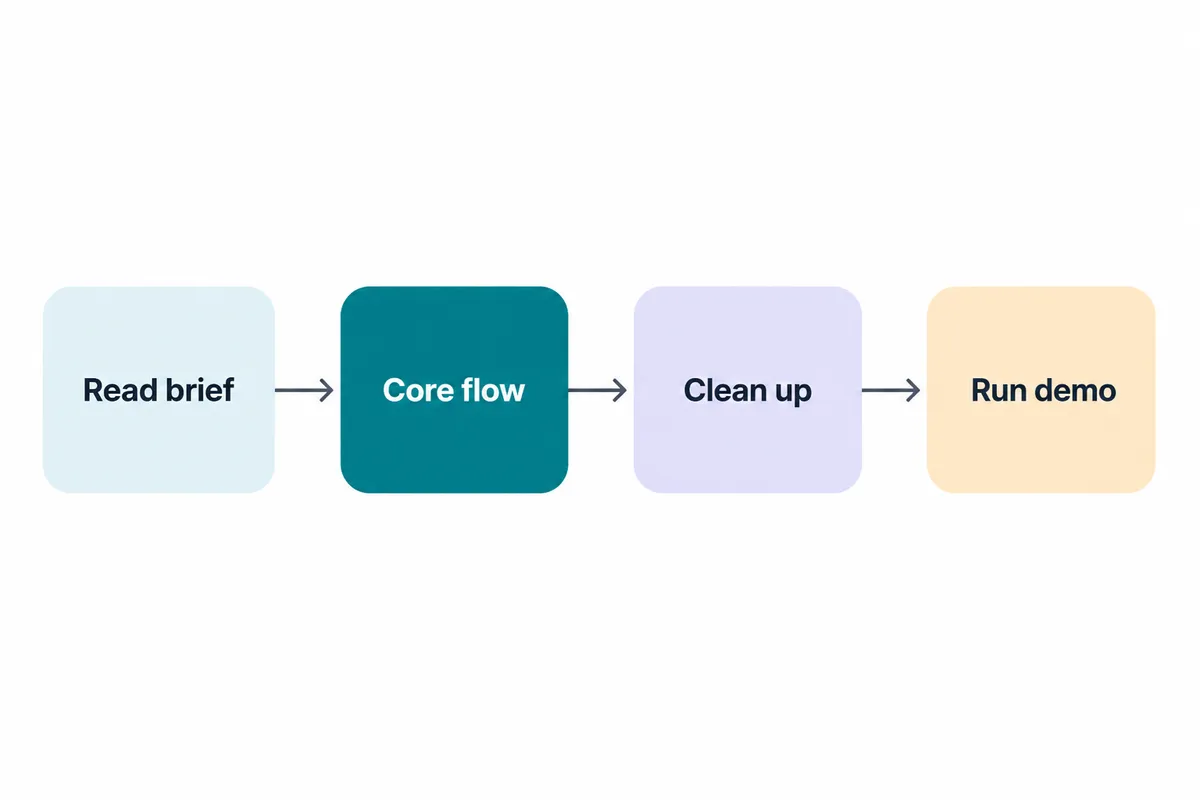
For a live exercise, use the clock to protect the core workflow. For a take-home, use the same sequence as a checklist, with more time reserved for tests, cleanup and a concise README.
| Phase | What to do | Output before moving on |
|---|---|---|
| Read and clarify | Identify actors, commands, state changes and invalid cases | A short list of assumptions |
| Sketch the model | Name the main objects and their responsibilities | A minimal class outline |
| Build the core | Implement one complete happy path first | Code that runs end to end |
| Guard the rules | Add the most important validation and error paths | Invalid actions handled safely |
| Refine structure | Extract only the abstractions the prompt needs | Clear boundaries and names |
| Demonstrate | Run representative flows and explain trade-offs | A reviewer-friendly submission |
The trap is spending too long in the sketch stage. A design diagram can feel productive because it postpones uncertainty. But the moment code runs, it exposes missing state, awkward method boundaries and assumptions that do not hold. Start learning from the implementation early.
If you struggle to narrate choices while coding, practise the communication separately. How to explain your thought process clearly in coding interviews gives a practical structure: clarify, propose, justify, implement, verify.
Failure modes that cost strong candidates
Designing the full product instead of the requested slice
A machine-coding prompt is a bounded exercise. Adding authentication, databases, queues, configuration systems and deployment concerns can consume the time needed for the actual problem. Model the requested behaviour first. Mention production extensions only after the core is complete.
Building abstractions before discovering the flow
Candidates sometimes create a hierarchy of interfaces before they have even executed one use case. This often produces code that is elegant in theory but hard to finish. Start with concrete objects. Extract an abstraction only once a second behaviour proves that variation exists.
Skipping the driver or demonstration
Without a main method, tests or a small scripted scenario, reviewers must infer whether the code works. Make the happy path observable. Then add one meaningful rejected path. This is one of the cheapest ways to improve a submission.
Treating assumptions as invisible
Prompts leave gaps deliberately. If you decide that an action is atomic, that duplicates are disallowed, or that requests are processed in order, write it down. Silent assumptions look like overlooked requirements when they differ from the reviewer’s expectation.
Over-polishing code that is not yet correct
Formatting, package layout and renamed methods can wait. First make the central use case run. Then make the code easier to read. Correctness before presentation; presentation before optional features.
Practising only untimed design discussion
Discussion-based low-level design helps, but it does not force implementation choices. You need repetitions where you begin with an empty editor, make decisions under pressure, and run the result. The Low Level Design Sheet is free to browse and can supply prompts for that style of practice.
A two-week PhonePe machine-coding practice plan
This plan assumes you are also maintaining DSA preparation in shorter sessions. The goal is not to memorise solutions. It is to establish a repeatable build process.
Week one: build design instincts
Day one and two: model small domains. Pick simple workflows such as a library, parking allocation, appointment booking or wallet transfer. Do not time yourself. Focus on identifying entities, commands, state and invalid transitions.
Day three and four: practise core-flow first. Begin each session by writing a tiny executable demonstration. Only then add validation. Notice how often the first implementation reveals a better class boundary.
Day five: study pattern decisions. Review strategy, factory, observer and state patterns, but pair each one with the design pressure it addresses. Avoid collecting patterns as vocabulary.
Day six: add change requests. Take an existing solution and introduce one new requirement: another rule, another type, another workflow. Refactor only what breaks. This is the fastest way to learn whether your abstractions are useful.
Day seven: review and explain. Revisit two previous solutions. Explain the model aloud in a few minutes, including one trade-off and one future extension.
Week two: simulate the real work
Day one and two: timed builds. Use a strict timer and complete a small prompt from a blank file. Finish with a runnable driver even if the structure is imperfect.
Day three: feedback session. Compare your approach with an editorial or peer review. Look for one structural improvement and one process improvement; do not rewrite everything.
Day four and five: unfamiliar prompts. Practise problems you have not seen before. This matters more than repeating a polished solution because the interview tests requirement interpretation.
Day six: take-home simulation. Give yourself a day-sized window, but set internal milestones: core flow first, tests next, README last. Produce a clean submission rather than endlessly adding features.
Day seven: full rehearsal. Work through one of the PhonePe interview kit’s low-level design problems as though you were submitting it. Record your explanation or use an AI mock interview to rehearse defending your choices.
Frequently asked questions
Is the PhonePe machine coding round live or take-home?
Reported accounts describe a take-home machine-coding challenge for some roles, with roughly a day to complete it. Format varies by team and role, so confirm the current expectation with your recruiter.
What should I submit for a take-home task?
Submit a runnable solution, clear setup instructions, and a short explanation of assumptions and trade-offs. A small set of meaningful tests or a driver program makes the core flow easy to verify.
Should I use a framework?
Usually, no framework is necessary unless the prompt explicitly asks for one. Plain, well-organised code keeps attention on domain modelling and behaviour rather than setup.
What language should I use?
Use the language in which you can write clean, idiomatic code quickly. Familiarity matters more than language choice because you need time to model, test and explain.
How much low-level design should I know?
You should be comfortable identifying responsibilities, modelling relationships, enforcing invariants and extending a design without rewriting it. The distinction between class-level and architecture-level design is covered in low-level design versus high-level design.
Do I need to write tests?
Tests are valuable when they demonstrate important behaviour, especially invalid cases. If time is limited, a runnable driver covering the core and one failure path is better than an incomplete test suite.
What is the biggest mistake to avoid?
Ending with no working core flow. Build the smallest executable version first, then improve its design and coverage.
How should I handle unclear requirements?
State a reasonable assumption, explain why it is sensible, and keep the design flexible where uncertainty is likely to matter. Asking a concise clarifying question is always preferable to silently guessing.
Is DSA preparation still important for PhonePe?
Yes. Reported accounts describe a coding-intensive assessment and technical discussions that include DSA. Keep pattern practice active alongside machine-coding preparation.
Start with working code
The PhonePe machine coding round is best prepared for by practising the complete loop: read an imperfect brief, make assumptions visible, build the central flow, run it, and explain why the design is no larger than it needs to be.
Start with PhonePe's interview kit and its three low-level design problems evidenced at PhonePe. Then use the free-to-browse code practice workspace for implementation repetition and an AI mock interview to practise explaining your reasoning under pressure.
The objective is not a perfect design on paper. It is a small, clear, runnable solution that makes a reviewer confident you can turn an ambiguous requirement into dependable code.
Topics
Related on Thita
Your next step
Practise with AI mock interviews
A spoken interview that asks follow-up questions, runs your code and ends with a written report.