
Interview
PhonePe Interview Questions and Process: The Complete Guide (2026)
A full breakdown of PhonePe's SDE interview process — the competitive-programming assessment, design rounds, difficulty, timelines, and a 30-day prep plan.
PhonePe's online assessment is the hardest first round in Indian product hiring. Where most companies use a medium-difficulty screen to reduce volume, PhonePe's is described consistently as competitive-programming level — four problems that would sit comfortably at the harder end of any interview problem set. A great many candidates never get past it.
Clear it and the loop broadens into design: class-level design in the technical rounds, a take-home machine coding exercise for some roles, and an architecture round. This guide covers each stage and how to prepare for a loop that is genuinely algorithm-first.
To practise the design rounds, PhonePe's interview kit holds three low-level design problems attributed to the company, each with a worked editorial and AI-evaluated practice.
The process at a glance
| # | Round | Format | What it screens |
|---|---|---|---|
| 1 | Online assessment | ~4 coding problems, competitive-programming level | Algorithmic depth under pressure |
| 2 | Technical rounds | Live coding plus class-level design | Problem solving and design judgement |
| 3 | Machine coding (some roles) | Take-home, around 24 hours | Design quality without time pressure |
| 4 | High-level design | Architecture discussion | Scale, consistency, failure behaviour |
| 5 | Manager round | Project depth and fit | Ownership, collaboration, level |
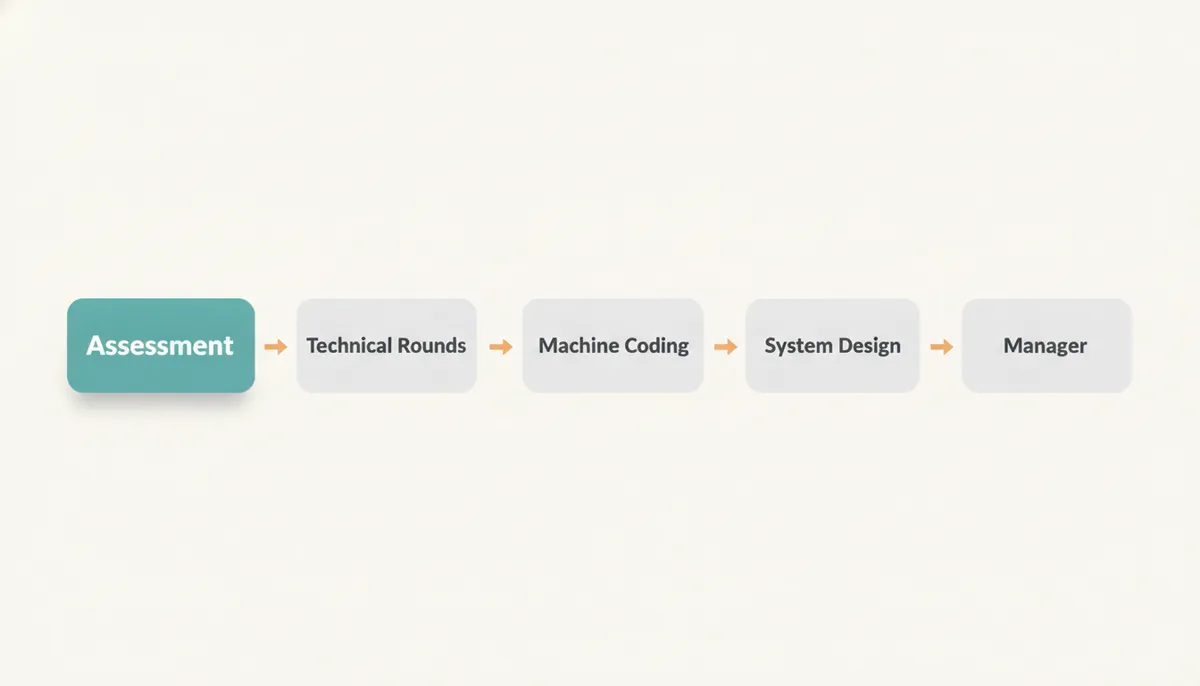
Round counts and whether the take-home appears vary by role and level. Confirm the sequence with your recruiter.
Round 1 — the assessment that filters everyone
This is the round to respect. Reported accounts put it at competitive-programming difficulty: roughly four problems, hard by interview standards, in a fixed window.
That difficulty changes what preparation should look like. A medium-difficulty screen rewards breadth — knowing many patterns shallowly. A hard screen rewards depth in the patterns that carry hard problems: dynamic programming, graphs beyond basic traversal, greedy arguments you can actually justify, binary search on the answer, and the ability to reason about complexity before committing to an approach.
Two things matter more than problem count:
Recognition under pressure. Hard problems are usually familiar problems in unfamiliar clothing. The skill is seeing the underlying shape quickly — which is exactly what pattern-based preparation builds. The DSA Patterns Sheet is free to browse and organises problems by the pattern each one tests rather than by topic label; how to identify the right DSA pattern covers the recognition skill itself.
Implementation speed without bugs. At this difficulty, knowing the approach and still failing on off-by-one errors is a common outcome. Regular timed practice with real execution — in-browser code practice with AI feedback works well — builds the fluency that hard problems assume.
💡 Pro Tip: Practise at one difficulty band above where you are comfortable. A screen at this level punishes candidates who have only ever solved medium problems, even when they know the right technique.
Round 2 — technical rounds: coding plus design
Live rounds combining algorithmic problems with class-level design discussion. The coding half is a step beyond the assessment in interaction rather than difficulty: you are expected to clarify, state your approach and complexity before typing, and reason aloud.
The design half asks how you would model a system at the class level — entities, relationships, where behaviour varies and therefore where an interface belongs, how the design absorbs a new requirement. Interviewers are looking for judgement rather than pattern recitation: an interface placed where the requirements clearly branch scores well, while interfaces everywhere read as pattern application without thought.
The free Low Level Design Sheet is the fastest way to build the vocabulary these discussions assume, and design patterns for interviews covers the ground.
Round 3 — the take-home machine coding exercise
For some roles, PhonePe uses a take-home machine coding challenge — commonly described as a roughly 24-hour window — instead of a live timed round.
This is a materially different exercise from the ninety-minute live version other companies run, and it should change how you approach it. Time pressure is not the constraint, so "I ran out of time" is not available as an explanation. The expectations rise accordingly:
- Structure. A clean domain model, sensible package or module layout, one responsibility per class.
- Tests. With a day available, real tests are expected rather than a bare driver.
- A README. How to run it, what you assumed, what you deliberately left out and why. This is often the highest-leverage file in the submission.
- Restraint. A day is long enough to over-engineer. A focused, complete, well-tested core beats a sprawling framework.
⚠️ Important: Do not treat a take-home as an invitation to build everything. Scope it deliberately, then say in the README what you scoped out. Stated judgement reads far better than unfinished ambition.
Round 4 — high-level design
An architecture round, present at senior levels and sometimes earlier. PhonePe operates payments infrastructure at national scale, so the natural territory is high-throughput transaction systems: idempotency at service boundaries, consistency under partition, how the system behaves when a downstream dependency slows rather than fails outright, and reconciliation between systems that disagree.
Strong answers name what they trade away and why. The System Design Sheet is free to browse, how to design a rate limiter is a good worked example of expected depth, and how much system design is enough for SDE-1 vs SDE-2 will calibrate how much applies at your level. An HLD mock interview with AI evaluation of the submitted design is the closest rehearsal to the real format.
Round 5 — the manager round
Project depth, ownership and fit. Two or three projects you can discuss for ten minutes each without notes: what you decided, what broke, what you would change. In a payments context, stories about judgement under incomplete information land particularly well.
Is the PhonePe interview hard?
Yes — and specifically at the front.
The online assessment is the hardest part of the loop and the hardest first round among comparable Indian product companies. If you are used to clearing medium-difficulty screens comfortably, this one will still surprise you.
The later rounds are demanding but more conventional: design judgement, architecture reasoning, project depth. Candidates who clear the assessment tend to find the rest of the loop fair.
How many rounds? Typically four to five stages after the assessment, varying by role and level.
How long does it take? Commonly two to four weeks end to end.
A 30-day preparation plan
Weeks 1 and 2 — algorithmic depth, weighted heavily. This is where the loop is won or lost, so give it half the total time. Work the patterns that carry hard problems: dynamic programming, graphs, greedy, binary search on the answer. Timed sessions from the start. Push into the harder band deliberately rather than staying where you are comfortable. Top coding interview questions by pattern is a reasonable spine.
Week 3 — design. Class-level design vocabulary and two design problems implemented end to end. The three low-level design problems evidenced at PhonePe come with editorials worth reading against your own attempts.
Week 4 — architecture and rehearsal. If a high-level design round applies at your level, spend the week on distributed systems fundamentals and two HLD mocks. Otherwise use it to keep algorithms sharp and rehearse project stories aloud.
If the assessment does not go your way
Because the assessment eliminates a large share of applicants, it is worth knowing what happens next — and the answer is usually less final than it feels on the day.
Cooling-off periods are common but not permanent. Most companies allow reapplication after a set interval, frequently six to twelve months. Confirm the policy with the recruiter rather than assuming, since it varies by company and role and changes over time.
The gap is almost always specific and closeable. At this difficulty band, candidates rarely fail because of a broad deficiency. It is usually one or two areas — most often dynamic programming, or graph problems beyond basic traversal — plus implementation speed. That is a diagnosable, trainable gap rather than a verdict.
Write down what you saw while it is fresh. Which problems you recognised, which you did not, where the time went. Within a day this detail is gone, and it is the most useful preparation input you will ever get for the next attempt.
Referrals do not lower the bar, but they change the path. A referral can affect whether and when you get a fresh assessment. It does not make the problems easier.
The broader point is that a hard first round is a filter on preparedness rather than ability, and preparedness is the variable you control. Six focused weeks between attempts moves most candidates a long way, particularly if the second attempt is planned around the specific gaps the first one exposed rather than a general repeat.
Frequently asked questions
How hard is PhonePe's online assessment? Reported accounts describe it as competitive-programming level — around four problems at the harder end of interview difficulty. It is the most demanding first round among comparable Indian product companies.
How many rounds does PhonePe have? Typically the assessment, technical rounds combining coding and design, sometimes a take-home machine coding exercise, a high-level design round, and a manager round.
Is the machine coding round live or take-home? Role-dependent. Some roles get a take-home window of around 24 hours rather than a live timed round. Confirm with your recruiter.
Does PhonePe ask system design questions? Yes, at senior levels and sometimes earlier, with a payments-infrastructure character.
What should I prioritise? Algorithms, clearly. The assessment eliminates most candidates, so preparation weighted toward it is rational even though the later rounds are design-heavy.
What language should I use? Whichever you are most fluent in. At this difficulty, implementation speed matters, and that comes from fluency.
How long does the process take? Commonly two to four weeks, varying by team and role.
Do I need frontend knowledge? For frontend-specific roles, yes. For backend and general SDE roles the loop is as described above.
Can I reapply if I do not clear the assessment? Most companies allow reapplication after a cooling-off period, commonly six to twelve months. Confirm the specific policy with your recruiter, as it varies and changes over time.
Does a referral make the assessment easier? No. A referral can affect whether and when you receive an assessment, but the problems and the bar are the same. Preparation is the only variable that moves your score.
Where to start
PhonePe's loop is front-loaded. The assessment is the gate, and it is harder than the equivalent round almost anywhere comparable — so preparation that treats it as a formality fails at step one.
Start with algorithmic depth using the free DSA Patterns Sheet and timed code practice. Then open PhonePe's interview kit for the three low-level design problems evidenced at PhonePe, each with an editorial and AI-evaluated practice, and rehearse the discussion rounds with an AI mock interview.
Interview processes change. Confirm round structure and timings with your recruiter, and check PhonePe's careers site for current openings.
Topics
Related on Thita
Your next step
Practise with AI mock interviews
A spoken interview that asks follow-up questions, runs your code and ends with a written report.