
Interview
Pramp in 2026: Is It Still Free, Does It Have AI, and an AI Interviewer That Runs Your Code
Pramp now runs on Aced Practice (ex-Exponent). Peer mocks are still free on monthly credits; AI feedback is paid. Compare an AI that runs your code.
If you are looking for Pramp alternatives, it is tempting to treat the choice as simple: peer mock interviews are old-fashioned, AI mock interviews are convenient, and one must replace the other.
That is not quite right.
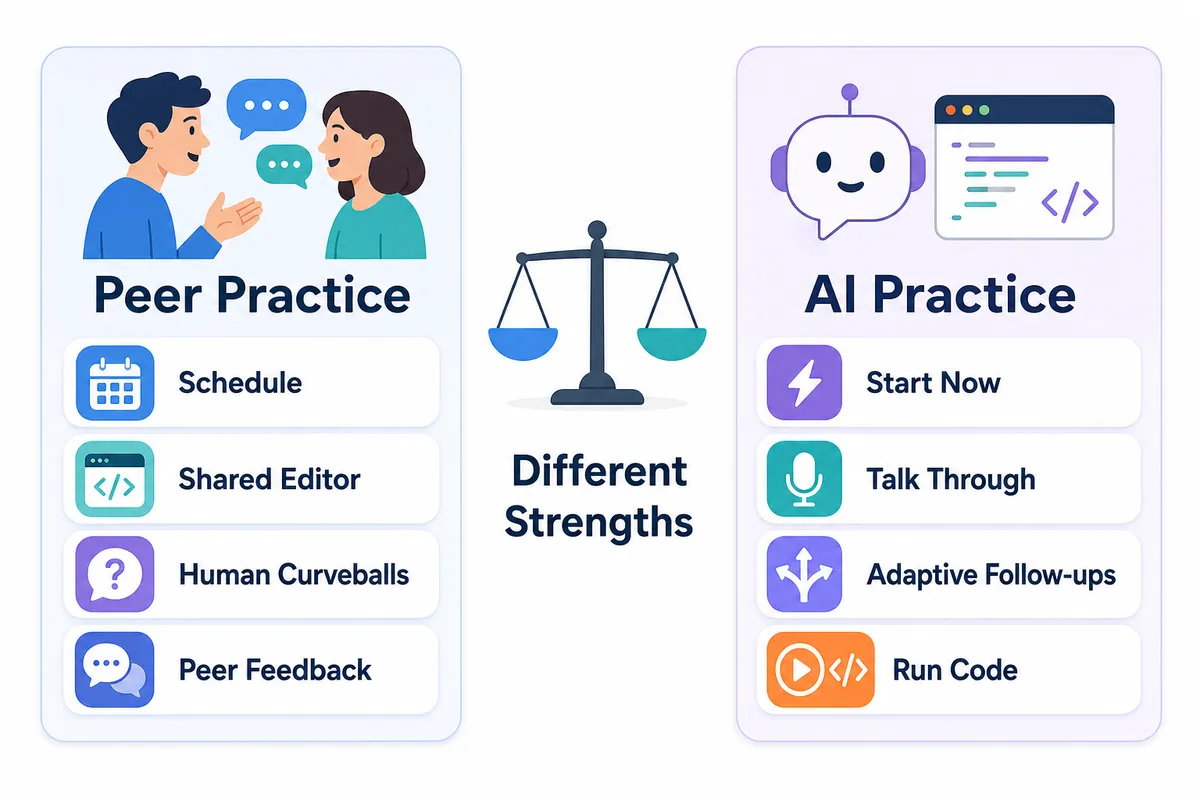
Pramp gives you something genuinely useful: a live human peer, a real shared editor, and the unpredictability of speaking to another person who may challenge your assumptions. But it also asks you to schedule a session with another candidate and relies on that person turning up, being prepared, and being able to give useful feedback.
An AI interviewer changes that trade-off. With a live AI interview that runs your code, you can start immediately, speak through your solution, receive adaptive follow-ups, and test whether your program works in a real editor. For many candidates, the best answer is not Pramp or AI. It is using both deliberately.
This guide compares peer practice and AI practice honestly, including what each format teaches that the other cannot.
Pramp in 2026 at a glance
| Question | Short answer (checked October 2026) |
|---|---|
| Is Pramp still running? | Yes, but not as a separate product. Exponent acquired Pramp, and pramp.com says that "as of July 2024, all new Pramp sessions are hosted" on the company's practice platform. |
| Who runs it now? | Exponent, which has renamed itself Aced. Aced lists Pramp as one of its brands, and the peer mocks live at Aced Practice. |
| Is Pramp still free? | Peer mock interviews are free to use. Aced says free users "are allotted credits to practice every month"; it does not publish the number on that page, so treat third-party figures (often quoted as five a month) as unconfirmed. |
| Does Pramp have an AI interviewer? | Pramp's own page describes human peers only. Aced Practice adds AI practice that grades answers for behavioural, product, system design and data science rounds, but viewing that feedback and transcript needs a paid membership. |
| Does it run code? | DSA, SQL and frontend peer mocks include a collaborative code editor. The person checking your code is another candidate. |
| What is the alternative for coding rounds? | An AI interviewer that executes your code against test cases and asks follow-ups on what actually happened, such as Thita's AI mock interview. |
Sources: pramp.com, Aced Practice, Exponent is becoming Aced, Pramp joining Exponent. Plans and credit counts change, so check the live pages before you rely on a number.
What happened to Pramp?
Pramp started as a free peer-to-peer mock interview site: two candidates are matched, each takes a turn as interviewer, and both work in a shared editor over video. Exponent announced that it had acquired the Pramp platform and said at the time that "Pramp is first and foremost a free platform—and we're committed to keeping it that way."
The practical changes since then:
- 2024: new Pramp sessions moved onto Exponent's practice platform. pramp.com still loads, but its main button sends you there.
- 2026: Exponent rebranded as Aced. The announcement describes Aced as a family of brands that includes Pramp and Interview Cake, and it introduced an Expert plan that "includes access to Ace and all of our AI-powered practice tools".
So when someone searches "Pramp interview" today, the product they reach is Aced Practice, still built around peer mocks.
Is Pramp still free?
The peer format is. Aced's FAQ says its "mock interview practice tool is free to use" and that free users get a monthly credit allowance. What is not free is the AI-graded feedback: Aced says that "to unlock feedback and transcripts, you'll need to upgrade to a paid membership".
Does Pramp have AI mock interviews?
Not under the Pramp name. The AI practice belongs to Aced: you answer real interview questions and an AI grades the answer against a rubric. Aced lists that AI grading for behavioural, product management, system design and data science/ML practice. Its page does not list AI grading for the DSA coding format, so for coding rounds the realistic Pramp experience is still a human peer.
If what you want from "Pramp AI" is an interviewer that is always available, asks follow-ups out loud and checks whether your code works, that is a different product category, covered below.
The actual Pramp trade-off: realism for coordination
Pramp's core format is straightforward: you are paired with another candidate, take turns interviewing each other, and work in a shared editor. That is a meaningful form of practice because neither side can entirely predict what will happen next.
A human peer may ask an awkward follow-up. They may misunderstand your explanation. They may respond with a pause that makes you realise you have not been clear. They may approach the same problem differently and expose an assumption you did not know you were making.
Those are real advantages.
The limitation is not that peer interviews are ineffective. The limitation is operational: you need to find a mutually suitable time, your assigned partner has to attend, and the quality of the session depends partly on their preparation and interviewing ability.
A strong partner can make a peer mock feel close to a real interview. A distracted partner, someone who has not read the prompt, or someone who is as nervous as you are can make the same format less useful. Neither outcome is entirely under your control.
That is why “convenience” alone is too shallow a description of the difference between Pramp and AI. The bigger difference is control over repetition.
With a peer mock, you practise a live social interaction that has natural unpredictability. With AI, you can repeat a targeted scenario five times in a week: a graph problem, a debugging round, a system design discussion, or a behavioural interview based on your own CV. Both are valuable. They simply solve different preparation problems.
💡 Pro Tip: Use peer mocks for the moments you cannot fully simulate alone: handling a genuine human reaction, explaining an unfamiliar idea to another person, and staying composed when the conversation becomes unpredictable.
Pramp vs AI mock interview: what changes in the coding round?
The most important difference in a technical interview is not whether someone asks you a question. It is whether your work can be tested while you answer it.
Pramp gives candidates a real shared editor. That matters. You are not merely describing code in a chat box; you are writing a solution in a collaborative setting while another person watches. For practising the social pressure of live coding, that is useful.
However, your interviewer is still a peer. They must decide which follow-up to ask, whether your solution is correct, and how to respond if your implementation fails. Some peers will be excellent at this. Others may not know how to assess complexity, edge cases, or language-specific behaviour.
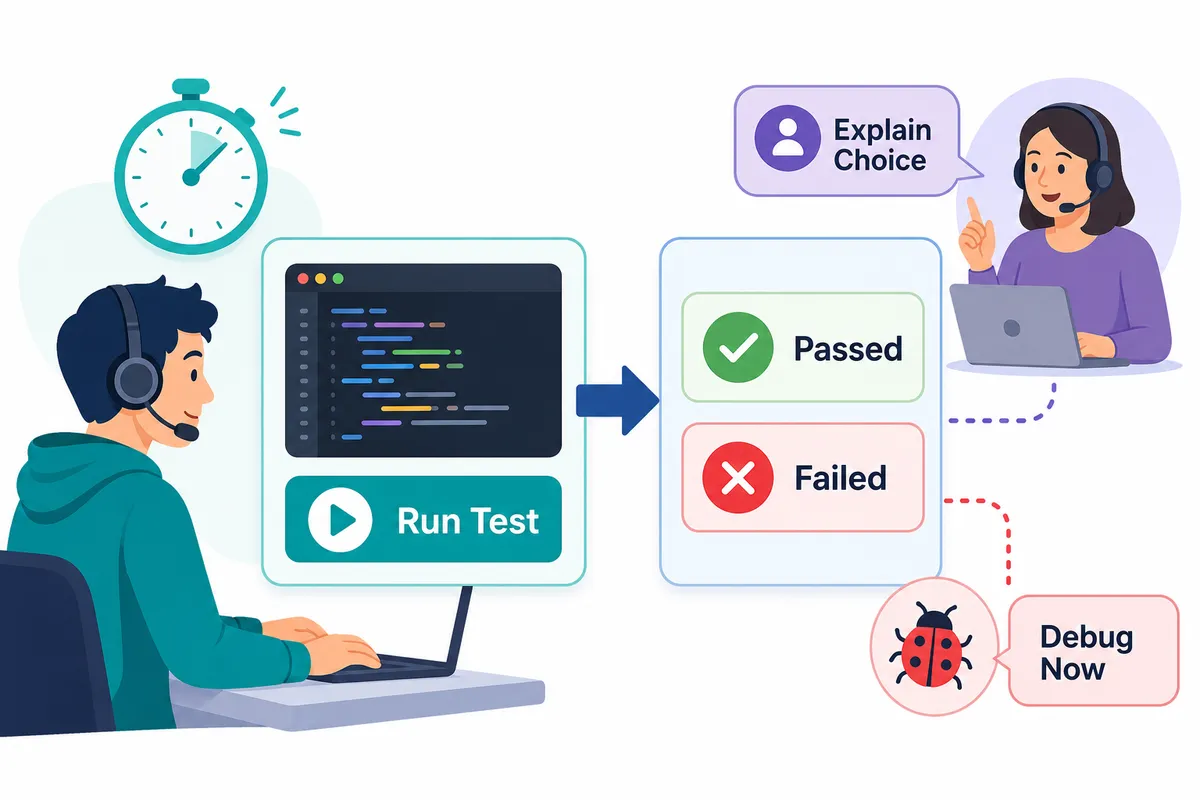
An AI interviewer that runs code approaches the same problem differently. You write your answer in an editor, execute it, inspect actual output, and respond to results. The interviewer can then follow up based on what you have done: perhaps your solution passes basic cases but has an avoidable complexity issue, perhaps it fails when the input is empty, or perhaps your explanation and implementation do not match.
On Thita, candidates can practise in six languages: Python, C++, Java, JavaScript, Go and C#. The code editor compiles and runs code, so practice includes a critical real-interview moment: seeing a result you did not expect and recovering while explaining your thinking.
That recovery is often where interviews are won or lost.
A candidate who can calmly say, “The failing case suggests my loop excludes the final element; I am going to check the boundary condition,” appears far stronger than a candidate who silently edits until something passes. The same is true in a real hiring loop. Interviewers assess your reasoning, not just your final answer.
For a deeper look at why execution changes the quality of practice, read does your AI mock interview actually run your code?. If you want the full how-to on spacing peer, paid and AI sessions, see how to use mock interviews effectively.
Pramp (Aced Practice) vs Thita's AI interviewer, side by side
| Pramp / Aced Practice peer mock | Thita AI mock interview | |
|---|---|---|
| Who interviews you | Another candidate, then you swap roles | A voice AI interviewer |
| Scheduling | Book a slot and wait for a match | Start on demand |
| Coding rounds | Shared collaborative editor | In-browser editor; code runs against the problem's test cases in Python, C++, Java, JavaScript, Go or C# |
| Follow-ups | Depend on your peer | Adaptive follow-ups on vague reasoning and on how the code behaved |
| System design | Peer-led; AI grading on paid plans | Voice round with a shared canvas the interviewer reads |
| Resume-based round | Not listed on the practice page | Built from your uploaded resume |
| Feedback | Peer feedback; AI feedback and transcripts on paid plans | Written report after every session, kept in your history |
| Cost | Free monthly credits; paid plans for more | Free 3-question mock with no sign-up; free Starter plan with limited sessions; Pro $14.99/month |
| Best for | Human reactions and practising the interviewer role | Frequent, targeted reps with real code execution |
What peer mock interviews do better
The honest answer in the peer mock interview vs AI debate is that people remain better at some things.
Genuine human reactions
An AI can ask follow-ups and challenge an answer, but a human peer may react in ways that are harder to anticipate. They may look unconvinced. They may take your explanation literally when you expected them to infer context. They may ask a question you think is obvious and force you to explain from first principles.
That is uncomfortable practice, which is exactly why it can be useful.
Learning to interview another person
Taking the interviewer role teaches you what good answers sound like. When you hear someone jump into code without clarifying constraints, you notice why it creates problems. When you watch someone narrate a clean trade-off, you learn a pattern worth adopting.
This is an underappreciated benefit of peer platforms. Interviewing someone else develops judgement about structure, communication, and what an interviewer may be listening for.
Accountability
A booked session creates a deadline. If you have been postponing preparation, knowing another candidate expects you to appear can force you to practise. For candidates who need external structure, that can be more effective than having unlimited access to an on-demand tool.
A different candidate’s perspective
Peers may share useful company-specific context, language tips, or a way of approaching a problem you would not have considered. A good discussion after the mock can be as valuable as the mock itself.
⚠️ Important: Do not assume every peer session will be a high-quality rehearsal. Treat partner quality as variable. Prepare your own questions, clarify the format at the start, and ask for specific feedback rather than a vague verdict.
What an AI interviewer does better
AI is strongest where consistency, availability, and targeted repetition matter.
Start when you actually have time
Interview preparation rarely happens in a perfect two-hour block. It happens at 7am before work, after a long commute, or late at night when an interview is suddenly scheduled for next week.
An AI interview does not require matching calendars or waiting for a peer to accept a session. You can practise a live voice interview on demand when you have 30 minutes available, then return tomorrow for another round.
Repeat the exact weakness
Suppose you are fine at solving array problems but struggle to think aloud. Or you can explain DSA well but freeze during behavioural questions. Or you are interviewing for a senior role and need system design practice more than another easy coding question.
A self-directed AI session lets you target the weak point repeatedly. Thita supports DSA, system design, low-level design, machine coding, behavioural, product management, data science, AI and ML, CS fundamentals, and resume-based interviews generated from your own CV.
That breadth matters because most candidates do not fail only one kind of interview. They may clear a coding round but stumble in architecture, product judgement, or the “tell me about yourself” conversation that opens the process.
Test code rather than merely discuss it
When the code compiles and runs, feedback has a concrete basis. You can see the test result, investigate a failure, and practise debugging under time pressure.
This is especially useful if you have spent months solving problems independently. Solo practice can build algorithmic knowledge, but it does not always build the habit of narrating trade-offs while another party waits for you to make progress. A live voice format adds that pressure without needing a partner.
Get adaptive follow-ups
A useful mock does not stop when you produce a working answer. It asks what happens at scale, whether memory can be reduced, what an API contract should be, why a cache belongs in one part of a system rather than another, or how you would handle an ambiguous requirement.
That is closer to what turns a coding exercise into an interview.
An Exponent Pramp review question candidates should ask
Many searches for an Exponent Pramp review are really searching for one answer: “Will this help me perform better in a real interview?”
The answer depends on what you need next.
If you have not spoken through a solution with another person recently, a peer mock can be extremely helpful. It introduces social stakes, forces you to listen, and exposes whether your explanation works outside your own head.
If you have a technical interview in two weeks and need frequent repetitions, relying only on peer availability is less practical. You need a way to run coding rounds, practise system design, rehearse behavioural answers, and revisit mistakes without waiting for another person.
That is why a combined plan works well:
- Use AI sessions during the week for volume, targeted feedback, and realistic code execution.
- Use a peer mock once a week to test your communication with a real person.
- Review the session afterwards and choose one weakness for the next AI practice round.
- Repeat until your explanation, implementation, and recovery process all become more reliable.
This approach avoids a common mistake: treating preparation as a search for one perfect platform. Interview skills are a collection of skills. A single format does not need to do everything.
For candidates building a schedule from scratch, these 7-day, 30-day and 90-day coding interview preparation plans can help you decide how often to alternate between independent, AI-led, and peer-led practice.
How to use both formats without wasting time
The best combined routine is intentional, not random.
Before a peer mock
Choose one thing to test that an AI session has already highlighted. Perhaps you tend to skip clarifying questions, lose structure when explaining complexity, or become quiet when a test case fails.
Tell your peer what feedback you want. “Please stop me if I begin coding before clarifying constraints” is far more useful than “How did I do?”
During an AI session
Make the session harder than your usual solo practice. Speak aloud from the first minute. Clarify assumptions before coding. Run tests before claiming success. When a result fails, state your hypothesis before editing the program.
If you are preparing for a company with a known round mix, use the company-wise interview preparation kits to organise your practice around the types of rounds you are likely to face.
After either session
Write down only three things:
- One thing you did well and should repeat
- One technical gap to revise
- One communication habit to improve next time
Do not turn every mock into a giant retrospective. The goal is a clear next action, not an archive of every imperfect sentence.
✅ Do use AI practice for repetitions you can control.
✅ Do use peer mocks to test how your explanations land with another person.
✅ Do practise the recovery after an error, not only the final correct solution.
❌ Don't cancel a peer mock because AI practice feels easier.
❌ Don't depend exclusively on peer scheduling when your interview date is close.
❌ Don't mistake a completed problem for an interview-ready performance.
Frequently asked questions
What happened to Pramp?
Exponent acquired Pramp, and since July 2024 new Pramp sessions are hosted on Exponent's practice platform. In 2026 Exponent renamed itself Aced, so Pramp peer mocks now run on Aced Practice.
Is Pramp still free?
The peer mock interviews are free to use on a monthly credit allowance. AI-graded feedback and transcripts on Aced need a paid membership.
Does Pramp have an AI interviewer?
Pramp itself pairs you with human peers. Aced, which now runs Pramp, offers AI-graded practice for behavioural, product, system design and data science answers on paid plans. It does not list an AI interviewer that runs your code in a DSA round.
What is the best Pramp alternative for coding interviews?
If you want human practice, a paid mock with an experienced interviewer gives more reliable feedback than a random peer. If you want frequent reps, an AI interviewer that runs your code and asks follow-ups is the closest on-demand substitute. Thita's free 3-question AI mock needs no sign-up.
Is Pramp better than an AI mock interview?
Neither is universally better. Pramp is strong for human interaction, unpredictability, and practising with a peer. An AI mock interview is stronger for on-demand repetition, consistent availability, adaptive follow-ups, and code execution. Many candidates benefit from both.
Does Pramp run code during a mock interview?
Pramp provides a real shared editor for live peer practice. The key trade-off is that the interviewer is another candidate whom you need to schedule, and the quality of feedback depends on that peer’s preparation and experience.
Can an AI interviewer really run my code?
It depends on the platform. On Thita, the coding editor compiles and runs code in Python, C++, Java, JavaScript, Go and C#. You can test output and practise responding to failures during the interview.
Is peer mock interview vs AI practice an either-or choice?
No. AI practice is useful for frequent, targeted sessions. Peer practice is useful for genuine human interaction. Combining them gives you more repetitions while retaining exposure to real social unpredictability.
How often should I do peer mock interviews?
For most candidates, one strong peer mock each week is enough when combined with several shorter AI sessions. Increase the frequency if your biggest challenge is communication rather than technical knowledge.
Can I practise more than coding interviews with AI?
Yes. Thita offers live voice practice for system design, low-level design, machine coding, behavioural interviews, product management, data science, AI and ML, CS fundamentals, and resume-based interviews.
What should I do if I freeze when my code fails?
Practise saying what you observe before you edit. Identify the failing case, state a likely cause, and explain the fix you want to test. This makes your reasoning visible and builds a repeatable recovery habit.
Use AI for repetitions, peers for unpredictability
Pramp remains useful because a real human peer brings something no tool can completely reproduce: authentic reaction, imperfect conversation, and the pressure of explaining your ideas to another person.
But you should not have to wait for a partner to practise the skills that improve through repetition. You need to write code, run it, explain it aloud, handle follow-ups, and make mistakes often enough that they stop feeling catastrophic.
Start a live AI interview that runs your code and use it for the repetitions you can do today. The free 3-question mock takes about ten minutes, needs no account, and runs your coding answer against stored test cases. Then book a peer mock when you want to test how those skills hold up with another person in the room.
If you are hiring rather than interviewing, visit interviews.thita.ai.
Topics
Related on Thita
Your next step
Try Thita before you decide
The Starter plan is free: pattern sheets, code execution in six languages and an AI mock interview. Pro adds more AI code feedback and mock interviews, company kits and the 90-day roadmaps.