
Interview
Roblox Interview Questions and Process: The Complete Guide (2026)
Understand Roblox interview questions, reported coding and onsite rounds, the game-based screen, difficulty, and a practical 30-day preparation plan.
Roblox interview questions commonly span a recruiter conversation, a CodeSignal technical screen, and an onsite loop of three to four interviews. Reported accounts also describe an unusual early screen with game-based assessments and a dedicated behavioural section. Prepare for coding fundamentals, explain your reasoning clearly, and be ready to discuss design trade-offs in product-shaped scenarios such as matchmaking, rate limiting, and social counters.
For focused coding practice, Roblox's interview kit holds four mapped DSA questions. Use it alongside timed practice and mock interviews rather than treating any single question list as a prediction of your exact loop.
The Roblox interview process at a glance
Candidate reports are limited and may vary by team, level, and hiring need. The table below is best read as a reported loop shape, not a fixed company policy. Confirm your format with the recruiter once your process begins.
| Stage | Reported format | What it screens for | How to prepare |
|---|---|---|---|
| Recruiter screen | Initial conversation | Role fit, motivation, experience | Know your projects and why Roblox |
| Technical screen | CodeSignal-based coding screen | Problem solving, implementation, complexity | Practise timed coding and edge cases |
| Game-based screen | Two game-based tasks plus behavioural section | Applied reasoning and communication | Stay calm, read rules carefully, explain choices |
| Onsite coding | Live technical discussion | Coding fluency and collaborative reasoning | Narrate your approach before coding |
| Onsite design | Product-shaped design discussion | Trade-offs, scale thinking, product judgement | Practise clear assumptions and system boundaries |
| Onsite behavioural | Experience and collaboration discussion | Ownership, communication, team fit | Prepare detailed project stories |
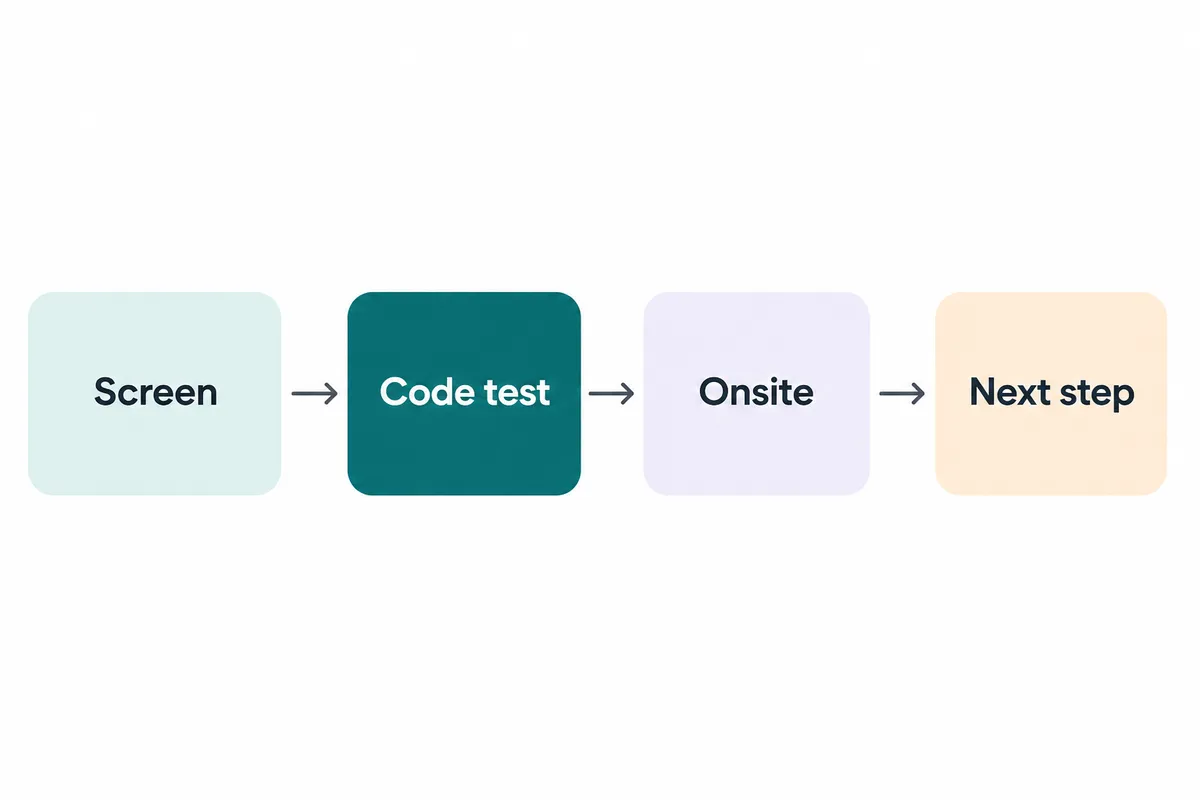
The reported onsite count is three to four interviews. That does not mean every candidate sees identical topics: experienced engineers may spend more time discussing design, while early-career candidates may face a more coding-led conversation. The transferable preparation is the same: solve deliberately, communicate your thinking, and make your assumptions visible.
Round one — the recruiter screen
The opening conversation is usually where the process, team context, and your background are introduced. It may feel informal, but it still establishes whether your experience, interests, location, and level align with the opening.
For Roblox, prepare a credible answer to why the company and product interest you. Avoid generic lines about enjoying games if you cannot connect that interest to engineering. Better answers explain what attracts you to a platform with creator-facing tools, social experiences, and systems that must serve a large and varied user base.
You should also be ready to walk through recent work in enough detail to support follow-up questions:
- What problem did you personally own?
- What constraints shaped the solution?
- What trade-off did you make?
- What went wrong after launch or during delivery?
- What would you change now?
This preparation matters later as well. A behavioural interviewer can use your project history to assess judgement, collaboration, and how honestly you describe uncertainty.
Round two — the CodeSignal technical screen
Reported accounts describe a CodeSignal technical screen before the onsite. Treat it as a test of reliable implementation under a clock, not merely an exercise in recalling data structures.
The evaluator is likely looking for a recognisable sequence: understand the prompt, identify constraints, choose an appropriate approach, implement cleanly, and test awkward inputs before submitting. A correct answer with unclear complexity reasoning or fragile edge-case handling can still leave a weaker impression than a slightly incomplete solution with sound reasoning.
Build preparation around patterns rather than random problem volume. The DSA Patterns Sheet is free to browse and groups problems by the reusable ideas behind them. For example, arrays and strings may call for hashing, two pointers, or sliding windows; graph-like prompts may call for a traversal rather than a clever one-off trick.
If pattern selection is your weak point, read how to identify the right DSA pattern in a coding interview. It is often more valuable to recognise the shape quickly than to memorise a long catalogue of solutions.
💡 Pro tip: Simulate the technical screen properly. Use a timer, write code in one sitting, and reserve the final portion for testing empty inputs, duplicates, boundaries, and unexpectedly large values.
The Roblox-specific element: game-based assessments
The most distinctive detail in reported Roblox accounts is the early assessment format: two game-based assessments alongside a dedicated behavioural section of roughly twenty-five minutes.
That format is worth taking seriously because it changes the mental model. Instead of expecting every prompt to resemble a conventional coding puzzle, expect an applied task with rules, goals, and possibly changing conditions. Your first job is to read carefully enough to identify what is actually being measured. Your second is to avoid rushing into an interpretation that the prompt does not support.
A sensible approach is:
- Restate the goal and the rules in your own words.
- Identify the state that matters and the events that change it.
- Ask about any ambiguity before committing to an approach.
- Choose the simplest correct solution first.
- Explain what you would improve if scale, reliability, or new features became important.
The behavioural segment deserves equal attention. Prepare concise stories that show collaboration, resilience, user empathy, and learning from a mistake. Use a simple context-action-result structure, but keep the focus on your contribution rather than a vague account of what “we” did.
There is no named ritual in the available research beyond this reported assessment format. That is important: do not overfit your preparation to online rumours about a supposedly standard Roblox puzzle or secret scoring system. Practise the underlying skills instead.
Onsite coding — make your reasoning observable
The coding portion of an onsite generally tests more than whether you eventually reach a working answer. In a live setting, interviewers can observe how you deal with incomplete information, whether you compare approaches, and whether you recover when the first idea is not ideal.
Start with questions. Clarify input shape, output expectations, constraints, and error handling. Then state a straightforward approach before writing code. If there is a more efficient version, explain the trade-off and choose intentionally.
A strong live-coding rhythm looks like this:
- Explain the brute-force or simplest version.
- State why it may not meet the constraints.
- Propose the improved structure.
- Give time and space complexity aloud.
- Implement in small testable steps.
- Walk through an example and name edge cases.
This is not performative narration. It lets the interviewer evaluate the reasoning that produced the code. For more detail, see what interviewers actually look for in live coding interviews and how to explain your thought process clearly in coding interviews.
Use Roblox's interview kit for a compact set of company-mapped practice prompts, then broaden out with the free sheets when you need more repetitions of a pattern.
Onsite design — reason from the product surface
Reported design prompts skew towards problems such as matchmaking, rate limiters, and social counters. Those are useful themes because they combine product requirements with systems concerns: users expect responsive interactions, services need sensible limits, and shared state needs to remain believable as activity grows.
This does not mean Roblox asks a particular design prompt. It means the kind of design problem evidenced at Roblox is product-shaped rather than purely abstract. Prepare to turn a familiar user flow into components, data flows, assumptions, and trade-offs.
For a matchmaking-style discussion, start by defining what “good” means. Is the goal low wait time, skill balance, social compatibility, regional proximity, or some combination? For a rate-limiting problem, establish who is limited, where counters live, what happens at the threshold, and what degree of inaccuracy is acceptable. For social counters, discuss read volume, write volume, caching, delayed updates, and whether users need exact values immediately.
The System Design Sheet and Low Level Design Sheet are free to browse. Use the first for boundaries, data flow, and scale trade-offs; use the second for interfaces, responsibilities, and code-level structure. The distinction is also explained in low-level design vs high-level design: what interviews actually expect.
✅ Do: Make assumptions explicit and revisit them when new requirements appear.
❌ Don’t: Draw a large architecture immediately without first agreeing on the user problem.
Onsite behavioural — project depth and collaboration
The reported game-based screen already includes a behavioural component, and onsite loops commonly contain further conversations about experience and collaboration. Do not leave these stories until the night before.
Choose examples that show several dimensions of engineering work: resolving disagreement, making a difficult technical choice, responding to an incident, improving an unclear process, and receiving feedback. The best stories include tension. A project where everything went perfectly gives an interviewer little evidence about how you operate under pressure.
Be specific about your own actions. “I led the migration” is only useful if you can explain what you decided, how you persuaded others, what risks you identified, and what result followed.
An AI mock interview can help you rehearse answers aloud and notice where your stories become vague. Aim for clarity and reflection, not a memorised script.
Is the Roblox interview hard?
Yes, but the challenge is broader than hard coding questions alone. The reported process combines a timed technical screen, a game-based assessment format, onsite coding, design discussion, and behavioural evaluation. Candidates who prepare only for isolated DSA puzzles may be caught out by the shift between formats.
How many rounds are there? Reported accounts describe a recruiter screen, a CodeSignal technical screen, and an onsite of three to four interviews. The game-based and behavioural assessment components are also reported as part of the early evaluation. Team and level variation is likely, so confirm your exact schedule with the recruiter.
How long does it take? The supplied reports do not establish a reliable end-to-end timeline. Avoid planning around an assumed deadline; ask the recruiter what stages remain and when feedback is expected.
The practical difficulty is switching gears. You need enough coding fluency to work under time pressure, enough design judgement to discuss trade-offs, and enough self-awareness to explain your decisions and past work clearly.
A 30-day Roblox preparation plan
Days one to seven — rebuild coding speed
Work through core patterns: arrays, strings, hash maps, trees, graphs, recursion, sorting, and complexity analysis. Do not simply read solutions. Solve, explain, implement, and test.
Use in-browser code practice for timed sessions. After each attempt, write down what clue should have helped you recognise the pattern sooner.
Days eight to fourteen — practise the assessment mindset
Alternate conventional coding tasks with applied exercises. For every prompt, spend the opening minutes extracting rules, states, goals, and ambiguities before coding.
Rehearse behavioural stories in parallel. Prepare examples of ownership, collaboration, failure, conflict, and learning. Keep each one adaptable rather than memorising an answer word for word.
Days fifteen to twenty-one — add design communication
Practise product-shaped design prompts. Begin with requirements, define success metrics, sketch a small initial system, then discuss failure modes and scale. Use the free computer networks sheet when you need to refresh concepts behind latency, requests, and service communication.
For coding, continue timed work but prioritise verbal explanation. Record yourself if possible. Long silent stretches usually reveal where your thinking is less structured than it felt.
Days twenty-two to thirty — simulate the full loop
Run several mock sessions: a timed coding round, a design discussion, and a behavioural interview. Review your performance for process errors rather than merely counting solved questions.
In the final days, revisit Roblox's interview kit and redo problems without looking at earlier solutions. The goal is not recall. It is recognising the approach, articulating it, and implementing it cleanly under realistic conditions.
Frequently asked questions
What are the most common Roblox interview questions?
Reported accounts describe coding, design, and behavioural questions rather than a fixed public question bank. Product-shaped design themes include matchmaking, rate limiters, and social counters.
Does Roblox use CodeSignal?
Candidate reports describe a CodeSignal technical screen. Confirm the platform and format with your recruiter because processes can vary.
What is unusual about the Roblox interview process?
Reported accounts describe two game-based assessments and a dedicated behavioural section in the early evaluation. That makes applied reasoning and communication especially worth practising.
How many onsite interviews does Roblox have?
Reported accounts describe an onsite loop of three to four interviews. The exact mix can vary by role and seniority.
Are Roblox coding interviews only about DSA?
No. Coding is one part of the reported process, alongside design discussion and behavioural evaluation. Prepare for implementation, explanation, and trade-off reasoning.
How should I prepare for the CodeSignal screen?
Practise timed coding, state your complexity reasoning, and leave time for edge-case testing. Pattern-based repetition is more useful than collecting disconnected solutions.
Does Roblox ask system design questions?
Reported accounts describe design problems with themes such as matchmaking, rate limiting, and social counters. The exact depth may depend on level and team.
How should I answer behavioural questions for Roblox?
Use specific examples from your work, clearly separate your contribution from the team’s, and explain decisions, setbacks, and lessons learned.
What should I do if the game-based task is unclear?
Read the rules carefully, restate the objective, identify ambiguity, and ask clarifying questions where possible. Do not silently assume details that shape the solution.
Where to start
Start with the skills that travel across every reported Roblox stage: pattern recognition, clean implementation, clear communication, and thoughtful trade-offs.
Open Roblox's interview kit to practise the four mapped DSA questions for Roblox. Then use the free DSA and design sheets to widen your preparation, and rehearse your explanations in an AI mock interview.
Interview processes change, and candidate reports are not a company specification. Confirm your round order, platform, and expectations directly with your recruiter.