
Interview
Rubrik Interview Questions and Process: The Complete Guide (2026)
Prepare for Rubrik interview questions with a practical guide to likely rounds, coding preparation, design discussions, behavioural practice and a 30-day plan.
Rubrik interview questions are best prepared for as a modern software engineering loop: an initial screen, a technical coding conversation, deeper technical or design discussion, and a behavioural conversation about your work. Reported company-specific accounts are thin and vary by team, so confirm the exact format with your recruiter. What you can prepare now is transferable: recognise coding patterns quickly, explain trade-offs clearly, and defend decisions in your past projects.
For focused practice, Rubrik's interview kit holds five mapped DSA questions evidenced at Rubrik. Use it alongside timed practice and mock interviews rather than waiting for every scheduling detail to arrive.
The process at a glance
The table below is a preparation model, not a fixed Rubrik script. Candidate reports do not establish a reliable company-wide sequence, named platform, time limit, or standard number of rounds. Treat it as the likely shape of a software engineering process and use your recruiter conversation to replace assumptions with facts.
| Stage | Common format | What it may screen for | Best preparation |
|---|---|---|---|
| Initial screen | Recruiter or hiring-team conversation | Role fit, experience, motivation | Clear project summary and role questions |
| Technical coding | Live coding or shared editor | Problem solving, complexity, communication | Pattern recognition and spoken reasoning |
| Technical depth | Discussion, coding, or design | Engineering judgement and fundamentals | Trade-offs, clean code, system thinking |
| Team conversation | Hiring manager or behavioural discussion | Ownership, collaboration, level fit | Detailed examples from your own work |
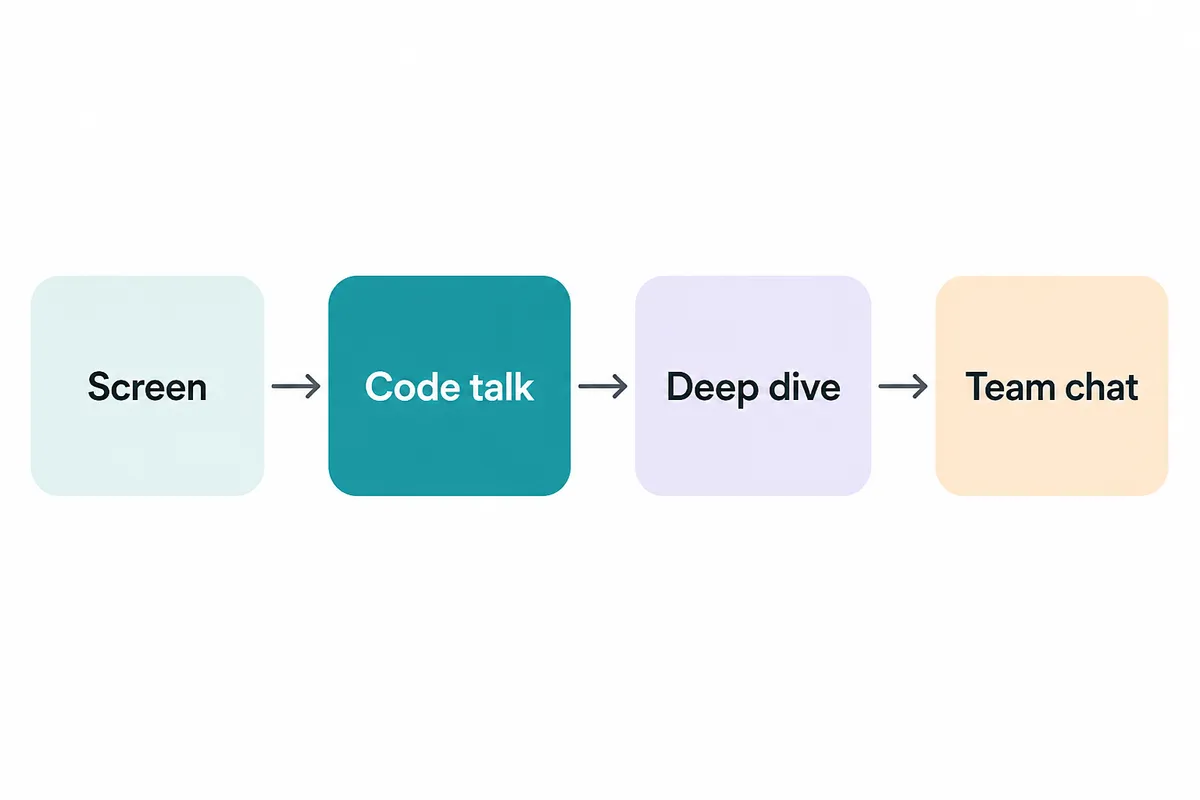
The uncertainty around format does not make preparation vague. It changes the order of operations: build broad interview readiness first, then tune your practice once you know the team, level, language expectations, and whether the technical discussion is coding-led or design-led.
Initial screen — establish fit without sounding rehearsed
An initial conversation is usually where both sides determine whether a deeper technical process makes sense. It may involve a recruiter, a hiring manager, or an engineer, depending on the team and hiring route. Because Rubrik-specific reports are limited, do not assume a particular interviewer or agenda.
Prepare a concise account of your current work: what the system does, what you personally owned, the hardest decision you made, and the outcome. The useful version is not a polished autobiography. It is a clear explanation that lets someone understand your scope and technical judgement quickly.
Be ready to explain why the role interests you without relying on generic phrases about innovation or growth. Read the job description closely. Identify the engineering problems it implies, then connect those problems to work you have done or skills you want to deepen.
Good questions also matter at this stage. Ask what the remaining process evaluates, whether there is a coding exercise or design discussion, what language choices are supported, and how the role’s level affects the loop. That is how you turn an uncertain process into a concrete preparation plan.
💡 Pro Tip: Write a short project introduction, then practise saying it aloud until it sounds natural. If you cannot explain your work plainly before the technical rounds, deeper follow-up questions will be difficult.
Technical coding — make your reasoning visible
A coding round generally tests more than whether you can arrive at a correct answer. The interviewer needs evidence that you can take an unclear problem, identify the important constraints, select an approach, and verify it under pressure.
Start by restating the task in your own words. Ask about input size, edge cases, expected output, and whether mutation is allowed. Then describe a straightforward approach before jumping to the efficient one. This gives the interviewer a view of your problem-solving process and makes your final choice easier to justify.
When you do settle on an approach, say why it fits. Name the time and space complexity. Explain which data structure carries the key invariant. Test ordinary cases, boundary cases, and invalid or surprising inputs before declaring the solution complete.
The most common avoidable failure is silent coding. A clean solution that arrives without explanation gives an interviewer little evidence about how you work. A candidate who narrates assumptions, catches an error, and corrects it calmly often performs more strongly than someone who produces code quickly but cannot explain it.
Rubrik's interview kit is a useful place to rehearse the coding shapes evidenced at the company. The wider DSA Patterns Sheet is free to browse and helps you organise practice around repeatable approaches rather than disconnected question lists.
For a stronger method, read how to identify the right DSA pattern in a coding interview. The goal is not to memorise solutions. It is to recognise the signals that suggest hashing, two pointers, graph traversal, binary search, or dynamic programming.
Technical depth — show engineering judgement, not vocabulary
A later technical conversation may go beyond a standalone coding puzzle. Depending on the role and team, it can become a discussion about code quality, object design, system boundaries, debugging, data modelling, or the decisions behind your previous work.
The safest preparation is to practise making trade-offs explicit. If you choose a cache, explain what it improves and what consistency risk it creates. If you introduce an interface, explain which behaviour is expected to vary. If you choose a database model, explain the access pattern that drove the choice. Technical depth is less about naming every pattern you know and more about showing that your choices have reasons.
For a low-level design discussion, begin with the core flow. Identify the main entities, their responsibilities, and the interactions between them. Keep the first version small and working in your head before adding optional abstractions. A design that handles the stated requirement clearly is stronger than a complicated hierarchy built for hypothetical future needs.
For higher-level system design, structure your answer: clarify requirements, estimate scale only where it changes a decision, sketch the core components, identify bottlenecks, and discuss failure handling. The System Design Sheet is free to browse if you want structured prompts for those conversations. The Low Level Design Sheet is also free to browse for class-level practice.
If you are unsure which kind of design discussion your level calls for, low-level design versus high-level design explains the difference and how interview expectations tend to change with scope.
Team and behavioural discussion — prove the work was yours
The behavioural portion of an engineering process is not a break from technical evaluation. It is where interviewers test ownership, communication, prioritisation, collaboration, and judgement under difficult conditions.
Prepare several stories from your work that you can explain in detail. Choose examples involving a difficult trade-off, a production issue, disagreement with a colleague, an ambiguous project, feedback you acted on, or an outcome that did not go as planned. For each story, know the context, your personal role, the decision you made, what happened, and what you learned.
Avoid hiding behind “we”. Team outcomes matter, but an interviewer needs to understand your contribution. Say where you led, where you influenced, where you made a mistake, and what you would do differently. Honest reflection is more credible than a story in which every choice was obviously correct.
Practise the delivery as well as the content. AI mock interviews can help you rehearse behavioural answers aloud, receive follow-up questions, and notice where your explanation becomes vague. Pair that with the guidance in how to explain your thought process clearly in coding interviews.
Named rituals and what is actually known
No reliable company-specific source in the available research establishes a named Rubrik interview ritual, a fixed company-wide platform, or a standard technical exercise format.
That is worth stating plainly because invented specificity is worse than uncertainty. You may find older anecdotes, isolated forum posts, or generic interview guides that describe a precise sequence. They are not enough to treat a detail as a dependable Rubrik-wide rule.
Use the recruiter screen to ask direct questions:
- Is the technical portion live coding, a take-home exercise, or both?
- Will there be a separate design conversation?
- Is there a preferred programming language or shared-editor environment?
- What level of system design is expected for this role?
- Which parts of the loop are evaluative versus introductory?
These questions do not make you look unprepared. They show that you prepare deliberately.
Is the Rubrik interview hard?
It can be difficult because the process appears to vary by team and role, not because there is a reliably sourced company-wide obstacle you can optimise around.
How many rounds are there? Available reported accounts do not establish a dependable standard count. A modern engineering loop commonly includes screening, technical evaluation, deeper technical discussion, and a team or behavioural conversation, but your recruiter is the source of truth for your application.
How long does it take? There is no reliable Rubrik-specific end-to-end timeline in the available research. Scheduling, team urgency, level, and interviewer availability can all change it. Ask for the expected process cadence when you speak with the recruiting team.
The practical answer is to prepare for both coding and communication from the start. Candidates often over-invest in solving more questions while under-investing in explaining complexity, testing code, and discussing real engineering decisions. Those skills transfer across formats, even when the exact loop changes.
A 30-day preparation plan
Week one — rebuild coding fluency
Start with the foundational patterns: arrays, strings, hash maps, trees, graphs, sorting, and binary search. Focus on identifying the shape of a problem before writing code. After each solution, explain it aloud as though an interviewer were listening.
Use in-browser code practice to make testing part of your routine. A correct idea is not enough if implementation errors, missed edge cases, or unclear naming make it difficult to trust.
Week two — practise under interview conditions
Move from untimed learning to timed sessions. Read the prompt, ask clarifying questions aloud, state an approach, code, test, and summarise complexity. Review your own recording or notes afterwards: did you communicate the key invariant, or did you merely narrate keystrokes?
Work through Rubrik's interview kit during this week. Treat each question as an opportunity to practise the full interview routine, not simply to reach an accepted answer.
Week three — add design and fundamentals
Spend time on clean object boundaries, interfaces, error handling, testing, and trade-offs. Then add system-level reasoning: requirements, data flow, scaling pressure, reliability, and observability.
You do not need to predict an exact Rubrik design prompt to benefit from this. The point is to build a reusable answer structure. If a discussion begins with an unfamiliar problem, structure prevents panic.
Week four — rehearse the complete conversation
Alternate coding practice with project deep-dives and behavioural stories. Run mock sessions where you must solve a problem while explaining it, then switch to a project question where you must defend a technical decision.
End the week by preparing recruiter questions and reviewing the role description again. At that point, your preparation should be adaptable enough to absorb newly confirmed process details.
Rubrik-specific preparation: turn uncertainty into signal
The Rubrik-specific fact that matters most is not a named ritual or a fixed interview sequence. It is that dependable public round-shape reporting is thin. That makes recruiter communication part of preparation rather than an administrative afterthought.
Many candidates prepare against an assumed process and discover too late that the role emphasises a different skill: project depth instead of a second coding round, design discussion instead of a take-home task, or a team conversation that probes technical ownership more closely than expected.
Your advantage is to arrive with a preparation base that transfers. Be strong on coding fundamentals, ready to discuss design decisions, and able to explain your own work with precision. Then use confirmed details to allocate the final stretch of practice intelligently.
Frequently asked questions
What kinds of Rubrik interview questions should I prepare for?
Prepare for coding questions, technical discussion, project deep-dives, design trade-offs, and behavioural questions. Exact company-specific formats are not reliably established, so confirm the role’s loop with your recruiter.
Does Rubrik have a coding interview?
A technical coding evaluation is a sensible expectation for a software engineering process. Practise writing correct code, explaining complexity, and testing edge cases aloud.
How many Rubrik interview rounds are there?
There is no dependable company-wide count in the available reported research. Ask your recruiter for the sequence associated with your role and level.
How long does the Rubrik interview process take?
No reliable Rubrik-specific timeline is established in the available research. Ask about scheduling expectations when your process begins.
Should I prepare system design for a Rubrik interview?
Prepare enough design thinking to discuss requirements, trade-offs, and technical decisions clearly. The expected depth may depend on the role and level.
What should I say in a behavioural interview?
Use detailed examples from your own work. Explain the situation, your individual contribution, the decision you made, the outcome, and what you learned.
How should I practise live coding?
Practise with a timer, clarify requirements before coding, state your approach, test edge cases, and summarise time and space complexity at the end.
Which programming language should I use?
Use the language in which you can write clear, reliable code and explain your choices comfortably. Confirm any language constraints with the recruiter.
Where to start
Begin with transferable coding skill, then refine your plan when the recruiter confirms the loop. That approach avoids preparing for an imagined format while still giving you meaningful progress from day one.
Open Rubrik's interview kit to practise the five mapped DSA questions evidenced at Rubrik. The free-to-browse DSA Patterns Sheet can broaden your pattern preparation, and an AI mock interview can help you rehearse both technical explanation and behavioural discussion.
Interview formats can change by team, role, and hiring cycle. Confirm the current process with your recruiter before your final preparation sprint.