
Interview
Salesforce Interview Questions and Process: The Complete Guide (2026)
Prepare for Salesforce interviews with a round-by-round guide to the Ohana values signal, technical screening, panel, difficulty, and a 30-day plan.
Salesforce interview questions commonly span a recruiter conversation, hiring-manager discussion, technical screening, and final panel. Reported accounts describe coding at a medium level rather than competitive-programming hard, but technical performance is assessed alongside the company’s Ohana values throughout the process. Prepare for both: practise clear coding fundamentals, explain trade-offs aloud, and have specific examples of collaboration, trust, customer focus, and ownership ready. Salesforce’s interview kit holds seven mapped DSA questions to help structure technical practice.
The exact sequence can vary by team, location, level, and hiring need. Treat this guide as the commonly reported shape, then confirm your specific format with the recruiter. The useful headline is that Salesforce is not merely testing whether you can reach a correct answer: it is also looking for how you work with others and whether your decisions reflect the company’s values.
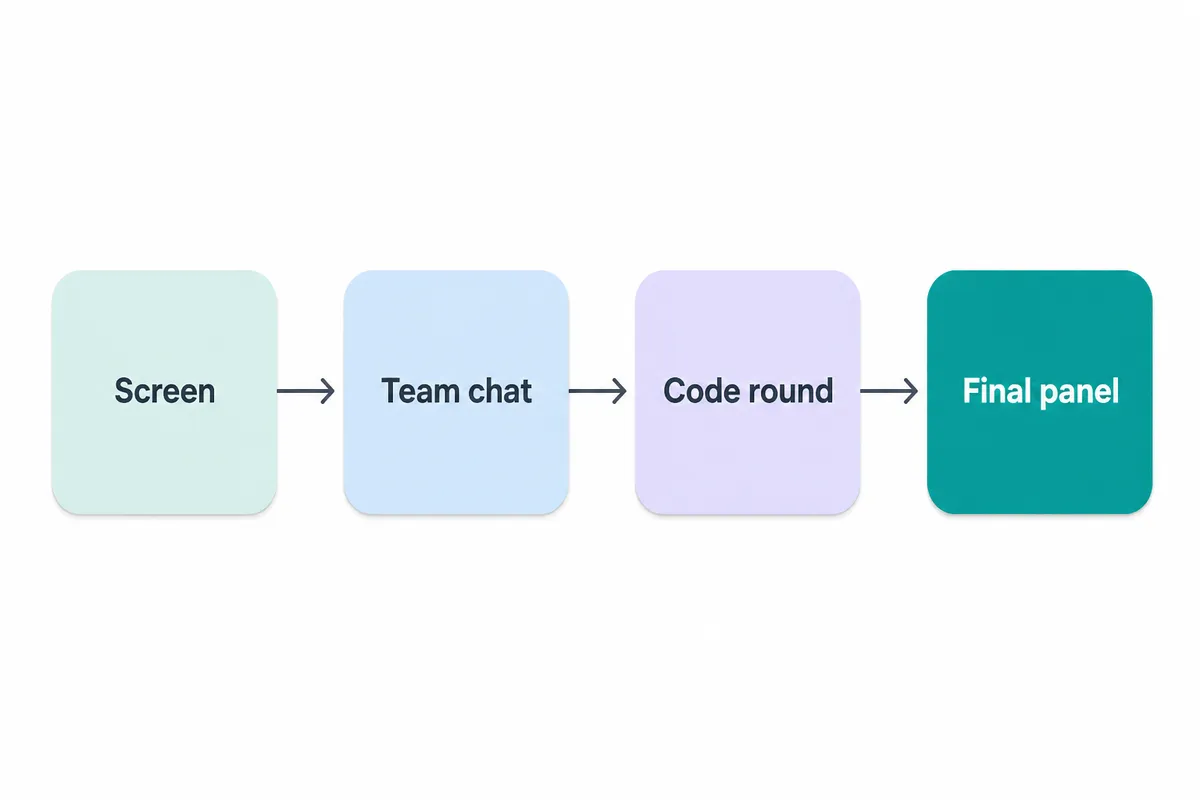
The process at a glance
| Stage | Common format | What it screens for | How to prepare |
|---|---|---|---|
| Recruiter screen | Initial conversation | Motivation, role fit, communication | Know why Salesforce and what role you want |
| Hiring-manager conversation | Project and experience discussion | Ownership, judgement, team fit | Prepare detailed project stories |
| Technical round | Coding and technical discussion | Problem solving, code quality, reasoning | Practise patterns and explain your approach |
| Final panel | Several conversations or interviews | Technical depth, values, collaboration | Connect your evidence across technical and behavioural answers |
Reported accounts describe this as a broad sequence rather than a universal script. Some teams may combine discussions, add domain-specific depth, or place technical evaluation at a different point. Ask early what the panel will cover, whether the role has a design component, and what programming environment you should expect.
Round one — recruiter screen
The recruiter screen is where the process becomes concrete. It commonly checks basic eligibility, your interest in the team, what you are looking for next, and whether your background broadly matches the role.
This is not usually a coding test, but it matters because it sets the narrative for every later conversation. A vague “I am looking for a new challenge” answer gives the interviewer little to work with. A useful answer connects three things: the work you have done, the kind of engineering problem you want next, and why Salesforce is a sensible place to do it.
Prepare a concise introduction that covers your current scope, strongest technical area, and the kind of impact you want to have. Research the product area once you know the team. Do not memorise a corporate slogan; instead, identify a credible reason the company’s customer-facing software, cloud platform, or engineering scale fits your goals.
Have practical questions ready too:
- What does the interview sequence look like for this role?
- Which technical skills will the team prioritise?
- What level of system or product knowledge is useful beforehand?
- How will the panel assess the Ohana values?
These questions are useful because candidate reports are necessarily incomplete. Your recruiter is the best source for the current process.
Round two — hiring-manager conversation
The hiring-manager discussion commonly moves beyond your résumé into how you make decisions. Expect a project deep-dive: what you owned, how you chose a direction, where you disagreed with others, how you handled risk, and what outcome your work produced.
This round screens for engineering maturity. The manager is trying to distinguish between someone who participated in a project and someone who understood its constraints, influenced its direction, and can learn from its mistakes.
Use a simple structure for project stories:
- Set the context and the user or business problem.
- Name your specific responsibility.
- Explain the decision, including constraints and alternatives.
- State the outcome and what you would change now.
Avoid hiding behind “we”. Teamwork matters, but the interviewer still needs to understand your individual contribution. If you say, “We improved reliability,” follow it with what you personally investigated, proposed, built, or measured.
The strongest stories include trade-offs. For example, explain why your team chose a simpler release over a larger redesign, how you handled an incident, or how you balanced customer needs against technical debt. That kind of answer demonstrates judgement more effectively than listing technologies.
For rehearsal, an AI mock interview can help you practise answering follow-up questions without relying on prepared wording.
Round three — technical screening
The technical stage is commonly reported as a coding evaluation, with medium-difficulty problems rather than a competitive-programming contest. The focus is likely to be standard software-engineering fundamentals: choosing suitable data structures, turning an approach into readable code, reasoning about complexity, testing edge cases, and communicating as you work.
That does not make it easy. Medium problems become difficult under observation when you skip clarification, code too soon, or cannot explain why your solution works.
A reliable live-coding routine is:
- Restate the problem and clarify assumptions.
- Walk through a small example.
- Describe a straightforward approach before reaching for an optimised one.
- State time and space complexity.
- Code in readable stages.
- Test normal, boundary, and failure cases aloud.
The DSA Patterns Sheet is free to browse and helps you practise recognition by problem shape rather than by a random list. If pattern selection is your weak point, read how to identify the right DSA pattern in a coding interview.
For Salesforce-specific technical preparation, work through Salesforce’s interview kit. Its seven mapped DSA questions are a focused way to rehearse the kind of coding reasoning evidenced at Salesforce. Use them to build a process, not to memorise solutions: solve first, explain your decisions, then compare your approach with the editorial.
✅ Do: narrate the reason for each important decision.
❌ Don’t: silently type for several minutes and reveal the solution only at the end.
For more on that distinction, see what interviewers actually look for in live coding rounds.
Round four — final panel
Candidate reports describe a final panel after the earlier conversations. Its exact format can differ by team, but it is best treated as an evidence-gathering stage rather than a victory lap. The panel may revisit technical judgement, collaboration, project experience, and your fit with the role.
Prepare for consistency. Your technical answer, project stories, and values examples should tell the same story about how you operate. If you describe yourself as customer-focused in one discussion, be ready with a concrete example of how customer impact changed an engineering decision. If you say you value quality, explain how you tested, monitored, or safely rolled out a change.
This is also where communication has extra weight. Senior interviewers often care less about whether you know a fashionable term and more about whether you can make a complicated decision understandable. Practise summarising an architecture, incident, or delivery decision in plain language before adding technical depth.
If the role involves design, separate object-level design from system-level design in your preparation. The Low Level Design Sheet and System Design Sheet are free to browse. This guide to low-level design versus high-level design explains what each format tends to assess.
The Salesforce-specific signal: Ohana
Ohana is the Salesforce-specific idea worth preparing for most carefully. Reported accounts describe it as a values framework assessed at every stage, with weight comparable to technical skill.
In practical terms, this means values questions are not confined to a single culture conversation. How you collaborate during a technical round, how you describe a disagreement with a colleague, and whether you consider customer impact in a project discussion can all shape the evaluation.
Do not treat this as a request for polished “culture fit” language. Generic answers tend to collapse under follow-ups. Instead, prepare truthful evidence that shows how you work.
Useful story themes include:
- A time you rebuilt trust after an error or missed expectation.
- A disagreement where you listened, changed your view, or found a workable compromise.
- A customer issue that changed the order in which your team prioritised work.
- A moment when you helped another engineer succeed without taking over their work.
- A difficult decision where you made the trade-off visible to stakeholders.
The key is specificity. Explain the situation, your role, what you did, and what happened. Then add what you learned. That final reflection shows that your judgement continues after the immediate outcome.
Is the Salesforce interview hard?
Yes, but the difficulty is balanced rather than concentrated in extreme coding puzzles.
Reported accounts describe technical coding as medium rather than competitive-programming hard. Candidates still need sound fundamentals, especially the ability to recognise common patterns, implement them cleanly, and test their work. A technically correct solution is not always enough if you cannot explain complexity, adapt to a clarification, or work through an edge case.
The harder part for many candidates is the combination of technical and values-based assessment. You need to switch comfortably between precise engineering reasoning and honest discussion of collaboration, leadership, customer impact, and mistakes.
How many rounds are there? Reported accounts commonly describe a recruiter screen, hiring-manager conversation, technical stage, and final panel. The exact structure varies by team and role.
How long does the process take? There is no reliable company-wide timeline in the available reports. Ask your recruiter for the current schedule and any deadlines attached to the role.
The process is manageable if you prepare both tracks. Candidates often overinvest in coding practice and leave project stories until the last evening. Reverse that habit: technical fluency and credible examples should develop together.
A 30-day Salesforce preparation plan
Days one to seven — establish coding rhythm
Start with core patterns: arrays, hash maps, two pointers, sliding windows, recursion, trees, graphs, and binary search. Focus on recognising when each approach applies and explaining why.
Use the free DSA Patterns Sheet for structured practice. Add short sessions in code practice so you get used to writing and testing code without relying on an editor’s comfort features.
Days eight to fourteen — improve communication
Continue coding, but make every session verbal. Before writing code, explain your plan as if an interviewer is listening. After coding, test it aloud with examples and name the complexity.
Read how to explain your thought process clearly in coding interviews, then record yourself solving a problem. Listening back will reveal where you jump between ideas or leave key assumptions unstated.
Days fifteen to twenty-one — build your Ohana evidence
Write several project stories using the context, action, result, learning structure. Cover collaboration, conflict, customer impact, ownership, and failure. Keep each story truthful and detailed enough to withstand follow-up questions.
Practise with an AI mock interview, especially for behavioural follow-ups. The goal is not a perfect script. It is being able to retrieve the right detail calmly.
Days twenty-two to thirty — simulate the loop
Alternate technical and conversational sessions. Use Salesforce’s interview kit for timed DSA practice, then spend the next session on a project deep-dive or values story.
In the final few days, run a complete rehearsal: introduction, coding problem, project discussion, and questions for the interviewer. Review where your answers feel vague. Replace broad claims with evidence.
Frequently asked questions
What are the most common Salesforce interview questions?
Reported accounts describe a mix of coding questions, project deep-dives, hiring-manager discussion, and values-focused questions. Prepare both technical reasoning and specific examples from your work.
Does Salesforce use coding interviews?
Yes. Candidate reports describe a technical stage, including a HackerRank NextGen assessment in some processes. Confirm the current format with your recruiter.
Are Salesforce coding questions difficult?
Reported accounts describe medium-level coding rather than competitive-programming hard. Clear reasoning, correct implementation, testing, and communication remain important.
What does Ohana mean in a Salesforce interview?
Ohana is Salesforce’s values framework. Candidate reports describe it as being assessed throughout the process, not only in a dedicated values conversation.
How should I prepare for the hiring-manager round?
Prepare detailed stories about projects you owned, decisions you made, trade-offs you handled, and outcomes you influenced. Be clear about your individual contribution.
How many interview rounds does Salesforce have?
A commonly reported sequence includes recruiter screening, a hiring-manager conversation, technical evaluation, and a final panel. Team and role variation is normal.
Is system design part of a Salesforce interview?
It can be relevant depending on level and team, particularly for experienced engineering roles. Ask your recruiter what technical areas the panel will cover.
What programming language should I use?
Use the language in which you can write clean, correct code and explain your choices confidently. Fluency matters more than selecting a fashionable language.
How do I prepare for Salesforce values questions?
Choose real examples involving trust, collaboration, customer impact, ownership, and learning. Explain your actions and the result rather than offering generic statements.
Where to start
Salesforce preparation works best when you treat technical skill and values evidence as one interview story. Build coding consistency, practise explaining your decisions, and prepare project examples that demonstrate how you work with people as well as systems.
Open Salesforce’s interview kit to practise the seven mapped DSA questions for the company. Then use the free sheets to reinforce fundamentals and an AI mock interview to rehearse the conversations where clear, credible examples matter most.
Interview processes change, so confirm the current round structure, platform, and expectations with your recruiter before the loop begins.
Topics
Related on Thita
Your next step
Practise with AI mock interviews
A spoken interview that asks follow-up questions, runs your code and ends with a written report.