
Interview
TCS CodeVita Season 14 (2026): Registration Dates & Rounds
TCS CodeVita Season 14 (2026): registration window status, round structure, Ninja vs Digital offers, and the algorithm practice plan that gets you ranked.
TCS CodeVita is the odd one out on the hackathon circuit. There's no team, no prototype, no pitch, no judges. It's a pure competitive programming contest — and it's one of the few coding competitions in India that routes directly into an offer.
That purity makes it the most straightforwardly preparable event you can enter. There's no luck in problem-statement selection, no teammate risk, no presentation skill required. You solve problems correctly and fast, or you don't.
This guide covers the format, the question style that catches most people out, the offer paths, and how to actually practise for it.
The whole game is algorithmic fluency. Start with the DSA Patterns Sheet — 404 problems across 94 sub-patterns — and the 90-Day Interview Roadmap for structure.
Key Dates (last checked 2026-09-07)
| Detail | Status |
|---|---|
| Season 13 registration | Closed 18 September (most recent confirmed season) |
| Season 14 (2026) registration window | not announced yet (last checked 2026-09-07) — historically opens in the August–September window |
| Season 14 result / ranking announcement | not announced yet (last checked 2026-09-07) |
TCS has not published fixed Season 14 dates anywhere Thita could confirm — check codevita.tcsapps.com weekly through August and September for the announcement.
What Is TCS CodeVita?
CodeVita is TCS's global coding competition, run in annual seasons and billed as one of the largest programming contests in the world. It's open to engineering students across eligible graduating batches, and strong performance can route you into TCS's higher-tier hiring bands.
Eligibility
- Engineering students completing their course in eligible years — recent cycles have covered roughly the 2026–2029 batches
- Open globally, with heavy participation from India
- Free to enter
Registration Timing
Registration typically opens in the August–September window. Season 13 registration closed on 18 September, which makes the pattern to watch clear: check codevita.tcsapps.com weekly through August and September for the Season 14 announcement.
⚠️ Important: CodeVita registration doesn't get the marketing push that company hackathons do. Most students find out it exists after it closed. Set a recurring calendar reminder for mid-August, every year.
Why It's Worth Doing
- Direct offer routes — strong CodeVita performance is used as a signal for TCS Ninja (
₹7 LPA) and Digital (₹14 LPA) hiring bands - A global rank is a genuine, verifiable resume line — far stronger than "participated in"
- Zero team risk — your result depends only on you
- It's the best possible training for every other timed coding round you'll face
The Format
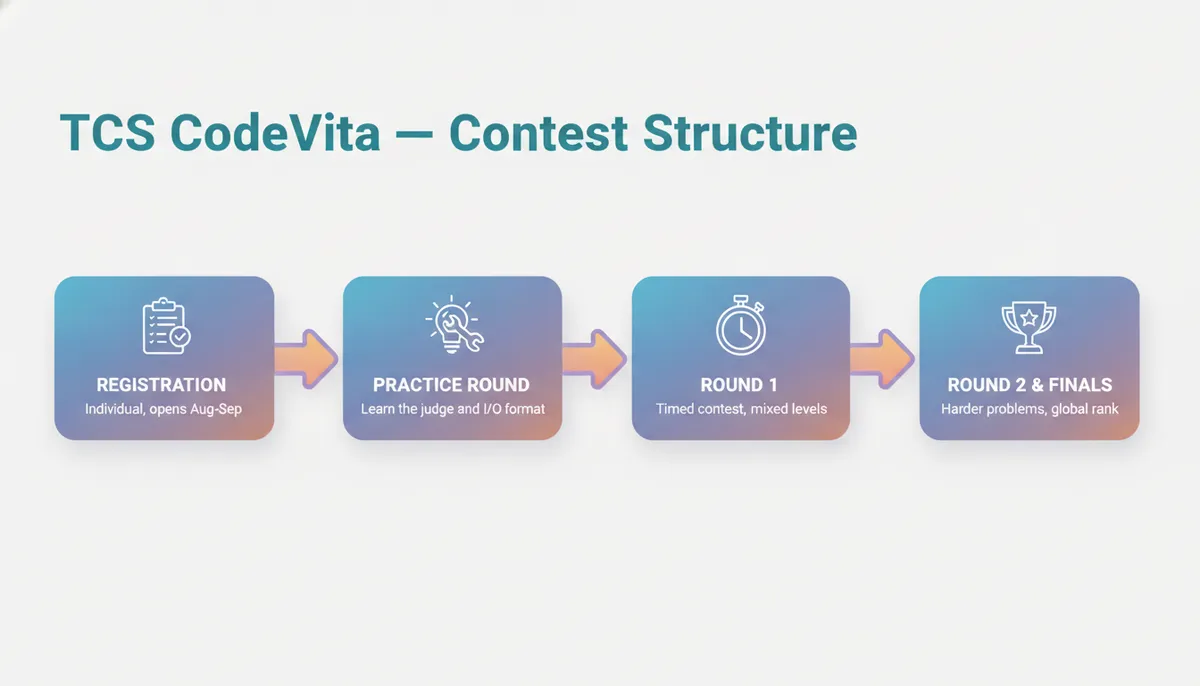
CodeVita runs across multiple rounds, with a global leaderboard. Broadly:
| Stage | Format | What it demands |
|---|---|---|
| Registration | Individual, online | Just don't miss the window |
| Pre-qualifier / practice | Sample problems, environment familiarisation | Learn the judge and the I/O format |
| Round 1 | Timed contest, multiple problems, wide difficulty spread | Solve as many as possible, correctly |
| Round 2 | Harder problem set for qualifiers | Genuine algorithmic depth |
| Finals | Top global performers | Elite competitive programming |
The scoring rewards correctness plus speed. Partial solutions generally don't score the way they do on interview-style platforms — CodeVita's judge is closer to a competitive programming judge, meaning your solution passes all test cases or it doesn't count.
The Question Style (This Is What Catches People Out)
CodeVita problems are notoriously wordy. A problem that reduces to a straightforward dynamic programming recurrence will be wrapped in three paragraphs of narrative about a merchant, a kingdom, and a set of arbitrary rules.
This creates three specific difficulties that pure LeetCode practice doesn't prepare you for:
1. Problem comprehension is half the work
You have to extract the actual computational problem from a story. Many strong coders lose time — or solve the wrong problem entirely — because they misread a constraint buried in paragraph four.
How to practise: after reading any problem, write a two-line restatement in pure input/output/constraint terms before touching code. Do this for every problem for a month and it becomes automatic.
2. Input/output parsing is non-trivial
CodeVita frequently uses custom input formats that require real parsing work — variable-length lines, nested structures, delimiter quirks. Getting the parsing wrong means a correct algorithm scoring zero.
How to practise: don't skip the practice round. Solve the sample problems in your chosen language until reading and writing the format is muscle memory.
3. The difficulty spread is enormous
A single contest can contain a problem solvable in ten lines and one that only a handful of people worldwide solve. Time allocation is a scored skill.
How to practise: in every timed session, spend the first five minutes reading all problems and ranking them by expected time-to-solve. Then solve in that order. This single habit is worth more than any algorithm you'll learn.
The Topics That Actually Appear
CodeVita leans harder on classical algorithms and mathematics than interview-style contests do:
- Ad-hoc / implementation — heavy simulation, careful edge cases, no clever trick
- String processing — parsing, pattern matching, transformations
- Mathematics & number theory — primes, GCD/LCM, modular arithmetic, combinatorics
- Recursion & backtracking — permutations, constraint satisfaction, puzzle solving
- Dynamic programming — classic 1D/2D formulations, knapsack, LCS variants
- Graphs — BFS/DFS, shortest paths, connectivity, grid traversal
- Greedy & sorting — interval problems, scheduling, custom comparators
- Matrix manipulation — rotations, spiral traversal, grid simulation
- Bit manipulation — subset enumeration, masking tricks
- Search techniques — binary search on the answer, two pointers
The DSA Patterns Sheet covers the core of this across 15 pattern families. For CodeVita specifically, weight your extra practice toward implementation-heavy simulation, mathematics, and recursion — the three areas interview-focused preparation tends to under-cover.
💡 Pro Tip: Pick one language and become genuinely fast in it. C++ is favoured for speed and its standard library; Python is fine and often faster to write, but be aware of time limits on heavy computation. Switching languages mid-preparation is a waste of the fluency you've built.
The Preparation Plan
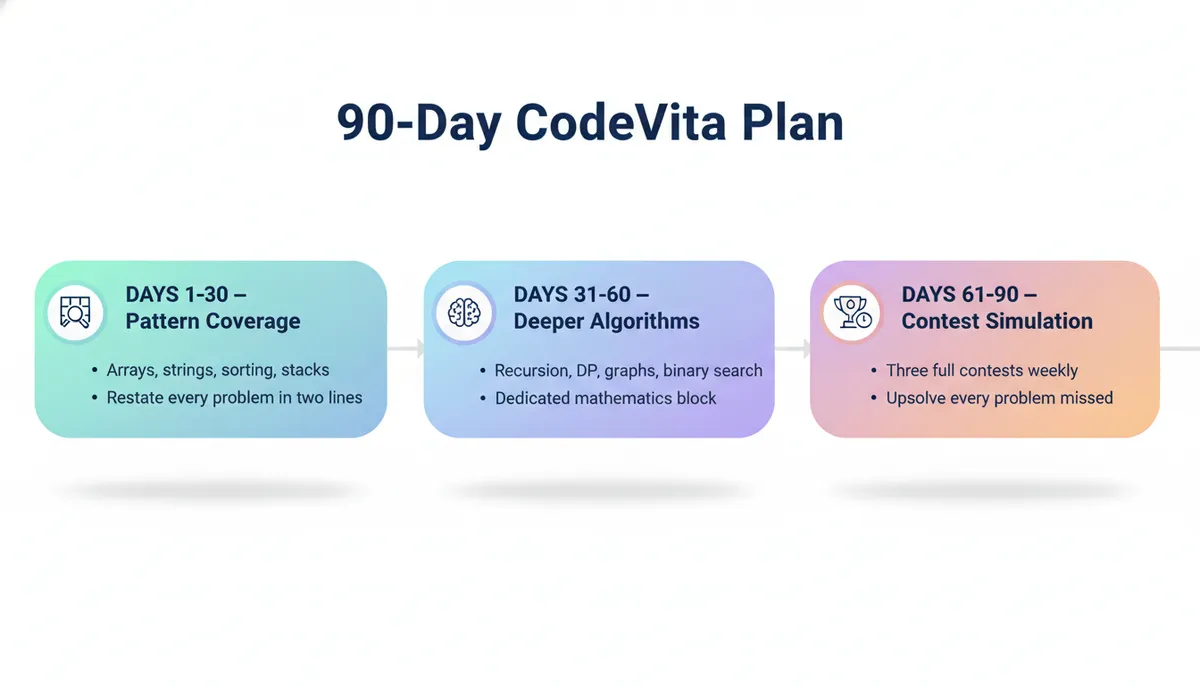
Days 1–30: Pattern Coverage
- Work the DSA Patterns Sheet in order: arrays, strings, hash maps, two pointers, sorting, stacks
- 3 problems daily, with a written two-line restatement before each
- Weekly: one 90-minute timed session with mixed difficulty
Milestone: 90+ problems, fluent in your chosen language's I/O.
Days 31–60: Algorithmic Depth
- Recursion and backtracking, dynamic programming, graphs, binary search on the answer
- Add a dedicated mathematics block: modular arithmetic, primes, combinatorics — 30 minutes, three times a week
- Two timed contests per week, full length, ranked-order strategy practised every time
Milestone: comfortable with medium-hard DP and graph problems; time allocation habit established.
Days 61–90: Contest Simulation
- Three full-length simulated contests per week, treated as the real thing
- After each: a full upsolve — solve every problem you couldn't finish, without a time limit. This is where most improvement actually happens.
- Practise the CodeVita judge's I/O format specifically
- Keep an error log: for every wrong submission, one line on why — misread constraint, off-by-one, wrong complexity, parsing bug. Patterns emerge fast.
Milestone: consistent contest routine, an error log you actually review.
The 90-Day Interview Roadmap provides the underlying structure — 316 DSA problems, 114 theory modules and 22 mock interviews — which doubles as your placement preparation. CodeVita and campus interviews draw from the same well.
From CodeVita to a TCS Offer
Performance in CodeVita is a signal, not an automatic offer. The path still runs through TCS's hiring process, where higher bands come with their own interview loops.
| What you need | Where to prepare |
|---|---|
| DSA for the technical interview | DSA Patterns Sheet + AI mock interviews |
| CS fundamentals | OS, DBMS, Networks sheets |
| Project depth / design | LLD sheet |
| HR and managerial rounds | Behavioural sheet |
| A resume that survives screening | Resume Analyzer |
💡 Pro Tip: Put your global rank and the number of participants on your resume — "Global rank 812 of 100,000+, TCS CodeVita Season 13" is a concrete, verifiable achievement that recruiters at every company recognise, not just TCS.
Common Mistakes
❌ Missing the registration window. It's the most common CodeVita failure and it's entirely avoidable.
❌ Skipping the practice round. The I/O format will cost you a correct solution if you meet it for the first time in the real contest.
❌ Reading problems in order. Rank by expected solve time first. Always.
❌ Only practising interview-style problems. CodeVita is more mathematical and more implementation-heavy than LeetCode mediums.
❌ Not upsolving. Solving a contest and never revisiting the problems you missed wastes the most valuable practice material you have.
❌ Language-hopping. Fluency in one language beats familiarity with three.
Frequently Asked Questions
When does TCS CodeVita registration open?
Historically August–September. Season 13's registration closed on 18 September, so check codevita.tcsapps.com weekly from early August for the Season 14 announcement.
Who is eligible for TCS CodeVita?
Engineering students in eligible graduating batches — recent cycles covered roughly 2026 through 2029. Check the official portal for the current season's exact list.
Does CodeVita guarantee a TCS job?
No. Strong performance is a signal used toward TCS Ninja and Digital hiring bands, but you still go through the hiring process and its interviews.
Which language should I use?
C++ for raw speed and standard library support, or Python for faster writing. Java is entirely viable. Pick one and get genuinely fast — don't switch mid-preparation.
How hard are CodeVita questions?
The spread is wide — a contest typically has problems ranging from straightforward implementation to genuinely difficult algorithmic work. The verbose problem statements add a comprehension difficulty on top of the algorithmic one.
Is CodeVita worth it if I don't want to work at TCS?
Yes. It's excellent training for every timed coding round you'll ever face, and a global rank is a resume line that any recruiter understands.
How is CodeVita different from other hackathons?
Completely. There's no team, no building, no pitching, no judges. It's pure competitive programming — see the hackathon calendar for how it compares to build-style events.
Final Thoughts
CodeVita is the most honest competition on this circuit. No team politics, no presentation skill, no problem-statement lottery — just whether you can read a problem correctly and solve it fast.
That means the preparation is unusually direct:
- Work the DSA Patterns Sheet in pattern order, timed
- Add a mathematics and implementation block that interview prep skips
- Run full contest simulations and upsolve every single one
- Use the 90-Day Interview Roadmap so the same effort also carries your placement season
And set that August calendar reminder. The most common way to lose CodeVita is to never register.
Related reading: Hackathon calendar 2026-27 · Flipkart GRiD guide · How to win a hackathon