
Interview
TCS Interview Questions and Process: The Complete Guide (2026)
Prepare for TCS interview questions with a clear guide to the NQT, technical, managerial and HR rounds, campus hiring tracks, and a 30-day plan.
TCS interview questions are usually part of a campus-hiring flow that begins with the TCS National Qualifier Test, then moves through technical, managerial and HR conversations. The most effective preparation is broad rather than narrowly algorithmic: build speed for the test, revise programming and CS fundamentals for the technical discussion, and prepare clear examples of your projects, teamwork and career goals. For coding-pattern practice, TCS's interview kit holds four mapped DSA questions to help you rehearse common problem-solving shapes.
Reported accounts describe TCS as a mass campus-hiring process rather than a product-company-style interview loop. That distinction matters. The early test helps sort a large applicant pool; the later conversations assess whether you can explain foundations, communicate professionally and fit the role or track under consideration.
The process at a glance
| Stage | Round | Typical focus | What it screens for |
|---|---|---|---|
| One | NQT exam | Aptitude, verbal ability, reasoning and coding | Baseline readiness and test-taking discipline |
| Two | Technical Q&A | Programming, projects and CS fundamentals | Technical understanding and problem solving |
| Three | Managerial | Teamwork, ownership and work approach | Professional judgement and role fit |
| Four | HR | Motivation, communication and availability | Practical fit and confidence |
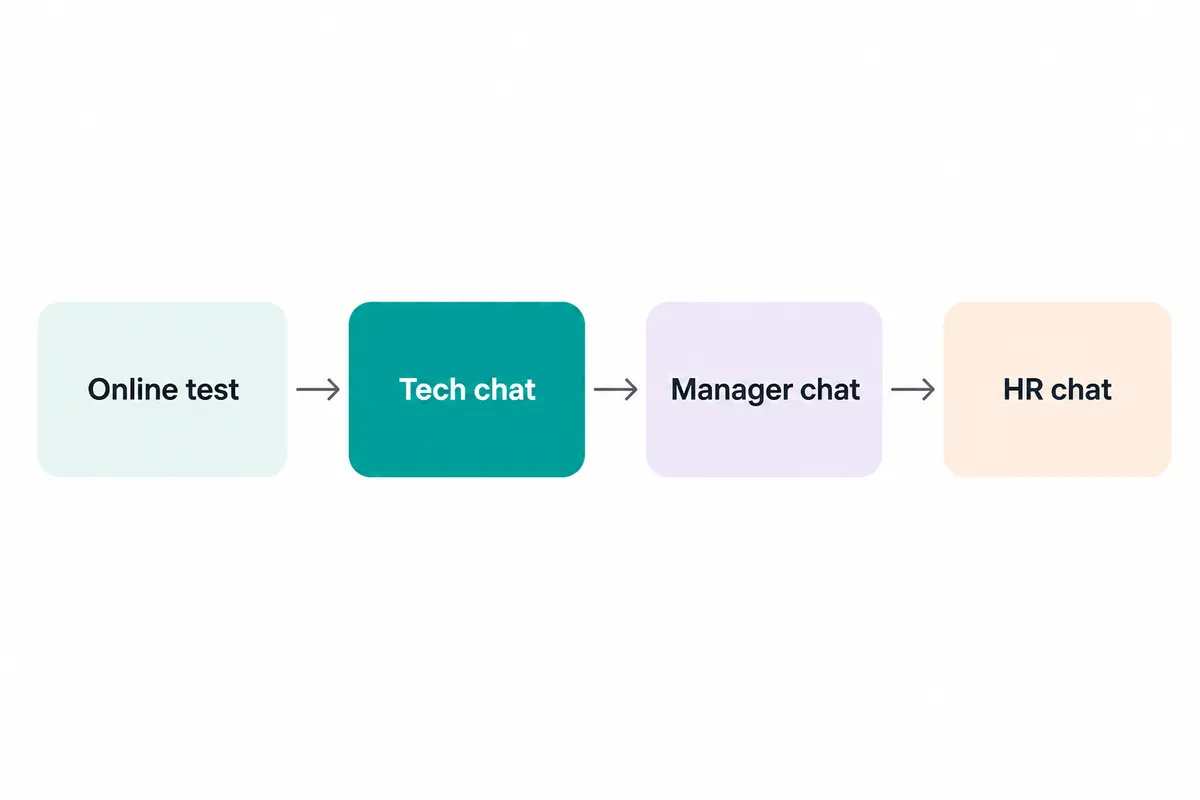
Candidate reports vary by college, role, hiring channel and business unit, so treat this as the commonly reported shape rather than a fixed policy. Your recruiter or campus placement cell is the best source for the exact format attached to your application.
Round one — the NQT exam
The NQT is the opening gate in the commonly reported TCS process. It is not simply a coding test. Candidates should expect a mixed evaluation of quantitative aptitude, verbal ability, logical reasoning and programming-oriented problem solving.
What this stage screens for is range. TCS hires across a very large campus pool, so the test needs to distinguish candidates who can work accurately across different kinds of structured tasks. A candidate who is strong at coding but rushes numerical reasoning, or reads verbal questions carelessly, can lose ground before reaching a technical conversation.
For the coding component, prioritise familiar shapes: arrays, strings, hash-based lookup, sorting, loops, conditionals and straightforward complexity reasoning. The aim is not to display an obscure trick. It is to recognise the task, select a reliable approach and finish with enough time to check input handling and edge cases.
The DSA Patterns Sheet is free to browse and is useful for practising recognition rather than memorising disconnected solutions. Pair it with in-browser code practice when you need to build the habit of writing, testing and correcting a solution under pressure.
A useful routine for this round is simple:
- Read the full prompt before writing anything.
- Identify the input, output and constraints.
- Start with the clearest correct solution.
- Check empty input, repeated values and boundary conditions.
- Re-read the question before submission.
The NQT rewards accuracy as much as speed. Treat every practice session as an exercise in avoiding preventable mistakes.
Round two — the technical Q&A
The technical round is where reported accounts describe a shift from test performance to explanation. You may be asked about the language you know best, the projects listed on your CV, core programming concepts and foundational computer science topics. Coding questions can arise, but the broader point is whether you understand what you claim to have built and studied.
This round screens for practical technical fluency. Can you explain how a program works rather than recite a definition? Can you discuss a project’s inputs, design choices and limitations? Can you reason through a simple problem aloud when an interviewer changes a requirement?
Prepare your programming fundamentals carefully. Revise object-oriented concepts, functions, classes, inheritance, polymorphism, exception handling, memory basics and the trade-offs in the language you plan to discuss. Do not prepare definitions in isolation. For each concept, have a small example ready from coursework, a personal project or a familiar application.
CS fundamentals can also matter because they reveal how you reason beneath the code. The Operating Systems Sheet, DBMS Sheet and Computer Networks Sheet are free to browse when you need a structured revision pass through processes, scheduling, normalisation, transactions, networking basics and related topics.
Projects deserve special attention. Many candidates prepare for theoretical questions and under-prepare for the one subject where they should be most credible: their own work. For every project on your CV, be ready to explain:
- the problem it was intended to solve;
- the tools and language choices you made;
- your individual contribution;
- a difficult bug or limitation;
- how you tested it;
- what you would improve with more time.
If you cannot explain a project clearly, reduce its prominence on your CV. It is better to discuss one modest project honestly and deeply than present several large projects that dissolve under follow-up questions.
The delivery matters too. The guide to explaining your thought process clearly in coding interviews is worth reading before you practise. Interviewers can only assess reasoning that you make visible.
Round three — the managerial conversation
The managerial stage commonly follows the technical discussion. It is not a technical formality, nor is it merely a friendly chat. It examines how you work with other people, how you respond to uncertainty and whether your expectations match the organisation and role.
Reported accounts describe questions about teamwork, conflict, deadlines, learning, relocation, priorities and handling pressure. You may also be asked to revisit a project, but the emphasis changes from implementation detail to decision-making and ownership.
This round screens for professional judgement. Managers want evidence that you can take feedback, communicate when blocked, contribute in a team and learn in an environment where projects, clients and technologies may change.
Use specific examples. A vague answer such as “I work well in teams” is difficult to assess. A better answer explains the context, your action and the result: a disagreement over scope, a deadline that required reprioritisation, a teammate you helped unblock, or feedback that changed your approach.
Do not try to sound flawless. A thoughtful account of a mistake can be stronger than a generic success story if you explain what you learned and what you changed afterwards. The key is ownership: distinguish what the team did from what you personally decided, built or communicated.
Practising aloud is important here. AI mock interviews can help you rehearse project explanations and behavioural answers until they sound direct rather than memorised.
Round four — the HR conversation
The HR round usually focuses on communication, motivation and practical fit. Commonly reported topics include why you want to join TCS, your background, your preferred work environment, location flexibility, career goals and any practical joining considerations.
This round screens for clarity and consistency. Your answer to “Why TCS?” should connect to something real: the opportunity to start in a large technology organisation, exposure to different industries, structured learning, client-facing work, engineering at scale, or the chance to develop across domains. Avoid an answer that could apply unchanged to every employer.
Prepare a concise introduction that covers your education, strongest technical interests, relevant project work and what you want to learn next. Keep it conversational. A long chronological autobiography can make a confident candidate sound unprepared.
Be honest about constraints. If you have questions about location, joining dates or role allocation, ask them professionally. The goal is not to perform certainty where none exists; it is to show that you can have a straightforward professional conversation.
The TCS-specific feature: NQT tracks and campus hiring
The feature that makes TCS preparation different from a typical software interview guide is the campus-hiring structure. Reported accounts describe candidates being streamed into Ninja, Digital and Prime tracks, with different compensation bands and expectations.
That means your preparation should not assume one identical interview experience for every candidate. The NQT and subsequent conversations may be used to assess both whether you clear the hiring bar and where you are best placed within the available tracks.
This has two practical consequences.
First, do not treat the exam as a hurdle to clear with the minimum possible effort. A stronger overall performance can affect the opportunities available after it. Build balanced readiness across aptitude, communication and coding instead of betting everything on one technical topic.
Second, prepare to discuss growth. Campus hiring is partly about potential. You may not have years of production experience, but you can demonstrate curiosity, reliable learning habits and the ability to contribute in a structured environment. Talk about what you have learned from projects, how you approached unfamiliar tools and how you would ramp up on a new team.
For the coding portion, work through TCS's interview kit alongside broader pattern practice. The company-specific set gives you a focused starting point; the free sheets help you build the transferable foundations that matter across the larger process.
Is the TCS interview hard?
TCS interviews are best described as moderately difficult, with the challenge coming from breadth and consistency rather than from unusually specialised technical questions.
The NQT can be demanding because it covers multiple skills in one sitting. Candidates who prepare only coding may find the aptitude and verbal sections costly; candidates who focus only on test practice may struggle when asked to explain projects or programming fundamentals in the technical round.
The technical discussion is often manageable for candidates with sound basics, but it exposes shallow preparation quickly. If you list Java, Python, SQL, cloud tools or a major project on your CV, expect follow-up questions that test whether you understand them beyond the headline.
How many rounds are there? Reported accounts commonly describe the NQT followed by technical, managerial and HR stages. The exact sequence can vary by campus, role and hiring stream.
How long does the process take? There is no sufficiently consistent reported timeline to treat as a reliable promise. Campus schedules, result batches and role allocation can all affect the pace. Confirm timing directly with your placement cell or recruiter.
The encouraging part is that the preparation is highly transferable. Clear coding, CS fundamentals, project depth and communication are useful in this process regardless of the final track.
A 30-day preparation plan
Days one to seven — build your test base
Start with diagnostic practice. Identify whether your weakest area is aptitude, reasoning, verbal questions or coding. Then create short daily sessions rather than saving everything for a single weekend.
For coding, focus on arrays, strings, maps, sorting and basic recursion. Read how to identify the right DSA pattern in a coding interview to turn practice into a recognition skill instead of a memorisation exercise.
Days eight to fourteen — revise technical foundations
Choose your primary language and revise it deeply. Practise explaining common concepts aloud, including object-oriented principles, error handling, collections and complexity.
Add a focused pass through operating systems, databases and networks. You do not need to turn every topic into a lecture. You need enough understanding to explain the central idea, give an example and connect it to software you have written.
Days fifteen to twenty-one — make your CV interview-ready
Review every line of your CV. For each skill, decide whether you can explain it confidently. For each project, prepare a problem statement, architecture summary, contribution, obstacle and improvement.
Do a mock technical conversation. Ask a friend to interrupt your project explanation with “why?”, “how?” and “what would happen if?”. If you do not have a practice partner, use an AI mock interview to rehearse the same pressure in a repeatable format.
Days twenty-two to thirty — simulate the real sequence
Alternate test practice with spoken practice. Complete mixed aptitude and coding sessions, then spend time answering technical and managerial questions aloud.
Use TCS's interview kit for focused coding rehearsal, but keep the rest of the process in view. Review one project each day, practise your introduction, and refine your answer to why you want this opportunity.
In the final days, prioritise sleep, clarity and consistency over cramming new material. The best last-stage preparation is often reviewing what you already know until you can explain it calmly.
Frequently asked questions
What are the main TCS interview questions?
Commonly reported topics include programming fundamentals, projects on your CV, object-oriented concepts, databases, operating systems, networking basics, teamwork and career motivation.
Is coding asked in the TCS interview?
Reported accounts describe coding and programming-oriented problem solving in the NQT, with technical conversations also able to test coding fundamentals and reasoning.
What is the TCS NQT?
The TCS National Qualifier Test is commonly reported as the opening assessment for campus hiring. It can cover aptitude, reasoning, verbal ability and coding-related tasks.
How should I prepare for the TCS technical round?
Revise your primary programming language, core CS subjects and every project on your CV. Practise explaining decisions aloud, not only writing code silently.
What are Ninja, Digital and Prime at TCS?
Reported campus-hiring accounts describe these as TCS candidate tracks with different compensation bands and expectations. Confirm the current details for your campus and application.
Does TCS ask DBMS and operating systems questions?
Candidate reports commonly include CS-fundamentals discussion. Revise DBMS, operating systems and networking alongside programming concepts.
What should I say when asked why I want to join TCS?
Give a specific and honest answer about the learning environment, scale, industry exposure, engineering work or career development you value. Avoid a generic answer that fits every company.
Is the TCS interview difficult for freshers?
It can be challenging because it tests several areas, but it is approachable with balanced preparation. Strong basics, clear project explanations and disciplined test practice matter most.
How can I improve my communication for the interview?
Practise short explanations of your code, projects and decisions. The aim is not polished jargon; it is a clear structure, direct answers and calm reasoning.
Where to start
Start with the part of the process you are most likely to underestimate: balanced preparation. Build coding confidence, but also revise CS fundamentals, prepare your projects and rehearse how you communicate under follow-up questions.
Open TCS's interview kit for four mapped DSA questions, then use the free-to-browse DSA Patterns Sheet and code practice environment to strengthen your broader problem-solving routine.
Reported processes can change by campus, role and hiring stream, so confirm your specific format with your recruiter or placement cell.
Topics
Related on Thita
Your next step
Practise with AI mock interviews
A spoken interview that asks follow-up questions, runs your code and ends with a written report.