
Interview
Tesla Interview Questions and Process: The Complete Guide (2026)
Prepare for Tesla interview questions with a round-by-round process guide, practical coding advice, realistic timelines, and a focused 30-day plan.
Tesla interview questions are commonly reported to test practical engineering judgement alongside coding ability. Candidate accounts describe an initial screen, a technical phone conversation, a coding assessment, and panel interviews. The standout stage is often a language-agnostic practical technical screen: rather than rewarding memorised syntax alone, it tests whether you can turn an engineering problem into clear, working code and explain your decisions.
For focused preparation, Tesla's interview kit holds 6 mapped DSA questions associated with Tesla. Use them to practise pattern recognition, complexity reasoning, and communicating a solution under interview conditions.
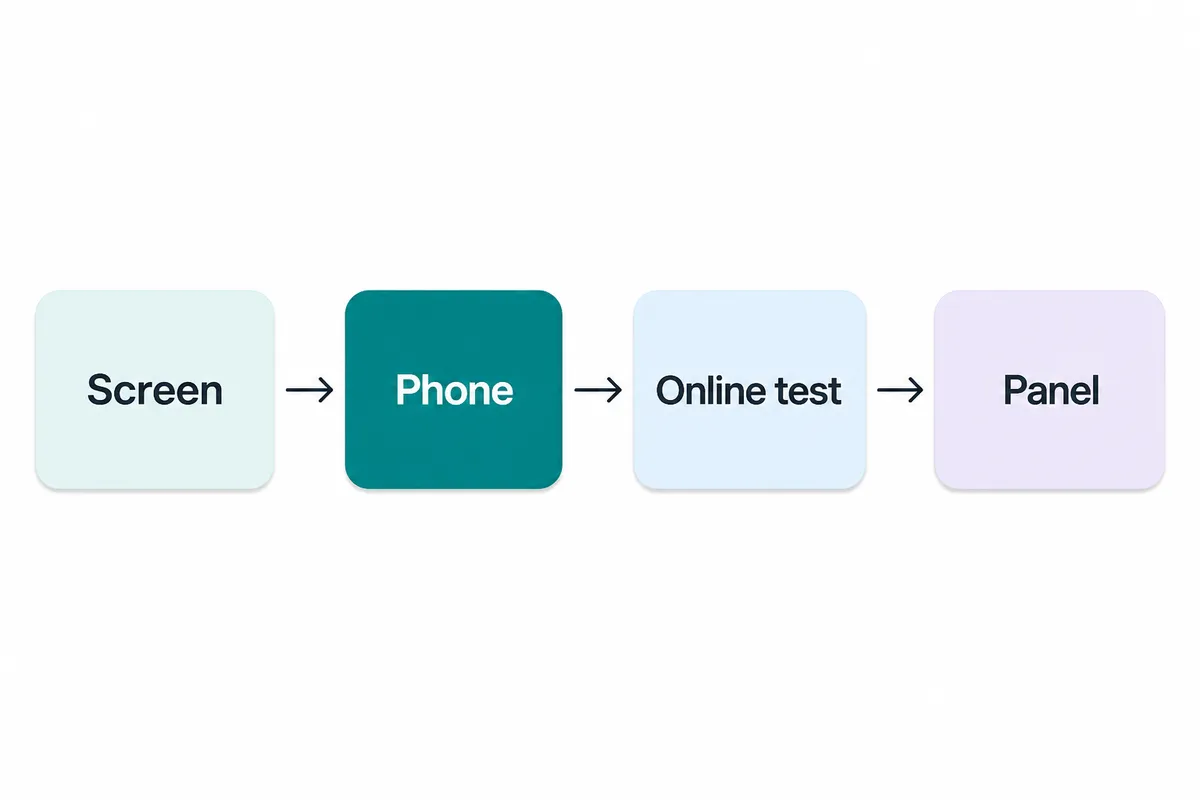
Tesla interview process at a glance
Reported accounts vary by team, role, location, and hiring urgency. Treat this as a common shape rather than a fixed company policy, then confirm your own format with the recruiter.
| Stage | Round | Reported format | What it screens for |
|---|---|---|---|
| 1 | Initial screen | AI-assisted or recruiter conversation | Role fit, experience, motivation |
| 2 | Technical phone | Practical, language-agnostic technical discussion | Applied problem solving, communication |
| 3 | Coding assessment | Codility-style test with medium-to-hard coding problems | Core coding, speed, correctness |
| 4 | Panel interviews | Two to three technical and team conversations | Depth, judgement, collaboration |
The practical emphasis is the useful headline. You still need reliable data structures and algorithms foundations, but preparation should not stop at solving isolated puzzles. You need to make sensible assumptions, explain trade-offs, test your work, and keep moving when the prompt is incomplete.
The DSA Patterns Sheet is free to browse and is a good place to refresh the recurring patterns behind coding assessments. If pattern selection is the part that slows you down, read how to identify the right DSA pattern in a coding interview.
Stage 1 — the initial screen
Reported accounts describe either an AI-assisted screen or an early recruiter conversation. This stage is less about proving that you can solve a difficult coding problem and more about establishing whether the role, your experience, and Tesla's needs line up.
Be ready to give a concise account of what you have built. Strong answers make your personal contribution unmistakable: the problem, your constraints, the technical decision you made, what changed after release, and what you would improve now. Avoid turning every answer into “we did this”. Teamwork matters, but the interviewer still needs to understand your individual judgement.
For engineers, the best preparation is not a memorised pitch. It is choosing two or three project stories with enough technical depth to survive follow-up questions. One should show ownership, one should show a difficult trade-off, and one should show how you handled a failure, disagreement, or changing requirement.
💡 Pro tip: Prepare a short answer for why this role specifically, then stop. A clear answer tied to the product or engineering problem is stronger than a long speech about the company.
Stage 2 — the practical technical phone screen
This is the part of Tesla's reported process that deserves special attention. Candidate accounts describe a technical screen of around an hour that is language-agnostic and practical, modelling real engineering work. For many teams, reports suggest it replaced a take-home exercise.
That distinction changes how you should practise. A take-home gives you time to research, refactor, and return later with a cleaner answer. A live practical screen rewards a different skill: forming a workable plan while someone is watching, writing code that addresses the core need, and narrating the decisions that keep the solution maintainable.
The interviewer may be listening for several things at once:
- Can you clarify the problem before committing to an approach?
- Can you choose a data structure that matches the access pattern?
- Can you separate the essential requirement from optional polish?
- Can you test likely edge cases without being prompted repeatedly?
- Can you explain why you made a trade-off?
You do not need to turn every answer into a grand architecture discussion. In fact, over-design can be a problem when the prompt needs a direct implementation. Start with the simplest correct path, state what you would change if scale or requirements changed, and then write code.
Our guide to explaining your thought process clearly in coding interviews is useful here. The goal is not to fill every second with talking. It is to make the important reasoning visible.
✅ Do: Clarify inputs, outputs, constraints, and failure cases before coding.
❌ Don't: Spend half the screen silently constructing a perfect solution that the interviewer cannot assess.
Stage 3 — the coding assessment
Candidate reports commonly describe a Codility coding assessment with two or three medium-to-hard problems. This stage is where interview fundamentals matter most: translating an idea into correct code quickly, choosing a reasonable complexity target, and checking the ugly cases before time runs out.
The exact topics vary, so prepare transferable patterns rather than betting everything on a narrow list. Arrays, strings, hash maps, sorting, trees, graphs, recursion, and dynamic programming are all worth revisiting. The real advantage comes from recognising the shape early enough to leave time for implementation and validation.
A good timed routine has four parts:
- Read the entire prompt before coding.
- State the brute-force approach privately or in notes, then improve it.
- Implement the smallest correct version first.
- Test normal, empty, duplicate, boundary, and large-input cases.
If you repeatedly finish with code that is nearly correct, your issue is probably not knowledge. It is process. Build a habit of reserving time to inspect index bounds, null or empty inputs, integer limits, and assumptions hidden in the wording.
Use in-browser code practice to rehearse implementation under a timer. Then work through Tesla's interview kit and explain each solution aloud after you solve it. You are preparing for both the assessment and the conversations that follow.
For a refresher on a frequently useful family of problems, graph traversal patterns with DFS and BFS provides a structured way to review traversal choices and complexity.
Stage 4 — panel interviews
Reported accounts describe two to three panel rounds after the assessment. The exact mix is not well standardised in public reports, so avoid assuming that every Tesla team runs the same panel. Some conversations may go deeper into coding, others into previous projects, systems thinking, technical choices, or how you work with adjacent teams.
What is consistent about a panel format is that it creates multiple opportunities to show engineering maturity. A candidate who can solve one problem but cannot explain a past decision, defend a trade-off, or collaborate through ambiguity can struggle here.
Prepare for project depth in layers.
First layer: the overview. What did the system do, who used it, and what was your role?
Second layer: the hard part. What constraint mattered most: latency, reliability, safety, cost, hardware limits, data quality, integration risk, or delivery time?
Third layer: the decision. What options did you consider, what did you choose, and why?
Fourth layer: the retrospective. What went wrong, what did you learn, and what would you do differently now?
For more experienced roles, revise design fundamentals as well as coding. The Low Level Design Sheet and System Design Sheet are free to browse. The distinction between class-level design and larger service-level design matters, and low-level design vs high-level design explains where each belongs in an interview.
The Tesla-specific preparation edge: practical work over polished theatre
Tesla's reported practical, language-agnostic technical screen is the feature that should shape your preparation. It is easy to prepare for interviews as if every round were a sequence of abstract algorithm puzzles. That approach can leave you underprepared for a discussion where the interviewer is watching how you turn a real-world-shaped prompt into an implementation.
Practise making decisions with incomplete information. When a prompt is vague, say what you would clarify. If the interviewer does not answer, state your assumption and continue. When a requirement changes, identify the smallest part of the solution that needs to move rather than rewriting everything.
This is also where language fluency becomes important. “Language-agnostic” does not mean language does not matter. It means you should choose the language in which you can write readable code, use core collections confidently, handle errors sensibly, and test without searching for basic syntax.
A practical rehearsal might look like this:
- Read a short engineering prompt.
- Spend a few minutes identifying assumptions.
- Sketch the data model and main flow.
- Write a working core implementation.
- Add targeted tests.
- Explain one improvement you would make with more time.
That is a more valuable exercise than trying to memorise a perfect answer. It trains the judgement that a practical screen can reveal.
Is the Tesla interview hard?
Yes, especially if your preparation has been limited to untimed problem solving.
Reported accounts describe a process with an initial screen, a technical phone, a coding assessment, and two to three panel rounds. In practical terms, that usually means five to six stages, depending on how the first screen and panel conversations are organised.
The difficulty is not only the coding assessment's medium-to-hard problems. It is the need to perform across different formats. You may need to move from discussing your experience, to solving a timed problem, to explaining a practical implementation, to defending past technical decisions.
How long does it take? Public accounts are not consistent enough to give a reliable Tesla-wide timeline. Team needs and scheduling can change the pace substantially. Ask the recruiter when you should expect each stage and whether panels will be grouped closely together.
What makes it difficult? The combination of speed, communication, and practical judgement. Candidates who can solve a problem eventually may still struggle if they cannot make their reasoning clear or produce a working answer within the available time.
A 30-day Tesla interview preparation plan
Days 1–7 — rebuild coding speed
Review arrays, strings, hash maps, two pointers, sliding windows, recursion, trees, and graphs. Do timed practice every day, but keep sessions short enough that you can review mistakes properly.
After each problem, write down the signal you missed: an ordering constraint, repeated lookup, a moving range, a graph relationship, or overlapping subproblems. This turns practice into recognition training instead of a growing list of solved questions.
Days 8–14 — practise practical implementation
Choose small engineering prompts rather than only puzzle-style questions. Build a small working feature from scratch, define assumptions, and include a few tests. Focus on readable naming, sensible data structures, and a clear main flow.
Use the Computer Networks Sheet and DBMS Sheet, both free to browse, if you need to refresh the fundamentals that can support project and systems discussions.
Days 15–21 — work under interview conditions
Alternate between timed coding and a practical technical simulation. For coding, explain the approach before writing. For practical work, set a limit, deliver a running core solution, and leave enhancement ideas until the end.
Work through the 6 mapped DSA questions in Tesla's interview kit. Do not merely read solutions. Attempt each problem first, then compare your approach with the editorial and identify the decision that would have saved the most time.
Days 22–30 — panel readiness
Prepare your project stories and rehearse them aloud. Run mock interviews that combine coding, follow-up questions, and behavioural discussion. AI mock interviews can help you practise answering under pressure and receiving immediate feedback.
In the final few days, prioritise sleep, short revision sessions, and confidence in your chosen language. Avoid cramming entirely new topics. Your aim is to make existing ability reliable.
Frequently asked questions
What is the Tesla interview process for software engineers?
Reported accounts describe an initial AI-assisted or recruiter screen, a practical technical phone screen, a Codility coding assessment, and two to three panel rounds. The exact sequence can vary by team.
How many rounds are in a Tesla interview?
A commonly reported process has five to six stages when the initial screen, technical phone, assessment, and panel rounds are counted together.
Does Tesla use Codility?
Candidate reports commonly mention a Codility coding assessment. Confirm the platform and format with your recruiter because teams can vary.
What difficulty are Tesla coding questions?
Reported assessments are commonly described as medium to hard. Prepare core data structures, complexity analysis, implementation speed, and edge-case testing.
Is the Tesla technical screen language-agnostic?
Candidate accounts describe the practical technical screen as language-agnostic. Choose the language in which you can write clear, tested code confidently.
Does Tesla give take-home assignments?
Reports suggest that the practical technical screen replaced a take-home exercise for many teams. This may not apply to every role, so ask the recruiter about your process.
What should I expect in Tesla panel interviews?
Expect technical and team conversations that can probe coding ability, project depth, engineering judgement, and collaboration. The precise content is reported to vary by team.
How should I prepare for Tesla behavioural questions?
Prepare specific stories about ownership, difficult trade-offs, failures, collaboration, and decisions you would revisit. Keep the focus on your contribution, not only the team's outcome.
How long does Tesla's interview process take?
Public reports do not support one reliable Tesla-wide timeline. Ask the recruiter about scheduling, feedback windows, and whether panel rounds will happen together.
Where to start
The best Tesla preparation is a blend of coding fundamentals and practical engineering rehearsal. Build speed for the assessment, but also practise clarifying an incomplete prompt, producing working code, and explaining why your approach is appropriate.
Open Tesla's interview kit to practise the 6 mapped DSA questions associated with Tesla. Pair that work with the free-to-browse sheets and an AI mock interview so that your communication is as prepared as your code.
Interview formats change by team and role. Confirm the current structure, platform, and timing with your recruiter before finalising your preparation plan.
Topics
Related on Thita
Your next step
Practise with AI mock interviews
A spoken interview that asks follow-up questions, runs your code and ends with a written report.