
Interview
Twilio Interview Questions and Process: The Complete Guide (2026)
Prepare for Twilio interview questions with a round-by-round guide to coding, system design and values, plus a focused 30-day preparation plan.
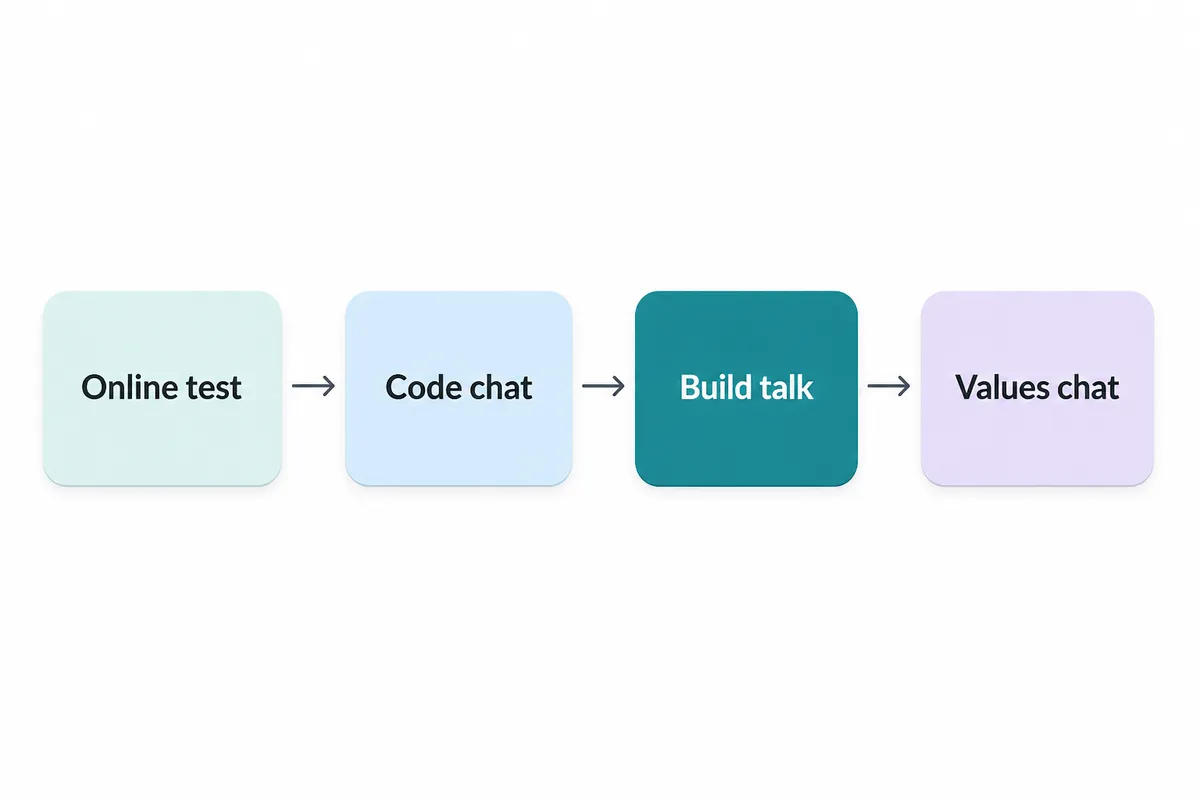
Twilio interview questions commonly span a HackerRank online assessment, a live technical screen, onsite coding and system-design discussions, and a dedicated values round. Reported accounts describe coding prompts that feel applied to Twilio’s communications domain rather than purely abstract puzzles: think about a task scheduler with limits or an SMS delivery platform, then explain the choices that make your solution dependable. Prepare algorithms, practical implementation, system trade-offs and clear examples of how you work with others.
For coding preparation, Twilio’s interview kit holds four mapped DSA questions. Use it alongside timed practice and mock interviews, then confirm the exact format, level expectations and scheduling details with your recruiter.
The Twilio interview process at a glance
Reported accounts describe the following broad sequence. Team, level and location can change the detail, so treat this as a preparation map rather than a fixed company policy.
| Stage | Reported format | What it screens for |
|---|---|---|
| Online assessment | HackerRank, reported at about ninety minutes | Core coding fluency, correctness and time management |
| Technical screen | Live coding discussion, reported at forty-five to sixty minutes | Problem solving, communication and complexity reasoning |
| Onsite coding | Applied implementation discussion | Turning requirements into reliable code |
| System design | Architecture and trade-off conversation | Scale, reliability, interfaces and operational judgement |
| Values round | Dedicated conversation | Collaboration, ownership and alignment with working principles |
The useful distinction is between solving a self-contained coding problem and building an answer around a product scenario. A correct algorithm is necessary, but candidates also need to clarify assumptions, identify failure modes and explain what they would change as requirements grow.
Round one — the online assessment
Candidate reports commonly describe a HackerRank assessment of roughly ninety minutes. Its purpose is to establish that you can write correct code under a clock, select sensible data structures and handle edge cases without extensive guidance.
Expect transferable interview foundations: arrays and strings, hash maps, linked structures, trees, graphs, sorting, searching and complexity analysis. The best preparation is not memorising disconnected answers. It is learning to identify the underlying pattern quickly enough to leave time for testing.
The DSA Patterns Sheet is free to browse and groups problems by reusable approaches, so you can practise recognition as well as implementation. For a framework to apply during timed work, read how to identify the right DSA pattern in a coding interview.
A sound assessment routine looks like this:
- Read every prompt before committing to the first one.
- State the target complexity in your own words.
- Implement the simplest correct approach that meets the constraint.
- Test empty input, repeated values, boundary values and large cases.
- Reserve time for compilation errors and input-output details.
💡 Pro tip: Do not spend the opening minutes trying to invent a clever solution. A well-tested standard approach usually beats an elegant idea that remains incomplete when the timer ends.
Round two — the technical screen
The reported technical screen lasts around forty-five to sixty minutes and introduces the part that a silent online assessment cannot measure: your engineering conversation.
The interviewer is likely evaluating whether you can turn an ambiguous prompt into a tractable problem. That means clarifying inputs and outputs, identifying constraints, narrating the approach before coding and explaining the cost of your choices. You do not need to deliver a polished speech. You do need to make your reasoning visible.
This matters especially for scenario-shaped prompts. If a scheduler has a limited worker pool, ask what happens when tasks arrive faster than they can run. If a messaging service needs delivery tracking, ask what counts as success, what happens after a retry and whether ordering matters. The interviewer is not necessarily looking for a fully fledged distributed system in a coding screen; they are looking for evidence that you notice the questions an engineer should ask.
Practise that rhythm in AI mock interviews: clarify, propose, compare alternatives, implement, test and summarise. The goal is to make the conversation feel natural rather than rehearsed. Our guide to explaining your thought process clearly in coding interviews gives a practical structure for doing that.
✅ Do: Explain why your chosen data structure matches the operations the problem needs.
❌ Don’t: Type in silence and reveal the design only after the code is finished.
Onsite coding — applied engineering, not just puzzle solving
Twilio’s reported differentiator is the applied shape of its coding prompts. Rather than preparing solely for isolated array or graph questions, practise problems where code sits inside a small product scenario: scheduling work, sending messages, tracking state, handling retries or enforcing a service limit.
That does not mean algorithms disappear. It means the algorithm lives inside requirements. A task scheduler may still require a queue, a heap or a map. An SMS delivery flow may still require deduplication, lookup efficiency or careful state transitions. The stronger answer connects those structures to a clear operational need.
What this round can screen for:
- Requirement handling: Can you separate stated requirements from assumptions?
- Code structure: Can another engineer follow your names, functions and boundaries?
- Correctness: Does the happy path work, and have you considered failure paths?
- Trade-offs: Can you explain why the design is simple now and what would need to change later?
- Practical judgement: Can you avoid both under-design and needless abstraction?
Use Twilio’s interview kit to work through the four mapped DSA questions in a company-focused setting. Then repeat each problem without looking at the editorial. The second attempt matters because it tests whether you retained the pattern, not whether you recognised a familiar prompt.
For implementation drills, in-browser code practice lets you practise writing, running and refining solutions without switching context. Make a habit of ending every session by saying aloud how you would test the solution in production. That final explanation helps bridge coding ability and engineering judgement.
The system-design conversation
Reported accounts include a system-design discussion in the onsite process. This is often the round where breadth of technical judgement becomes visible: not merely whether you know component names, but whether you can choose between alternatives and defend the consequences.
Twilio’s product surface makes communications-flavoured scenarios particularly useful preparation. An SMS delivery platform, notification service or event-processing workflow gives you a way to rehearse real design tensions:
- How do clients submit work reliably?
- Where should state live?
- How are retries managed without producing unwanted duplicates?
- What happens when a downstream provider slows down?
- Which data needs strong consistency, and which can be eventually consistent?
- How will you observe delivery failures and diagnose incidents?
Start by agreeing on scope. A candidate who immediately draws a large architecture without confirming volume, latency or delivery guarantees risks solving the wrong problem. Then state the core flow, identify bottlenecks and discuss the first trade-off before adding more components.
The System Design Sheet is free to browse and is useful for reviewing common building blocks and trade-offs. If you need to distinguish class design from architecture design, low-level design vs high-level design is a practical reference.
⚠️ Important: Do not treat system design as a vocabulary test. Naming queues, caches and databases without explaining why they are needed is weaker than a smaller design with clear assumptions, failure handling and observability.
The dedicated values round
A dedicated values round is commonly reported as part of Twilio’s onsite process. This deserves deliberate preparation because it measures a different kind of evidence from technical rounds: how you make decisions with other people, respond to setbacks and take ownership when a system or project does not go to plan.
Prepare concise stories from your own experience. Good topics include a difficult technical decision, a disagreement with a colleague, a project that failed or slipped, a process you improved, or a time you explained a technical choice to a non-specialist audience.
Use a simple structure: context, your responsibility, the action you took, the result and what you learned. Keep the focus on “I” without pretending that engineering is solitary work. The interviewer needs to understand your contribution, your judgement and how you worked with the team.
AI mock interviews are useful for rehearsing these stories under follow-up questions. The first answer is rarely the hard part; the challenge is staying specific when asked what you personally decided, what alternatives you considered and what you would change now.
Is the Twilio interview hard?
Twilio’s interview is challenging because it combines conventional coding ability with practical engineering communication. Candidates who prepare only for puzzle-style questions can be caught out by prompts that require them to model a realistic service, clarify operational assumptions and discuss reliability.
The online assessment and live coding screen reward standard DSA preparation: pattern recognition, complexity reasoning and clean implementation. The onsite raises the bar by testing whether those skills transfer to a product-shaped setting. System design adds another dimension, while the values round checks whether your technical decisions make sense in a collaborative environment.
How many rounds are there? Reported accounts describe an online assessment, a technical screen and an onsite that includes coding, system design and a dedicated values conversation. The exact number of conversations can vary by team and level, so confirm the schedule with your recruiter.
How long does the process take? Only the assessment and technical-screen durations are consistently reported. Candidate experiences do not provide a reliable company-wide end-to-end timeline, so avoid planning around a fixed date until the recruiting team confirms it.
A 30-day Twilio preparation plan
Days one to seven — restore coding fluency
Start with core patterns: hash maps, two pointers, sliding windows, binary search, stacks, queues, trees and graph traversal. Solve one timed problem each day, then review the complexity and edge cases before reading any solution.
The goal is not volume for its own sake. You should be able to answer: what operations matter, which structure supports them, and why is this complexity acceptable? Review graph traversal patterns: DFS and BFS if graph problems feel slow or uncertain.
Days eight to fourteen — practise applied prompts
Shift from isolated questions to small engineering scenarios. Build a basic scheduler, notification flow or event processor in your preferred language. Keep the scope small, but make it executable.
For each exercise, write down assumptions about input, failure, retries, state and testing. Then explain the design aloud as if an interviewer had asked why you made each choice. This is the week to use Twilio’s interview kit and revisit the four mapped DSA questions until the underlying patterns feel transferable.
Days fifteen to twenty-one — add design depth
Practise one architecture conversation every other day. Choose a product scenario, define the core user journey, estimate scale only where it affects the design and describe failure handling. Spend less time drawing boxes and more time explaining the reasons for each component.
The free system design sheet can help structure this work. If rate limits are unfamiliar, use this guide to designing a rate limiter to practise discussing limits, fairness and service protection clearly.
Days twenty-two to thirty — rehearse the complete loop
Alternate between timed coding, an applied implementation exercise, a system-design discussion and a values-story rehearsal. At least twice, simulate the full experience: start with a coding prompt, explain your approach aloud, test the code, then answer a follow-up about how the solution would work at scale.
Use the final days to reduce uncertainty rather than cram. Prepare your questions for the interviewer, review your strongest projects and ensure you can explain one technical success, one failure and one difficult collaboration experience with specific details.
What is specific to Twilio’s interview style?
The most useful Twilio-specific preparation is to treat communications systems as engineering scenarios, not as decorative themes pasted onto generic problems.
A scheduler with a concurrency limit is not simply a queue exercise. It raises questions about fairness, priorities, cancellation, worker failure and what the caller should see when capacity is exhausted. An SMS delivery platform is not merely a database design. It introduces provider failures, retry policies, delivery-state tracking, duplicate requests and observability.
You do not need to assume every prompt will be about messaging. Reported examples are not a universal question bank. But practising these scenarios builds the habit that applied interviews reward: connect code and architecture to a real operational constraint.
When answering, make the communication path explicit: define the client action, identify the state that must be stored, explain normal processing, name the important failure case and state the trade-off you would revisit at larger scale. That structure works for a task scheduler, an SMS platform and many other service-oriented prompts.
Frequently asked questions
What types of Twilio interview questions should I expect?
Reported accounts describe coding questions, applied engineering scenarios, system design and a dedicated values conversation. Prepare standard DSA patterns alongside service-oriented problem solving.
Does Twilio use an online assessment?
Candidate reports commonly describe a HackerRank online assessment, reported at about ninety minutes. Confirm the platform and format with your recruiter because processes can change.
How long is the Twilio technical screen?
Reported accounts describe a live technical screen of around forty-five to sixty minutes.
Are Twilio coding questions purely algorithmic?
Not always. Reported examples are scenario-shaped, such as a task scheduler with limits or an SMS delivery platform. The underlying coding skills remain transferable DSA skills.
Is system design part of the Twilio interview process?
Reported accounts include a system-design conversation in the onsite. Prepare to clarify requirements, discuss reliability and explain trade-offs rather than memorising a diagram.
Does Twilio have a values round?
Reported accounts describe a dedicated values round. Prepare specific stories about ownership, collaboration, setbacks and technical decisions.
How should I prepare for the coding rounds?
Practise pattern recognition, complexity analysis, clear verbal reasoning and timed implementation. The DSA Patterns Sheet is free to browse and provides a structured starting point.
What should I focus on for system design?
Focus on requirements, core data flow, reliability, retries, observability and trade-offs. Avoid adding components unless you can explain the problem each one solves.
How many interview rounds does Twilio have?
Reported accounts describe an assessment, a technical screen and onsite conversations covering coding, design and values. Exact round totals vary by team and level.
Where to start
The strongest Twilio preparation combines reliable DSA fundamentals with the ability to reason about real service behaviour. Practise writing correct code under time pressure, then practise explaining how that code would behave when requirements become less tidy.
Open Twilio’s interview kit to practise the four mapped DSA questions in the company set. Pair that work with the free-to-browse Low Level Design Sheet, system-design practice and an AI mock interview for coding, design and values rehearsal.
Interview formats change. Use this guide to prepare the transferable skills, then ask your recruiter which rounds, tools and expectations apply to your specific Twilio process.
Topics
Related on Thita
Your next step
Practise with AI mock interviews
A spoken interview that asks follow-up questions, runs your code and ends with a written report.