
Interview
Twitter System Design Interview: Complete Guide (2026)
Prepare for Twitter's system design interview with reported loop details, design priorities, a focused plan, and practical answers for every stage.
The Twitter system design interview is not only a test of whether you know the names of distributed-systems components. It is a test of judgement: can you turn an unclear product prompt into a sensible architecture, choose trade-offs deliberately, and explain where the design will bend under load?
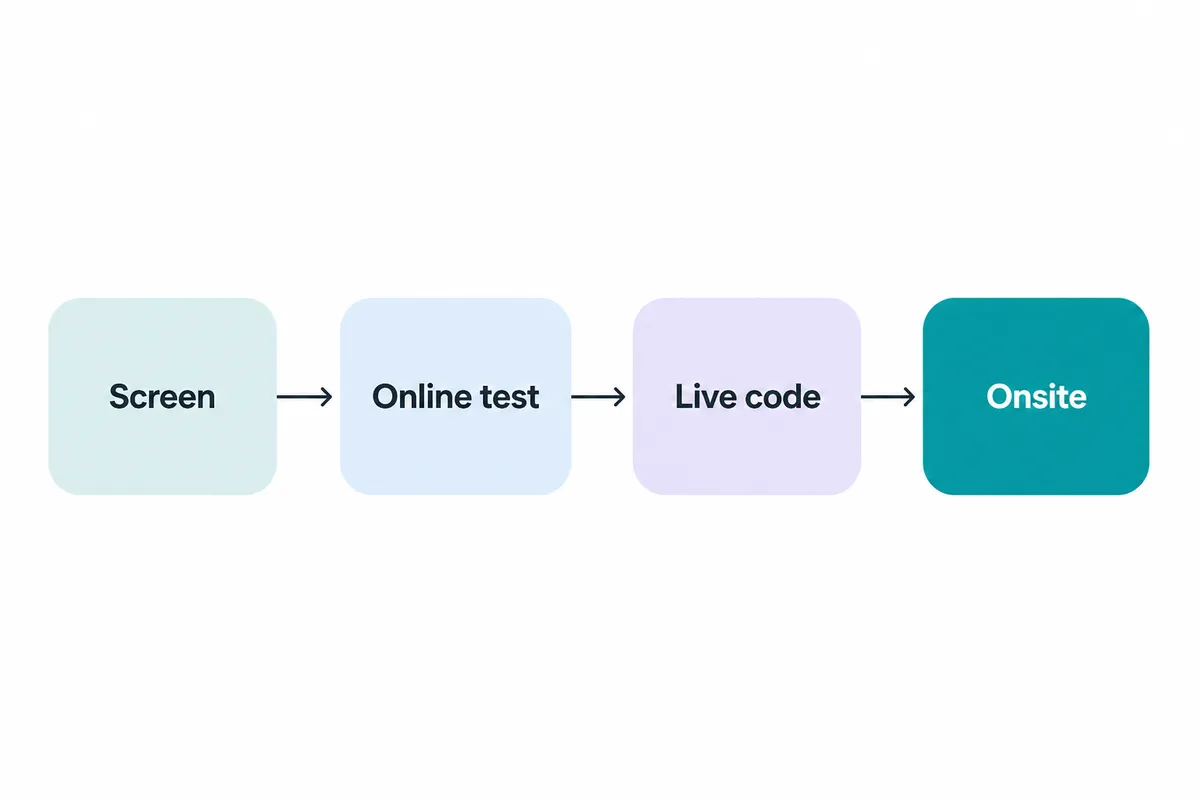
Reported accounts describe a loop with a recruiter screen, technical assessment, live coding, and an onsite that includes system design, coding, a technical presentation, and a hiring-manager conversation. The exact format can vary by team, so confirm the details with your recruiter. For direct practice, Twitter's interview kit contains 17 mapped DSA questions and 2 system design problems evidenced at Twitter.
The distinctive part of the reported onsite is the technical presentation. Candidates also report that interviewers may introduce ambiguity deliberately to see how they respond. That makes preparation less about memorising a single ideal diagram and more about learning a repeatable way to clarify, prioritise, and revise your thinking in public.
When the Twitter system design interview applies
System design is most relevant when the role expects you to make architectural decisions, communicate across engineering boundaries, or own systems beyond a narrowly defined feature. In reported Twitter loops, system design appears as part of the onsite rather than as a replacement for coding.
For an early-career engineer, the discussion may focus more on fundamentals: modelling the main entities, defining APIs, selecting a data store, explaining a cache, and identifying a simple path for scaling. You still need to reason clearly, but you do not need to force every answer into a globally distributed architecture.
For more experienced candidates, the expectations usually deepen. You should be ready to discuss data partitioning, availability, consistency, asynchronous processing, back-pressure, observability, failure recovery, and the operational cost of your choices. The goal is not maximal complexity. It is a design that fits the stated product and can evolve as requirements change.
A useful guide is how much system design is enough for SDE-1 versus SDE-2 interviews. It helps separate the foundational material worth mastering for every system design conversation from the deeper trade-offs expected at more senior levels.
Reported accounts are estimated rather than company-published policy. Treat the listed sequence as a useful preparation shape, not a fixed script. Ask your recruiter whether the role includes a design round, whether the presentation is expected, and what level of seniority the interview panel is assessing.
The product territory to prepare for
Twitter naturally points candidates towards real-time social-product territory. The useful preparation domain includes timelines, content publication, user interactions, notifications, counters, search, moderation workflows, and high-read systems where freshness matters.
That does not mean you should assume a particular prompt will appear. The right mindset is broader: practise the engineering tensions that show up in systems with many readers, bursts of activity, public content, and fast-moving updates.
A strong answer can discuss questions such as:
- Should new content be pushed to readers, pulled when they open the app, or handled through a hybrid approach?
- Which data must be immediately consistent, and where can the product tolerate delay?
- How do you prevent a popular account or viral event from overwhelming a single service?
- What happens when ranking, search indexing, notifications, or media processing falls behind?
- Which metrics reveal that the system is healthy before users report a problem?
The 2 system design problems evidenced at Twitter are a starting point for learning this style of reasoning. Work through them in Twitter's interview kit, then practise transferring the same principles to adjacent prompts. The important skill is not recognising a familiar title. It is identifying the workload, bottleneck, and product constraint hidden inside a new title.
For structured architecture practice, the System Design Sheet is free to browse. Use it to build a mental library of components, but avoid treating that library as a shopping list. A queue, cache, database replica, or stream processor should enter your diagram only when it solves a stated problem.
What a strong system design answer does differently
Weak answers often sound technically busy. They name Kafka, Redis, sharding, load balancers, and microservices before establishing what the system needs to do. Strong answers earn each decision.
They start with scope, not infrastructure
Begin by restating the product in your own words. Ask a few targeted questions:
- Who are the users and what is the core action?
- What needs to happen synchronously?
- Is freshness more important than perfect consistency?
- Are reads, writes, or fan-out likely to dominate?
- Which failure would be most damaging to the user experience?
You do not need to interrogate the interviewer for ten minutes. A handful of clarifications gives you a defensible basis for the rest of the design.
Then state assumptions openly. For example: “I will optimise first for creating posts and reading a personalised timeline, while treating search and analytics as downstream concerns.” This is not a disclaimer; it is prioritisation.
They draw the smallest viable architecture first
Start with the request path: client, API layer, core service, primary storage, and response. Make sure the simplest version works before you add scale.
For a feed-like product, that might mean defining how a post is accepted, stored, and made visible to a follower. Only then should you introduce fan-out workers, caches, ranking services, or separate read models.
This order matters because it gives the interviewer a coherent baseline. It also gives you somewhere to return when an ambiguous requirement changes. Candidates who begin with a sprawling diagram often struggle to explain what each component actually owns.
They make trade-offs visible
A system design interview is rarely asking for the one correct architecture. It is asking whether you see the cost of your preferred architecture.
If you choose asynchronous fan-out, explain the benefit in write responsiveness and the cost in eventual visibility. If you cache timelines, explain invalidation, stale reads, and how you would handle a cache miss. If you partition data by user, explain what happens to unusually active accounts.
Use simple language:
“This choice keeps the write path fast, but it may delay updates for some readers. I would monitor that lag and adjust the approach for high-fan-out accounts.”
That sentence demonstrates product awareness, operational awareness, and judgement without pretending the system has no flaws.
They revisit the design under pressure
Reported Twitter interviews may introduce ambiguity deliberately. Do not interpret a new constraint as proof that your first answer was wrong. Treat it as an invitation to adapt.
When the interviewer says, “What if one account suddenly reaches millions of followers?”, pause and separate the normal path from the exceptional path. You might propose a hybrid delivery model, rate controls, or a special handling path for high-fan-out publishers. Explain what changes and what remains stable.
The interviewer is often learning more from this adjustment than from your original diagram. A calm revision shows that you can work with incomplete information rather than defend an architecture at all costs.
The technical presentation: prepare a narrative, not a performance
The reported technical presentation round makes project communication a meaningful part of Twitter preparation. Your strongest material is usually a project you genuinely understand, including the constraints and mistakes.
Build a concise story around one project:
- Context: What user or business problem existed?
- Your role: What did you personally own or decide?
- Technical choice: Which options did you consider, and why did you choose one?
- Result: What changed after launch?
- Reflection: What would you improve now?
Avoid presenting a polished architecture with no tension in it. Interviewers can probe a smooth story quickly. It is much more credible to explain a trade-off you made under deadline pressure, a production issue you investigated, or a decision you would now reverse.
Prepare diagrams that are legible without being decorative. Each box should have a purpose. Each arrow should represent a meaningful interaction. Rehearse explaining the diagram aloud, because technical communication is often where otherwise capable candidates lose clarity.
An AI mock interview can help you rehearse the presentation and follow-up questions in a lower-pressure setting. Ask for interruptions, requirement changes, and sceptical questions about your design choices rather than only practising a memorised monologue.
A focused preparation plan
First phase: strengthen coding communication
Coding remains part of the reported process, so do not prepare for design in isolation. Work through the 17 mapped DSA questions in Twitter's interview kit with an emphasis on explanation.
Before typing, say the brute-force option, explain why it is insufficient, describe the improved approach, and state time and space complexity. This is the habit that turns private problem-solving into interview performance.
The DSA Patterns Sheet is free to browse and is useful for organising practice around recognition rather than random volume. If identifying an approach is your main bottleneck, read how to identify the right DSA pattern in a coding interview.
Second phase: build design fundamentals
Practise a small number of systems deeply. For each one, cover requirements, APIs, data model, request flows, scaling path, reliability risks, and metrics.
Keep your first pass intentionally simple. Then add one scale challenge at a time: a burst of writes, hot-key pressure, a slow downstream service, regional failure, or delayed processing. This trains the adjustment skill that ambiguity-heavy interviews reward.
The DBMS Sheet and Computer Networks Sheet are free to browse if you need to refresh replication, indexing, caching, request behaviour, or connection-level basics.
Third phase: practise full verbal walkthroughs
Set a timer and simulate the beginning of a design round. Spend the opening minutes clarifying scope, then talk through a baseline architecture. Do not silently draw for most of the session.
Afterwards, review your answer against three questions:
- Did every component have a clear responsibility?
- Did I explain why a trade-off was appropriate?
- Did I identify at least one failure mode and mitigation?
For a focused example of this style of reasoning, see how to design a rate limiter for a system design interview. The topic matters less than the method: define the requirement, compare options, choose deliberately, and discuss limits.
Final phase: rehearse the presentation and manager discussion
Prepare one major project and one backup project. Be ready to go deeper than your résumé bullet points. Practise distinguishing your contribution from the team’s contribution without diminishing collaboration.
Use in-browser code practice to keep coding fluency active, and schedule at least one verbal design mock before the interview. The sheets are free to browse; use them for targeted refreshers rather than as a reason to collect more material than you can properly practise.
Frequently asked questions
Does Twitter have a system design interview?
Reported accounts describe system design as part of the onsite process. The exact format may vary by team and role, so confirm the current structure with your recruiter.
Is system design more important for senior candidates?
Usually, yes. More experienced candidates are generally expected to discuss scaling, reliability, trade-offs, and operational consequences in greater depth. Foundational design reasoning remains useful at every level.
What makes Twitter's interview process distinctive?
Reported accounts describe a technical presentation during the onsite and interviewers introducing ambiguity to observe how candidates respond. Prepare both technical depth and clear adaptation under changing requirements.
What should I design for a Twitter system design interview?
Practise real-time social-product territory: content publishing, feeds, notifications, search, counters, ranking, and high-read workloads. Focus on transferable reasoning rather than predicting an exact prompt.
Should I memorise a feed system design answer?
No. Memorise a framework, not a script. Clarify requirements, propose a baseline, identify the bottleneck, make trade-offs explicit, and adapt when constraints change.
How should I prepare for the live coding round?
Practise explaining your approach before coding, naming complexity, testing edge cases, and responding to hints. What interviewers actually look for in live coding rounds explains the communication behaviours that matter.
How do I prepare a technical presentation?
Choose a project you understand deeply. Explain the problem, your ownership, the alternatives considered, your technical decisions, the outcome, and what you would improve now.
What if I do not know a component the interviewer mentions?
Ask what requirement it is meant to solve, state what you know, and reason from first principles. Guessing confidently is weaker than making your uncertainty explicit and working through the implications.
Should I prepare behavioural examples too?
Yes. The hiring-manager conversation and technical presentation both reward clear ownership, collaboration, and reflection. Prepare concrete examples rather than generic claims about teamwork.
Where to start
The highest-value preparation is to combine clear coding communication with design practice that forces you to make and defend trade-offs. Do not wait until you feel you know every distributed-systems term. Start with a simple system, make it work on paper, then stress it with realistic constraints.
Open Twitter's interview kit to practise the 17 mapped DSA questions and 2 system design problems evidenced at Twitter. Pair that work with the free-to-browse System Design Sheet and an AI mock interview to rehearse the discussion, presentation, and ambiguity that reported accounts describe.