
Interview
Uber Interview Questions and Process: The Complete Guide (2026)
Understand Uber's software engineering interview process: coding, system design and behavioural rounds, difficulty, preparation priorities and a 30-day plan.
Uber interview questions typically appear across a recruiter conversation, a coding phone screen, and an onsite loop with data structures and algorithms, system design, and behavioural evaluation. Reported accounts describe system design as the differentiator for mid-level and senior candidates: you need to reason about dispatch, location updates, matching, latency and scale, not merely draw familiar service boxes. Prepare coding patterns for the early screen, then spend serious time explaining architecture decisions aloud. Uber's interview kit holds 72 mapped DSA questions, 10 low-level design problems, and 4 system design problems to organise that technical preparation.
Treat the reported structure as useful consensus rather than a guaranteed script: teams, levels and hiring needs can change the sequence.
The process at a glance
| Stage | Round | Typical format | What it screens for |
|---|---|---|---|
| Recruiter | Initial conversation | Role and experience discussion | Motivation, level fit, communication |
| Phone screen | Coding | Live problem solving | Core DSA ability and clear reasoning |
| Onsite | DSA | Live coding with an engineer | Problem solving, correctness and complexity |
| Onsite | System design | Architecture discussion | Scalable judgement, trade-offs and scale maths |
| Onsite | Behavioural | Project and collaboration discussion | Ownership, influence and engineering maturity |
| Decision | Hiring Committee debrief | Interview feedback review | Consistency of evidence across the loop |
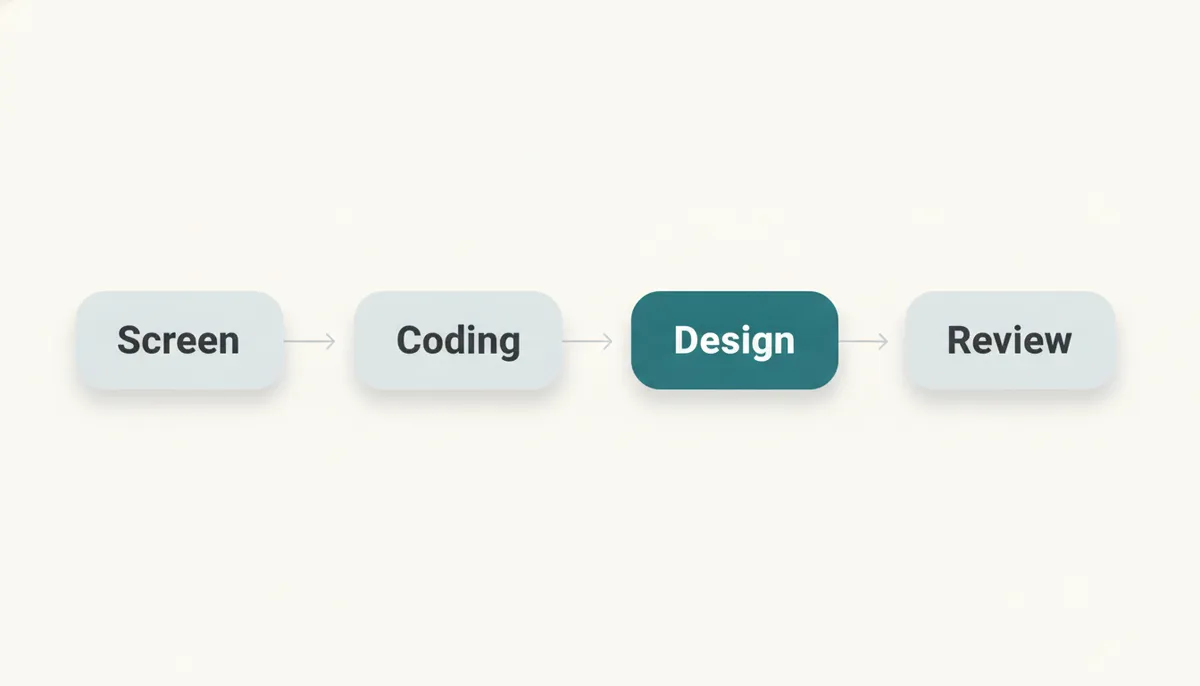
Reported accounts commonly describe a coding phone screen followed by an onsite of three to five rounds. The onsite mix includes DSA, system design and behavioural assessment; system design is especially relevant for mid-level and senior engineering roles. A Hiring Committee debrief is also commonly reported after interviews.
Recruiter conversation — establish the right fit
The recruiter conversation is not normally a technical test, but it still matters. It establishes likely team and level fit, why Uber interests you, and whether your experience matches the role’s scope.
Prepare a concise account of recent work: the system, the part you personally owned, the constraints you faced and the result. Avoid a generic “fast-moving company” answer. Uber’s product surface gives you concrete material: real-time marketplaces, mobility, delivery, maps, routing, pricing and large operational systems.
Ask whether system design is included for your level, whether there is a preferred coding language, and whether the team has a domain focus. This is sensible preparation, not an attempt to negotiate the evaluation.
Phone screen — coding under discussion
The phone screen is commonly reported as a live coding round. It screens for the fundamentals: can you understand a problem, choose an appropriate data structure, produce correct code, and explain why the approach works?
Expect familiar interview shapes rather than obscure tricks. Arrays, strings, hash maps, trees, graphs, intervals, queues and traversal are useful foundations. The difficult part is recognition under pressure: seeing that a problem calls for a sliding window, breadth-first search, sorting or a map before getting lost in implementation details.
Use the free DSA Patterns Sheet to browse problems by underlying technique rather than working through an unstructured list. For a stronger method, read how to identify the right DSA pattern in a coding interview.
A strong live-coding answer follows a repeatable rhythm:
- Restate the problem and clarify assumptions.
- Describe a simple baseline before moving to optimisation.
- State the chosen approach and its complexity.
- Code in small, explainable steps.
- Test normal cases and awkward edge cases aloud.
The interviewer cannot score reasoning they cannot hear. If you silently type a correct answer, you reduce the evidence that you can collaborate in an engineering setting. What interviewers actually look for in live coding rounds explains why communication changes the outcome.
💡 Pro Tip: Do not wait until the final minute to test. Walk through a small input while you still have time to repair a boundary condition.
Onsite DSA round — depth, not just a solution
The onsite coding round goes beyond whether you can reach an answer. Interviewers are looking for disciplined engineering reasoning: trade-offs, complexity, edge cases, readable implementation and response to follow-up constraints.
A common failure is treating the first workable idea as finished. A candidate may solve the initial version, then struggle when asked about memory limits, streaming input, duplicate values, changing requirements or larger input sizes. You do not need to predict every twist, but you should show that your solution has a clear model and known limits.
Practise narrating alternatives. For example: “A brute-force scan works, but it repeats work. I can retain state in a hash map, reducing repeated lookup. That uses extra memory, which seems acceptable unless the input is unbounded.” This is more useful than reciting complexity notation without explaining the trade-off.
For Uber-specific technical practice, return to Uber's interview kit. Use the mapped coding problems to identify weak patterns, then solve a smaller set repeatedly under interview conditions. The free code practice workspace is useful for rehearsing implementation and reviewing feedback after each attempt.
System design — the round that distinguishes Uber candidates
For mid-level and senior candidates, reported accounts describe one or two system-design rounds as a central part of the loop. This is where Uber becomes meaningfully different from a generic coding interview.
The design discussion is commonly geared towards infrastructure resembling Uber’s operating reality: ride matching, driver location, dispatch, dynamic pricing and geospatial coordination. This does not mean you should memorise a proprietary architecture. It means you should reason from first principles about a marketplace where supply and demand move continuously and stale updates affect real users.
The interviewer may care about questions such as:
- How do clients send and consume frequent location updates?
- How do you find nearby eligible drivers without searching the whole world?
- What happens when location data is delayed, duplicated or briefly unavailable?
- How do matching, trip state and pricing remain understandable when events arrive out of order?
- Which operations need strong consistency, and which can tolerate eventual consistency?
- What latency target matters to the user, and where is the budget spent?
The strongest answers begin with product flow before naming infrastructure. Define actors, actions and core data. Estimate traffic and payloads. State important read and write paths. Only then introduce partitions, caches, queues, indexes, storage and asynchronous processing.
Scale maths matters because it makes architecture choices credible. You do not need perfect estimates. You need to make assumptions visible and use them. If a location service receives a high volume of small writes, explain the implications for partitioning, fan-out, retention, hot regions and query patterns. If matching has a tight latency budget, identify which network hop, datastore lookup or queue delay threatens it.
The free System Design Sheet can help you practise this structure. If you are unsure how much design depth your level requires, how much system design is enough for SDE-1 versus SDE-2 interviews offers a useful benchmark.
What a good design discussion sounds like
A strong candidate does not present architecture as a finished diagram. They make decisions in response to requirements.
For example: “For the first version, I would partition active drivers by geographic cell because nearby lookup is the dominant query. I would accept slightly stale displayed locations, but validate a driver’s latest availability before confirming a match. If one city becomes hot, I would split the busiest cells further rather than partition solely by city.”
That demonstrates product awareness, a data model, an explicit consistency choice and a plan for skew. It is stronger than listing infrastructure components without explaining why each exists.
Behavioural round — evidence of ownership
Uber’s behavioural round tests how you operate when the answer is not a coding problem. Expect detailed questions about projects, disagreements, incidents, prioritisation, difficult trade-offs and work across functions.
Prepare stories from your own experience rather than polished slogans. A useful structure is context, your responsibility, the difficult decision, your actions and the measurable outcome. Be precise about “I” versus “we”. Collaboration is good; unclear ownership is not.
Choose examples that reveal judgement: a production issue where you improved the system afterwards, a technical disagreement where you changed someone’s mind or changed your own, a project where constraints forced a scope decision, or a mistake that changed how you work.
Practise saying these stories aloud. An AI interview mock can help you rehearse follow-up questions, particularly if you tend to give either very short answers or a lengthy technical monologue without a clear outcome.
The Uber-specific challenge: designing for a moving marketplace
Many companies can ask you to design a feed, a chat service or a URL shortener. Uber’s distinctive interview identity is the combination of real-time location, marketplace matching and operational latency.
A ride request is not merely a database record. It is a decision made against a moving set of drivers, changing supply, imperfect GPS signals, local traffic conditions and user expectations that a result should appear quickly. Your architecture should account for messy reality: drivers go offline, devices reconnect, a location update arrives late, an area becomes suddenly busy, or a requested trip cannot be matched immediately.
Practise thinking in layers:
Location ingestion. How are updates authenticated, deduplicated and stored only as long as useful?
Geospatial lookup. How do you find candidates close to a pickup point while allowing the search area to expand?
Matching workflow. How do you avoid offering one driver to conflicting requests, and what happens when a driver declines?
User experience. Which data can be approximate, and which state must be authoritative before a trip is confirmed?
Operational resilience. What metrics expose a failing region, growing queue or deteriorating matching latency?
This is the kind of system-design problem evidenced at Uber: not a demand for internal knowledge, but a demand for sound decisions under realistic marketplace constraints. Work through Uber's interview kit alongside verbal whiteboard practice so you can connect implementation, design and explanation.
Is the Uber interview hard?
Yes, particularly for experienced engineers, because the loop assesses different skills rather than one narrow form of technical recall.
The coding rounds require standard interview fluency: recognising patterns, choosing sensible data structures and producing correct code while communicating. That is demanding but highly trainable.
The harder shift is system design. Reported accounts consistently position high-level design as the differentiator for mid-level and senior roles. You need to make reasonable estimates, identify bottlenecks, discuss consistency and failure modes, and defend choices without disappearing into needless detail. Candidates who are excellent at DSA can still struggle if their design answers are generic or cannot connect architecture to dispatch, location and latency.
How many rounds are there? Reported accounts commonly describe a recruiter conversation, a coding phone screen, and an onsite loop of three to five rounds, followed by a Hiring Committee debrief.
How long does the process take? The research does not support one reliable end-to-end timeline. Ask your recruiter about scheduling expectations, because team needs and interviewer availability can change it.
A 30-day Uber interview preparation plan
Days 1–7 — rebuild coding recognition
Review core DSA patterns: arrays, maps, two pointers, sliding window, trees, graphs, intervals and traversal. Focus on recognising the shape before coding. Solve problems slowly enough to explain every decision, then repeat selected ones with a timer.
Use the graph traversal patterns guide if graph problems are a weak point; location and routing-flavoured discussions make graph vocabulary useful even outside a pure coding round.
Days 8–14 — make coding interview-ready
Shift from solving alone to solving aloud. For every problem, practise clarifying requirements, presenting a baseline, choosing an improved approach and testing edge cases. Keep a short error log. Categorise failures as pattern recognition, implementation, complexity reasoning, testing or communication, then repair the category rather than randomly adding problems.
Days 15–21 — learn a design framework
Practise one architecture discussion each day. Start with requirements, estimates, APIs, data model, core flows, bottlenecks, failure handling and observability. Use the free low-level design sheet for object-level thinking and the system-design sheet for broader architecture.
Do not memorise diagrams. Ask why a cache exists, what the partition key is, what happens when a message arrives twice, and what degrades when a dependency fails.
Days 22–26 — focus on the Uber-shaped problem
Practise systems involving live state, geographic search, matching, notifications or rapid updates. Put a visible latency target on each exercise and explain the trade-offs it creates. Draw the request path, then identify the first bottleneck you expect at scale.
Use the four system design problems in Uber's interview kit as structured prompts, but spend as much time on follow-up discussion as on the initial design.
Days 27–30 — simulate the loop
Run a coding mock, a system-design mock and a behavioural mock. Afterwards, write down what you would change rather than immediately repeating the same question. Prepare project stories, recruiter questions and a concise introduction.
💡 Pro Tip: In the final days, prioritise sleep, communication and repeatable process. A new topic learned poorly is less useful than a familiar framework you can explain calmly.
Frequently asked questions
Does Uber ask DSA questions?
Yes. Reported accounts describe coding in the phone screen and DSA within the onsite loop. Prepare standard data structures, algorithms, complexity reasoning and live communication.
Does Uber ask system design questions?
Yes, especially for mid-level and senior roles. Reported accounts commonly describe system design as a major differentiator, with scenarios resembling real-time Uber infrastructure.
What should I study for Uber system design?
Practise requirements gathering, capacity estimates, latency budgets, data partitioning, caching, asynchronous processing, consistency and failure handling. Apply those ideas to dispatch, geospatial lookup and moving marketplace systems.
Is an online assessment part of the Uber interview process?
The available reported accounts do not consistently identify an explicit online assessment. The commonly reported shape begins with recruiter contact and a coding phone screen.
How many onsite rounds does Uber have?
Reported accounts describe an onsite loop of three to five rounds. The mix can vary by level and team, but commonly includes coding, system design and behavioural evaluation.
What is the Hiring Committee debrief?
Reported accounts describe a Hiring Committee debrief after the interview loop. It reviews feedback collected across rounds rather than treating any one interview in isolation.
Is Uber harder for senior engineers?
It can be, because system-design expectations become more central. Senior candidates need to demonstrate technical judgement, trade-off reasoning, scale awareness and leadership through ambiguous engineering decisions.
How should I prepare for the behavioural round?
Prepare specific stories about ownership, incidents, conflict, technical decisions and outcomes. State your individual contribution clearly, then practise handling detailed follow-up questions.
Where to start
Start with the technical areas that carry across the loop: coding fluency, clear explanation and architecture judgement. Then make your system-design practice Uber-shaped by working through real-time location, matching, scale and latency constraints rather than memorising generic diagrams.
Open Uber's interview kit to practise the 72 mapped DSA questions, 10 low-level design problems, and 4 system design problems evidenced for Uber. Combine it with the free sheets and an AI mock interview to rehearse the conversation that turns a reasonable answer into a convincing one.
Interview processes change, so confirm the current format, level expectations and scheduling details with your recruiter.
Topics
Related on Thita
Your next step
Practise with AI mock interviews
A spoken interview that asks follow-up questions, runs your code and ends with a written report.