
Interview
VMware Interview Questions and Process: Complete Guide (2026)
Understand VMware interview questions, reported rounds, systems-focused design, difficulty, timelines and a practical 30-day plan for software engineers.
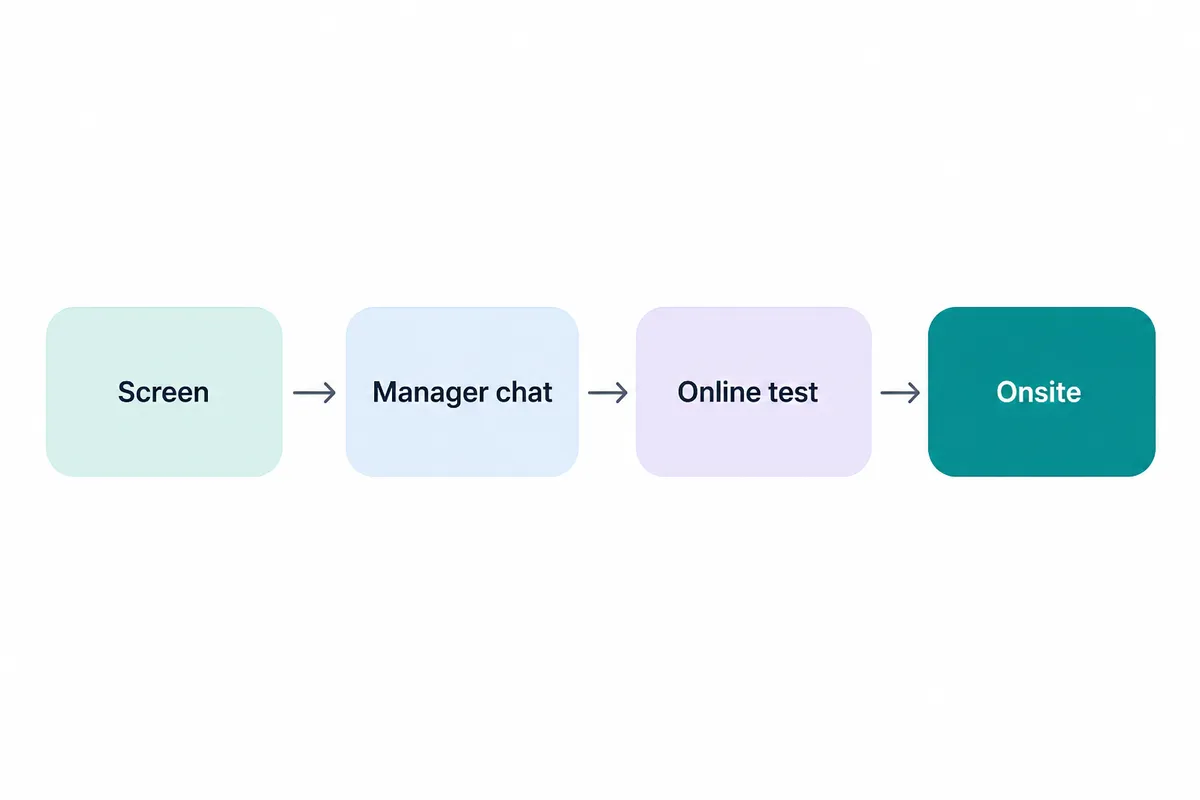
VMware interview questions commonly span coding, project discussion and systems-flavoured design. Reported accounts describe a recruiter screen, a hiring-manager discussion paired with an online coding challenge, then an onsite loop. The most useful preparation is to practise clear coding fundamentals, explain trade-offs aloud, and be ready to connect design decisions to systems concerns such as reliability, performance and operational simplicity.
For coding preparation, VMware's interview kit holds 18 mapped DSA questions. Use it to identify recurring problem shapes, practise under time pressure and review the reasoning behind a solution rather than memorising implementations.
Candidate reports for VMware are relatively thin and can vary substantially by team, location and level. Treat the process below as a reported outline rather than a fixed company policy, and confirm the exact format with your recruiter.
VMware interview process at a glance
| Stage | Reported format | What it may screen for | How to prepare |
|---|---|---|---|
| Recruiter screen | Initial conversation, reported around 30 minutes | Role fit, experience and motivation | Know your project story and preferred work |
| Hiring-manager discussion | Project and experience conversation | Ownership, technical judgement and team fit | Prepare detailed examples of decisions you made |
| Online coding challenge | Timed coding exercise | Core DSA, correctness and complexity | Practise patterns with a timer |
| Onsite loop | Reported total process of three to five rounds | Coding, design depth and communication | Rehearse both implementation and explanation |
The reported median process is about 27 days, although that figure is best treated as directional. Hiring priorities, interview availability and the particular engineering organisation can all change the pace.
Round one — recruiter screen
Reported accounts describe an initial recruiter conversation of roughly 30 minutes. This is usually the point where the company and candidate establish whether there is a sensible match before technical time is scheduled.
Do not treat it as administration. A concise explanation of what you build, what kind of engineering problems interest you and why the role fits your next step makes later conversations easier. You do not need a rehearsed speech, but you should be able to explain your recent work without hiding behind “we”.
Prepare answers to questions such as:
- What was the most consequential system or feature you owned?
- What trade-off did you make, and why?
- What kind of team or technical environment helps you do your best work?
- Why are you considering VMware now?
Keep the conversation specific. “I enjoy solving hard problems” is vague; “I want to work closer to distributed infrastructure, where availability and operational choices matter” gives the recruiter something useful to take forward.
Round two — hiring-manager discussion
Reported VMware processes include a hiring-manager discussion before the onsite. This is likely to examine the depth behind your CV: not merely whether you shipped something, but whether you understood the constraints, alternatives and consequences involved.
Expect project questions to become progressively more detailed. If you say you improved latency, be ready to describe the baseline, bottleneck, measurement method, change made and any regression risk. If you say you designed a service, be ready to identify its dependencies, failure modes and the part you personally owned.
This conversation also screens for judgement. Strong candidates do not present every past decision as perfect. They can explain what they would change with more time, what they learned from an incident, and where a simpler solution would have been better.
A good preparation exercise is to choose two projects and write a short outline for each:
- Context and goal.
- Your specific responsibility.
- Technical choices and rejected alternatives.
- Result and how you measured it.
- What you would improve now.
Practise saying the outline aloud. The aim is not to sound scripted; it is to ensure you can retrieve the useful detail when someone follows up.
Round three — online coding challenge
The reported process includes an online coding challenge. This is where the familiar core of VMware interview questions is most likely to appear: data structures, algorithms, complexity reasoning and implementation accuracy.
The key skill is pattern recognition. Before writing code, identify whether the problem is really about a hash map, two pointers, a sliding window, traversal, binary search or dynamic programming. Candidates often lose time because they begin implementation before they have named the shape of the problem.
The free DSA Patterns Sheet helps organise practice around those repeatable shapes. Pair it with this guide to identifying the right DSA pattern if you find that you can solve problems after seeing a solution but struggle to select an approach independently.
A reliable coding-round routine looks like this:
- Clarify inputs, outputs and constraints.
- State a straightforward baseline solution.
- Improve it only when you can explain the gain.
- Name the time and space complexity.
- Test edge cases before submitting.
Use in-browser code practice for timed sessions. Practising with a timer is important, but so is reviewing why you got stuck. A missed pattern is usually more valuable than another easy completion.
💡 Pro tip: Narrate your reasoning even when working alone. If you cannot explain why a hash map belongs in the solution, you probably have not fully understood the approach yet.
Round four — onsite interviews
Reported accounts describe an onsite after the early conversations and coding challenge, with the overall process commonly containing three to five rounds. The exact composition is not well documented, so avoid assuming that every VMware team uses the same sequence.
A modern software engineering onsite commonly combines live coding, design discussion and behavioural or project-depth conversations. At VMware, the differentiating technical theme reported in available research is systems-flavoured design. That means a design discussion may reward candidates who naturally ask about scale, state, failure recovery, observability, deployment constraints and performance.
For coding, the interviewer is not only judging whether the final code works. They can also observe whether you clarify ambiguous requirements, break the task into manageable parts, recover from a mistake and respond constructively to hints. Read what interviewers actually look for in live coding rounds before your mock sessions.
For design, avoid jumping straight into diagrams or named technologies. Start with the user flow, identify the core data and services, then explain the trade-offs. A good answer is structured but adaptable:
- Clarify scope and assumptions.
- Define the main components.
- Identify data flow and state.
- Discuss scale, reliability and failure handling.
- Explain what you would monitor.
- Revisit trade-offs when requirements change.
The System Design Sheet is free to browse and useful for rehearsing this order of thought. If you are unsure whether an interviewer wants class-level design or architecture-level design, low-level design vs high-level design explains the distinction.
Are there named VMware interview rituals?
No strongly distinctive named ritual was established in the available VMware research.
That is worth saying plainly because candidates often search for a VMware equivalent of a famous company-specific final round or values framework. The available accounts instead point to a more conventional progression: screen, hiring-manager discussion, online coding challenge and onsite interviews.
The practical implication is that transferable interview skills matter more than memorising a branded process. Prepare to code, design, discuss your work and communicate under follow-up questions. Then ask your recruiter which areas the specific team intends to emphasise.
Is the VMware interview hard?
VMware interviews appear moderately difficult, with the challenge coming from breadth rather than one unusually exotic stage. You may need to demonstrate coding fluency, system-level thinking and credible ownership of prior work within the same process.
How many rounds are there? Reported accounts describe three to five rounds overall. The sequence commonly includes a recruiter screen, hiring-manager discussion, online coding challenge and onsite interviews, but the exact breakdown can vary by team.
How long does it take? Candidate reports suggest a median of roughly 27 days. Treat that as an estimate, not a promise. Some processes move quickly when a team has urgent hiring needs, while others pause between stages.
What makes it difficult? The onsite can test whether you connect a correct technical answer to operational reality. A solution that works in a toy example may invite questions about scale, failure handling, monitoring and maintainability.
The best response is balanced preparation. Do not spend every hour on difficult algorithms if your project explanation is vague. Equally, do not prepare only design stories if you have not recently implemented a clean solution under time pressure.
A 30-day VMware interview preparation plan
Days one to seven — rebuild coding speed
Work through core patterns: arrays, strings, hash maps, two pointers, sliding windows, trees, graphs and binary search. Focus on recognising the pattern before you code.
Use VMware's interview kit as your company-focused problem set, then use the free sheets to broaden your exposure. After every problem, explain the complexity aloud and identify one edge case that could break an otherwise correct solution.
Days eight to fourteen — practise implementation and communication
Alternate timed coding sessions with verbal walkthroughs. In each session, practise clarifying the prompt, proposing a baseline, selecting an efficient approach and testing your code.
Read how to explain your thought process clearly in coding interviews. It is especially useful if you tend to solve quietly and only explain once the code is complete.
Days 15 to 21 — add systems thinking
Take familiar systems and discuss them from an operational angle. How would you handle a dependent service failing? What would you log? What metrics would reveal a bottleneck? How would you roll out a risky change safely?
The free Operating Systems Sheet can help refresh foundations relevant to systems conversations. For architecture practice, sketch a small service, define its interfaces, then challenge your own design with increased traffic or partial failure.
Days 22 to 30 — simulate the whole loop
Run complete practice sessions: one coding round, one design discussion and one project deep-dive. Use an AI mock interview to practise handling follow-up questions without preparing the exact prompt in advance.
In the final days, prioritise consistency. Revisit mistakes, practise project stories and ensure your coding environment is familiar. Avoid cramming unfamiliar advanced material at the expense of the foundations you are likely to need in every round.
The VMware-specific edge: think beyond the happy path
The available research does not point to a branded ritual, but it does identify systems-flavoured design as VMware’s useful differentiator. This is where preparation can become company-specific without pretending that every team asks the same question.
In a systems-oriented conversation, a correct design is only the starting point. Interviewers may care about how it behaves when reality intervenes:
- A dependency becomes slow or unavailable.
- State is partially written.
- A deployment must be rolled back.
- Load grows faster than expected.
- Monitoring reveals an error before users report it.
Build the habit of ending design answers with operational questions: “How would we know this is failing?”, “What is the safe fallback?”, and “Which component becomes the bottleneck first?” Those questions demonstrate engineering maturity because they move beyond building a feature towards running one.
That same mindset helps in project discussions. When describing your work, include how you tested it, measured it, monitored it and supported it after release. It is a more persuasive story than a feature list.
Frequently asked questions
What VMware interview questions should I prepare for?
Prepare coding questions covering common DSA patterns, plus project-depth and systems-flavoured design discussions. Reported accounts describe an online coding challenge and onsite interviews after early screening stages.
How many interview rounds does VMware have?
Reported accounts describe three to five rounds overall. The exact number can vary by team, level and hiring route.
Does VMware have an online assessment?
Candidate reports describe an online coding challenge as part of the process. Confirm the platform, timing and format with your recruiter.
Is VMware interview coding difficult?
The coding preparation should focus on standard interview patterns, clean implementation and complexity reasoning. Difficulty varies by role, so practise a range of medium-level problems rather than relying on one topic.
Does VMware ask system design questions?
Reported research points to systems-flavoured design as a relevant theme. Be prepared to discuss scale, reliability, performance and operational trade-offs, especially for experienced roles.
How long does the VMware interview process take?
Reported accounts suggest a median of about 27 days. Actual timing may differ considerably by team and scheduling.
What should I expect in the hiring-manager discussion?
Prepare for questions about project ownership, technical decisions, trade-offs, collaboration and what you learned from difficult work. Specific examples are more convincing than broad summaries.
How should I prepare for a VMware coding challenge?
Practise pattern recognition, complexity analysis and edge-case testing under time pressure. Start with the free DSA Patterns Sheet, then simulate a timed challenge in your usual programming language.
Should I prepare behavioural answers?
Yes. Even where the process is technically focused, project discussion and team fit matter. Prepare clear examples of ownership, disagreement, failure, learning and collaboration.
Start with the questions closest to your loop
A strong VMware preparation plan combines coding fluency with systems-aware communication. Build speed on DSA patterns, practise explaining every technical choice, and make your project stories concrete enough to withstand follow-up questions.
Open VMware's interview kit to practise the 18 mapped DSA questions for VMware. Then use the free sheets and an AI mock interview to rehearse the coding, design and discussion skills that carry across the full loop.
Interview formats change, so confirm the current round structure with your recruiter before finalising your preparation schedule.