
Interview
Wish Interview Questions, Process and AI Interview: Complete Guide (2026)
Does Wish use an AI interview? What candidates report, what an AI-led round looks like, the Wish loop, a 30-day plan and 8 mapped DSA questions.
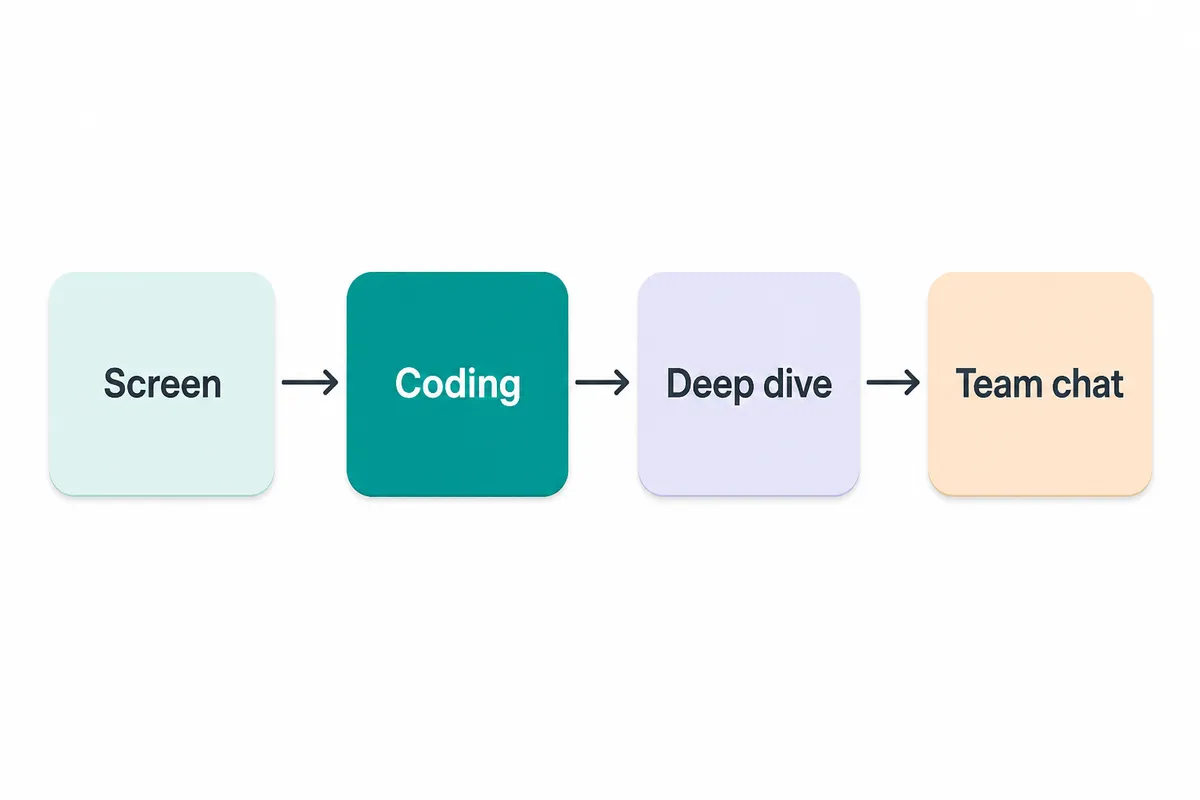
Wish interview questions are best prepared for as a modern software engineering loop: an initial screen, a technical coding conversation, deeper onsite-style technical discussions, and a behavioural or hiring-manager conversation. Reported company-specific accounts are thin and can vary by team, so confirm the exact format with your recruiter. In the meantime, build the skills that transfer across those stages: pattern recognition, clean implementation, complexity reasoning, and clear communication. For company-mapped practice, Wish's interview kit holds eight mapped DSA questions.
This guide explains the likely shape of the process without pretending there is a fixed public script. It also gives you a preparation plan that remains useful whether your Wish loop emphasises coding, project discussion, or design judgement.
Wish AI interview: what it is and how to prepare
Many people search for a "Wish AI interview" after an invitation mentions an automated or AI-led step. Here is what we could and could not verify as of October 2026.
Is there public evidence that Wish uses an AI interviewer? No. We found no Wish careers page, recruiter guidance or candidate report that describes an AI system running a Wish interview. Candidate reports on Glassdoor describe a recruiter call, a HackerRank-style online test, a roughly one-hour live coding interview and a virtual onsite, all led by people.
Why the term still shows up. Three things are commonly meant:
- An automated online assessment. A timed coding test on a platform such as HackerRank is the step candidates most often call "the AI round". These platforms score your code against hidden test cases and many run automated integrity checks; HackerRank, for example, documents AI plagiarism detection and a proctor mode that employers can switch on. A machine grades the code; a person still decides what happens next.
- A different product with a similar name. Hiring tools with "Wish" in their name, such as the WISH HIRE video-interview platform, are unrelated to the Wish shopping marketplace. If an invitation comes from an unfamiliar domain, check that it really is from the company you applied to.
- AI-led screens at other employers. Some companies now use AI interviewers for first-round screens. If your Wish invitation names a specific tool, the format is whatever that tool runs, and your recruiter can confirm it.
Ownership changed in 2024. ContextLogic agreed in February 2024 to sell the Wish marketplace to the Singapore-based e-commerce group Qoo10 for about $173 million (Korea Economic Daily, Retail TouchPoints). Most public interview reports predate the sale, so the hiring process you meet today may differ from older accounts. That is one more reason to confirm the format with your recruiter.
How to prepare if a round is AI-led or automated
- For an automated coding test: practise timed problems in the language you will use, write your own edge-case tests before submitting, and do not paste code from elsewhere. Integrity checks flag copied and AI-generated code.
- For a spoken AI interviewer: speak your reasoning in full sentences. An AI interviewer can only score what it hears or sees, so a silent pause followed by correct code gives it less to work with than a narrated approach.
- For either: rehearse the format, not just the content. An AI mock interview for coding rounds runs your code against real test cases and asks spoken follow-ups, which is close to both formats. Pair it with the eight mapped Wish DSA questions.
The Wish interview process at a glance
Because current, detailed candidate reports for Wish are limited, treat this as a practical preparation map rather than a guaranteed sequence. A recruiter can confirm the stages, interview format, language expectations, and whether design is in scope for your role.
| Stage | Common format | What it may screen for | How to prepare |
|---|---|---|---|
| Initial screen | Recruiter or hiring conversation | Role fit, experience, motivation | Know your projects and preferences |
| Technical screen | Live coding or shared-editor discussion | Problem solving, code clarity, communication | Practise common DSA patterns aloud |
| Deeper technical loop | Coding, design, project depth, or paired discussion | Engineering judgement and trade-offs | Explain decisions, not just answers |
| Hiring discussion | Behavioural and role-focused conversation | Ownership, collaboration, level fit | Prepare detailed project stories |
The useful mindset is simple: do not spend your preparation time trying to predict a hidden question bank. Build a repeatable interview process of your own. You should be able to hear a problem, identify its likely pattern, explain a sensible approach, write correct code, test it, and discuss what you would change if the requirements grew.
Initial screen — establish fit and technical context
The first conversation commonly establishes whether your background matches the role, team, and level. It may be led by a recruiter, hiring manager, or engineer, but the preparation principle is the same: tell a coherent story about the work you have done and the work you want to do next.
Prepare a concise introduction that covers your current scope, strongest technical area, and one project you are proud of. Do not recite your CV line by line. Instead, connect your experience to evidence:
- the problem your team faced;
- the decision you personally influenced;
- the technical constraint that made it difficult;
- the measurable or observable outcome;
- what you learned afterwards.
This stage also gives you a chance to reduce uncertainty. Ask your recruiter whether the loop includes live coding, a practical exercise, system design, project review, or a behavioural panel. That is not over-preparing; it is using the conversation to plan intelligently.
For candidates who become vague when discussing their work, rehearse with an AI mock interview. Practising aloud helps turn a familiar project into a clear, evidence-based story.
Technical coding screen — show how you think
A live coding stage usually screens for more than whether you can reach a correct answer. Interviewers need to see how you handle incomplete information, choose an approach, and recover when the first idea is not ideal.
The underlying material is often familiar: arrays, strings, hash maps, trees, graphs, sorting, recursion, intervals, and search. The differentiator is recognition speed. Can you identify that a problem is really a sliding-window problem rather than treating it as an unstructured array question? Can you recognise when a graph traversal is safer than repeatedly scanning a list?
The free DSA Patterns Sheet is useful here because it groups practice around the reusable shapes behind coding questions. Pair that with how to identify the right DSA pattern in a coding interview to build a deliberate method for choosing an approach.
A strong live-coding rhythm looks like this:
- Restate the problem in your own words.
- Ask about constraints, inputs, and edge cases.
- Describe a simple baseline approach.
- Improve it only when the constraints justify doing so.
- State time and space complexity before coding.
- Write readable code in small steps.
- Test ordinary and awkward cases aloud.
The point is not to narrate every keystroke. It is to make your judgement visible. A technically correct solution that arrives without explanation gives an interviewer less evidence than a well-communicated solution with a small bug that you identify and fix.
For a more detailed breakdown, read what interviewers actually look for in live coding rounds.
💡 Pro tip: Do not wait until the end to test. After each meaningful block of code, run through one normal example and one edge case. This prevents a small assumption from becoming a full rewrite.
Deeper technical discussion — demonstrate engineering judgement
Later technical conversations often go beyond a standalone puzzle. Depending on team and level, they may involve another coding problem, a discussion of object-oriented design, architecture trade-offs, debugging, or a detailed review of past work.
Since there is no reliable public Wish-specific round map to narrow this further, prepare for the transferable skills underneath all of these formats.
If the discussion is code-focused
Expect follow-up questions after the main solution. An interviewer may ask how you would reduce memory use, handle much larger input, support updates, or make the code easier for another engineer to maintain.
Good answers distinguish between what is necessary now and what would be sensible later. Avoid reflexively adding complexity. A straightforward solution with a clearly stated limitation is often stronger than an elaborate one built for requirements nobody gave you.
Use in-browser code practice to rehearse the full loop: understand the prompt, implement a solution, test it, and review feedback. The aim is not merely to collect solved problems; it is to make your process calm and repeatable.
If the discussion is design-focused
Design interviews screen for structure and judgement. You may be asked to turn a vague product requirement into entities, interfaces, data flow, failure handling, or a system that can grow.
Start by defining the scope. What is the core user action? What data must persist? Which assumptions are safe? What does success look like? Then make trade-offs explicit rather than silently choosing one path.
The free Low Level Design Sheet can help you practise class responsibilities, boundaries, and extensibility. For broader architecture discussions, the free System Design Sheet is a useful place to review common components and trade-offs.
The important distinction is explained in low-level design vs high-level design: what interviews actually expect. Low-level design asks whether your code structure can absorb change; high-level design asks whether a larger system can meet scale, reliability, and operational needs.
Behavioural and hiring discussion — make ownership concrete
A behavioural conversation is not filler after the technical rounds. It helps an interviewer understand how you work when requirements change, incidents happen, priorities conflict, or you disagree with a teammate.
The strongest answers are specific. Rather than saying, “We improved performance,” explain what was slow, how you found the bottleneck, what options you considered, what you chose, and what happened after deployment.
Prepare stories around these themes:
- a difficult technical decision;
- a project that did not go to plan;
- a disagreement you handled constructively;
- an instance where you took ownership;
- feedback that changed how you work;
- a time you simplified an overly complex solution.
Use a simple structure: situation, responsibility, action, result, reflection. Keep the emphasis on your contribution without erasing the team. “I led the investigation” is clearer than “we looked into it”, but it should be followed by an honest description of who collaborated and why.
Is the Wish interview hard?
The honest answer is that the exact Wish process is hard to characterise from public reporting alone. There is not enough reliable, current company-specific detail to state a fixed number of rounds, standard duration, named ritual, platform, or universal difficulty level.
That uncertainty does not mean you cannot prepare well. It means your preparation should prioritise skills with the broadest return:
- solve common coding patterns without relying on memorised solutions;
- explain complexity and trade-offs clearly;
- write readable, testable code;
- discuss past work at implementation depth;
- practise behavioural answers aloud;
- confirm the exact interview structure with your recruiter.
For many candidates, the hard part is not an exceptionally obscure algorithm. It is switching between problem solving, coding, communication, and project discussion without losing clarity. The best preparation mirrors that reality.
If your recruiter confirms a coding-heavy loop, spend more time on timed DSA practice. If design is included, add structured design drills. If the role is senior or specialised, expect deeper questions about decisions you have made in production systems.
A 30-day preparation plan for Wish
Days 1–7 — rebuild pattern recognition
Work through core DSA shapes: arrays and hash maps, two pointers, sliding window, binary search, trees, graphs, and recursion. Do not rush into difficult questions before you can recognise the basic patterns.
Use the free DSA Patterns Sheet to organise practice by technique. When you finish a problem, write down the trigger that should have helped you recognise the pattern sooner.
Days 8–14 — improve implementation quality
Shift attention from “I found the idea” to “I can deliver it cleanly”. Practise writing code with useful variable names, small helper functions, clear base cases, and deliberate tests.
Choose a language you can use fluently under pressure. Interview preparation is not the moment to learn a new language’s standard library or debugging habits.
Read how to explain your thought process clearly in coding interviews, then record yourself solving a problem aloud. Listen for unexplained jumps in reasoning.
Days 15–21 — add design and project depth
Spend part of each session on design. Take a modest product requirement and practise clarifying it before proposing classes, APIs, storage, or services. Focus on the core flow first. Only then discuss scaling, reliability, permissions, or future extensions.
Also prepare your project stories. Pick work you genuinely understand at depth, including choices you would now revise. Honest reflection signals maturity better than presenting every project as flawless.
Days 22–30 — simulate the real conversation
Alternate timed coding sessions with mock interview conversations. In a coding rehearsal, use the full process: clarify, plan, code, test, and summarise. In a behavioural rehearsal, answer follow-ups rather than delivering polished monologues.
Return to Wish's interview kit during this final stretch for the eight mapped DSA questions. Treat each problem as a communication exercise as well as a coding exercise: explain why the approach fits, where it fails, and how you test it.
⚠️ Important: Do not let preparation become passive reading. Editorials are valuable after an attempt, not before one. The learning comes from noticing the gap between your first approach and a better one.
Wish-specific preparation: turn uncertainty into useful questions
The distinctive challenge of preparing for Wish is not a publicly documented ritual or standardised interview format. It is the absence of enough trustworthy, current candidate reporting to responsibly claim one.
Use that uncertainty productively. Before the loop, create a short recruiter-confirmation checklist:
- Which stages are scheduled?
- Is there a live coding exercise?
- Is a shared editor or another format used?
- Does the role include design discussion?
- Should you prepare a project walkthrough?
- What level and team is the interview calibrated for?
This is not a request for questions in advance. It is a professional request for format clarity. Your recruiter may not be able to answer every detail, but even knowing whether the focus is coding, design, or project depth can materially improve your preparation plan.
Then prepare broadly enough that a changed format does not unsettle you. Candidates are often strongest when they have a method rather than a script.
Frequently asked questions
Does Wish use an AI interview?
We found no public evidence that Wish runs interviews with an AI interviewer. Candidate reports describe a recruiter call, an online coding test, a live coding interview and a virtual onsite. The automated coding test is the step most often called "the AI interview".
What are Wish AI interview questions like?
If your process includes an automated coding test, expect data structures and algorithms problems scored against hidden test cases. Prepare the same patterns as for the live coding round, and practise under a timer.
What interview questions should I expect at Wish?
Prepare for coding questions that test data structures, algorithms, complexity reasoning, and communication. Depending on role and team, deeper technical and behavioural discussions may also appear. Confirm the exact format with your recruiter.
How many interview rounds does Wish have?
There is no sufficiently reliable public consensus to state a fixed number. Reported accounts are thin and may vary by team, role, and hiring route.
Does Wish have a coding interview?
A technical coding stage is a common part of modern software engineering loops, so it is sensible to prepare for one. Ask your recruiter to confirm the format for your specific process.
What DSA topics should I practise?
Prioritise arrays, strings, hash maps, two pointers, sliding window, binary search, trees, graphs, recursion, and complexity analysis. Pattern recognition matters more than memorising individual prompts.
How difficult are Wish interview questions?
Public reporting is too limited to make a reliable company-wide difficulty claim. Build comfort with common interview patterns, then practise explaining and testing your solution under time pressure.
Should I prepare system design for Wish?
If you are interviewing for an experienced role, it is sensible to ask whether design is in scope. Prepare both class-level design and broader architecture fundamentals if you have time.
How should I prepare for the behavioural interview?
Prepare detailed stories about ownership, technical decisions, conflict, setbacks, collaboration, and learning. Use specific actions and results rather than broad team statements.
What language should I use in a coding interview?
Use the language you can write, debug, and explain most confidently. Fluency, clarity, and testing discipline matter more than choosing a fashionable language.
How long should I spend preparing?
Use the 30-day plan as a structured baseline, then adjust it after your recruiter confirms the format. More focused practice is usually better than a larger, unstructured problem list.
Start with transferable technical practice
The most effective Wish interview preparation is practical: learn the recurring coding patterns, practise explaining decisions aloud, and be ready to discuss real engineering work with precision. Once you have confirmation from your recruiter, adjust the balance between coding, design, and project preparation.
Open Wish's interview kit to practise the eight mapped DSA questions and build a stronger coding-interview routine. Combine that work with an AI mock interview for spoken rehearsal, and use the free sheets to fill gaps before your technical conversations.
Topics
Related on Thita
Your next step
Practise with AI mock interviews
A spoken interview that asks follow-up questions, runs your code and ends with a written report.