
Interview
Your First Job Interview Ever: How to Actually Rehearse It
Never had an interview before? Learn what happens, what to say, and a simple rehearsal plan for your first job interview with more confidence today.
If this is your first job interview ever, you may be worrying about things nobody has explained properly: Where do you sit? Do you shake hands? What if you do not know an answer? How long are you supposed to talk? What does an interviewer write down while you are speaking?
That uncertainty is normal. If you have never had an interview before, you are not behind; you simply have no reference point yet. Interviews are partly about your skills, but they are also a format you can learn through rehearsal.
The quickest way to make the format less mysterious is to try a live AI interview simulation. You can hear questions, answer aloud, pause when you need to think, and get used to the rhythm before a real person is deciding whether to hire you.
This guide explains what usually happens, what the interviewer is doing, what is completely fine not to know, and how to prepare when you do not have years of work experience to talk about.
First: what actually happens in an interview?
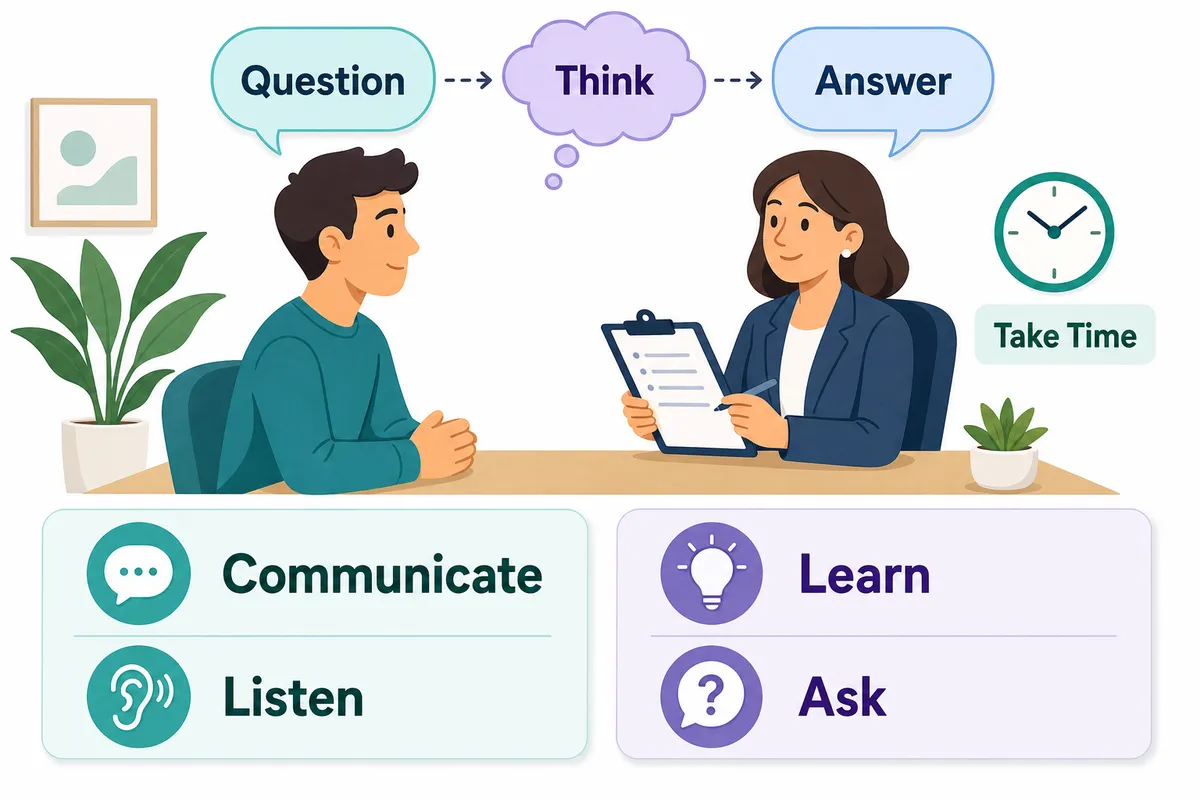
An interview is a structured conversation. It is not an exam where the interviewer already knows every answer and waits for you to fail. Their job is to collect enough evidence to make a sensible hiring decision.
For an entry-level role, that evidence often comes from four places:
- How you communicate — whether you can listen, answer clearly, and ask useful questions.
- What you have done so far — coursework, projects, internships, volunteering, societies, competitions, freelance work, or personal learning.
- How you think — how you approach a problem when the answer is not obvious.
- Whether you are likely to learn well — especially important when you are applying for your first role.
A typical first interview has a simple shape:
- A greeting and brief introduction
- A question about you, your background, or your application
- Questions about projects, studies, skills, or scenarios
- Role-specific questions, which may be technical, practical, or behavioural
- Time for your questions
- A closing explanation of what happens next
The exact order changes by company. A recruiter screen may be mostly about your interests, availability, and resume. A hiring manager may ask deeper questions about your work. A technical interview may include a coding task, a case study, an analysis exercise, or a discussion of a project.
⚠️ Important: You are allowed to ask what kind of interview it is. Before the meeting, you can write: “Could you please share what the interview will cover and whether I should prepare anything specific?” That is organised, not embarrassing.
What the interviewer is doing while you answer
One reason a first interview nervous feeling can become overwhelming is that interviewers often look serious, type notes, or pause before asking the next question. It is easy to assume that every pause means you said something wrong.
Usually, it does not.
They may be doing any of the following:
- Taking notes so they can remember your answer accurately
- Comparing your answer with the skills listed for the role
- Deciding which follow-up question will tell them more
- Checking the time
- Thinking about how your experience connects to another question
- Trying to give you space to finish rather than interrupting
A neutral face is not a bad sign. Many interviewers are trained not to react too strongly, because they want to treat every candidate fairly.
You also do not need to fill every second with talking. A short pause is professional. Try one of these phrases:
- “That is a good question. Let me think for a moment.”
- “I have not done that in a job yet, but the closest example from my project is…”
- “Could I clarify what you mean by…?”
- “I would approach that in two steps.”
- “I am not fully sure, but my first thought is…”
These phrases buy you thinking time while showing the interviewer how you reason.
💡 Pro Tip: Silence feels much longer to you than it does to the other person. A three-second pause before you answer usually feels thoughtful, not awkward.
What is normal not to know
You do not need a perfect career story to earn a first job. You also do not need to pretend that university, a bootcamp, or self-study gave you real workplace experience.
For a fresher, it is normal not to know:
- How formal the conversation will be
- What salary negotiation sounds like
- Every tool named in a job description
- The exact day-to-day work in the role
- How to answer a question about a weakness
- What examples “count” as experience
- The answer to every technical question
What matters is how you handle the gap.
Instead of saying, “I have no experience,” make the sentence more accurate:
“I have not had a full-time role yet, but I built this project as part of my final-year work, and I was responsible for…”
Or:
“I have not used that tool directly, but I have used a similar one. I would start by learning the workflow and asking how the team currently uses it.”
That is honest, specific, and forward-looking.
Your projects count. So do assignments where you made decisions, group work where you resolved disagreement, events you organised, customer-facing part-time work, tutoring, sports teams, and responsibilities at home. The point is not to stretch an ordinary task into a grand achievement. The point is to identify what you did, what changed because of your contribution, and what you learned.
For more help turning limited experience into useful evidence, read how to write a resume with no experience for tech jobs. The same material you put on a resume is often where your first interview questions begin.
Your resume is your best rehearsal script
When you do not yet identify with a specific job title, do not start by trying to rehearse every possible industry question. Start with the document the interviewer already has: your resume.
Read every line and ask yourself:
- Could I explain this to someone unfamiliar with it?
- What problem was I trying to solve?
- What exactly did I do?
- What tools or skills did I use?
- What was difficult?
- What would I improve if I did it again?
- What did the result teach me?
If your resume says, “Built a college event app,” the interviewer may ask:
- Why did you choose that project?
- What did the app do?
- What was your contribution in the team?
- What was the hardest problem?
- How did you test it?
- What would you change with more time?
You do not need a polished speech for every answer. You need enough familiarity that you can explain your own work without sounding surprised by it.
A good answer usually follows this small structure:
- Context: What was the project, task, or situation?
- Action: What did you personally do?
- Result: What happened, changed, or worked?
- Reflection: What did you learn or what would you improve?
This is a simpler version of the STAR method: Situation, Task, Action, Result. For a first role, the reflection matters because it demonstrates self-awareness and growth.
You can rehearse questions generated from your own CV through a resume-based AI interview. This is especially useful for freshers and non-technical candidates because it begins with your coursework, projects, skills, and experience rather than assuming you already know which professional track fits you.
A practical first job interview preparation plan
Do not try to memorise fifty answers. Memorised answers can sound stiff, and one unexpected follow-up can make you lose your place. Instead, prepare a small set of stories and practise saying them naturally.
Step 1: prepare your 60-second introduction
You will probably hear some version of “Tell me about yourself.”
This is not an invitation to tell your whole life story. It is a short professional introduction that connects your present situation to the role.
Use this outline:
“I am currently a [student, graduate, or career starter] with an interest in [relevant area]. Recently, I worked on [project, course, or experience], where I learned [skill]. I am applying for this role because [specific reason], and I am keen to develop in a team where I can contribute to [relevant part of the role].”
Keep it truthful. If you do not yet know exactly what career you want, say what you are curious about and why this role is a sensible place to begin.
Step 2: choose four stories
Pick four examples from your life that show different strengths:
- A project you are proud of
- A difficult problem you solved
- A time you worked with other people
- A mistake, challenge, or setback you learned from
Write only bullet points: context, action, result, lesson. Then speak through each story out loud. The first attempt may feel awkward. That is exactly why rehearsal works.
Step 3: research the role, not everything on the internet
Read the job description slowly. Highlight:
- Responsibilities
- Required skills
- Nice-to-have skills
- The company’s product, customers, or mission
- Words repeated more than once
Then connect your existing evidence to two or three of those points. If the role mentions communication, prepare a teamwork example. If it mentions analysis, prepare a project example where you compared options or found an error.
✅ Do learn enough about the company to explain why you applied.
❌ Don't spend six hours memorising the company’s founding date, leadership team, and every press release. Useful research helps you ask better questions; trivia rarely helps you answer them.
Step 4: rehearse aloud, not only in your head
Thinking of an answer is different from saying it. When you speak, you notice where your sentences ramble, where you use filler words, and where your example lacks a clear ending.
Set a timer for 90 seconds. Answer one question aloud. Listen back if you can. Then improve one thing only: structure, clarity, pace, or specificity.
If you are preparing for a technical role, do the same with problem-solving. Explain your approach before writing anything. This guide on how to think out loud in coding interviews shows how to make your reasoning easier for an interviewer to follow.
How to rehearse when nobody can mock interview you
You do not need a friend, mentor, or family member available every evening. A solo rehearsal can still be useful if you make it realistic.
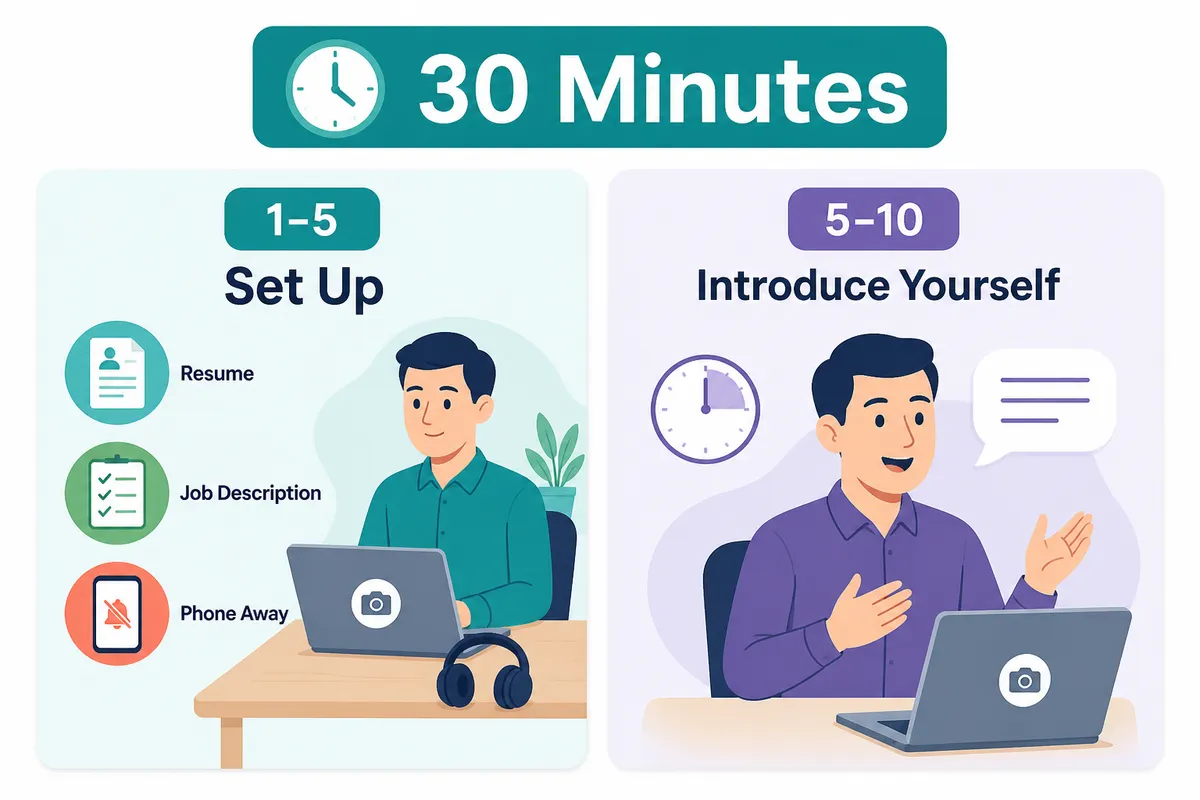
Try this 30-minute session:
Minutes 1-5: Set up. Sit upright at a desk. Put your phone away. Open your resume and the job description. If the real interview is online, use your laptop camera and headphones.
Minutes 5-10: Introduce yourself. Say your answer to “Tell me about yourself” twice. The second version should be clearer, not longer.
Minutes 10-20: Answer six common questions. For example: Why this role? Why this company? Tell me about a challenge. What are your strengths? What do you want to learn? What questions do you have for us?
Minutes 20-25: Rehearse uncertainty. Choose one question you cannot answer perfectly. Practise saying, “I do not know that yet, but here is how I would find out.”
Minutes 25-30: Review. Write down one answer to strengthen and one point you did well. Do not make a giant list of faults.
Once you have tried that alone, use a live simulation to add the unpredictable part: follow-up questions. A good interviewer does not simply move through a list. They ask, “What do you mean by that?” or “What would you do differently?” because your first answer gave them something to explore.
A live voice AI interview practice session lets you rehearse that conversation without scheduling a partner. Thita supports behavioural, resume-based, product management, data science, AI and ML, CS fundamentals, coding, system design, low-level design, and machine coding rounds. Resume-based sessions are equally useful when your first role is outside software engineering.
For technical candidates, you can practise in six languages: Python, C++, Java, JavaScript, Go, and C#. The in-browser editor compiles and runs your code, so you can rehearse explaining, testing, debugging, and responding to follow-ups rather than only solving a question silently.
Questions you should ask at the end
When the interviewer says, “Do you have any questions for us?”, try not to say “No” just because you are nervous. Asking one or two thoughtful questions shows that you are deciding whether the role suits you too.
Choose questions you genuinely want answered:
- “What does success look like in the first three months?”
- “What would I be working on first?”
- “How does the team support someone who is new to the role?”
- “What do people on this team enjoy most about working here?”
- “What are the next steps in the process?”
Avoid questions answered clearly on the company website. Also avoid asking about salary, leave, or remote work as your only questions in the first five minutes. Those topics can be important, but start by showing interest in the work and team.
For a broader view of what employers assess, see how interviewers evaluate junior versus senior software engineers. The main takeaway for a junior candidate is reassuring: nobody expects senior-level experience. They are looking for sound basics, clear thinking, honesty, and learning potential.
Frequently asked questions
What should I do if I am nervous for my first interview?
Prepare a short introduction, four examples from your experience, and two questions for the interviewer. Then rehearse aloud. Nervousness may not disappear, but familiarity makes it far more manageable.
What happens if I do not know the answer to a question?
Pause, clarify the question if needed, and explain what you do know. If you genuinely do not know, say so honestly and describe how you would find the answer or approach the problem.
How long should my answers be in a first job interview?
Most answers should take around 30 to 90 seconds. For a story-based question, aim for one to two minutes. Stop once you have answered the question, rather than adding unrelated details.
Can I use university projects as interview experience?
Yes. Projects, coursework, group assignments, hackathons, volunteering, and part-time work can all provide useful examples. Be clear about your personal contribution and what you learned.
Should I memorise answers word for word?
No. Memorise the key points and structure instead. You want to sound prepared but natural, and you need enough flexibility to handle follow-up questions.
What should I wear to a first job interview?
Match the organisation’s level of formality where possible. Clean, comfortable, simple clothes are usually safer than trying to look overly formal or overly casual. If unsure, ask the recruiter.
How many times should I practise before an interview?
Two or three spoken rehearsal sessions are enough to make a major difference. Focus on improving your weakest answers, not repeating the same polished answer until it sounds scripted.
Rehearse the room before you enter it
Your first interview does not require you to become a different person overnight. It asks you to explain what you have done, show how you think, and demonstrate that you can learn.
The unfamiliarity is often the hardest part. Remove some of it before the day arrives: practise your introduction aloud, talk through your resume, answer a few follow-ups, and let yourself make mistakes in rehearsal.
Start a live AI interview rehearsal and practise the conversation before it matters. Begin with a resume-based round if you are unsure what type of role you fit, then use the feedback to strengthen the stories only you can tell.
If you are reading this because you need to hire candidates rather than prepare for an interview, visit interviews.thita.ai.
Topics
Related on Thita
Your next step
A placement plan you can follow day by day
Start with the free DSA patterns sheet (410 problems in 99 patterns). The 90-day College roadmap adds OS, DBMS and computer networks, and is included with Pro while you are subscribed.