
Resume
How Recruiters Read Tech Resumes in the First 10 Seconds
Most software engineers spend hours polishing their resume—yet a recruiter may decide in under 10 seconds whether it moves forward. That gap between effort a...
Most software engineers spend hours polishing their resume—yet a recruiter may decide in under 10 seconds whether it moves forward. That gap between effort and attention is where many strong candidates quietly get filtered out.
Understanding how recruiters actually scan a tech resume in those first seconds is a huge advantage. Once you know their mental model and constraints, you can design your resume like you’d design an API: optimized for the primary consumer.
This post breaks down, step by step, how recruiters and hiring managers skim a software engineer resume during initial screening, what they look for, and how to structure your resume so it survives that first pass.
The Reality of Tech Resume Screening
Before we get into the scan pattern, it helps to understand the environment:
- A recruiter might see 200+ applications for a single mid-level backend role.
- Many are skimming 20–40 resumes in a batch.
- They are usually not the hiring manager or a senior engineer (at least in the first pass).
- They’re matching against a job description with ~5–10 key requirements.
- Their goal in the first 10 seconds is not to “hire you”; it’s to decide:
- Yes → worth a deeper read / send to hiring manager
- No → clear mismatch or too weak
- Maybe → borderline; might revisit if the pipeline is thin
Your tech resume is competing for a “Yes” in that environment. That means:
- Clarity beats cleverness.
- Signal density beats length.
- Structure beats prose.
How Recruiters Read a Tech Resume in 10 Seconds: The Scan Path
Most recruiters follow a predictable scan path on a software engineer resume. It’s not always conscious, but it’s remarkably consistent.
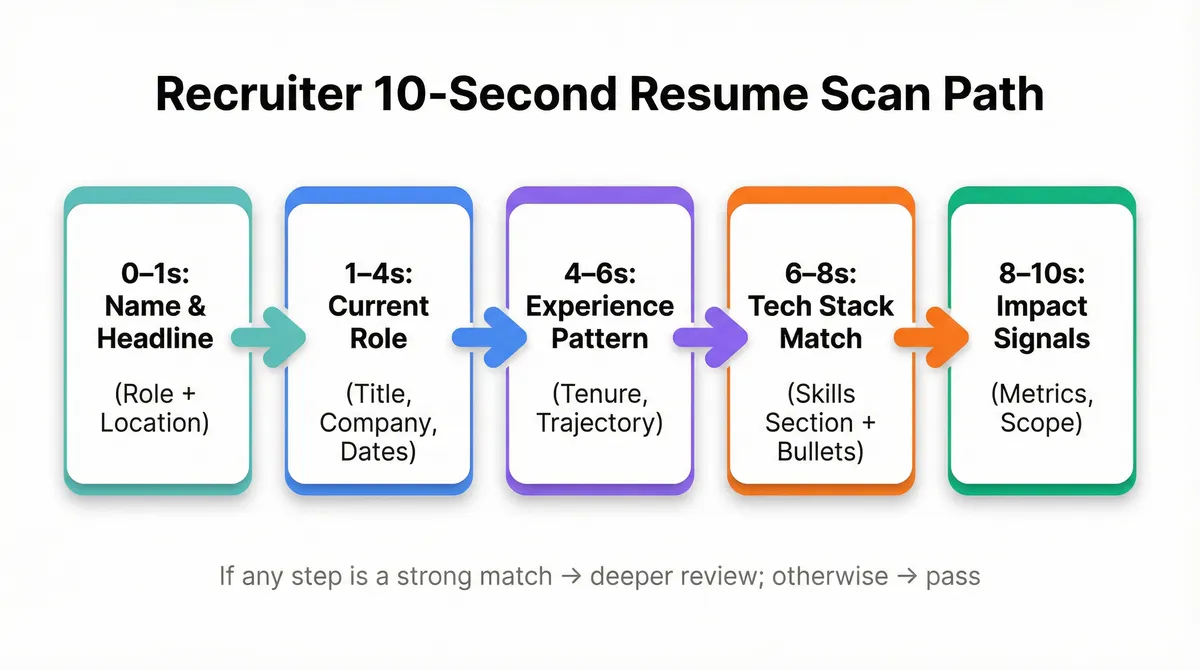
The 10-Second Scan: A Typical Sequence
- Name + Title Line (0–1s)
- Current Role / Most Recent Experience (1–4s)
- Company Names + Tenure Pattern (4–6s)
- Tech Stack Snapshot (6–8s)
- Education / Level Check (8–9s)
- Quick Signal for Impact / Complexity (9–10s)
If anything in that path looks like a strong match, they’ll slow down and read more deeply. If it doesn’t, they move on.
Let’s walk through each step and how to optimize for it.
Step 1: The First Line – Name, Role, and Location
In the first second, a recruiter confirms they’re looking at the right person and roughly what you are.
What They Look For
- Your name (obvious, but must be prominent)
- Your target role (e.g., “Software Engineer”, “Senior Backend Engineer”)
- Location or Time Zone (especially for remote roles)
- Contact info (email, phone, LinkedIn, GitHub/portfolio)
They are not reading; they are recognizing.
How to Optimize
- Use a simple, single-line headline under your name:
- “Software Engineer – Backend | Python, Go, Distributed Systems”
- “Senior Frontend Engineer | React, TypeScript, Performance”
- Keep contact info clean and horizontally aligned:
email | phone | city, country (or time zone) | LinkedIn | GitHub
Avoid:
- Dense blocks of text at the top.
- Objective statements like “Seeking a challenging role…”—they add no signal.
Step 2: Current Role: Title, Company, and Dates
From ~1–4 seconds, the recruiter’s eyes go straight to your most recent experience.
What They’re Asking
- Is your current or last role close to this job?
- Title alignment: “Software Engineer” vs “IT Support Specialist”
- Domain/stack alignment: backend vs frontend vs mobile vs data
- Is the company recognizable or contextually credible?
- Well-known tech companies are easy signals.
- For lesser-known companies, they look at industry and scale hints.
- Are you at the right level?
- “Senior”, “Staff”, “Lead” vs “Junior”, “Intern”
- Is your experience recent and continuous?
- Any big unexplained gaps or 6-month hops?
How to Format for Fast Parsing
Use a consistent, scannable structure:
- Company Name – bold
- Title – regular
- Dates – right-aligned or clearly separated
- Location – light, secondary
Example:
Stripe – Software Engineer, Payments
San Francisco, CA · Jul 2021 – Present
Or, for startups:
Acme Analytics (Series B, B2B SaaS) – Backend Engineer
Remote (UTC-5) · Jan 2022 – Present
Those small parenthetical notes (“Series B”, “B2B SaaS”) give quick context to unknown names.
Step 3: Company & Tenure Pattern – Are You Stable and Growing?
Around 4–6 seconds, recruiters mentally scan down your experience timeline.
What They Notice
- Total years of experience
- Tenure at each company
- Trajectory: intern → junior → mid → senior → lead, etc.
- Patterns:
- Multiple sub-1-year stints
- Constant title stagnation over many years
- Frequent industry or role switches
They’re not judging your life choices; they’re estimating risk:
- Will this person leave quickly?
- Do they grow and get promoted?
- Have they worked in environments with some complexity?
How to Help Them See the Right Story
- Keep dates aligned and easy to scan.
- Avoid overlapping dates without clear explanation (e.g., contract + full-time).
- If you have multiple short stints, briefly label them:
- “Contract (6 months)”
- “Startup shut down”
- “Company acquired by X”
You don’t need essays—just enough for a recruiter to not assume the worst.
Step 4: Tech Stack Snapshot – Can You Work in Our Environment?
From about 6–8 seconds, the recruiter looks for technology keywords that match the job description.
They often have a JD open in one tab and your resume in another. They’re doing a quick mental (or literal) keyword match.
What They Look For
- Core languages: Python, Java, C++, Go, JavaScript/TypeScript, etc.
- Frameworks: React, Node.js, Spring, Django, etc.
- Infrastructure: AWS, GCP, Kubernetes, Docker, Terraform
- Databases: PostgreSQL, MySQL, MongoDB, Redis, etc.
- For some roles: ML frameworks, data tools, mobile stacks
Where They Look
- A dedicated “Skills” or “Tech” section
- Tech mentioned in experience bullets
- Project descriptions for students/new grads
If they don’t see matching tech quickly, your resume is likely a “No” even if you have relevant skills buried in text.
How to Structure Your Tech Stack
-
Use a dedicated Skills / Technologies section near the top.
-
Group by category, not alphabetically:
- Languages: Python, Go, TypeScript, SQL
- Backend: Django, FastAPI, Node.js, REST, gRPC
- Frontend: React, Next.js, Redux
- Data & Storage: PostgreSQL, Redis, Kafka
- Cloud & DevOps: AWS (EC2, S3, RDS), Docker, Kubernetes, Terraform
- Testing & Tools: PyTest, Jest, GitHub Actions, Prometheus, Grafana
-
Avoid long “laundry lists” of everything you’ve ever touched.
-
Prioritize what matches the job—even if you know more.
For candidates preparing for interviews, combining a recruiter-friendly resume with focused practice on mock interviews can significantly boost your chances of success.
Step 5: Education & Level Check
Around 8–9 seconds, especially for early-career roles, recruiters check your education to confirm:
- Degree type and field (CS, EE, related)
- School name (sometimes for signal, sometimes for visa/eligibility)
- Graduation year (to estimate level/seniority)
- For students: GPA (if strong) and core coursework
For experienced engineers (5+ years), education is a weaker signal, but they’ll still glance to confirm there’s nothing odd (e.g., obviously unrelated with no bridge story).
How to Present Education
-
Keep it simple and factual.
-
For early-career:
- B.S. Computer Science, University of X
2018 – 2022 · GPA: 3.7/4.0
Relevant Coursework: Data Structures & Algorithms, Operating Systems, Databases, Distributed Systems
- B.S. Computer Science, University of X
-
For experienced engineers, you can shrink it:
- B.S. Computer Science, University of X
If you’re using something like Thita’s /dsa-patterns-sheet to strengthen fundamentals, that’s valuable for your skills, but it doesn’t belong in education. It can, however, inform the projects and achievements you list.
Step 6: Impact & Complexity Signals – Do You Actually Build Things?
In the last 1–2 seconds of the initial scan, recruiters look for evidence of impact:
- Did you ship real features?
- Did you work on meaningful systems?
- Are there numbers that show scale or improvement?
They’re scanning the first few bullets of your current/most recent role.
What Strong Bullets Look Like
Strong bullets answer:
- What did you build or change?
- At what scale or complexity?
- What was the measurable impact?
Example:
- Designed and implemented a rate-limiting service in Go handling 15k+ RPS, reducing API abuse incidents by 40% and cutting average latency by 12%.
- Led migration of 3 core services from a monolith to Kubernetes on AWS, improving deployment frequency from monthly to daily and reducing rollback incidents by 30%.
Weak bullets:
- Worked on backend services using Go and Kubernetes.
- Responsible for developing APIs and fixing bugs.
The first set gives impact and scale; the second is pure activity.
If you want to improve your ability to communicate impact and complexity clearly, consider resources on how to explain your thought process in coding interviews, which can help you articulate your contributions effectively during interviews.
What Hiring Managers Look For in the Deeper Read
Once you pass the 10-second screen, a hiring manager or senior engineer will often do a more technical read. They tend to look for:
- Architecture and systems thinking
- Ownership of features or components
- Breadth vs depth of technologies used
- Evidence of problem-solving (not just implementation)
- Growth over time (increasing responsibility)
This is where the quality of your bullets, projects, and side work matters. The quick scan just determines if they’ll ever see it.
Common Tech Resume Mistakes That Fail the 10-Second Test
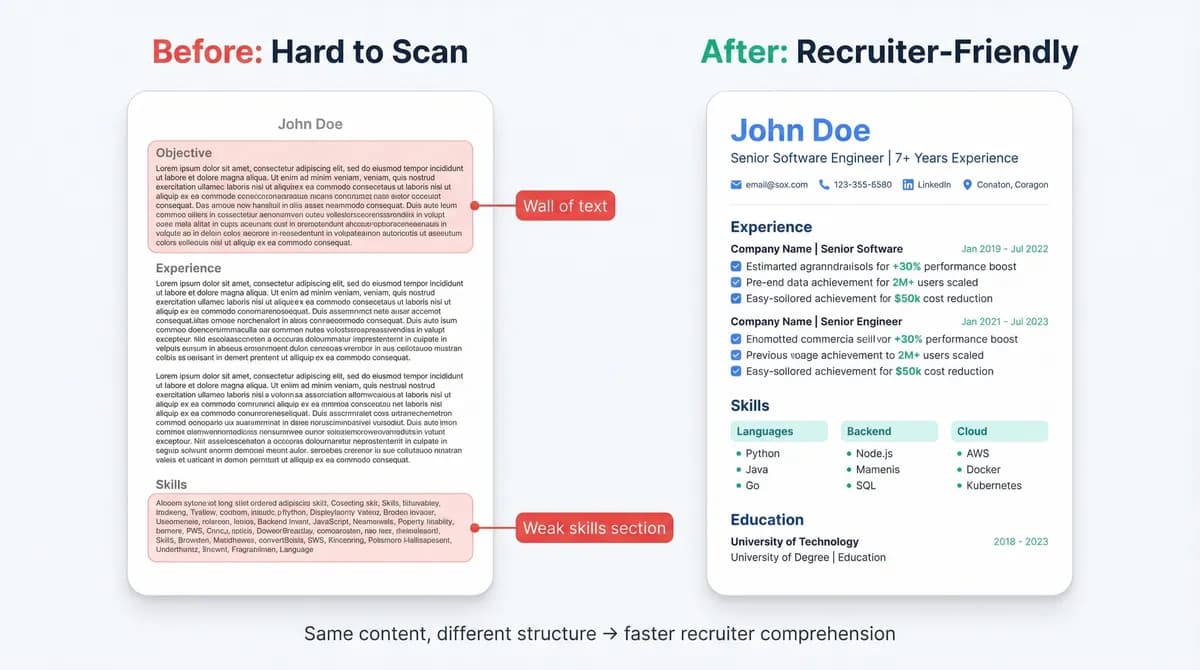
1. Walls of Text
Huge paragraphs under each role are unreadable at scan speed. Recruiters won’t parse them.
Fix: Use 3–6 concise bullets per role. Each bullet: 1–2 lines max.
2. Vague, Responsibility-Only Bullets
“Responsible for building APIs” doesn’t tell anyone if you did it well, at scale, or with impact.
Fix: Use a simple pattern:
[Action] + [What you built] + [Tech] + [Scale/Complexity] + [Impact]
Example:
- Implemented idempotent payment retry logic in Node.js and PostgreSQL, reducing duplicate charges by >95% across 2M+ monthly transactions.
3. Misaligned Tech Stack
Listing every tech you’ve touched makes it harder to see what you’re good at, and may dilute your match for specific roles.
Fix:
- Prioritize tech that aligns with the target role.
- Remove or demote irrelevant tools.
4. Over-Designed Layouts
Fancy multi-column designs, icons, and heavy colors may look nice, but:
- ATS (Applicant Tracking Systems) can break them.
- Recruiters scanning quickly can get lost.
Fix: Use a clean, single-column layout with clear headings and consistent formatting.
For guidance on ATS-friendly formatting, see ATS-Friendly Resume Formatting: Do's and Don'ts.
5. Irrelevant or Overweight Sections
- Long “Objective” sections
- Hobbies unrelated to the role
- Generic “soft skills” lists (teamwork, communication, etc.)
These consume space and attention that should go to your impact.
Fix: Focus on experience, projects, skills, and education. Let your bullets demonstrate soft skills implicitly (e.g., “collaborated with 3 teams to…”).
How to Rewrite Your Experience Bullets for Maximum Signal
Think of each bullet as a compact “mini case study” that shows:
- What problem you tackled
- What you designed/built
- What tech you used
- What outcome you achieved
A Simple Template
Implemented/Designed/Optimized [X] using [Tech], resulting in [Metric/Impact] at [Scale/Context].
Examples:
- Designed and implemented a caching layer with Redis for high-traffic endpoints, reducing P95 latency from 800ms to 230ms and cutting DB load by 45%.
- Built an internal feature flag service in Go and PostgreSQL, enabling safe canary releases to 5% of users and reducing incident frequency by 20%.
Handling Work Without Clear Metrics
Not every role has perfect numbers. You can still convey impact using:
- Relative improvements: “reduced build time by ~50%”
- Scale descriptors: “used by 15+ internal teams”, “across 10+ microservices”
- Complexity descriptors: “multi-region deployment”, “event-driven architecture”
Example:
- Refactored a legacy monolith module into 3 independently deployable services, simplifying ownership boundaries for 4 teams and reducing average lead time for changes from weeks to days.
Projects and Early-Career Tech Resumes
If you’re a student or junior engineer, recruiters will still use the same 10-second scan, but they’ll lean more heavily on:
- Projects section
- Internships
- Coursework and competitions
What They Look For in Projects
- Do you build non-trivial things?
- Are you using relevant technologies?
- Do you understand end-to-end systems?
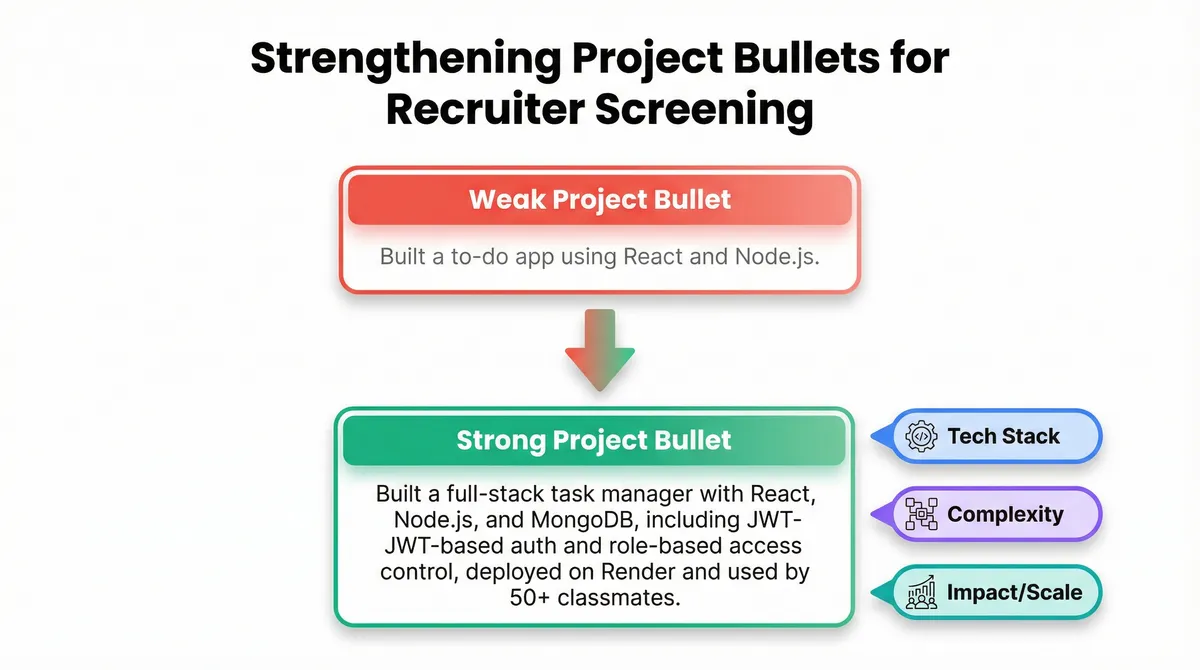
Weak project bullet:
- Built a to-do app using React and Node.js.
Stronger:
- Built a full-stack task manager with React, Node.js, and MongoDB, including JWT-based auth and role-based access control, deployed on Render and used by 50+ classmates.
If you’ve been practicing data structures and algorithms (for example, using pattern-based problem sets or an /ai-coach), you can reflect that in projects:
- Implemented a search autocomplete service using a Trie-based index in Python, supporting prefix queries over 100k+ entries with <50ms average response time.
This signals both practical coding and algorithmic understanding.
For improving your coding skills alongside resume building, exploring the Beginner to Advanced DSA Roadmap for Software Engineers in 2026 can help you master essential data structures and algorithms patterns.
Tailoring Your Tech Resume to the Job Description
A generic resume is like a generic API: it might work, but it’s rarely optimal.
Recruiters are matching you against a specific job description. You should tune your resume for that job, within the bounds of honesty.
Practical Tailoring Steps
-
Read the JD carefully and extract:
- Must-have skills
- Nice-to-have skills
- Core responsibilities
- Domain (fintech, e-commerce, infra, ML, etc.)
-
Adjust your Skills section:
- Move matching tech to the front of each category.
- Remove or de-emphasize irrelevant tech for this application.
-
Reorder bullets in your experience:
- Put the most relevant accomplishments first under each role.
- If the role emphasizes performance, surface latency/throughput wins.
- If it’s data-heavy, surface analytics, ETL, or ML-related work.
-
Rename sections if helpful:
- “Projects” → “Selected Projects”
- “Experience” → “Software Engineering Experience”
You’re not rewriting your history; you’re reordering and framing it to match what the recruiter is scanning for.
A Minimal Example: Before vs After (Text Only)
Before: Hard to Scan
Experience
Acme Corp – Software Engineer
2021 – Present
- Responsible for building backend services and APIs.
- Worked with Java, Spring Boot, and MySQL.
- Fixed bugs and improved performance.
- Collaborated with frontend team.
After: Recruiter-Friendly
Experience
Acme Corp (B2B SaaS) – Software Engineer (Backend)
Remote · Jan 2021 – Present
- Designed and implemented 5+ RESTful APIs in Java (Spring Boot) and MySQL for the core billing platform, used by 200+ enterprise customers.
- Optimized invoice generation pipeline, reducing average processing time from 90s to 25s by adding batching and caching with Redis.
- Introduced centralized request logging and Grafana dashboards for 10+ services, improving incident triage time by ~40%.
- Collaborated with frontend and DevOps teams to roll out features via blue-green deployments on AWS ECS.
In the “After” version, a recruiter can immediately see:
- Role and domain fit (backend, B2B SaaS)
- Core tech stack (Java, Spring Boot, MySQL, Redis, AWS)
- Impact and scale (200+ customers, 10+ services)
- Collaboration and ownership patterns
Key Takeaways: Designing Your Resume for the 10-Second Scan
- Recruiters follow a predictable scan path: headline → current role → experience pattern → tech stack → education → impact.
- Your headline and top third of the resume determine whether anyone reads the rest.
- Make your tech stack and impact unmissable:
- Clear Skills section grouped by category.
- Bullets with action + tech + scale + impact.
- Avoid walls of text, vague responsibilities, and over-designed layouts.
- Tailor your resume to the specific job description: reorder bullets, emphasize relevant tech, and surface domain-aligned work.
- For early-career engineers, projects are your experience—treat them with the same rigor.
A well-structured tech resume won’t get you the job by itself, but it will get you past the gatekeeper and into the conversations where your actual skills—your systems thinking, your DSA fundamentals, your debugging instincts—can be evaluated.
If you pair a recruiter-friendly resume with focused practice on patterns, mock interviews, and real-time feedback, you significantly increase the odds that the next resume you send doesn’t just get read—it gets shortlisted.