
Interview
How to Explain Your Thought Process in Coding Interviews
Most candidates focus on getting the right answer in a coding interview. The stronger signal, though, is *how* you get there. Your thought process—how you un...
Most candidates focus on getting the right answer in a coding interview. The stronger signal, though, is how you get there. Your thought process—how you understand the problem, explore options, reason about trade-offs, and react to hints—is what separates a passable solution from a strong hire.
This guide walks through how to explain your thought process in a coding interview clearly and systematically. We’ll cover what interviewers are actually listening for, concrete communication patterns you can practice in mock interviews, and detailed examples of “thinking out loud” at different stages of a problem.
Why Your Thought Process Matters More Than the Final Answer
In a real engineering job, you rarely solve a problem silently and perfectly on the first try. You:
- Clarify ambiguous requirements
- Propose multiple designs
- Justify trade-offs (time vs. space, simplicity vs. flexibility)
- Debug and iterate under constraints
A good coding interview mirrors that environment. Interviewers use your thought process to evaluate:
- Problem-solving approach – Do you start with brute force and then optimize? Do you recognize known patterns?
- Technical depth – Do you understand complexity, data structures, and edge cases?
- Communication – Can you explain your reasoning to teammates?
- Collaboration – Do you respond well to hints and questions?
- Resilience – What happens when you get stuck or make a mistake?
You’re not just being tested on your ability to code; you’re being evaluated as someone others will need to work with and trust.
A Structured Framework for Explaining Your Thought Process
You can treat a coding interview like a sequence of well-defined stages. At each stage, there’s a specific kind of thinking—and talking—that interviewers expect.
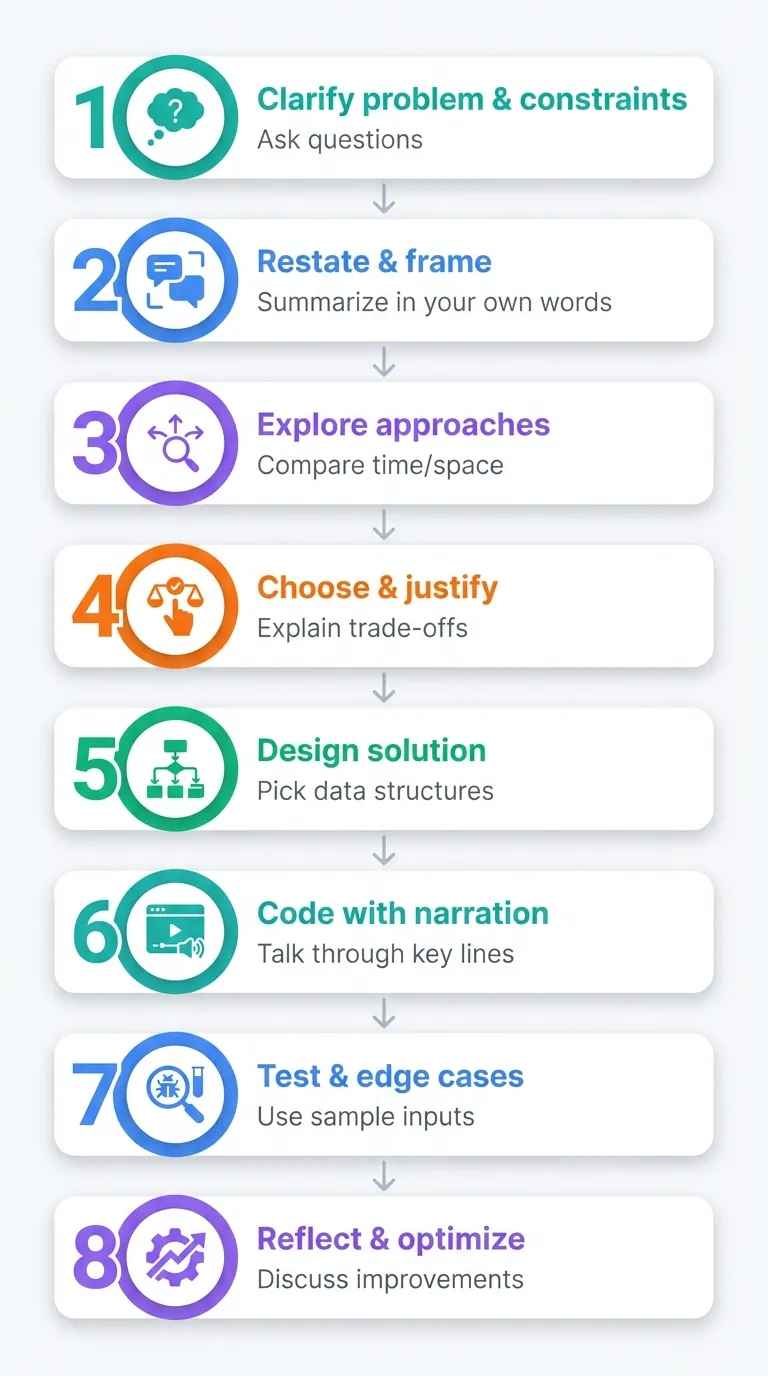
Here’s a high-level flow:
- Clarify the problem and constraints
- Restate and frame the problem
- Explore approaches (from brute force to optimal)
- Choose an approach and justify it
- Design the solution (data structures, invariants, complexity)
- Code while narrating
- Test with examples and edge cases
- Reflect and optimize if time allows
Think of this as a communication algorithm you can practice until it’s automatic.
Stage 1: Clarifying the Problem Without Sounding Lost
What to say right after you hear the question
Many candidates either:
- Jump into coding immediately, or
- Sit silently trying to understand everything in their head
Both are suboptimal. Instead, start with verbal clarification:
- “Let me restate the problem to make sure I understand.”
- “I have a couple of clarifying questions about constraints and edge cases.”
This signals that you’re methodical and collaborative.
Key clarifying questions to ask
For most algorithmic problems, cover:
-
Input details
- “Can the array contain negative numbers?”
- “Is the input already sorted?”
- “What’s the maximum size of
n?”
-
Output details
- “If there are multiple valid answers, do I return any one or all of them?”
- “What should I return if there is no solution? Empty list? -1?”
-
Constraints and guarantees
- “Are there any memory constraints I should keep in mind?”
- “Can I modify the input in place?”
- “Are there duplicate values?”
-
Edge cases
- “How should we handle empty input?”
- “What about very large values or overflow?”
Example: Clarifying a “Two Sum” style problem
“Given an array of integers and a target, return indices of the two numbers that add up to the target.”
You might say:
“Let me clarify a few things:
- Can the array contain negative numbers?
- Are there guaranteed to be exactly two numbers that sum to the target, or possibly zero or more?
- Can I return any valid pair if multiple exist?
- What’s the maximum array length? That will affect whether an O(n²) solution is acceptable.”
This takes 20–40 seconds and gives you critical information for your later reasoning.
Stage 2: Restating and Framing the Problem
After clarifying, restate the problem in your own words. This helps you and the interviewer align.
Using the Two Sum example:
“So we have an array
numsof lengthn, and a target integerT. We need to find indicesiandjsuch thatnums[i] + nums[j] == T. If there are multiple solutions, any one is fine. If none exist, we return -1.ncan be up to 10^5, so O(n²) might be too slow; ideally we want O(n log n) or O(n).”
This short summary:
- Shows you understood the constraints
- Sets up your complexity targets
- Provides a clean mental model to refer back to
Stage 3: Exploring Approaches Out Loud
This is where your thought process becomes most visible. Don’t silently think for 5 minutes and then present a final answer. Instead, walk the interviewer through your exploration.
A simple pattern: Brute force → optimize
For most coding interview problems, you can systematically go from naive to optimal:
-
Start with brute force
-
“The simplest approach I see is to try all pairs of indices
i, jand check if they sum to the target. That’s two nested loops.” -
Briefly analyze:
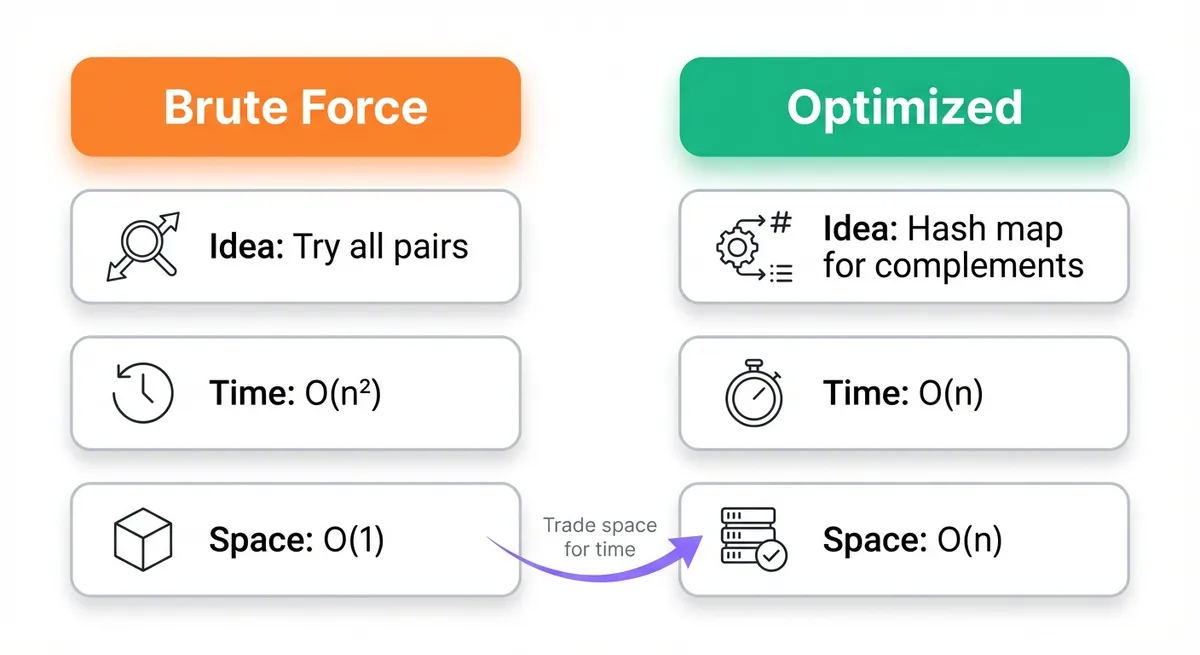
- “This is O(n²) time and O(1) extra space.”
-
-
Identify why brute force is insufficient
- “With
nup to 10^5, O(n²) is about 10^10 operations, which is too slow.”
- “With
-
Introduce a more efficient idea
- “To improve, I’d like to avoid checking all pairs. This looks like a good use case for a hash map to trade space for time.”
Example: Thought process for Two Sum
You might narrate:
“First, the brute force solution is to try all pairs
(i, j)withi < jand check ifnums[i] + nums[j] == T. That’s O(n²) time, O(1) space.Given
ncan be 10^5, that’s too slow. To improve, we can think about how to quickly check if we’ve seen a complement value before.For each element
nums[i], the complement isT - nums[i]. If we maintain a hash map from value to index, we can check in O(1) average time whether we’ve seen the complement. That would give us O(n) time and O(n) space.I’ll go with the hash map approach unless you’d like me to explore a sorted two-pointer variant as well.”
You’ve now:
- Demonstrated you can derive a brute force baseline
- Shown awareness of complexity
- Proposed a standard pattern (hash map lookup)
- Invited collaboration (“unless you’d like me to…”)
Stage 4: Choosing and Justifying an Approach
Once you’ve explored options, you need to commit and explain why.
A concise pattern:
-
State your choice
- “I’ll implement the hash map approach.”
-
Justify based on constraints
- “Given
nup to 10^5, O(n) time and O(n) space is acceptable and more scalable than O(n²).”
- “Given
-
Mention trade-offs
- “The trade-off is extra memory for the map, but that’s reasonable given typical interview constraints.”
-
Check alignment
- “Does that sound good, or would you prefer I implement the simpler O(n²) solution first?”
This shows you’re not just guessing; you’re making a reasoned decision.
Stage 5: Designing the Solution Before Coding
Before writing code, spend 1–2 minutes outlining the design verbally. This is where you demonstrate:
- Data structure choice
- Invariants
- Handling of duplicates / edge cases
- Complexity
Example: Designing the Two Sum hash map solution
You might say:
“I’ll use a hash map from value → index. I’ll iterate through the array once. For each
nums[i], I’ll computecomplement = T - nums[i]. Ifcomplementis already in the map, I’ll return[map[complement], i]. Otherwise, I’ll insertnums[i]into the map with its index.This ensures we find the first pair that sums to the target. The map stores at most
nelements, so space is O(n). We do a single pass with O(1) average-time operations per element, so time is O(n).”
At this point, the interviewer already knows you have the right idea. The code is implementation detail.
Stage 6: Coding While Narrating
Silently typing for 10 minutes is a common anti-pattern. Instead, narrate at a low bandwidth—not every character, but the key decisions.
Coding example (Python)
PYTHON
How to talk while you code
As you write, say things like:
- “I’ll create a map
index_by_valueto store seen values.” - “For each index
iand value, I compute the complement.” - “If the complement is in the map, I return the stored index and
i.” - “Otherwise, I insert the current value into the map and move on.”
- “If I finish the loop without finding a pair, I’ll return
(-1, -1)as a sentinel.”
This narration:
- Keeps the interviewer aligned with your mental model
- Gives them opportunities to correct misunderstandings early
- Demonstrates clarity and intent in your implementation
Stage 7: Testing and Debugging Out Loud
Once you’ve written code, don’t say “Done” and wait. Immediately move into testing, using both the example provided and your own edge cases.
A simple testing pattern
-
State your plan
- “Let me test this with a couple of examples, including edge cases.”
-
Walk through an example step-by-step
- Use a small array and narrate variable values as they change.
-
Check edge cases
- Empty input, single element, duplicates, negative numbers, etc.
Example walk-through
Using nums = [2, 7, 11, 15], target = 9:
“Start with empty map
{}.
- i = 0, value = 2, complement = 7. 7 not in map, insert
2: 0.- i = 1, value = 7, complement = 2. 2 is in map with index 0, so return
(0, 1).That matches the expected result.”
Then an edge case:
“Edge case: no solution.
nums = [1, 2, 3],target = 100.
- i = 0, value = 1, complement = 99 → not found, insert
1: 0.- i = 1, value = 2, complement = 98 → not found, insert
2: 1.- i = 2, value = 3, complement = 97 → not found, insert
3: 2. End of loop, return(-1, -1). That’s consistent with our earlier definition.”
By verbalizing the test, you show:
- You understand your own logic
- You proactively validate correctness
- You can simulate code in your head—critical for debugging
Stage 8: Reflecting and Improving
If you finish early, don’t just stop. Use the remaining time to reflect:
- “Time complexity is O(n), space is O(n).”
- “We could reduce space to O(1) if we sort and use two pointers, but that would change the output indices unless we track original positions.”
- “In a real system, we’d also consider integer overflow or streaming input.”
This kind of reflection shows senior-level thinking, even for junior roles.
Example: Explaining Thought Process on a More Complex Problem
Let’s briefly apply the same structure to a more complex problem: “Given a binary tree, return its level order traversal.”
Clarify and restate
“We’re given the root of a binary tree. We need to return a list of lists, where each inner list contains the node values at that depth from left to right.
Are there any constraints on the number of nodes? Can the tree be skewed? Is it okay to use O(n) extra space where n is the number of nodes?”
Explore approaches
“The brute force idea might be to do a DFS and track depths, but that’s actually already near optimal.
More naturally, this is a classic BFS/level-order problem. We can use a queue, process nodes level by level, and collect values per level.
Time will be O(n) since we visit each node once. Space is O(n) for the queue and output.”
Choose and justify
“I’ll use the BFS with a queue approach. It matches the level-order requirement directly and is straightforward to reason about.”
Design
“We’ll have a queue initialized with the root. While the queue is not empty, we:
- Determine the current level size
k = len(queue).- Pop
knodes, appending their values to acurrent_levellist.- Push their non-null children into the queue.
- Append
current_levelto the result.This guarantees we process nodes level by level.”
Code (Python)
PYTHON
Narration highlights
As you code, you might say:
- “I’ll handle the empty tree case first.”
- “I’m using a deque as a queue for BFS.”
- “At each iteration of the outer loop,
level_sizecaptures how many nodes are in the current level.” - “I’ll process exactly
level_sizenodes, collecting their values and enqueuing children.”
Then test with a simple tree and describe each level.
Common Communication Mistakes in Coding Interviews
1. Silent problem solving
Issue: You think deeply but say nothing for several minutes.
Impact: Interviewer can’t evaluate your reasoning; they may assume you’re stuck.
Fix: Verbalize your high-level thoughts every 30–60 seconds:
- “I’m considering whether a greedy approach would work here.”
- “I’m trying to think of a way to reduce this from O(n²) to O(n log n).”
2. Streaming every thought
Issue: You narrate everything (“Now I’ll type a for loop… now I’ll add a semicolon…”).
Impact: Hard to follow; feels like noise.
Fix: Focus on meaningful steps:
- Data structure choices
- Loop invariants
- Edge case handling
3. Jumping to code too early
Issue: You start coding before clarifying requirements or choosing a clear approach.
Impact: You often need to rewrite large parts of your solution.
Fix: Force yourself to:
- Restate the problem
- Propose at least one alternative approach
- Get explicit agreement: “I’ll implement the X approach.”
4. Over-optimizing prematurely
Issue: You dive into complex optimizations without establishing a correct baseline.
Impact: You might never get a working solution.
Fix: Explicitly start from brute force:
- “Let me first outline the simple O(n²) solution to ensure correctness, then we can optimize.”
5. Defensiveness when corrected
Issue: You argue or resist hints.
Impact: Signals poor collaboration.
Fix: Treat hints as collaboration:
- “Good point, I missed that edge case. Let me adjust the approach.”
- “You’re right, that would break when the array has duplicates. I’ll fix that.”
Best Practices: A Communication Checklist for Coding Interviews
You can treat this as a pre-interview checklist and a mid-interview mental guide.
Before the interview (practice phase)
- Use mock interviews to practice speaking out loud while solving problems.
- Record yourself and check:
- Do you restate the problem?
- Do you explicitly compare approaches?
- Do you test with edge cases verbally?
Pattern-based platforms and tools like AI mock interviews or an AI coding coach can simulate the interviewer and give structured feedback on your communication, not just correctness.
During the interview
-
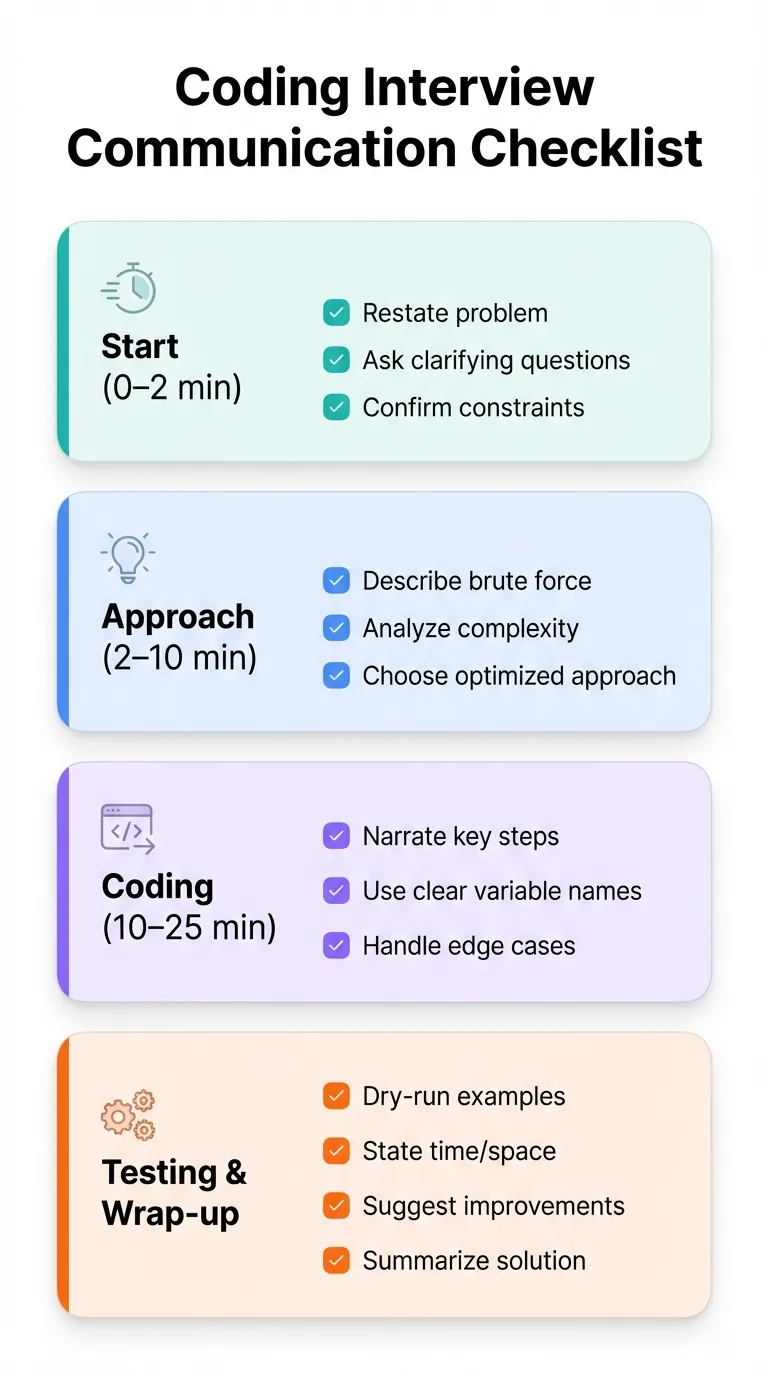
First 2 minutes
- Restate the problem.
- Ask 3–5 clarifying questions.
- Summarize constraints and edge cases.
-
Next 5–10 minutes
- Outline a brute force solution.
- Identify its complexity and why it’s insufficient.
- Propose an optimized approach and justify it.
- Confirm with the interviewer.
-
Coding phase
- Narrate key decisions, not keystrokes.
- Keep variable names descriptive.
- Handle edge cases explicitly.
-
Testing and wrap-up
- Walk through 1–2 normal cases and 2–3 edge cases.
- State time and space complexity.
- Briefly mention possible improvements or variations.
Practicing Thought Process with Patterns, Not Just Problems
Explaining your thought process becomes easier when you recognize patterns:
- Sliding window
- Two pointers
- Fast/slow pointers
- Binary search on answer space
- BFS/DFS
- Dynamic programming (top-down vs bottom-up)
- Greedy with proof of correctness
When you see a problem, you can say:
- “This feels like a sliding window problem because we’re looking for a contiguous subarray with certain properties.”
- “This is a graph reachability question; BFS or DFS should work.”
Pattern-based learning (for example, working through a DSA patterns sheet) helps you:
- Quickly map problems to known techniques
- Explain why a pattern fits
- Reuse standard complexity and trade-off explanations
Key Takeaways
- Interviewers care deeply about your thought process, not just the final code.
- Use a structured flow: clarify → restate → explore → choose → design → code → test → reflect.
- Always start with a brute force baseline, then optimize and justify your choice.
- Narrate at a high level: data structures, complexity, invariants, and edge cases—not every keystroke.
- Test your solution with examples and edge cases out loud, walking through state changes step-by-step.
- Avoid common pitfalls: long silences, premature coding, over-optimization, and defensiveness.
- Practice explaining patterns, not just individual problems, so your reasoning becomes reusable and predictable.
With deliberate practice—especially in realistic mock interviews where you force yourself to speak your reasoning—you’ll find that explaining your thought process becomes as natural as writing the code itself. That’s the point where technical interviews start to feel less like a performance and more like what they’re meant to simulate: real engineering work.