
System Design
GTA 6 NPC AI and the Wanted System: The Engineering Behind Leonida's Crowds
How does GTA 6 NPC AI work? Handcrafted state machines, not generative AI. The wanted system, Heat, pathfinding and Euphoria physics, for engineers.
A pedestrian on a Vice City sidewalk looks like a person with a plan. She has a route, a mood, and an opinion about your shotgun.
Underneath, she is a few kilobytes of state and a scheduler deciding how much of the frame she deserves.
Updated 19 November 2026, launch day. Figures are checked against the sources linked below.
What is GTA 6 NPC AI? As far as Rockstar has said, it is conventional, handcrafted game AI, not generative AI. Pedestrians and drivers run on state machines and behaviour logic, hear events, path through navigation graphs, and get cheaper simulation the further they are from you. The wanted system works like a state machine: stars, a Heat indicator, and police who must witness a crime before they respond. Rockstar has not published the architecture, so the detail below is inference.
This post is part of a series on how the game is probably built. The engine overview covers what engine GTA 6 uses. Here we look at the people who live on it.
Is GTA 6 NPC AI generative AI?
No, and Rockstar's parent company has been blunt about it.
Take-Two CEO Strauss Zelnick said that generative AI has "zero part" in what Rockstar is building for GTA 6, adding that the worlds are handcrafted, "building by building, street by street." The coverage of that statement is dated May 2026. The game's Wikipedia entry records Rockstar's confirmation of the same point.
So no language model is improvising dialogue in a pedestrian's head. That is a design choice, and an engineering one. A model call can cost hundreds of milliseconds. A frame at 30 fps gets 33.3. A crowd cannot wait for a sentence.
The reporting describes the opposite of improvisation. 80.lv, referencing a recent Edge feature, reports about 600,000 NPC animations, plus personality traits (temperament, aggression, location, what they have witnessed, how you have treated them) that shape how each pedestrian reacts.
Authored behaviour, selected by rules. The oldest kind of game AI, and done well it passes for magic.
How do GTA 6 NPCs work?
Strip away the polish and every large open world solves the same problem. How do you make ten thousand people feel alive when you can afford to think about a few hundred?
The answer is a stack of agreements:
- Decide who deserves attention (simulation level of detail).
- Give each person a small set of behaviours (state machines and behaviour trees).
- Let events travel without everyone watching everyone (perception and pub/sub).
- Move bodies along graphs (pathfinding).
- Answer "who is near me?" cheaply (spatial partitioning).
- React physically when the script runs out (Euphoria-style animation).
- Never allocate what you can recycle (pooling).
Everything below is that list, one item at a time. Rockstar has published none of these internals. Where we describe them, we are reasoning from public material and from how engines in this class are built.
How does simulation level of detail decide who thinks?
A city of thousands of people is a scheduling problem with good manners.
The manners are the illusion. The scheduling is the engineering. Every tick, the engine has a fixed budget (the 30 fps frame leaves 33.3 ms for everything), and AI is competing with streaming, physics and rendering for it.
So attention is rationed in rings.
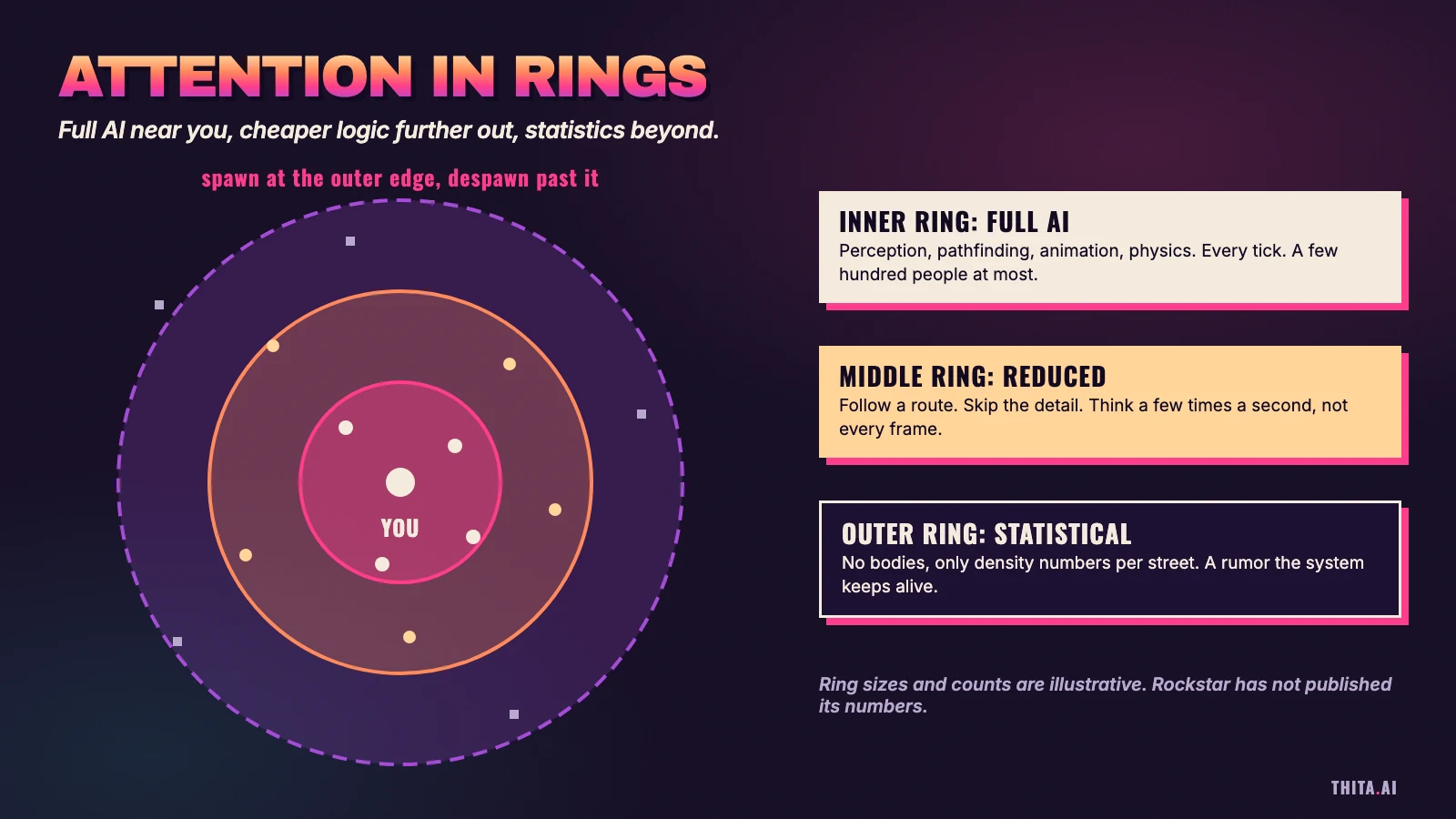
The three rings
- Inner ring, full AI. Perception, pathfinding, animation and physics, every tick. These are the people who can bump into you, see you, and be shot.
- Middle ring, reduced AI. A pedestrian follows a precomputed route and checks for trouble a few times a second instead of every frame. No fine animation, maybe no full physics body.
- Outer ring, statistical. No individuals. Only a density number per street segment: roughly how many people and cars should be here, given the time of day and the district.
A typical open-world engine might fully simulate a few hundred characters and cheaply simulate a few thousand. Those counts are illustrative, not Rockstar's.
Spawning is the other half
When you drive, the outer ring moves with you. People are spawned at its far edge, where you cannot see them appear, and despawned when they fall out the back. The city you are in is a sliding window over a much larger crowd the engine only counts.
The density numbers keep it honest. If a street targets 40 pedestrians at noon and 6 at 3 a.m., the spawner only closes the gap between what exists and what should exist.
This is the same shape as the world itself, which is streamed in rings around you. The GTA 6 file size and loading screens post covers that side: one ring decides which geometry is loaded, the other decides which people are alive. They share a centre and, very likely, a budget.
How does the GTA 6 wanted system work?
The GTA 6 wanted system pairs wanted stars with a Heat indicator that tracks what police know. Police respond to crimes that are witnessed and reported, and the stars change as they gain or lose sight of you. The clearest public description comes from a Rockstar demo reported by Vice, relayed by Game Rant.
According to reporting from Game Rant, itself citing Vice's account of a Rockstar demonstration, the stars come with a "Heat" system. Solid white stars mean officers have direct line of sight. Flashing white means you broke it. Hollow stars mean a crime was reported but police lack a description. Red stars mean you escaped but remain in an active search area. Crimes must be witnessed and reported before police respond, and police cars carry trackers.
Read that list as an engineer and it is a specification.
The wanted level is a state machine
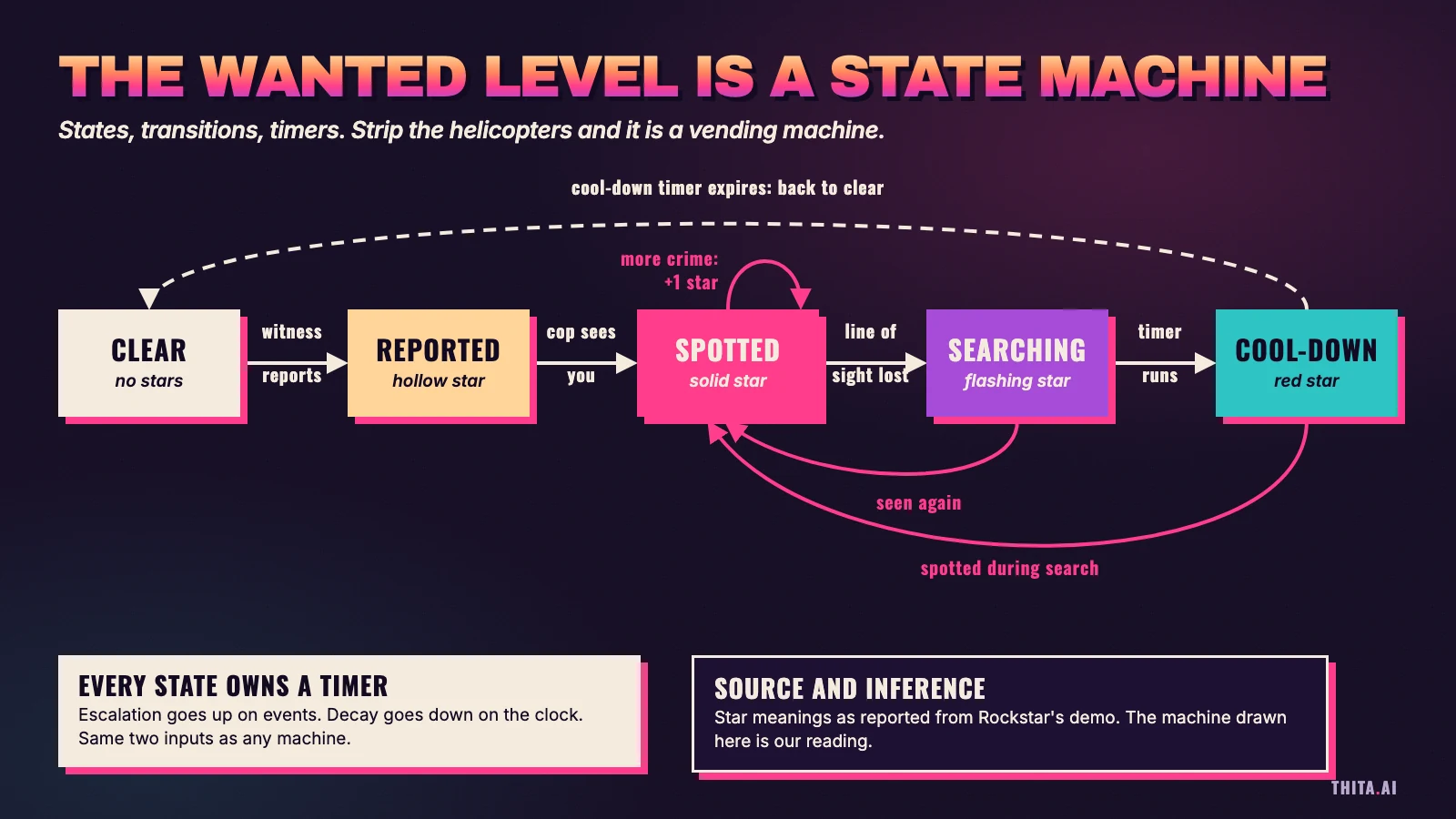
Each star meaning is a state. Each change (a witness reports, a cop sees you, line of sight is lost) is a transition triggered by an event. Each state has a timer or a condition that decides when it ends.
Underneath, the police AI is a state machine. Same shape as the vending machine in the State pattern lesson, just with more helicopters.
Three properties make it a textbook case:
- Explicit states. Clear, reported, spotted, searching, cool-down. No "kind of wanted."
- Escalation on events. More crime while spotted adds a star. The transition is a self-loop with a side effect.
- Decay on the clock. Stay hidden and the search timer runs out. Time is the second input to the machine, after events.
The machine drawn here is our reading of the reported behaviour, not a Rockstar diagram. The real thing certainly has more states (the highest wanted level reportedly lets police search the whole map), and probably a hierarchy: a global wanted state above, and each officer running their own smaller machine for chase, flank or hold.
Behaviour trees and the officer inside the system
A global state machine says how angry the city is. It does not say what one officer does.
For individuals, games usually reach for finite state machines or behaviour trees. A state machine is a graph of modes with transitions. A behaviour tree is a prioritised list of "try this, else that" nodes that is re-evaluated as conditions change. Trees compose better when the number of behaviours grows, which is why they took over from flat state machines in big games. Which Rockstar uses for which role is not public.
Reportedly, K9 units chase a runner in the demo, and that fits either shape. Coordinated pursuit would suggest a layer above the individual officer that hands out roles. That is inference. The interview section below sketches the classes.
How do witnesses and police find out about a crime?
The rule "crimes must be witnessed and reported" is an architecture decision wearing a gameplay costume.
The naive design has the police query every pedestrian: did you see anything? That is a nested loop across the city, every frame. The standard answer is publish and subscribe.
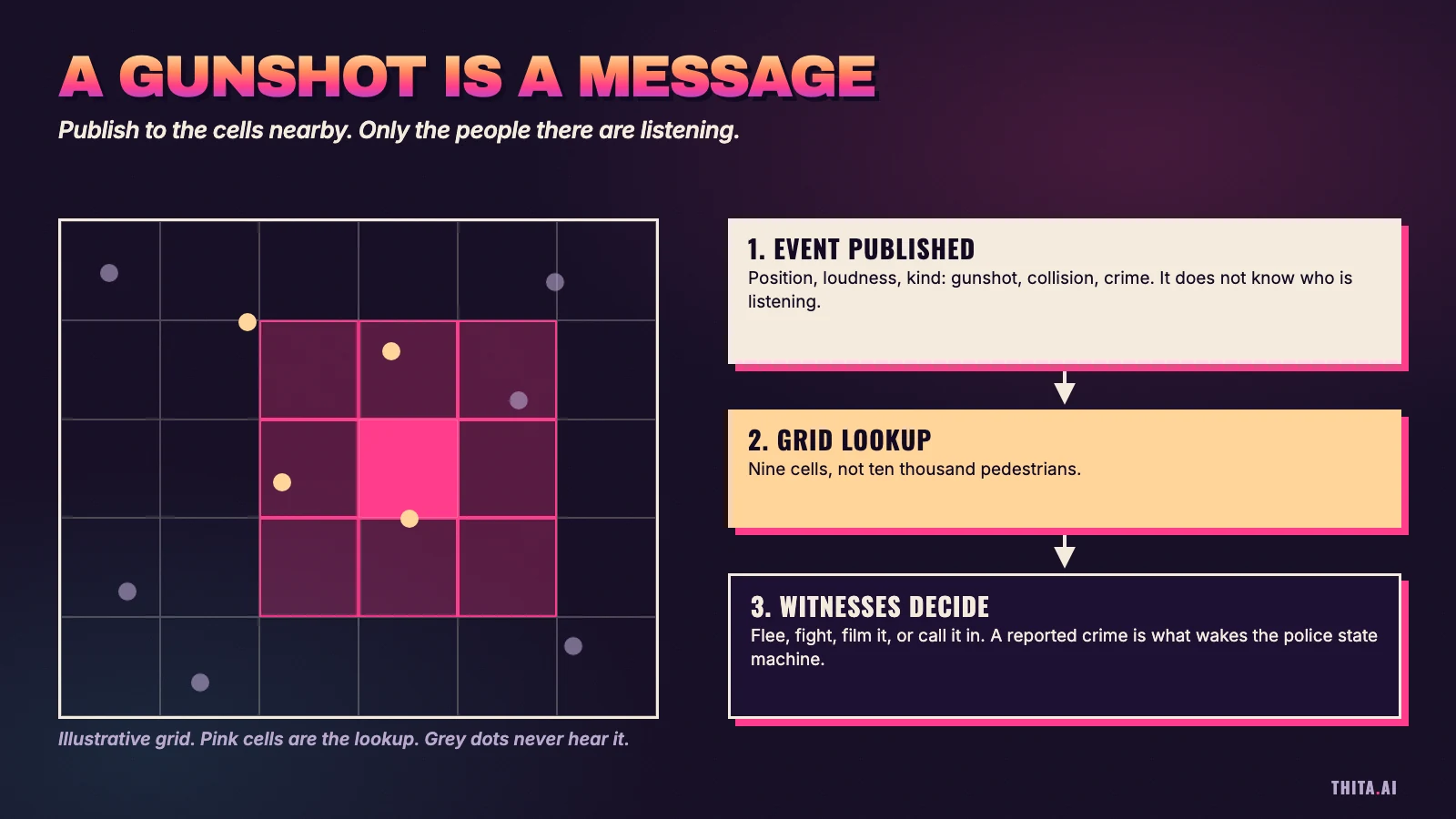
A gunshot is not a method call on a thousand objects. It is an event with a position, a loudness and a kind. Whoever is close enough, and listening, reacts: flee, film, fight back, call it in. The shooter does not know who they are. The system finds out by delivering the event to the right place.
If you have met the Observer pattern, this is the same pattern at city scale. The subject is the world, the observers are the NPCs, and the hard part is not the callback. The hard part is deciding who is allowed to hear.
Personality then decides the reaction. The Edge feature describes traits like temperament and aggression feeding into each response. In code terms, the same event hits different parameters of the same behaviour.
Police dispatch is one more subscriber. A witness who calls it in publishes a "crime reported" event, and the wanted state machine moves from clear to reported. A chain of events, with a human or a tracker at each link.
How do GTA 6 NPCs find who is nearby?
Delivering the event raises a smaller question that costs more than it looks: who is within thirty metres of this point?
Scanning every NPC is linear in the population. Do that for every gunshot, every honk and every collision, and the query becomes the bottleneck. The fix is spatial partitioning: divide the world into cells and store each entity in the cell it stands in. A proximity query then reads the cell and its neighbours.
A uniform grid is the simplest version and is very often the right one in games, because entities move constantly and rebuilding a grid is cheap. A quadtree adapts to density, splitting crowded areas into smaller cells, which suits worlds where downtown is packed and swamp is empty. Either way, the query touches nine cells instead of ten thousand people.
Whether Rockstar uses a grid, a tree or something custom is not public. The idea is not exotic. It is the same one behind how a ride-hailing app finds nearby drivers. The geospatial indexing lesson walks through quadtrees and geohash, and the same query serves a ride-hailing product. Swap pedestrians for drivers and a gunshot for a ride request, and you have the same system.
How does pathfinding work for NPCs and traffic?
Once a pedestrian has decided to leave, she needs to get somewhere.
Walking characters usually move over a navigation mesh: a simplified map of walkable polygons. Searching it is a graph problem, and A* is the standard answer. It is Dijkstra with a compass, expanding the cheapest nodes first but biased toward the goal by a heuristic. If you want the pattern in your hands, the DSA patterns sheet covers BFS, Dijkstra and A* as one family of graph searches.
Cars are a different graph: roads as nodes and links with lane rules. Here we have something better than inference, because a patent exists.
What the Take-Two patent says
We read the Google Patents page for US20200338450A1, "System and method for virtual navigation in a gaming environment." The assignee is Take-Two Interactive Software, the inventors are listed as Simon Parr and David Hynd, and it was filed on 24 April 2019 and published on 29 October 2020. The page lists a granted patent in the family, US11071916B2.
What it describes is a pathfinding design, not a game:
- A coarse graph over a fine one. Similar low-level nodes, such as a long straight road, are grouped so long routes can be planned over fewer nodes. The patent states that searching the coarse graph gives the same result as searching the low-level graph while expanding fewer nodes.
- Local route lists. An NPC keeps a short list of upcoming nodes and replans after travelling a set number of them. If it has no destination, it can follow a random wander path.
- Traffic density per road link. Each link has a target vehicle density, and vehicles are spawned where the current density falls short. Density is counted along road connections, not by radial distance, so a car on an overpass does not count against the road underneath.
- Tagged roads. Nodes carry speed, classification (highway, road, private driveway), supported vehicle types and restrictions, and tags such as "one way street" restrict who may use them.
Press coverage tied this to GTA 6. The filing describes game environments in general, and we did not see a game named in what we read. A patent does not prove a shipping implementation. Treat it as a published look at how a studio of this kind thinks, which is more than most games give us.
It lines up with the rings: spawn to a target, per street, and the statistical ring gets a concrete data structure.
How do spawning and pooling keep the city cheap?
A city that creates and destroys thousands of pedestrians and cars while you drive has a garbage problem.
Allocating a fresh character object, with its skeleton, animation state and AI state, is slow, and freeing it fragments memory. The standard answer is an object pool: allocate a fixed number up front, hand them out, reset them on return. Spawning becomes "take one from the pool and place it," and despawning becomes "reset and give it back." The object pool lesson covers the pattern, including what a safe reset has to clear.
Pools also cap the population. If the pool has no free pedestrians, nobody new spawns. A hard budget becomes a property of the data structure.
Then the Flyweight. A thousand pedestrians share a few hundred models, meshes and textures. The shared, read-only part (the mesh, the clothing set) lives once. The per-person part (position, health, current state) is tiny. That split is the Flyweight pattern, and it is the reason a crowd fits in memory at all.
What is Euphoria physics, and does GTA 6 use it?
When the script runs out, the body takes over.
Euphoria is NaturalMotion's animation middleware: it simulates a character's body at runtime instead of playing a fixed clip. Rockstar has not said whether GTA 6 uses it.
According to Wikipedia's entry, it animates characters on the fly "based on a full simulation of the 3D character, including body, muscles and motor," rather than playing predefined clips, so reactions are "different every time, even when replaying the same scene." GTA IV was Rockstar's first game to use Euphoria, and the same article lists Red Dead Redemption, GTA V and Red Dead Redemption 2 among later users, with Euphoria integrated into RAGE's source. NaturalMotion announced in 2017 that it would end licensing.
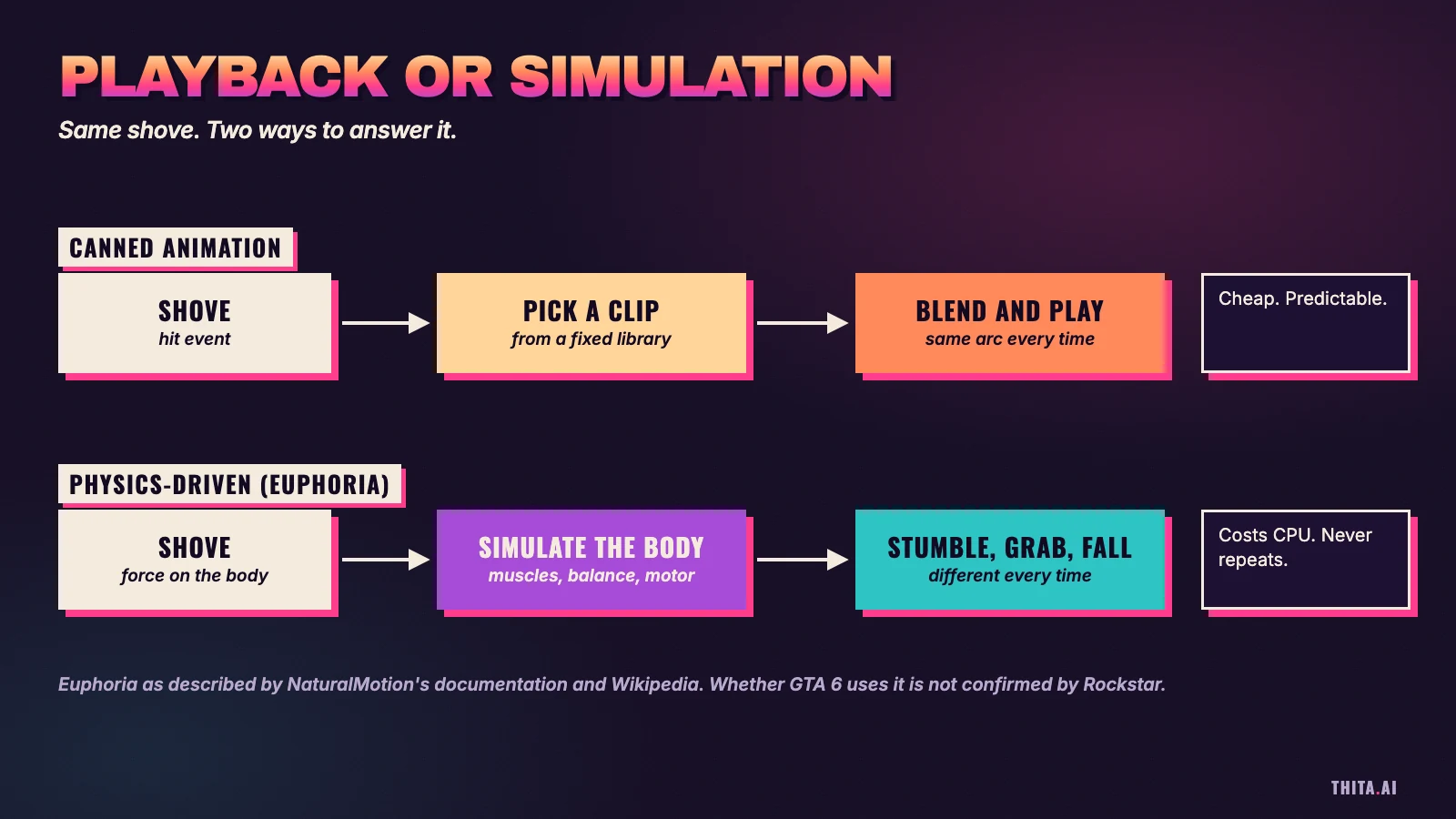
The difference is a design trade:
| Canned animation | Physics-driven (Euphoria-style) | |
|---|---|---|
| Response to a shove | Pick a clip, blend, play | Simulate balance and muscles |
| Repeatability | Same arc every time | Different every time |
| CPU cost | Low | Higher, per character |
| Authoring cost | Many clips, hand-made | Fewer clips, tuned simulation |
| Failure mode | Looks stiff or repeats | Looks silly, or behaves oddly |
It would be a natural continuation, and several outlets say so, but we are treating it as unconfirmed. The "Euphoria 2.0" name in some coverage has no source we could verify.
What the Edge feature reports is authored animation at enormous scale, around 600,000 clips, and art-directed NPC behaviour. The two approaches are not rivals. A sensible engine plays authored animation when things are calm and hands the body to a simulation when something hits it. That costs CPU, so only the inner ring can afford it.
How would you design NPCs and a wanted level in a machine-coding round?
Here is the question as an interviewer would ask it:
Design the wanted-level system for an open-world game. Classes, states, transitions.
The expected answer is short. Name the states and events, decide who owns the timer, and keep the machine separate from whatever reacts to it. A sketch:
PYTHON
Then the follow-ups. Is it thread-safe if perception runs on another thread? Where does the cool-down timer live? Why is an event bus better than police polling pedestrians?
That is the State pattern, the Observer pattern and a tick loop, which is most of what machine-coding rounds are made of. The low-level design course covers them, including game design patterns, and the same instincts carry into system design. If this is the first time a system like this has made sense to you, that is the start of the field, not the end of it. The roadmap lays out the rest in order.
What this adds up to
The city is not intelligent. It is attentive in the right places.
Rings decide who thinks. Machines decide what they do. Events decide who finds out. Graphs decide where they go. Grids make the questions cheap. Pools make the lifecycle cheap. A simulated body decides how they fall.
The craft is restraint: knowing, frame by frame, which person in the crowd deserves to be real.
Frequently Asked Questions
Does GTA 6 use generative AI for NPCs?
No, according to Take-Two. CEO Strauss Zelnick has said generative AI has "zero part" in what Rockstar is building, and the game's worlds are described as handcrafted. NPC behaviour is authored and rule-driven. Rockstar has not published how that logic is structured.
How does the GTA 6 wanted system work?
Reporting based on a Rockstar demonstration says stars show what police know: solid white for line of sight, flashing white for broken line of sight, hollow for a reported crime with no description, and red for an escape inside a search area. Crimes must be witnessed and reported first. Structurally it behaves like a state machine with timers.
What is Euphoria physics?
Euphoria is NaturalMotion's animation technology. It simulates a character's body, muscles and motor in real time instead of replaying fixed clips, so a stumble or fall differs each time. GTA IV was Rockstar's first game to use it, but Rockstar has not said whether GTA 6 does.
How many NPCs can GTA 6 simulate at once?
Rockstar has not published a number. Open-world engines usually run full AI on a few hundred nearby characters, cheaper logic on more, and statistical density beyond that. Any specific count you see online is a guess.
Is there a Rockstar patent on NPC navigation?
Take-Two filed US20200338450A1, "System and method for virtual navigation in a gaming environment," covering coarse navigation graphs, per-road traffic density and tagged roads. It does not name a game, so the link to GTA 6 is press speculation, and a patent does not prove a shipping feature.
What design patterns do game NPCs use?
The common ones are the State pattern or behaviour trees for decisions, Observer or publish and subscribe for events, object pools for spawning, and Flyweight for shared models. Pathfinding adds A* over navigation graphs, and spatial partitioning handles proximity queries.
Topics
Related on Thita
Your next step
Learn the system design behind worlds like this
Streaming, caching, real-time networking, state machines and geospatial indexes are the same ideas system design interviews test. Thita teaches them in 12 families with 26 worked case studies, and every lesson can be heard with an AI coach you can stop and ask.