
System Design
GTA 6 Engine: What RAGE Is, and the System Design Behind Leonida
What engine does GTA 6 use? Rockstar's in-house RAGE, not Unreal. How it streams a huge map, runs a crowd and holds a 33 ms frame, explained as system design.
GTA 6 is out on PS5 and Xbox Series X|S, and the first question most people type is the plainest one. What engine does it run on?
Updated 19 November 2026, launch day. Figures are checked against the sources linked below.
What engine does GTA 6 use?
GTA 6 uses RAGE, the Rockstar Advanced Game Engine. It is Rockstar's own in-house engine, not Unreal Engine and not a licensed one. "RAGE 9" is an unofficial label that began with 2022 insider claims. Rockstar does not number its engine versions publicly. The core is almost certainly C++.
That is the whole answer. The rest of this post is about why it matters.
An engine is not a graphics library. It is the set of agreements that lets a few hundred people build one world and have it run on a console with a fixed amount of memory and a fixed amount of time. If you want to understand how Leonida stays alive, you do not start with the pretty parts. You start with the agreements.
A note on sourcing. Rockstar publishes very little about its technology. Where this post states a fact, it comes from a public source linked in the text. Where it describes how the engine probably works, it says so once, in the section, and then speaks plainly.
What is the RAGE engine, and is GTA 6 running RAGE 9?
RAGE descends from the Angel Game Engine, built by Angel Studios for racing games. Take-Two acquired the studio in 2002, and the engine was renamed. Rockstar had mostly used Criterion's RenderWare for its PlayStation 2 era games. When Electronic Arts bought Criterion in 2004, that road closed, and Rockstar leaned on its own engine. Those details are in Wikipedia's article on the engine.
The first RAGE game was Rockstar Games Presents Table Tennis in 2006. A table tennis game. The engine that now simulates a Florida-sized state started out making sure a ball bounced correctly on a table.
RAGE is a long chain of small decisions, each one kept because it worked.
RAGE by game
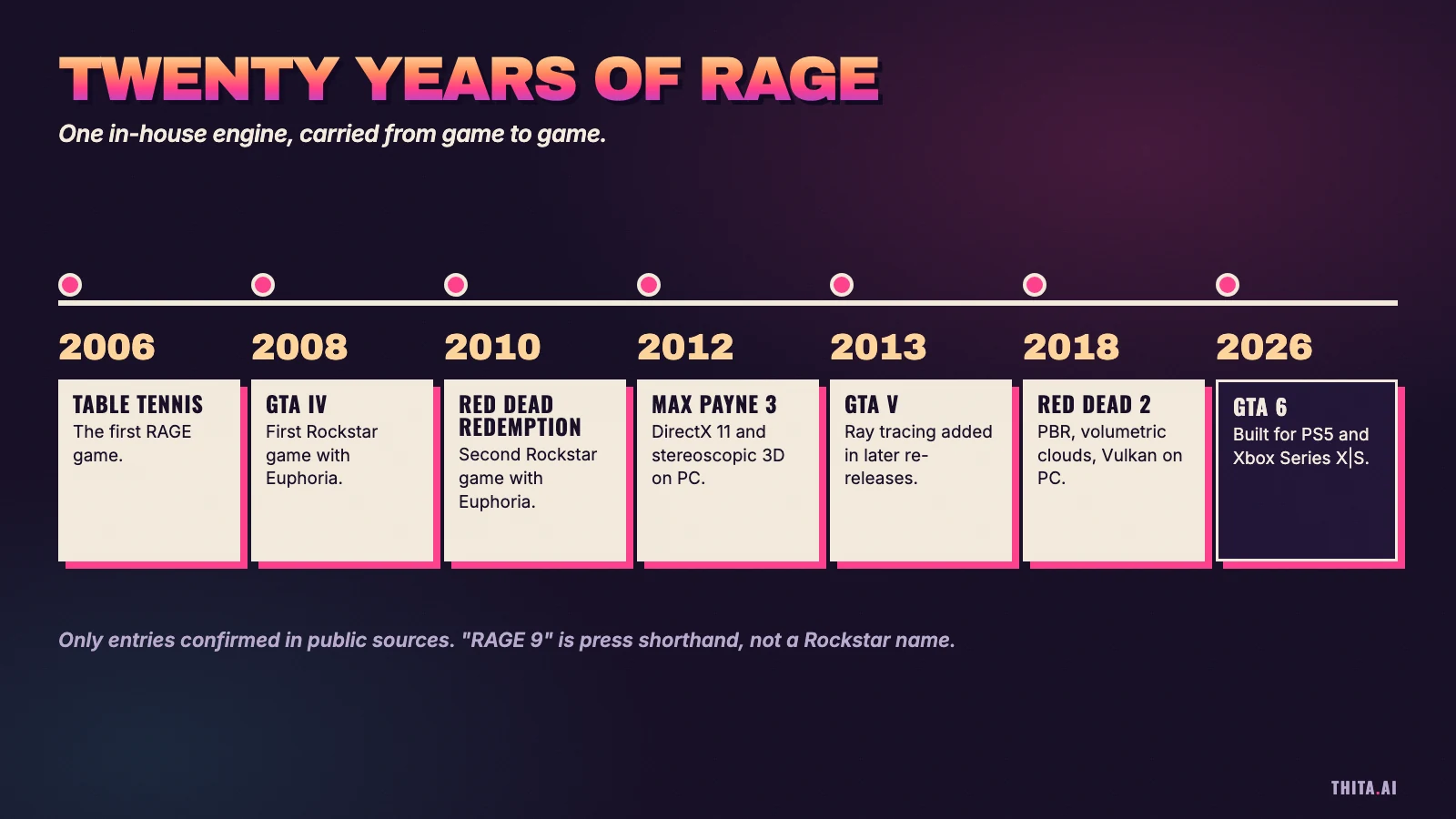
| Game | Year | Notable engine tech (publicly reported) |
|---|---|---|
| Rockstar Games Presents Table Tennis | 2006 | First RAGE game |
| Grand Theft Auto IV | 2008 | First Rockstar game with Euphoria procedural animation |
| Red Dead Redemption | 2010 | Second Rockstar game with Euphoria |
| Max Payne 3 | 2012 | DirectX 11 and stereoscopic 3D on PC |
| Grand Theft Auto V | 2013 | Ray-traced reflections and shadows arrived in later re-releases |
| Red Dead Redemption 2 | 2018 | Physically based rendering, volumetric clouds, Vulkan on PC, reworked Euphoria |
| Grand Theft Auto VI | 2026 | Built for PS5 and Xbox Series X|S |
The same Wikipedia article says RAGE has integrated the Bullet physics library, and Euphoria for character animation, from early in its life. Euphoria is middleware from NaturalMotion. The Euphoria article describes it as dynamic motion synthesis: characters animated from a simulation of body, muscles and motor, so a stumble is generated at the moment it happens and does not repeat exactly.
Wikipedia's GTA VI entry says it is built in RAGE. Its RAGE article, citing Bloomberg and Polygon reporting, says GTA VI brings significant engine upgrades. Rockstar has not confirmed the details, so whether the engine was rebuilt or extended is something nobody outside the studio can say.
Does GTA 6 use Unreal Engine?
No public evidence says it does. Every mainline GTA and Red Dead game since GTA IV (2008) has run on RAGE. There has been no credible report of a switch for GTA 6.
Which raises the better question. Why would a studio with a budget this size not just license an engine?
Why does Rockstar build its own engine instead of using Unreal 5?
The question is not which engine is better. The question is which constraint you would rather own.
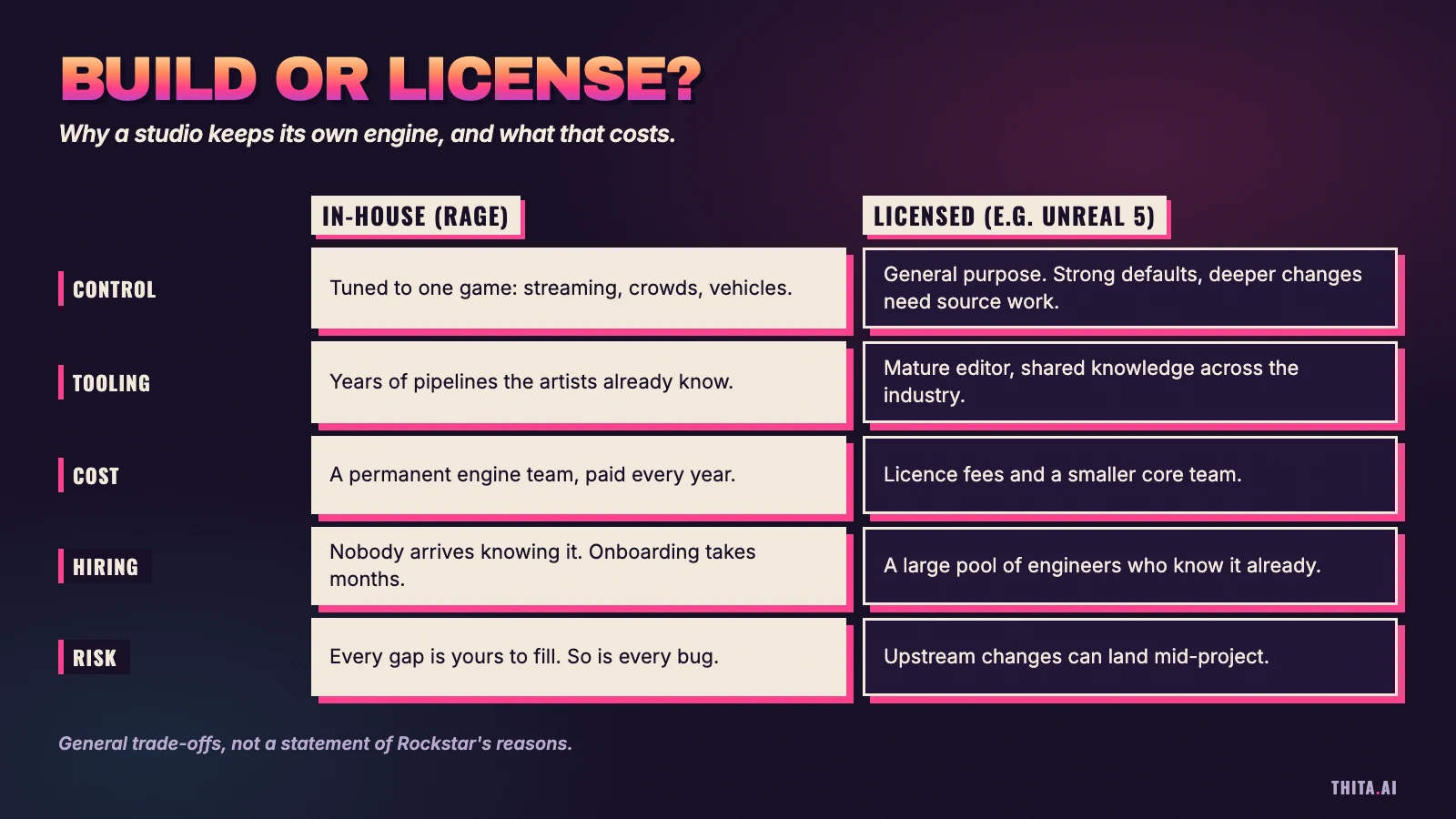
What follows is the general trade-off. It is not a statement of Rockstar's reasons, which are not public.
What an in-house engine buys
Control over the shape of the problem. A licensed engine is built to be good at many games. An open world with a dense crowd, a traffic system, and a state-sized streaming problem is a narrow target. When the engine and the game are tuned together, you can make decisions that a general tool would never make, like how the city stores pedestrians that nobody is looking at.
Pipelines that already exist. Artists, animators and designers at a studio like this have used one set of tools for years. The cost of retraining a large team, and of porting a decade of assets and scripts, is real. It often beats the licence fee.
Predictable ownership of bugs. When something breaks on a console in the final month, the people who can fix it are in the building and have the source.
What it costs
An engine team is a permanent expense. New hires arrive knowing nothing about your engine, and it takes months before they are useful. Every gap in the tooling is yours to fill. Features that a licensed engine ships for free, such as new rendering techniques, you build or you go without.
Licensed engines flip each of these. The tooling is mature, hiring is easier, and the cost is mostly a fee and a smaller core team. The price is that deep changes mean working in someone else's source, and upstream changes can land in the middle of your project.
Neither side is wrong. Rockstar's size, release cadence of one major game every several years, and the particular shape of its games make owning the engine a reasonable bet. From the outside, that is an inference, and a safe one.
How does the GTA 6 engine work as a system?
Start with the map.
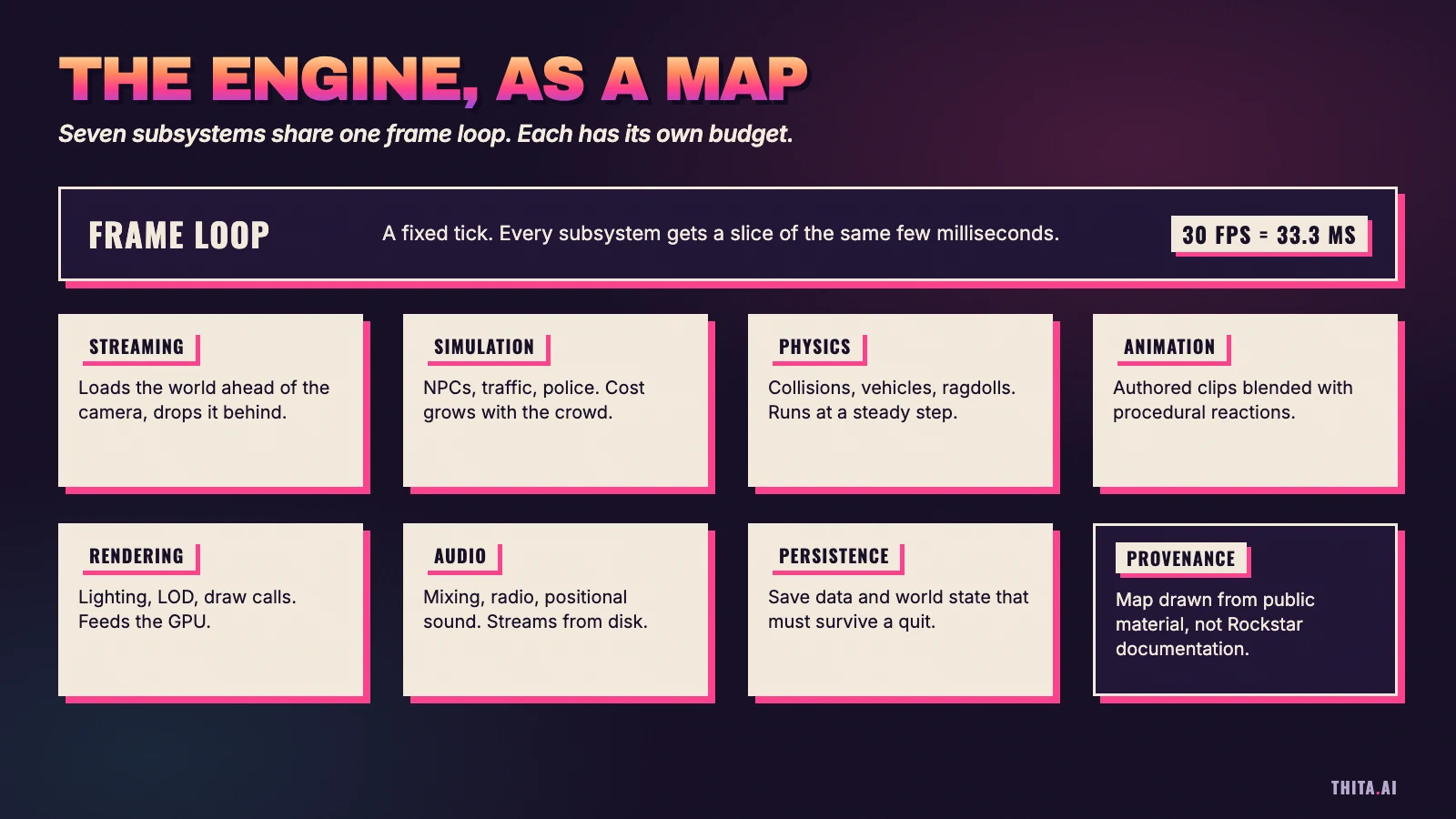
An engine of this kind is usually organised as a set of subsystems that share one clock. The details of RAGE's internals are not public. What follows is how engines of this class generally divide the work, and how the public reporting on GTA 6 fits that division. From the outside, the likely shape is a frame loop with seven participants.
Each one gets its own budget. The frame is the shared resource. Every subsystem is a tenant.
One more point before the tour. The game's console targets matter. Rockstar confirmed 30 fps on both consoles in August 2026. TweakTown reported on 10 November that this includes the PS5 Pro, with PSSR and ray-traced shadows. Digital Foundry's analysis points at the CPU, not the GPU, as the limit. Wikipedia's GTA VI article makes the same point: NPC density and AI heavily tax the Zen 2 cores. The bottleneck is simulation, not the picture.
World streaming: how does a map this big fit in memory?
Stand on a rooftop and the whole city seems to be there. Only a few hundred meters of it is real geometry. The rest is a budget decision, and streaming is the subsystem that makes it.
Streaming decides what to load ahead of the camera, what to keep, and what to drop behind. Wikipedia reports a playable area about three times Red Dead Redemption 2's. Rockstar has published no figure, and fan estimates vary. Either way, it cannot be resident at once.
So the engine thinks in budgets. A fixed amount of memory for geometry, textures and sound. A fixed amount of disk bandwidth. A prediction of where the player will be in a few seconds, based on speed and direction. Nearby tiles get full detail. Distant ones get cheaper models. Far ones become a silhouette.
Streaming is the same problem as virtual memory, wearing a different coat. The engine is deciding which pages stay resident and which get evicted. If you want the mechanics, the OS lessons on demand paging and page faults cover exactly the miss-and-recover pattern that a streaming engine tries to avoid at 200 kilometers an hour.
The full treatment, including why a game this size takes the disk space it does, is in the post on GTA 6 file size and loading screens.
Deciding what is near the player is also a spatial query. Cities are indexed by space, in grids, trees and hashes, so that "what is within 300 meters" is a lookup and not a scan. The geospatial indexing lesson covers quadtrees and geohash, the same family of structures a map service uses to find the nearest cab.
Simulation: how does a city fill itself with people?
Pedestrians, traffic and police are the part of the game that players read as life. They are also the part that costs the most CPU per frame, because their cost grows with the crowd.
The standard answer, in this class of game, is level of detail for behavior. Close to the player, an NPC runs the full routine: pathfinding, reactions, animation, conversation. Farther away, the same NPC is a cheap abstraction that moves along a lane and nothing more. Out of sight, it may not exist at all, and the system only keeps a rule for how to create a plausible one when you turn the corner.
This is a decision about attention. What the player sees is simulated. The rest is a rumor the system keeps alive.
Police behavior sits on top of that. Wanted levels, search patterns and escalation look like a state machine from the outside. Most game AI is one.
The longer version, including what is publicly known about NPC behavior and patents, is in the post on GTA 6 NPC AI and the wanted system.
Physics and Euphoria: why does a stumble look different every time?
Physics in a game is a numerical integrator that runs at a steady step. Cars, props, debris and bodies each get a small calculation per tick. The step needs to be steady, because physics that runs at a varying rate behaves differently from frame to frame, and that is how objects tunnel through walls.
Rockstar's physics has used the Bullet library, per Wikipedia. The more famous layer is Euphoria. In a conventional pipeline, an animator authors a clip and the engine plays it. Euphoria generates part of the motion at runtime from a model of the character's body. That is why a pedestrian grabs at a railing as they fall, and why no two falls match.
This costs CPU, and CPU is the scarce resource here. It is also a reason RAGE games feel the way they do. A fight in a Rockstar game is partly a physics experiment.
GTA IV was Rockstar's first game to use Euphoria. NaturalMotion announced in 2017 that it would end licensing. Whether and how Euphoria is changed in GTA 6 is not public. RDR2 is documented as having reworked it.
Animation: how do authored clips and procedural motion mix?
Animation is blending. A character at any instant is the weighted sum of several sources: a walk cycle, a head turn, a hand on a weapon, a physics reaction layered over the top.
The engineering question is who wins when they disagree. If a hand is animated to hold a cup and physics says the hand has been hit, one of them has to give. Engines solve this with layers and priorities, and the interesting design work is in the transitions. A poorly authored transition is the thing players call "floaty".
Animation is also a data problem. Thousands of clips have to stream in on demand, and the system has to know which ones the next few seconds are likely to need.
Rendering and lighting: how does the picture reach the screen?
Rendering is the subsystem people name first and the one least specific to this game. Every engine at this scale does roughly the same thing. It culls what the camera cannot see, picks a level of detail for what remains, batches draw calls, and hands the GPU a list.
The cost is spread across two processors. The CPU prepares the work. The GPU executes it. A frame is as slow as the slower of the two, plus the time it takes to hand over. That is why a game can be GPU-bound in one street and CPU-bound in the next.
The RAGE timeline above shows where rendering has moved: physically based materials, volumetric clouds and fog, then ray-traced effects in later GTA V releases. Each one adds cost and each one needs a budget.
Audio: why is sound a streaming problem?
Audio is the quiet subsystem, and the one that breaks immersion fastest when it fails. Radio stations, dialogue, ambient layers and positional effects all stream from disk and mix in real time.
The constraint is latency. A gunshot has to sound on the frame it is fired. Audio runs on its own clock with small buffers, which means that a stall anywhere else in the engine must never starve it. Audio is one of the clearest cases of a consumer that must never wait on a slow producer.
Persistence: what does the game remember?
When you save, the game writes a description of the world that is small enough to store and complete enough to rebuild a believable city. It cannot store every pedestrian. It stores the things that matter: your progress, your vehicles, the state of missions and, for an online mode, your account.
The most useful anecdote about persistence in this series comes from GTA Online. In 2021, a player found that loading took about six minutes because the game parsed a roughly 10 MB JSON file with about 63,000 item entries in a way that scaled badly, and ran a duplicate check against the whole array for each new item. Both fixes together cut the load time to under two minutes. Rockstar shipped the fix and paid a bounty. The full account is in the original write-up.
The lesson is that scale hides in places nobody profiles. A list of 63,000 items is not big. Checking each item against every other one is.
What programming language is GTA 6 coded in?
Almost certainly C++. RAGE is a C++ engine by every public account, which is the standard choice for this class of software, because it gives direct control over memory and over how data is laid out for the CPU cache. Rockstar has not published its source, so this is a well-supported inference and not an official statement.
There is a second layer. Rockstar games run mission and ambient logic in a proprietary scripting language, not in the engine's C++. The community calls it GTAScript. The GTA wiki page on GTAScript describes it as Rockstar's own language used across RAGE titles, with typed variables and no garbage collection, and a virtual machine whose main loop is small and allocates nothing once a thread exists. Built-in functions that only scripts can call are known as natives.
Modders have documented this layer for years. Decompilers exist for the compiled script files of GTA V and Red Dead Redemption 2, for example the GTA V Script Decompiler, which handles the compiled formats across several platforms. That is how the community knows scripts are shipped as compiled files, run by a VM, calling into the engine through natives.
Whether GTA 6 uses the same scripting layer is not public. It is a reasonable guess given the continuity of the engine, and only a guess.
The split itself is the lesson. The engine is fast and hard to change. The script layer is slower and easy to change. Designers write missions in the second without touching the first. It is a clean boundary, and clean boundaries are what let a large team work in parallel.
How does the frame work like an orchestra?
Everything above has to happen inside one frame. At 30 frames per second, that is 33.3 milliseconds. At 60, it is 16.7.
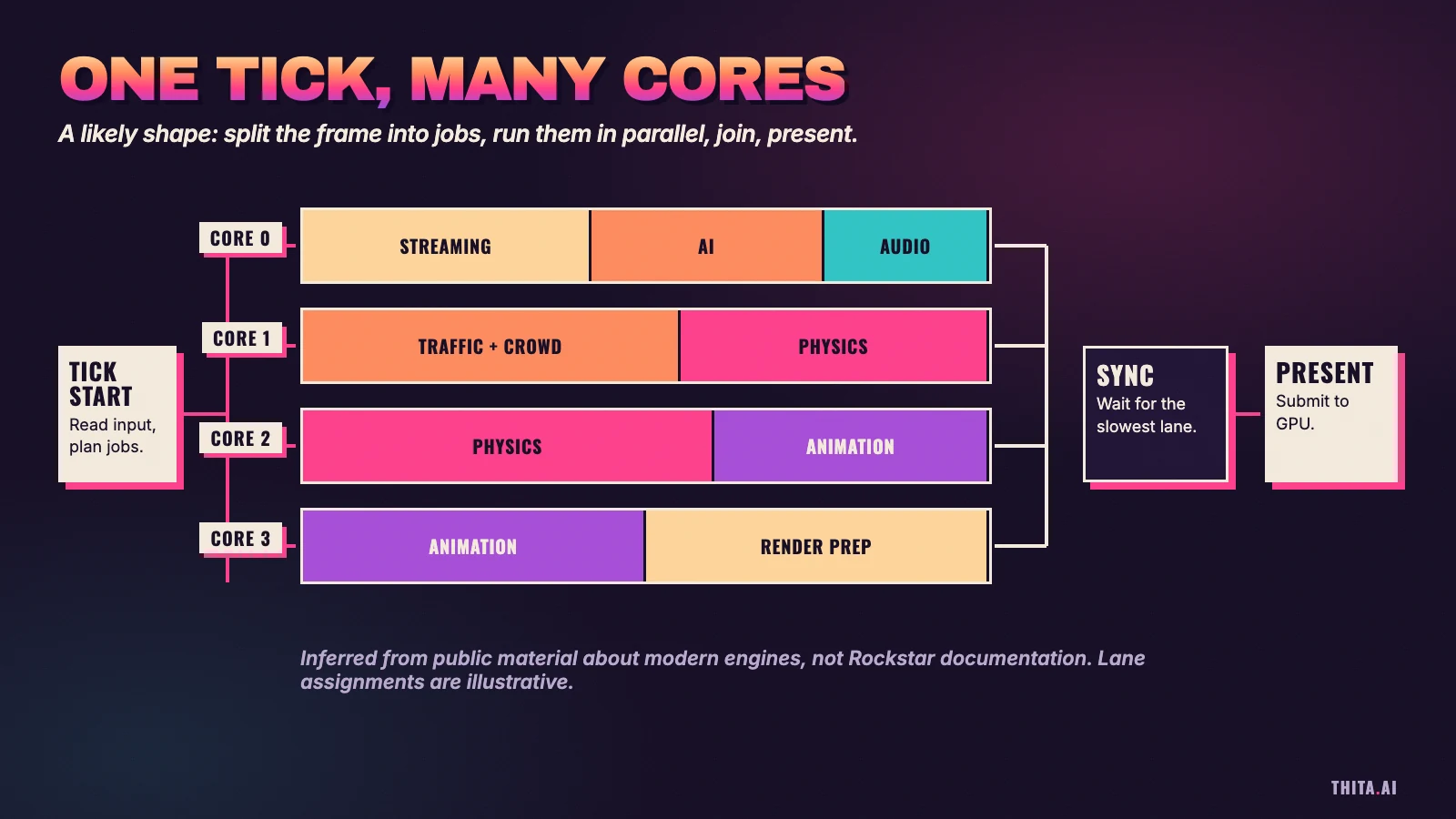
From the outside, the likely shape is a fixed tick with a job system underneath. Modern console CPUs have several cores, and the PS5 and Xbox Series X|S each have eight Zen 2 cores. An engine cannot run its subsystems one after another and still fit. It breaks the frame into small jobs, hands them to a pool of worker threads, and joins at a sync point before the GPU is given work.
This is inference. Rockstar has not documented its scheduler. But the pattern is so common in engines of this class that it is the safe default, and the diagram labels it as such.
A few properties follow from the shape.
The slowest lane sets the pace. A frame ends when the last job finishes. One long job on one core holds up everyone else. Engine programmers spend a lot of time breaking up the long job.
The tick is fixed, so the budget is fixed. If streaming takes more than its slice, something else loses its slice. That is why the list of subsystems is also a list of trade-offs.
Work that can wait should wait. Not everything has to complete inside the frame it started in. A path search can take several frames. An asset can arrive late and pop in. The art is deciding which work is allowed to be late.
Think of it as an orchestra. The conductor is the tick. Each section plays its part, and the piece only works if everyone arrives at the bar line together. A late violin is a glitch. A late brass section is a crash.
If you want the OS view of that, the thread pools lesson covers why you keep a fixed set of workers and feed them tasks, rather than spawning a thread per job. A game engine's job system is that pattern with a deadline attached.
Why 30 and not 60 is a question with enough depth for its own post. It is in why GTA 6 runs at 30 fps.
What about the online side of the engine?
RAGE is a client engine. It runs on your console. A multiplayer mode adds a second system around it: servers, matchmaking, sessions, and persistence for accounts and money.
GTA Online has been widely described as a hybrid. Players' consoles handle much of the moment-to-moment play, and Rockstar's servers handle the things that must not be cheated or lost. How GTA 6 Online will be built is not public. Twitch CEO Dan Clancy told Bloomberg he expects GTA 6 multiplayer in 2027. Rockstar has not announced a date. The reasonable expectation is a similar split, because the constraints that produced it have not changed.
The full design discussion is in the post on GTA 6 multiplayer and servers.
What are the lessons from the GTA 6 engine for engineers?
Five things carry over, and none of them are about games.
- Budgets beat speed. The design is the allocation of a fixed amount of time and memory.
- Attention is the scarce resource. Simulate what is observed and keep a rule for the rest.
- Draw a boundary and keep it clean. The engine and script layer let hundreds of people work in parallel.
- Scale hides in small places. A 10 MB file added minutes to every GTA Online login.
- Own what you must, borrow what you can. Every team faces the build-or-license decision.
How would you design a game world that never loads?
In an interview it might be phrased like this: "Design the backend of a city that never loads."
An answer that works has a shape:
- Clarify scope. One player or many? What is the frame or latency budget? What is allowed to be stale?
- Estimate. How big is the world, how much of it is near any one player, how fast do they move?
- Partition the world into tiles and index them spatially.
- Stream by prediction: load ahead of the player, evict behind.
- Set a level of detail for each tier, from full simulation to a rule.
- Name the failure mode. A late tile is a visible pop. Decide whether you drop detail or stall.
- Talk about what you would measure.
The structure is the point, and it works for any prompt.
Thita's system design course teaches each of these pieces as an interview topic, and the AI system design mock is a place to try the answer out loud.
If this is the first time a system like this has made sense to you, that is the start of system design, not the end of it. The system design roadmap lays out the rest in order.
Frequently Asked Questions
What engine does GTA 6 use?
GTA 6 runs on RAGE, the Rockstar Advanced Game Engine, which is Rockstar's in-house engine. It is not Unreal Engine. "RAGE 9" is an unofficial label that began with 2022 insider claims. Rockstar does not number its engine versions publicly.
Is RAGE 9 a new engine?
Not officially. "RAGE 9" is an unofficial label that began with 2022 insider claims. Wikipedia's RAGE article, citing Bloomberg and Polygon, says GTA VI brings significant engine upgrades, but Rockstar has not confirmed the details.
What programming language is GTA 6 coded in?
The engine is almost certainly C++, the standard language for engines of this class. Rockstar's games also use a proprietary scripting language for missions and ambient logic, which modders have documented for GTA V.
What is the Euphoria engine?
Euphoria is character animation middleware from NaturalMotion. It generates motion at runtime from a simulation of the body, so reactions like stumbles and falls differ each time. GTA IV was Rockstar's first game to use Euphoria. NaturalMotion announced in 2017 that it would end licensing.
Does GTA 6 use Unreal Engine 5?
No public report says so. Every mainline GTA and Red Dead game since GTA IV (2008) has run on RAGE. The usual reasons given for building in-house are control, existing pipelines and tuning for one kind of game.
How was GTA 6 made?
It was built on RAGE by Rockstar's studios over several years, and was delayed twice, first to 26 May 2026 and then to 19 November 2026. The details of the internal process are not public. What can be said is that the engine, tools and scripts come from a pipeline Rockstar has maintained since the mid 2000s.
Topics
Related on Thita
Your next step
Learn the system design behind worlds like this
Streaming, caching, real-time networking, state machines and geospatial indexes are the same ideas system design interviews test. Thita teaches them in 12 families with 26 worked case studies, and every lesson can be heard with an AI coach you can stop and ask.