
System Design
GTA 6 File Size: Why It Is About 210 GB, and the Streaming System Behind It
GTA 6 file size is about 210 GB on PS5, and Rockstar says up to 212 GB to preload. What fills it, and how world streaming avoids loading screens, for engineers.

The GTA 6 file size is about 210 GB. Rockstar says the preload needs up to 212 GB depending on your device. On Xbox, the store listing shows 209.86 GB, and a larger figure has been reported from Microsoft's backend data.
That is the number. The rest of this post is why, and it is the more interesting half.
The better question is why the number is that large, and why a game that large can drive across a state without asking you to wait. This post answers both. It is part of a series on how GTA 6 is probably engineered, and the pillar post on what engine GTA 6 uses sets the frame for the rest.
Updated 19 November 2026, launch day. Figures are checked against the sources linked below.
What is the GTA 6 file size on PS5 and Xbox?
Here are the figures, with who said what and when. Rockstar published one number. Everything else comes from preload screens and store listings that others copied.
| Platform | Reported figure | Source and date |
|---|---|---|
| PS5 | about 210 GB | Vice, 11 Nov 2026, citing PlayStation guidance |
| PS5 (free space) | at least 212 GB free | Same Vice report |
| Xbox Series X|S | 209.86 GB store listing; a 225.34 GB figure from Microsoft's backend data was reported | Xbox Store listing, and Notebookcheck, Nov 2026 |
| Physical (German box) | 230 GB printed | Vice, 11 Nov 2026 |
| Rockstar, official | "up to 212 GB depending on your device" (preload) | Quoted on GTASix, Nov 2026 |
To install, plan for 212 GB free on PS5. Xbox figures are still settling.
Two things stand out. The PS5 numbers agree closely, and the Xbox sources do not, so treat 225 GB as reported, not confirmed. Your console's store page is the final word for your region. Vice notes that regional builds differ slightly, with the Australia and New Zealand build listed at 209.913 GB.
A day-one patch is possible and would add to this. No size has been announced.
When does GTA 6 preload start?
Rockstar announced the preload on 3 November. It opened on Tuesday 10 November 2026, nine days before launch, per the wording reproduced on GTASix. On PS5 it opens at midnight local time in each time zone. On Xbox it opens globally at 12 a.m. GMT. The files stay locked until release at midnight local time on 19 November. The mechanism is presumably encryption plus a small release signal, but neither platform has published it.
How many GB is GTA 6, and why is it that big?
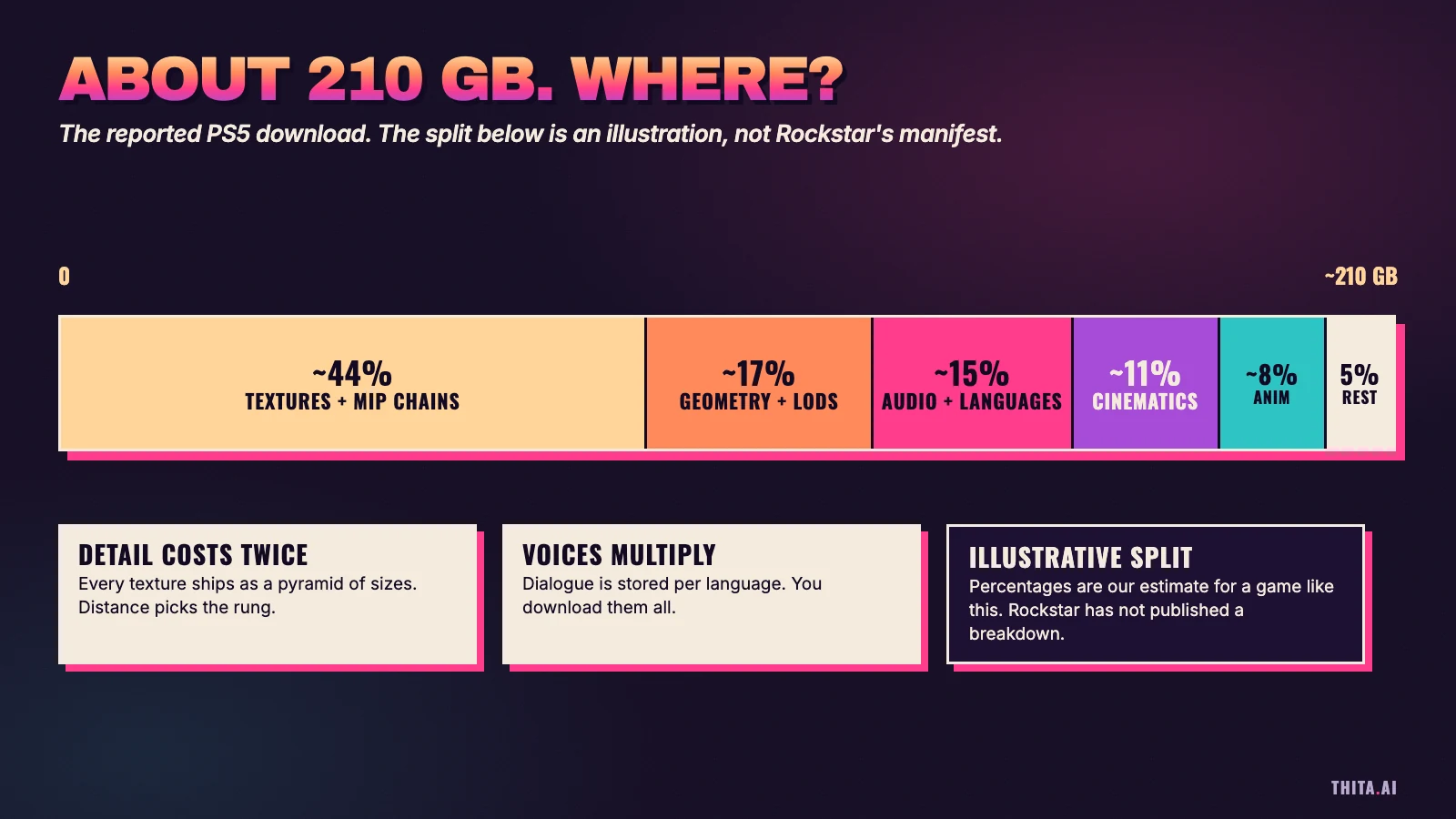
GTA 6 is about 210 GB because a dense open world holds huge amounts of unique texture, geometry, audio and animation. Rockstar has not published a manifest, so the split below is inference from how large open-world games are built. The diagram is an illustration of proportions, not Rockstar's data.
Textures, and the pyramid behind each one
Textures are almost always the largest category in a game like this. A surface is not stored once. It is stored as a mip chain: the full-resolution image, then a half-size copy, then a quarter, down to a single pixel.
The GPU picks the rung by distance. A full mip chain costs about one third more than the top image alone. Multiply by every wall, road and sign, then by the several maps per material (colour, normal, roughness). The pyramid is cheap per texture and enormous in total.
Geometry and levels of detail
The same idea applies to meshes. A building exists as a detailed model, a simpler one, a simpler one still, and finally a flat impostor for the horizon. This is level of detail, and each rung is a separate asset on disk.
You pay for the city several times, once for each distance at which someone might look at it.
Audio, dialogue and languages
A GTA game carries a lot of dialogue, plus radio, ambient chatter and crowd lines, stored per language. Large games commonly ship every language in the base download. Cutscenes and motion-capture animation add more, and neither compresses the way a texture does.
Is anything stored twice?
On a spinning hard drive, a seek costs milliseconds. Old console games fought this by duplicating assets so everything for one area sat next to everything else on the disc. If a street's textures and models were stored contiguously, one long read replaced hundreds of seeks. The price was disk space. The disk structure and performance lesson explains why a head moving across a platter dominates the cost.
Does it still apply? Mostly not on an SSD, where random reads are cheap and there is no head to move. Some studios keep a lighter version because large sequential reads still beat many tiny ones. Which side Rockstar landed on is not public, and the number alone does not say.
How big is the GTA 6 map?
Wikipedia reports a playable area about three times Red Dead Redemption 2's. Rockstar has published no figure, and fan estimates vary.
Square-mile numbers differ mostly because the baselines differ. Los Santos and its surroundings are quoted at about 31 square miles (81 km²) in some places and up to 49 in others, depending on whether you count the ocean. GTAIntel's roundup notes that such figures rely on trailer analysis and leaked footage.
No one outside Rockstar has the ruler.
Here is the engineering point. Map size does not set file size by itself. What sets it is how much unique detail fills that space. An empty desert is cheap. A dense city costs a great deal per block. Density is also what makes loading hard.
Why does GTA 6 have almost no loading screens?
Because the game is never "loaded." It is always loading, a little at a time, ahead of you.
A player in a car believes the whole state is there. It is not.
At 200 kilometers an hour the engine has about a second to bring in each new block. A few hundred meters are full detail, then geometry gets cheaper with distance, then silhouettes stand in for buildings.
From the outside, the likely shape is world streaming, a technique open-world games have used for two decades. This is the general technique, not a claim about Rockstar's implementation.
Cells and rings of detail
The world is cut into cells or tiles. Each cell is a self-contained package: terrain, buildings, props, textures, collision.
Around the player, cells sit in rings. The innermost ring has full detail. The next has reduced detail: lower mips, cheaper meshes. The outer ring is impostors. Beyond that, nothing is resident at all.
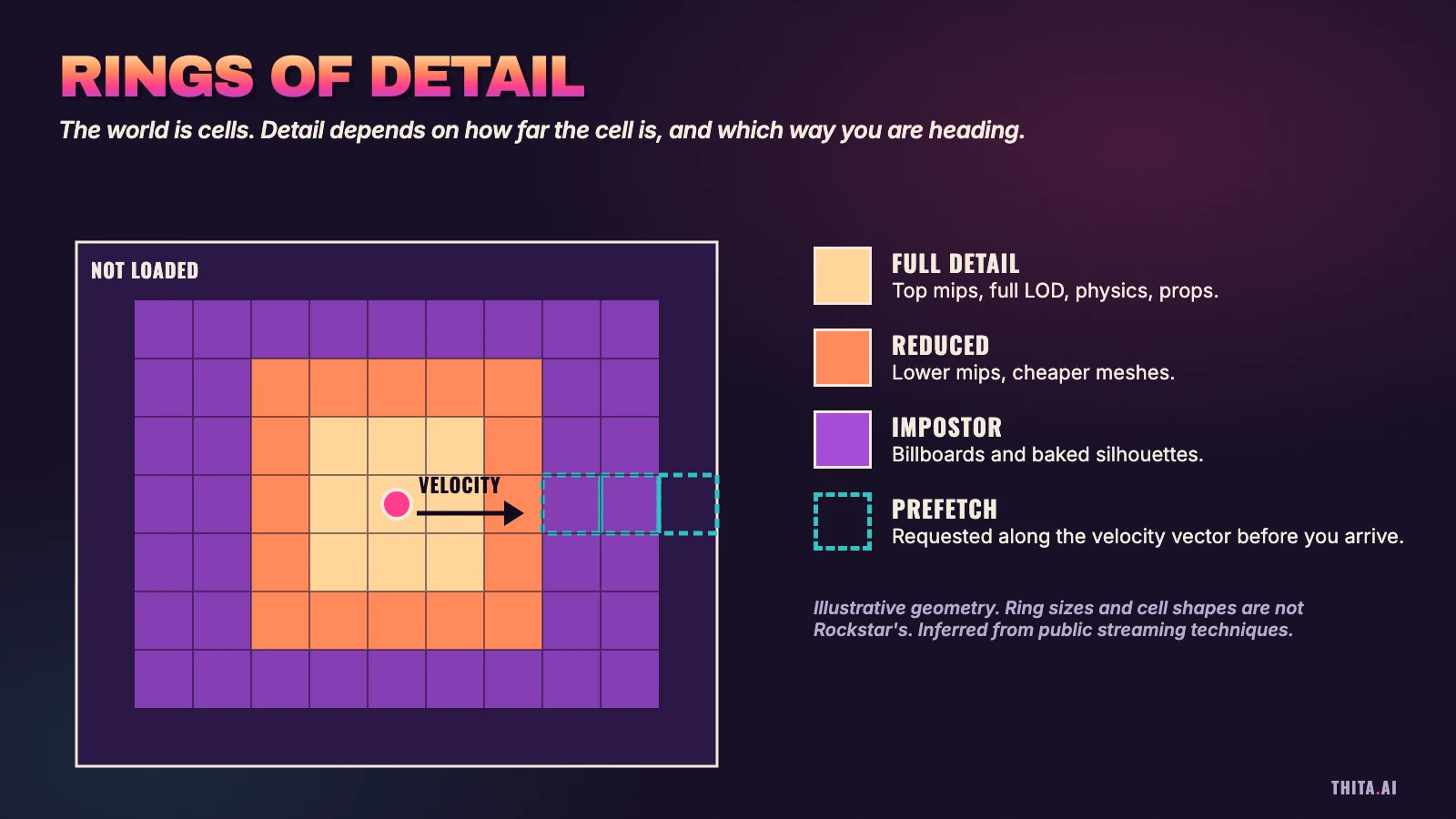
As you move, cells cross ring boundaries. A cell moving inward gets promoted: more detail is read from disk. A cell moving outward gets demoted, and eventually evicted.
Prefetching along the velocity vector
Reading a cell takes time, so waiting until you reach it is too late. The engine looks at where you are going.
Position plus velocity gives a direction. Cells along that direction are requested early, and the faster you move, the further ahead the request reaches. A helicopter needs a longer lookahead than a pedestrian, and a sharper turn invalidates part of the guess.
A wrong guess wastes bandwidth. A late guess shows up on screen.
The memory budget and the eviction policy
Memory is finite. The console has a fixed pool, and a slice of it belongs to streaming. Something has to leave when something arrives.
The natural policy is least-recently-used: evict what you have not touched in the longest time. Real engines add priority on top, so a likely return point such as a mission location may be kept. How GTA 6 weighs this is not public.
What happens on a miss?
Sometimes the guess is wrong, or the disk is busy. The failure looks like one of three things:
- Pop-in: an object appears at the last moment because its cell arrived late.
- The blurry texture: the low-mip version stays on screen while the sharp one is still in flight.
- The stall: the engine holds a frame, or the player, until the data arrives. This is the worst case and the one designers spend their effort avoiding.
Pop-in and blur are graceful degradation. The engine chooses a worse picture over a late frame. This ties straight into frame time. The post on why GTA 6 runs at 30 fps covers how streaming competes with AI, physics and rendering for the same few milliseconds.
The same rings also govern who exists. The post on GTA 6 NPC AI and the wanted system looks at how pedestrians and traffic spawn in a ring around you, and they share the pool with the geometry.
Is world streaming just demand paging?
Close enough that the vocabulary transfers one to one.
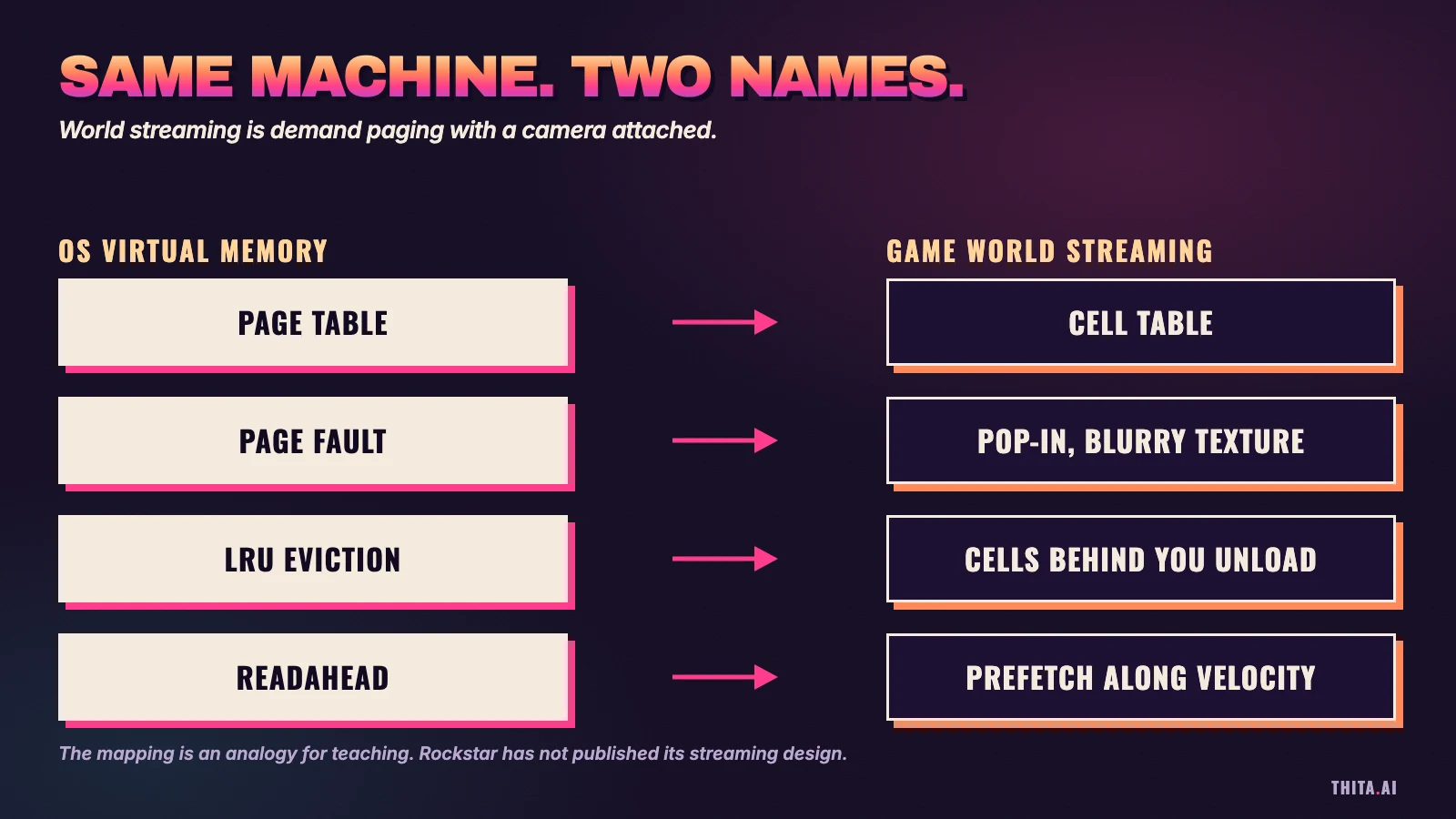
| OS virtual memory | Game world streaming |
|---|---|
| Page table | Cell table: which cells are resident, and at what detail |
| Page fault | The player needs a cell that is not loaded: pop-in, blur or stall |
| Page replacement (LRU and variants) | Evict the cells least likely to matter |
| Readahead | Prefetch along the velocity vector |
| Working set | The rings around the player |
| Thrashing | Turning fast enough that cells are evicted before they are used |
Demand paging means a program is given a large address space, but only the pages it actually touches are brought into memory. Touch a page that is not resident and the hardware raises a page fault. The OS fetches the page, updates the table and resumes. The demand paging and page faults lesson walks through the exact sequence.
A game does the same job one level up. The address space is Leonida. The resident set is what the player can see soon. A fault is a cell that arrived late.
One difference: an OS cannot predict much, but a game knows the camera, the speed and the road network. Streaming is paging with extra information.
The page replacement algorithms lesson covers FIFO, LRU and clock. Memory-mapped files are a close relative of this idea, since engines can map asset packs and let the OS page them in on demand.
How does the SSD make this possible?
Rings and prefetching are the policy. Hardware sets the speed limit.
Both consoles were built around the problem. These specs are public:
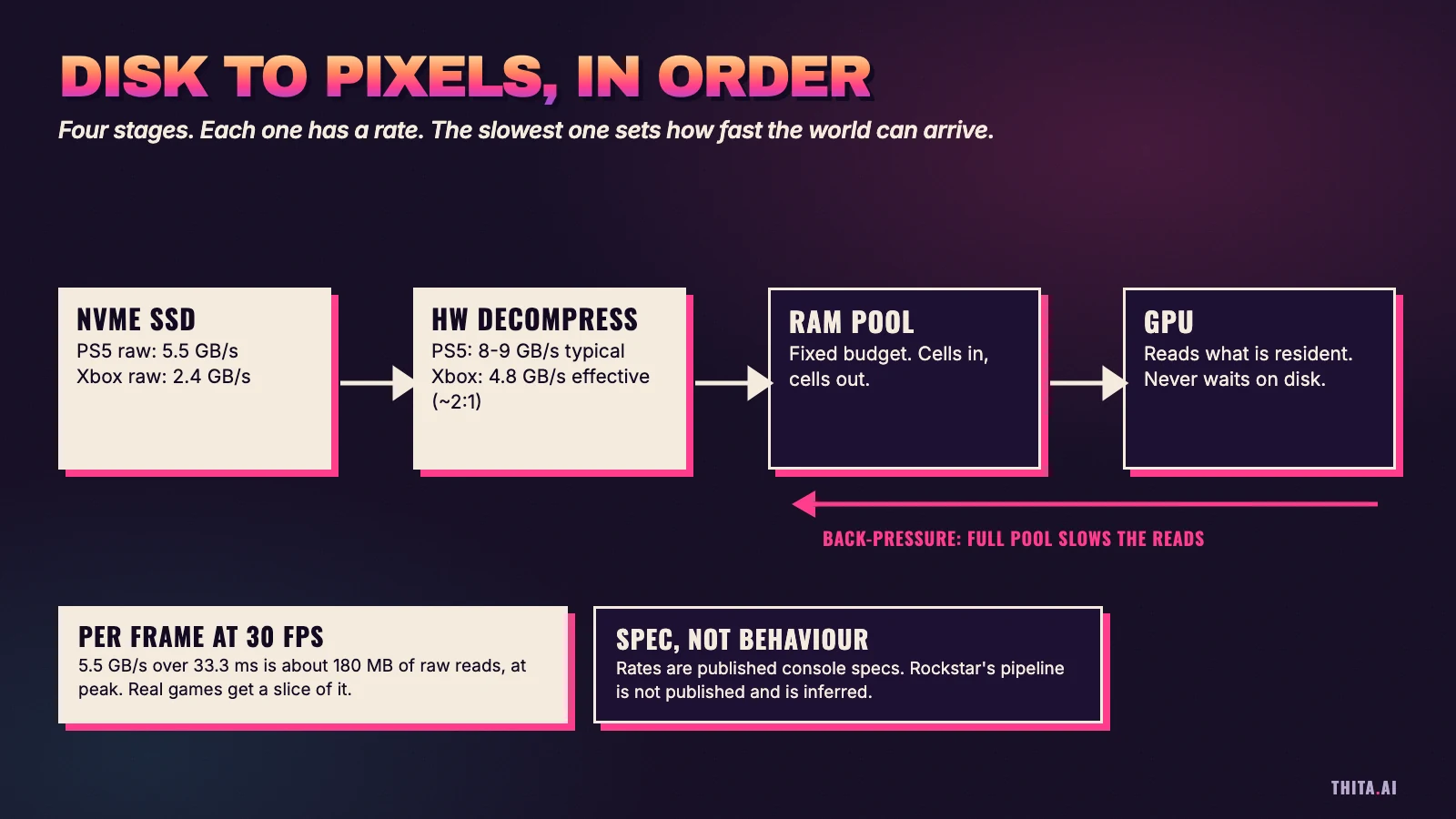
- PS5: 825 GB SSD, 5.5 GB/s raw read speed, and a dedicated decompression unit supporting zlib and Oodle Kraken. Wikipedia lists typical throughput of 8 to 9 GB/s after decompression, peaking at 22 GB/s. (PlayStation 5 on Wikipedia)
- Xbox Series X: 1 TB SSD, 2.4 GB/s raw, 4.8 GB/s effective, assuming about 2:1 compression, through the compression block, which handles zlib and a texture format called BCPack. The Series S has a 512 GB SSD with the same raw throughput. This is the Xbox Velocity Architecture, with DirectStorage as the API. (Xbox Series X and Series S on Wikipedia)
Assets are stored compressed and inflated on the way in by dedicated silicon, which frees the CPU cores for simulation.
The I/O pipeline, stage by stage
Four stages, each with a rate: SSD read in large aligned chunks, hardware decompression, a fixed pre-allocated RAM pool, and a GPU that reads only what is resident.
The slowest stage sets the pace. And if the pool is full, the request queue slows down. That is back-pressure: a full buffer pushes on the producer so the system degrades instead of overflowing. It is the textbook shape of an I/O chain.
A little arithmetic helps. At 30 fps a frame lasts 33.3 ms. A peak of 5.5 GB/s is about 180 MB of raw reads per frame. No game gets all of it, because textures, geometry and audio queue for the same pipe. But the figure explains why the same design would choke on a 100 MB/s hard drive. These are specs, not behaviour. How Rockstar schedules requests is not public.
Where do the loading screens still hide?
Almost no loading screens is not the same as none. Here is where we would expect them. This part is inference.
- Interiors. Walking through a door can swap the world for a different one with a different memory profile. A short fade or elevator ride often covers that swap.
- Mission starts and cinematics. Scripted scenes pull in specific characters, vehicles and animations that streaming would not have fetched.
- Fast travel and respawn. If you jump across the map, the prefetch has had no time to work, so something has to cover the gap.
- First boot and mode changes. The working set is built from scratch.
Most of these are disguised with a door animation, a fade or a long camera move, which buys the engine a few seconds.
How do millions of people download 210 GB on launch day?
Do the arithmetic. Say 20 million consoles each pull 210 GB. That is 4.2 exabytes, an illustrative number, not a Rockstar one. If all of them started at the same instant at 100 Mbps each, the aggregate demand would be 2 petabits per second. No origin server survives that.
So the work moves to the edge. Platform holders and publishers serve downloads from content delivery networks, with copies close to the user. The same logic runs the video services described in the Netflix video delivery architecture and every large video service: cache near the viewer, fall back through layers, keep the origin quiet.
Preloading as capacity planning
Preload is the clever part. Rockstar opened downloads nine days early and the files stay locked until release. The 210 GB moves in the quiet days. At midnight, only a tiny release signal has to reach every console.
That turns a bandwidth spike into a light control-plane event. Move the heavy work out of the peak and leave only the cheap work in it.
Cache failure modes at midnight
Preload does not remove the failure modes. If a patch or a day-one file is not yet warm on the edge, the first wave of requests all miss at once and fall through to the origin. That is a thundering herd, and the cache failure modes lesson shows the standard defences: request coalescing, staggered expiry and pre-warming.
The shape of the problem is the same whatever the platform operators do behind the scenes.
How would you explain demand paging, or plan a 200 GB midnight launch?
Two questions hide inside this post. One belongs to an OS round and one to a system design round.
"Explain demand paging." A process gets a large virtual address space, and pages map to frames lazily. The first touch of a non-resident page raises a page fault. The OS finds a free frame, reads the page from disk, updates the page table and restarts the instruction. If no frame is free, a replacement algorithm such as LRU or clock picks a victim, writing it back if it is dirty. Too many faults means thrashing, when the working set does not fit. Then add the line that earns points: a game's world streamer is the same machine with a better predictor.
"Design a content delivery plan for a 200 GB launch to 20 million consoles at midnight." Estimate first: about 4 exabytes in total, and compute the peak if everyone starts together. Move the bytes early with a locked preload and a small release signal at launch. Serve from CDN edge nodes with layered caches and regional origins. Chunk the file so downloads resume and verify. Stagger the release and any patch rollout, and pre-warm hot objects to avoid a thundering herd. Watch cache hit rate and origin load, with a fallback to throttle.
If this is the first time a system like this has made sense to you, that is the start of system design, not the end of it. The guide to starting system design preparation from zero lays out the rest in order. The OS lessons on virtual memory and the system design course cover both halves of this.
Frequently Asked Questions
What is the GTA 6 file size?
The GTA 6 file size is about 210 GB on PS5. Rockstar says the preload needs up to 212 GB depending on your device. On Xbox, the store listing shows 209.86 GB, and a 225.34 GB figure from Microsoft's backend data was reported. A day-one patch is possible and would add to this. No size has been announced.
How many GB is GTA 6 on PS5?
About 210 GB, per Vice on 11 November. PlayStation's guidance asks owners to have at least 212 GB free, so plan for that. A day-one patch is possible and would add to it.
How big is the GTA 6 map compared with GTA 5?
Wikipedia reports a playable area about three times Red Dead Redemption 2's. Rockstar has published no figure, and fan estimates vary.
Is there a GTA 6 PC file size?
No PC version has been released or dated, so there is no official PC size.
Does GTA 6 have loading screens?
Based on the engineering, it should have very few during open-world travel, because the world streams in around the player. Loading is more likely to hide in interiors, mission starts, cinematics and fast travel. That last part is inference, not something Rockstar has confirmed.
Why does GTA 6 need an SSD-class console?
A streamed world needs high, steady read throughput so detail arrives before the camera does. The PS5 and Xbox Series X|S both pair fast SSDs with hardware decompression for exactly this job. A mechanical drive cannot supply data at that rate.
Topics
Related on Thita
Your next step
Learn the system design behind worlds like this
Streaming, caching, real-time networking, state machines and geospatial indexes are the same ideas system design interviews test. Thita teaches them in 12 families with 26 worked case studies, and every lesson can be heard with an AI coach you can stop and ask.