
System Design
GTA 6 Multiplayer and Servers: How GTA 6 Online Will Likely Be Built
Does GTA 6 have multiplayer? Not at launch. What is confirmed, why GTA Online is peer to peer, and how GTA 6 Online servers and netcode would likely work.
GTA 6 multiplayer is not in the game you can buy today. As of 19 November 2026, Rockstar has announced no online mode for GTA 6, and a 2027 window for GTA 6 Online comes from outside commentary, not from the studio. So there are no servers to measure yet. There is only a design problem, and it is a good one.
Updated 19 November 2026, launch day. Figures are checked against the sources linked below.
This post is part of a series on how GTA 6 is probably engineered. The RAGE engine pillar covers the single-player machine. Here we look at what happens when thirty-odd people share it.
Does GTA 6 have multiplayer, and when does GTA 6 Online come out?
Short answer: No. GTA 6 launches on 19 November 2026 as a single-player game, and GTA 6 Online has no official date. Twitch CEO Dan Clancy told Bloomberg he expects GTA 6 multiplayer in 2027. Rockstar has not announced a date.
Wikipedia's article on the game lists the mode as single-player and notes that the only mention of a large online mode is an older press report, not a confirmation. On an earnings call, Take-Two CEO Strauss Zelnick said the company expects to support GTA Online going forward, as TweakTown reported. He did not say how it will evolve alongside GTA 6.
Everything below about GTA 6 Online is inference from how GTA Online works, what the industry does, and what the physics of networking allow. Where Rockstar has published nothing, we say so once and move on.
How do GTA Online servers work today?
The widely documented picture is a hybrid. Rockstar runs backend services: login, matchmaking, saves, the economy. Inside a session, players connect directly to each other, with one player acting as host. Rockstar has never published a technical description of this. What we know is community-level understanding, so treat the details as reported, not official.
Two things are well supported. Sessions have a host, and the host can change when the host leaves. And Wikipedia's GTA Online article records that the current-generation versions allow up to 30 concurrent players, while the PS3 and Xbox 360 versions allowed 16.
Why was peer to peer the right call in 2013?
Think about what a dedicated server costs. You rent compute for every active session, in every region, for every hour anyone plays. A hit game has millions of session-hours a week, and most of them are people driving around alone.
Peer to peer moves that bill onto the players' consoles. Their CPUs run the simulation. Their upload bandwidth carries it. The studio pays for login and storage, which are small by comparison.
It also scaled on its own. Every new player brings their own server. There is no capacity planning for "launch night", at least not for the game state.
That was a good trade in 2013. It was an old pattern, peer to peer networking, applied to a game.
What did peer to peer cost?
It cost trust. When the simulation runs on a player's machine, the player can lie to it.
A mesh has no referee. Each client holds a version of the world and tells the others about it. A client that says "I have a billion dollars" or "I am standing here, invulnerable" is hard to contradict, because no machine exists whose job is to disagree. That is the root of the mod menus and the griefing that GTA Online players know well.
It also cost consistency. Players in one session can have different network paths to each other, so there is no single ping and no single truth. A host with poor upload bandwidth or a strict NAT can make a lobby miserable. When host migration fails, the lobby can end.
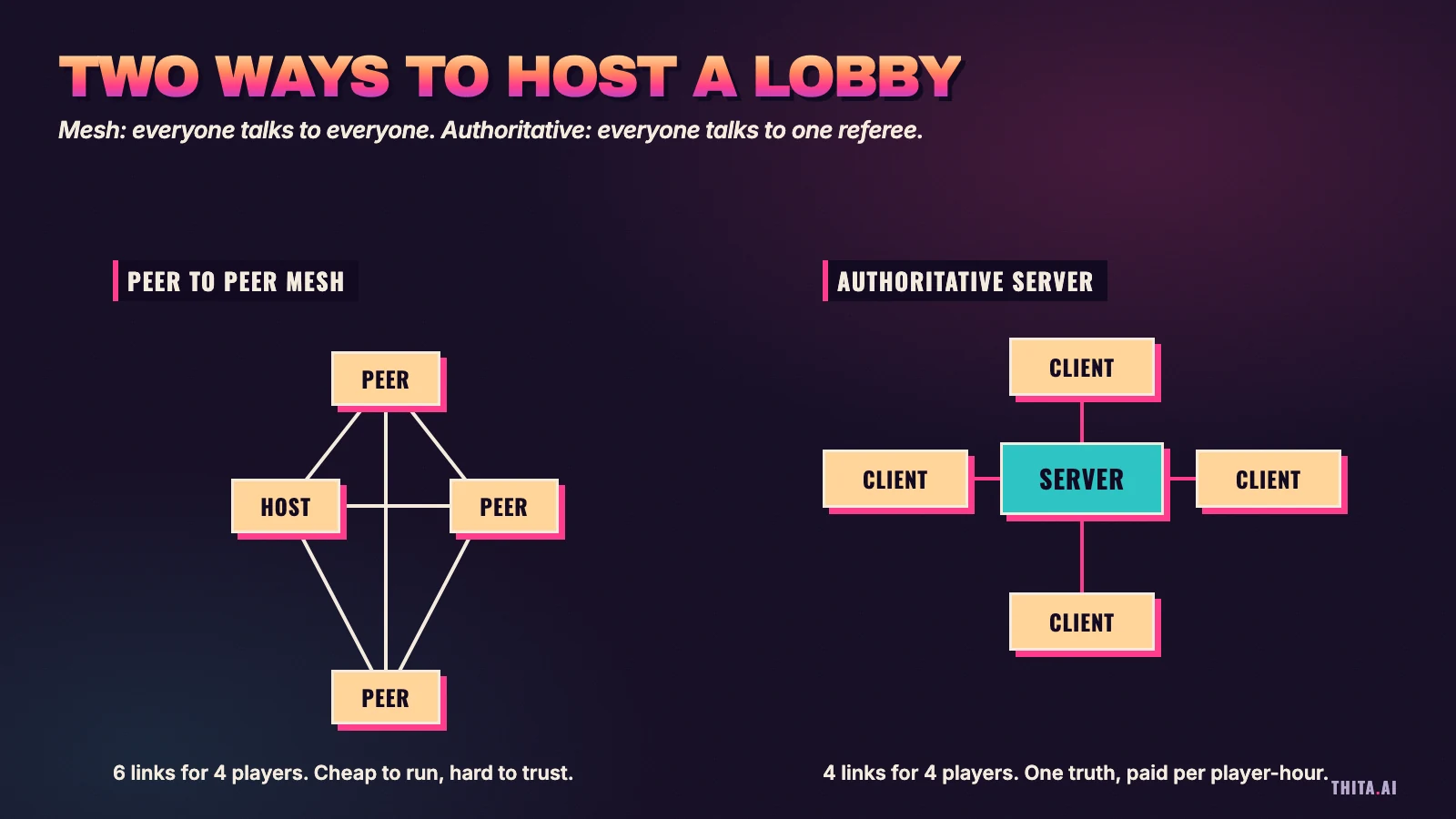
And it capped session size. In a full mesh of N players, every client holds N-1 connections, and the total link count grows as N(N-1)/2. Four players need 6 links. Thirty players need 435. That quadratic growth is a quiet reason session sizes stay in the tens.
What is the difference between peer to peer and client-server?
In peer to peer, clients exchange state with each other and one of them usually acts as referee. In client-server, every client talks to a dedicated server that owns the simulation and has the final word. The first is cheap and fast to build. The second is trustworthy and costs money for every player-hour.
| Peer to peer (mesh with a host) | Dedicated authoritative server | |
|---|---|---|
| Who runs the simulation | A player's console | Studio-run machine |
| Cost to the studio | Low, mostly backend | High, scales with player-hours |
| Cheating surface | Large: clients are trusted | Small: server validates input |
| Consistency | Varies per player pair | One shared truth |
| Latency | Direct paths can be short | Depends on server region |
| Host leaves | Needs migration | Session survives |
| Session size | Limited by mesh links | Limited by server CPU and bandwidth |
| DDoS exposure | Player IPs exposed | Server IPs behind protection |
That last row matters. In a mesh, your address is visible to the people you play with, which is why networking courses' attacks-and-defences chapter reads like a GTA Online support thread. A dedicated server hides players behind a front door that someone else is paid to defend.
What would a dedicated GTA 6 server cost?
The honest answer is that nobody outside Rockstar knows, and we will not invent a figure. The shape of the answer is knowable, though.
Cost per player-hour is roughly the price of a server divided by how many players one server can hold. Three levers decide it.
- Tick rate. The server steps the simulation at a fixed rate. A higher tick rate gives tighter hit detection and more CPU per player. Halve the tick rate and you can roughly double the players per machine, at the price of a mushier game.
- Simulation weight. A shooter arena is a few dozen entities. An open-world city has traffic, pedestrians, police, physics props. A server that owns all of that for every session is a heavy tenant.
- Regions. Players on three continents need servers on three continents, each with spare capacity for its own evening peak. Idle capacity in the wrong time zone is still a bill.
The tick rate here is the simulation's heartbeat, not the frame rate on your screen. People confuse the two. The frame side is covered in why GTA 6 runs at 30 fps. On a server there is no frame at all, only ticks, and each tick has a budget just like a frame does.
Open worlds make this harder than it sounds. NPC behaviour has to agree between players. We cover that problem in the NPC and wanted-system post, and it is the main reason a pure peer-to-peer open world gets awkward: two machines running the same crowd will drift apart.
How will GTA 6 Online probably be built?
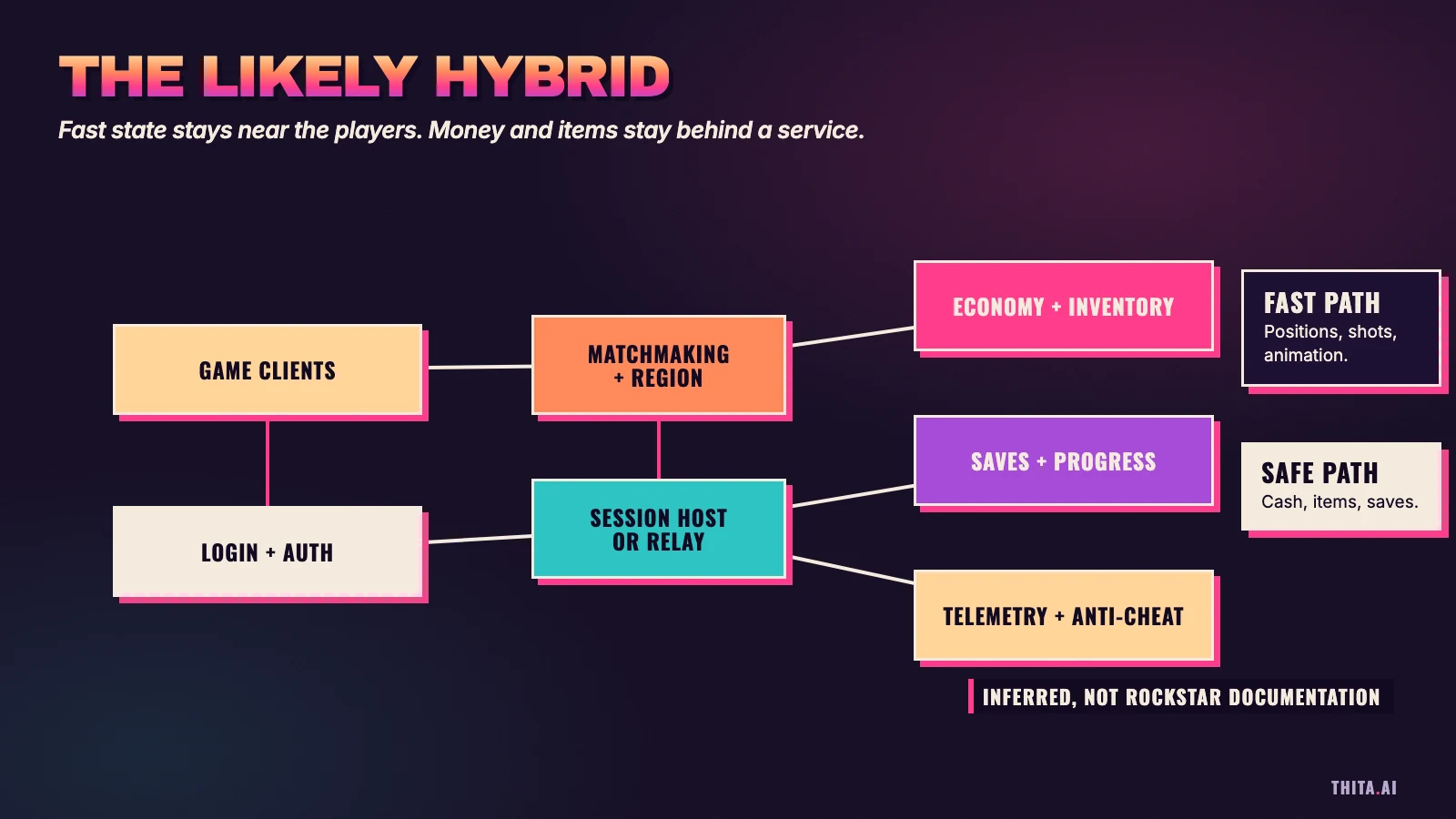
From the outside, the likely shape is a hybrid again, with the line moved. We have no inside information, so read this as a reasoned guess.
The principle is simple to state. Put authority where cheating pays, and put speed where cheating does not matter.
- Economy, inventory, progress: authoritative services. These hold money, vehicles, properties and unlocks. If a client can write to them, the economy dies within a week. So they live behind an API that validates every change.
- Session simulation: the open question. Options include a player host as today, a studio-run relay that hides player addresses and forwards packets, or dedicated session hosts that own the world. Each step up costs more and cheats less.
- Matchmaking: a service that picks a session by region, party size and platform, and tells clients where to connect.
- Auth and telemetry: login tokens, plus a stream of events that feeds anti-cheat and capacity planning.
Why would regional sharding matter?
A session lives in one place, so players are grouped by where they are. That is sharding by region, and database replication and sharding is its data-side twin. Persistent data is harder: a player in Mumbai and a friend in Miami want the same wallet. How Discord stores trillions of messages is a good study of that kind of long-lived, per-user data.
The usual answer is that session state is local and short-lived, while account state is global and strongly consistent, written through one authority per account. If you map players to those authorities with a hash ring, the consistent hashing lesson is the chapter to read. This is also where the CAP theorem and consistency models stop being vocabulary. Your position can be eventually consistent. Your bank balance cannot.
Do games use UDP or TCP?
Real-time games send most of their state over UDP. TCP guarantees reliable, ordered delivery by holding back new data until a lost packet is resent. For a game, that is the wrong promise. Glenn Fiedler's explanation is blunt: never use TCP for time-critical data. The player's position from 200 milliseconds ago is useless once a newer one exists.
UDP delivers whatever arrives, whenever it arrives. The game adds the pieces it needs on top: sequence numbers, acknowledgements for the few messages that must arrive, and nothing for the rest.
| TCP | UDP | |
|---|---|---|
| Delivery | Reliable, ordered | Best effort, unordered |
| Lost packet | Everything behind it waits | Skipped, next one is fresher |
| Good for | Login, purchases, saves | Positions, inputs, animation |
| Overhead | Handshake, congestion control | Minimal |
The lesson comparing TCP and UDP in practice goes through the mechanics. In a game you use both. UDP for the world. TCP, or something shaped like it, for the wallet.
How does a game stay smooth over a bad connection?
Four techniques do most of the work. They are the core of what players call netcode.
State snapshots. The server sends the world as a series of snapshots at a fixed rate. Sending 60 per second costs six times the bandwidth of sending 10, so the rate is a budget, not a preference.
Delta compression. Most of the world did not change since the last snapshot. So the server sends only what did, relative to a state the client has confirmed. A parked car costs almost nothing.
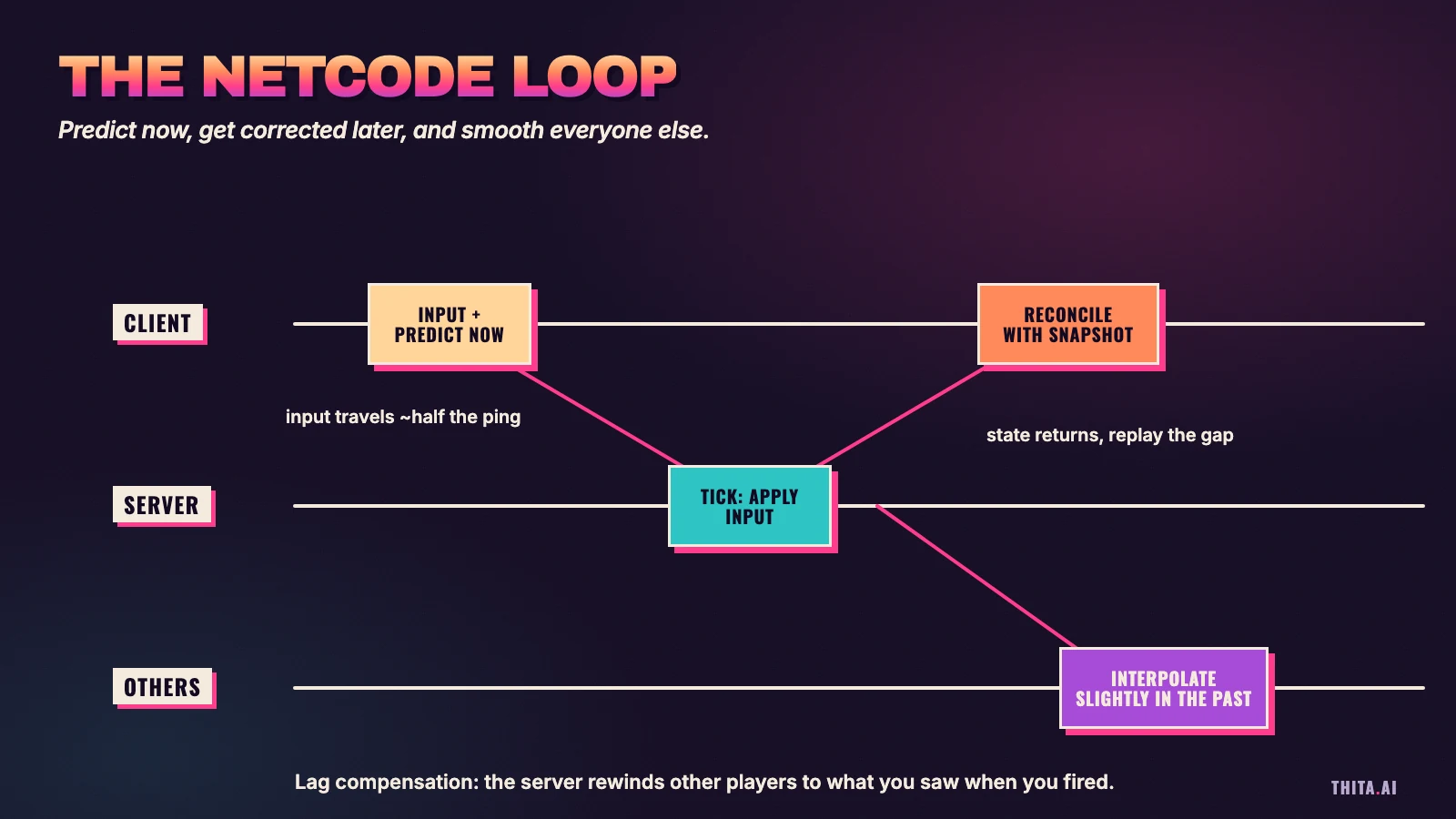
Client-side prediction. Your input is applied on your own machine immediately, before the server has seen it. You press forward and the character moves. The wait for the server's answer is hidden.
Interpolation. Other players' positions arrive in discrete snapshots. The client holds a small buffer and draws everyone slightly in the past, blending between two known states. Fiedler's snapshot interpolation article shows why that buffer is sized to survive a couple of lost packets in a row. Smoothness is bought with a little delay.
When the server disagrees with your prediction, the client rolls its state back to the server's version and replays the inputs the server had not yet seen. That is reconciliation. Done well, you never notice. Done badly, you rubber-band.
Lag compensation handles the other direction. You fire at a target you saw 100 milliseconds ago. By the time the shot reaches the server, the target has moved. The server rewinds the other players to where you saw them, checks the hit, then moves on. It is a small, deliberate lie that makes the game feel fair to the shooter.
What happens to servers on launch night?
Everything arrives at once. That is the part of GTA 6 Online that looks least like a game and most like a ticket sale.
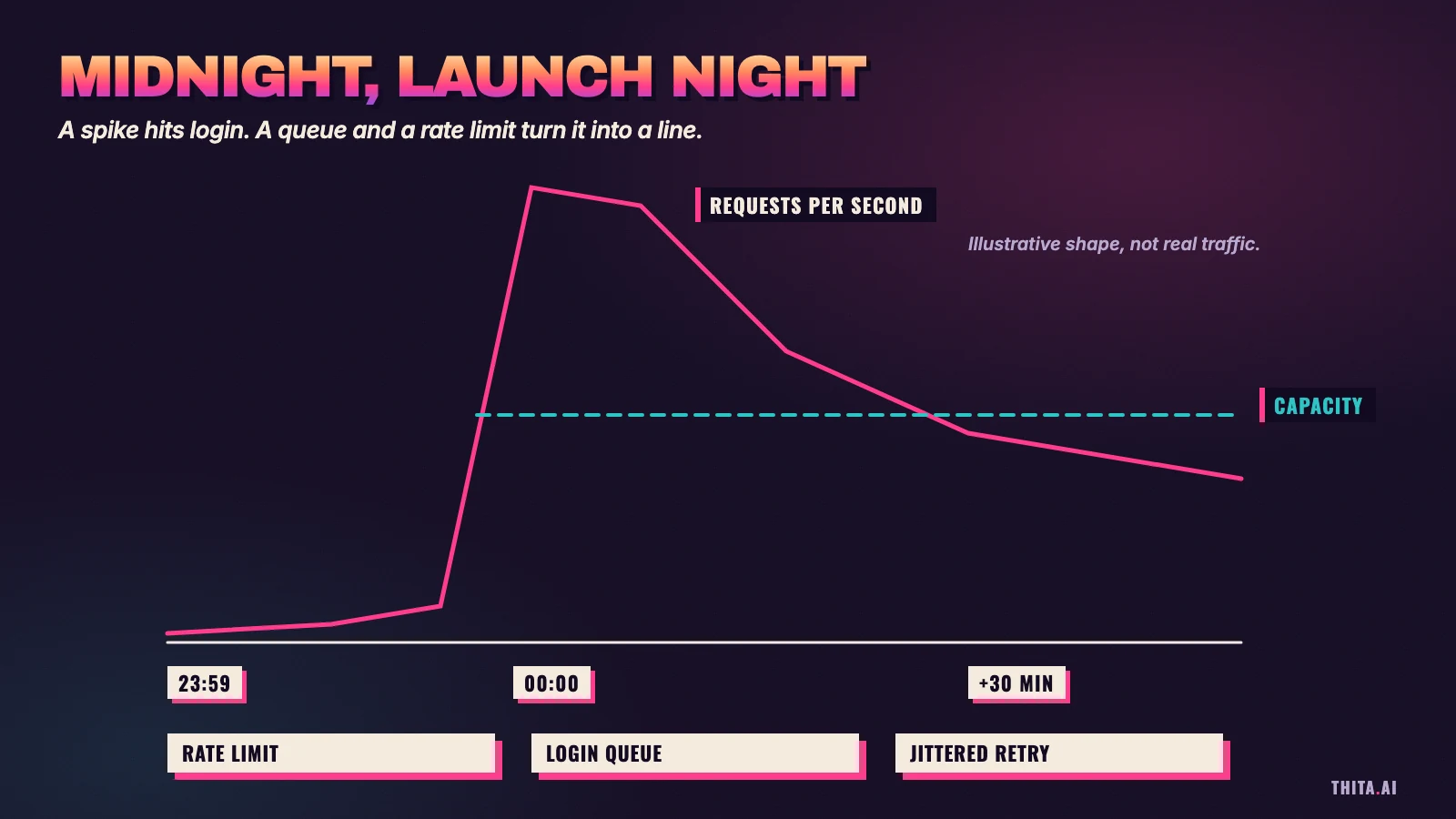
A midnight spike hits login, matchmaking and the economy before it hits the world. Players log in, fail, and retry. Each retry is another request, so a slow login service gets more load exactly when it is slowest. This is a thundering herd, and the thundering herd lesson shows how a cache expiry or a restart can trigger the same shape.
GTA Online's own launch in October 2013 is on the record. Wikipedia's account says many players had trouble connecting to the servers and the Social Club service, some saw their characters' progress disappear, Rockstar patched twice in the first weeks, suspended microtransactions as a fail-safe, and gave affected players GTA$500,000. That was a messy launch for a hit game, and it was the economy and persistence layer that hurt, not the simulation.
The standard defences are old and boring, which is the point:
- Rate limiting at the edge so a retry storm cannot take down login. Token buckets at the edge are the usual tool.
- A login queue that admits users at the rate the backend can serve, and tells everyone else their place in line. A queue is backpressure with a friendly face.
- Jittered retries so a million clients do not all return at the same second.
- Degraded modes that let the game start while a non-essential service catches up.
The spike is the same shape as a big ticket drop, and the same admission control and fair queue apply to a scarce resource. Here the scarce resource is a login slot.
Why is the economy a payments problem?
Because it is one. A purchase, a trade or a mission payout is a state change on money, and money must not be created or destroyed by accident.
The client on a flaky connection presses "buy". The request times out. The player presses again. Did the first one go through? If the system cannot tell, you get a double charge or a lost item, and an angry player either way.
The fix is idempotency. Every purchase carries a unique key generated by the client. The service stores the key with the result. A retry with the same key returns the stored result and does nothing else. Two clicks, one purchase.
What can one O(n²) hide for seven years?
This is the best story in the whole genre, and it is not about networking. It is about the backend.
In 2021 a developer who goes by t0st wrote up why GTA Online took around six minutes to load. The write-up found two problems in the client:
- The game parsed a roughly 10 MB JSON file, a shop catalogue of about 63,000 entries, with
sscanf. That function callsstrleninternally on the whole remaining string for every token, so the parse became quadratic. - Before storing each item, the game scanned the whole array so far to check for duplicates. By the author's estimate, that is close to two billion comparisons for 63,000 items, for hashes that were already unique. A hash map removes it.
Patching either one alone cut the load time. Patching both took the author's test machine from about 6 minutes to about 1 minute 50 seconds, roughly 69 percent faster. Rockstar confirmed a fix, shipped it in March 2021 and paid a $10,000 bounty, which is unusual for a program meant for security issues.
Why does this belong in a post about servers? Because the catalogue is backend data. The client downloaded it and handled it like a small config, and for seven years it grew and nobody noticed. Every new item made the next load slightly worse. A quadratic cost is invisible at 1,000 items and catastrophic at 63,000.
How would you design GTA 6 Online for launch night?
Here is the question, in the form it tends to arrive: "Design the session service for a 32-player open-world game."
The answer has a shape, and you can sketch it in a few minutes:
- Clarify. Casual or competitive? Cheating tolerance? Regions? Target latency? This decides everything below.
- Split the planes. Real-time state on one side. Account, economy and inventory on the other. Different consistency, different protocols.
- Transport. UDP for state, with snapshots, deltas, prediction and interpolation. TCP or HTTPS for purchases and login.
- Authority. Choose host, relay or dedicated server, and defend it with cost per player-hour and the cheating surface.
- Matchmaking and regions. Place sessions near players, shard by region, hash accounts to their authorities.
- Launch load. Rate limits, a queue, jittered retries, idempotent purchases.
- Failure. What happens when the host leaves, a region fails, or the economy service is down?
Every step of that is a chapter in the system design course. When you have a draft, the AI system design mock is a place to say it out loud.
If this is the first time a system like this has made sense to you, that is the start of system design, not the end of it. The system design roadmap lays out the rest in order.
Frequently Asked Questions
Will GTA 6 have multiplayer at launch?
No. GTA 6 launches on 19 November 2026 as a single-player game. Rockstar has not announced a GTA 6 Online date, and Twitch CEO Dan Clancy told Bloomberg he expects multiplayer in 2027. That is an expectation, not an announcement.
Does GTA 6 use dedicated servers?
Unknown. Rockstar has published nothing about GTA 6 Online's architecture. Some outlets cite leaked claims about dedicated servers. None is official. The design in this post is an inference from how GTA Online works.
Are GTA Online servers peer to peer?
Partly. Sessions are widely described as a hybrid: players connect directly to each other with one acting as host, while Rockstar's servers handle login, matchmaking, saves and the economy. Rockstar has not published a detailed description, so this is community understanding.
What is the difference between peer to peer and dedicated servers?
In peer to peer, a player's machine runs the simulation, which is cheap and easier to cheat. A dedicated server owns the simulation and validates every input, which is fairer and costs money for every player-hour.
What is tick rate in a multiplayer game?
Tick rate is how many times per second a server steps the simulation. A higher rate gives tighter hit detection and costs more CPU per player. It is different from frame rate, which is how often your screen draws.
Why do online games use UDP instead of TCP?
TCP makes new data wait behind a lost packet. In a game, the older packet is already useless. UDP lets fresh state through immediately, and the game adds reliability only for the messages that need it, such as purchases.
Topics
Related on Thita
Your next step
Learn the system design behind worlds like this
Streaming, caching, real-time networking, state machines and geospatial indexes are the same ideas system design interviews test. Thita teaches them in 12 families with 26 worked case studies, and every lesson can be heard with an AI coach you can stop and ask.