
AI
How Realistic Is an AI Mock Interview, Really?
How realistic is an AI mock interview? Learn what it reproduces, what it misses, and how to combine AI practice with human mock interviews effectively.
An AI mock interview can feel more realistic than many candidates expect. You may be speaking out loud, working through a problem under a timer, getting follow-up questions, explaining trade-offs, and receiving feedback immediately afterwards. That is already much closer to an interview than silently solving practice questions alone.
But how realistic is an AI mock interview compared with sitting opposite a recruiter, hiring manager, engineer, or panel that may decide whether you get the job?
The honest answer is: realistic enough to build important interview skills, but not realistic enough to replace every human practice session.
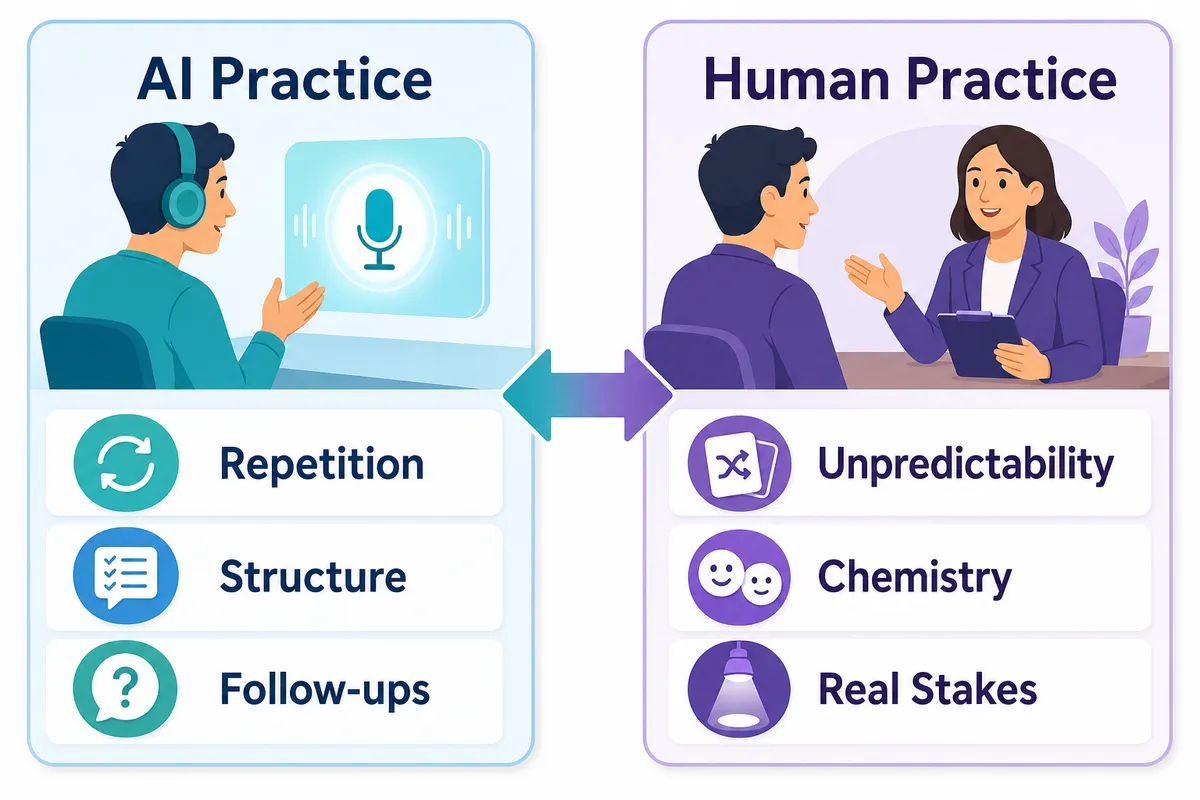
A good live voice AI mock interview can reproduce the repeated pressure of having to think aloud, answer follow-ups, structure your response, and recover when you get stuck. What it cannot fully recreate is the unpredictability of another person, the chemistry in the room, and the particular nerves that come from knowing a human is judging you in real time.
That does not make AI practice less useful. It simply changes how you should use it.
The short answer: realistic where repetition matters most
If your biggest interview problem is that you freeze, ramble, lose your structure, go quiet when challenged, or struggle to explain what you are doing while coding, AI practice can be highly realistic.
That is because many interview skills are not about the interviewer being human. They are about what you do under constraints:
- Can you clarify an ambiguous question before jumping in?
- Can you explain your assumptions?
- Can you think aloud without narrating every keystroke?
- Can you recover when an approach is not working?
- Can you respond to a follow-up without abandoning your original reasoning?
- Can you manage your time?
- Can you end with a concise summary of your decision?
These are repeatable behaviours. Repetition improves them.
An AI interviewer can ask a question, wait for your answer, probe your reasoning, challenge an assumption, and point out gaps in your explanation. For coding rounds, it can ask why you chose a data structure, what happens at scale, or how you would reduce time or space complexity. For behavioural rounds, it can ask for more context when your answer is vague. For product, data science, and system design rounds, it can push beyond the first polished answer.
That is why the question is not simply, “Are AI mock interviews accurate?” A better question is: accurate for which part of the interview experience?
For repeated practice, they can be very accurate. For reproducing every social and emotional detail of a real interview, they are not.
What AI mock interviews reproduce well
1. Volume without waiting for another person
AI sessions remove the friction of finding a suitable partner, agreeing on a format, choosing a time, and hoping they can give useful feedback. You can practise before work, late at night, between classes, or whenever you have the mental energy to focus.
That matters because interview performance improves through repeated exposure. Your first answer to “Tell me about yourself” may feel stiff. By your tenth, you can usually make it sound natural, relevant, and concise. The same applies to technical explanations: frequent spoken practice makes thinking aloud feel less unfamiliar.
✅ Do: use AI sessions for frequent reps, especially when your main goal is becoming more fluent under pressure.
❌ Don't: expect one polished AI session to make you ready for every variation of a real interview.
2. Consistent questioning and feedback
Human interviewers vary widely. One may give you generous hints. Another may interrupt quickly. A third may be distracted, inexperienced, or focused on a different rubric from the company you are targeting.
That unpredictability is part of real interviewing, but it also makes practice feedback inconsistent. A friend may tell you that your answer was “good” because they do not want to discourage you. A peer may over-focus on a minor coding detail because that is where they feel strongest.
AI practice is useful because it can apply a more consistent structure. It can repeatedly look for whether you clarified the problem, stated a plan, explained complexity, checked edge cases, or answered the actual question asked.
This does not mean AI feedback is automatically perfect. It is still feedback you should evaluate critically. But consistent feedback is valuable when you are trying to spot recurring habits:
- Starting to code before you have a plan
- Giving examples without explaining impact
- Forgetting to ask clarifying questions
- Failing to discuss trade-offs
- Giving behavioural answers with no measurable outcome
- Talking for too long before making a point
- Becoming silent when debugging
These are patterns, not one-off mistakes. AI practice is especially good at helping you notice them across multiple sessions.
💡 Pro Tip: Keep a short “repeat mistakes” list after every practice interview. If the same issue appears three times, make it the focus of your next session rather than doing another random question.
3. Adaptive follow-ups
A realistic interview is rarely just one question followed by one answer.
In a proper technical round, the interviewer may ask:
- “Why did you choose that approach?”
- “Can you improve the complexity?”
- “What happens if the input is empty?”
- “How would this change if the data did not fit in memory?”
- “Can you walk me through that test case?”
- “What would you do if this service suddenly had ten times the traffic?”
Those follow-ups are where many candidates struggle. They may solve the original question but lose confidence when the question changes shape.
This is an area where modern AI interview practice can be meaningfully realistic. A live voice AI interviewer can adapt to what you said rather than simply show the next pre-written prompt. If you skip an assumption, it can ask about it. If you propose an inefficient approach, it can challenge the trade-off. If you give a vague behavioural answer, it can ask what you personally did.
On Thita, AI interview practice with adaptive follow-ups is designed around that live exchange rather than a static question list. You can practise DSA, system design, low-level design, machine coding, behavioural, product management, data science, AI and ML, CS fundamentals, and resume-based rounds from your own CV.
That adaptability is important for realism because real interviewers are not simply checking whether you memorised a prepared answer. They are testing how you respond when the conversation moves beyond it.
4. Immediate feedback while the details are fresh
With a human mock, useful feedback may arrive late, be rushed, or be limited to general impressions. You may hear, “You need to be more confident,” without knowing what that means in practice.
AI feedback can arrive straight after the session, while you still remember exactly where you hesitated, changed direction, or lost the thread of your explanation.
Immediate feedback is particularly useful for:
- Coding explanations and missed edge cases
- Structure in behavioural answers
- Communication clarity
- Time management
- Follow-up responses
- System design trade-offs
- Resume-based questions you did not expect
For technical candidates, realism improves when the practice environment includes the actual tools used in an interview. Thita’s coding rounds include a real editor that compiles and runs code, so you can practise in six languages: Python, C++, Java, JavaScript, Go and C#. That means you are not only describing a solution; you are writing, testing, debugging, and explaining it under interview conditions.
If code execution matters to your preparation, read whether your AI mock interview actually runs your code before assuming that every AI interview tool does.
Where AI mock interview realism still falls short
1. True human unpredictability
AI can adapt, but a real interviewer can be unpredictable in ways that are hard to reproduce.
A human may misunderstand what you mean. They may challenge an assumption you thought was obvious. They may change direction because they are curious about your past work. They may ask a question badly, give incomplete information, or care about a detail you did not expect.
Sometimes the interview feels difficult because the question is difficult. Other times it feels difficult because the conversation itself is awkward.
That matters. In a real interview, you may need to politely clarify, redirect, or recover from an unclear prompt. You may need to decide whether to push back on an assumption or move forward with a reasonable interpretation.
AI can help you practise clarification, but it cannot fully recreate every odd conversational turn that comes from two people with different communication styles.
⚠️ Important: Do not mistake smooth AI sessions for proof that every real interview will feel smooth. A real interviewer may be more abrupt, warmer, quieter, more sceptical, or less structured than the practice environment.
2. Human chemistry and social cues
Interviewing is partly a communication task. You are reading the room, even when the room is a video call.
You may notice that an interviewer looks confused. You may sense that they want a shorter answer. You may need to decide whether a joke landed, whether to pause, or whether to offer more context.
AI can assess the content and structure of what you say, but human chemistry is more difficult. It is not just about eye contact or body language. It is about rapport, rhythm, warmth, and whether the interviewer feels they can work with you.
This matters most in behavioural, leadership, product, stakeholder, and hiring-manager conversations. A technically strong answer can still feel weak if it sounds overly rehearsed, defensive, or disconnected from the listener.
That is one reason to add occasional human mocks to your preparation. Ask a friend, mentor, colleague, or peer to focus not only on whether your answer was correct, but on how it felt to hear it.
3. The pressure of being judged by a person
Many candidates perform differently when they know a real person is deciding their outcome.
You might feel calm with an AI and suddenly lose your train of thought with a senior engineer. You might be able to debug comfortably alone but panic when someone is quietly watching your screen. You might handle an AI follow-up well but become defensive when a human disagrees with your design.
That response is normal. It does not mean AI practice failed. It means you have discovered a separate skill to train.
The specific pressure of a person judging you cannot be fully simulated. Even a very realistic AI mock does not carry the same stakes as a recruiter deciding whether to move you to the next round.
This is why candidates should not choose between AI and human practice as though one must replace the other. The better question is how to use each one for its strengths.
The best preparation mix: AI reps plus human calibration
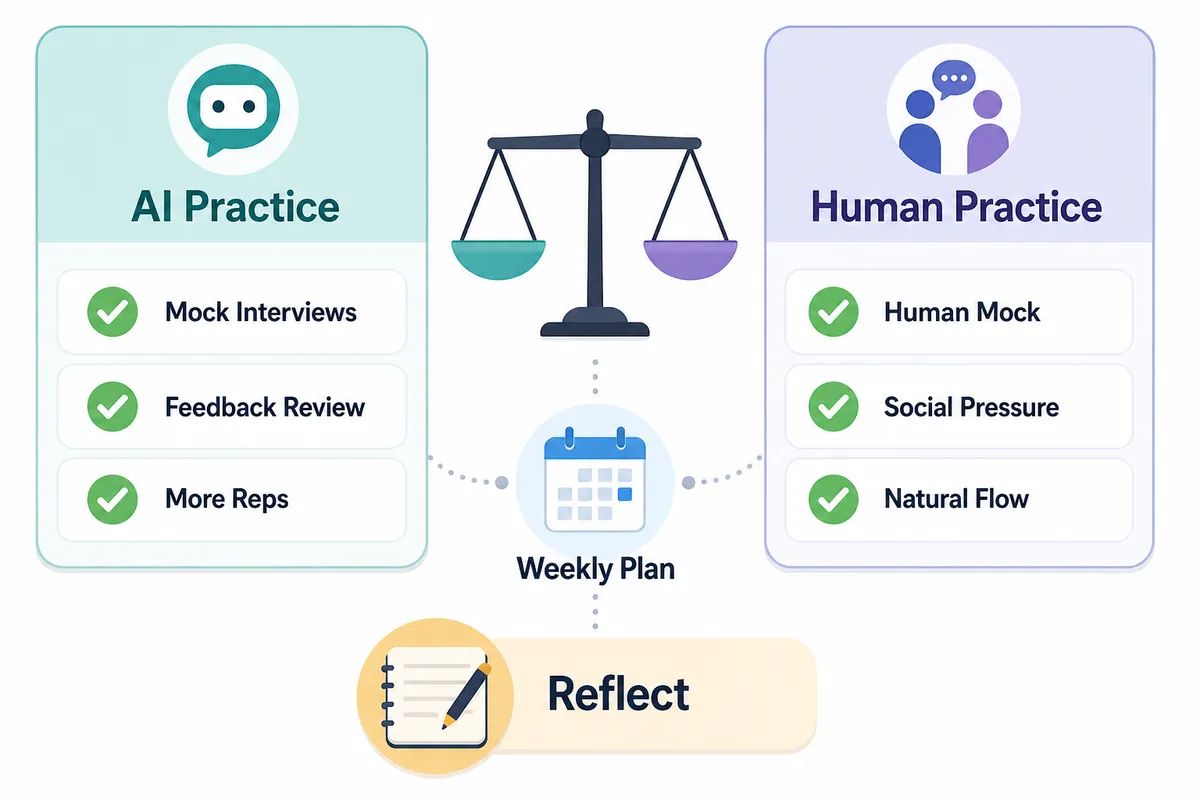
The strongest approach for most candidates is simple:
- Use AI mock interviews for frequent practice.
- Use human mocks occasionally to test transfer.
- Review the gaps between the two.
AI practice is ideal for the repetitions that make interview behaviour feel familiar. Use it to rehearse your opening, coding narration, system design structure, STAR stories, follow-up handling, and recovery when you get stuck.
Human practice is ideal for calibration. It tells you whether your answer works with another person, whether your communication feels natural, and whether you can handle social pressure.
A practical weekly plan might look like this:
- Two or three AI mock interviews focused on one weak area
- One focused revision session using feedback
- One human mock every one or two weeks
- One short reflection after each session
If you are interviewing soon, increase the number of AI reps. If you have been practising heavily with AI but still feel unsure around people, prioritise a human mock.
This complements, rather than replaces, the broader question of whether AI practice improves interview performance. For that wider discussion, read AI mock interviews vs real interviews: do they actually help?.
How to make an AI mock interview more realistic
The tool matters, but your behaviour during practice matters too.
✅ Do treat the timer as real. Avoid pausing to search for an answer or restart the question when it becomes uncomfortable.
✅ Do speak out loud, even for coding questions. Silent problem-solving is useful, but it does not train interview communication.
✅ Do ask clarifying questions before proposing a solution. This is one of the easiest habits to skip when practising alone.
✅ Do test your code and explain failures clearly. Say what you think went wrong before changing the implementation.
✅ Do practise your weak round types. If you avoid system design, behavioural questions, or resume discussions, your confidence will remain uneven.
❌ Don't memorise polished answers word for word. Real interviews change the question, and memorised wording often falls apart under follow-ups.
❌ Don't judge a session only by whether you got the answer right. A correct solution with unclear reasoning can still be a weak interview performance.
❌ Don't rely on AI as your only exposure to live conversation. Schedule at least a few human mocks before a high-stakes process.
For a structured way to fit practice into your timeline, compare 7-day, 30-day, and 90-day coding interview preparation plans.
Frequently asked questions
How realistic is an AI mock interview?
AI mock interviews are realistic for practising structure, time pressure, thinking aloud, follow-up questions, coding explanations, and repeated interview exposure. They are less realistic for human chemistry, unusual interviewer behaviour, and the emotional pressure of being judged by a person.
Are AI mock interviews accurate?
They can be accurate when the tool evaluates what you actually said, wrote, or designed and gives specific feedback. Accuracy is strongest when feedback is tied to concrete details, such as missed edge cases, unclear reasoning, or unsupported design choices.
Do AI mock interviews help candidates perform better?
Yes, especially when used for repeated practice. They help candidates become more comfortable answering aloud, explaining decisions, handling follow-ups, and identifying recurring weaknesses. They work best alongside occasional human mock interviews.
Can AI mock interviews replace human mock interviews?
No. AI can provide far more practice volume and immediate feedback, but human mocks are still valuable for social cues, interpersonal communication, and the pressure of a real person reacting to you.
Is AI mock interview realism good enough for technical interviews?
It can be highly useful for technical interviews when the platform includes live questioning, adaptive follow-ups, and a working coding or design environment. For coding practice, make sure the tool can actually run your code rather than only comment on it.
What interview rounds can I practise with AI?
Depending on the platform, you can practise coding, DSA, system design, low-level design, machine coding, behavioural, product management, data science, AI and ML, CS fundamentals, and resume-based interviews.
How often should I use AI mock interviews?
For most candidates, two to three sessions a week is enough to build consistency without turning practice into repetition without reflection. Increase frequency before an interview, but review your feedback and target one weakness at a time.
Use AI for the reps, and people for the reality check
AI mock interview realism is not all-or-nothing. It is realistic where practice volume, structure, follow-ups, live explanations, feedback, and convenience matter most. It is less realistic where human unpredictability, social chemistry, and high-stakes judgement take over.
That is still extremely useful.
Use AI to make the core mechanics of interviewing familiar before the real conversation matters. Then use a few human mocks to test whether those skills hold up when another person is watching, reacting, and challenging you.
Start a live voice AI mock interview when you want realistic interview reps without waiting for a partner or scheduling a session. Practise the questions, the follow-ups, the explanations, and the recovery moments until they no longer feel unfamiliar.
If you are hiring rather than interviewing, visit interviews.thita.ai.
Topics
Related on Thita
Your next step
Practise with AI mock interviews
A spoken interview that asks follow-up questions, runs your code and ends with a written report.