
Interview
AI Pair Programming Practice vs Tools Built for Cheating
Learn the difference between AI pair programming interview practice and real-time answer tools, why cheating risks your career, and how to prepare honestly.
Search for AI pair programming interview practice and you may find two very different types of product presented as though they solve the same problem.
One type helps you rehearse before an interview: it asks questions, listens to your reasoning, runs your code, pushes back on weak assumptions, and gives feedback after the session. That is preparation. It is the same basic purpose as practising with a friend, joining a mock interview, or reviewing a failed coding problem.
The other type is designed to sit beside you during a real interview and feed you prompts, suggestions, or answers as the interview happens. That is not preparation. It creates a short-term appearance of performance while leaving you less ready for the conversation, the follow-up rounds, and the job itself.
If you want the first experience, a live AI interview practice session can help you rehearse the conditions that matter: speaking clearly, coding under time pressure, responding to follow-up questions, and recovering from mistakes without someone quietly supplying the answer.
This distinction matters because the search results have become messy. Candidates looking for a way to practise coding with an AI interviewer can easily land on tools marketed around hidden assistance, real-time prompts, or invisible overlays. You do not need to be judgemental to recognise that these products solve a different problem from interview practice — and carry a very different kind of risk.
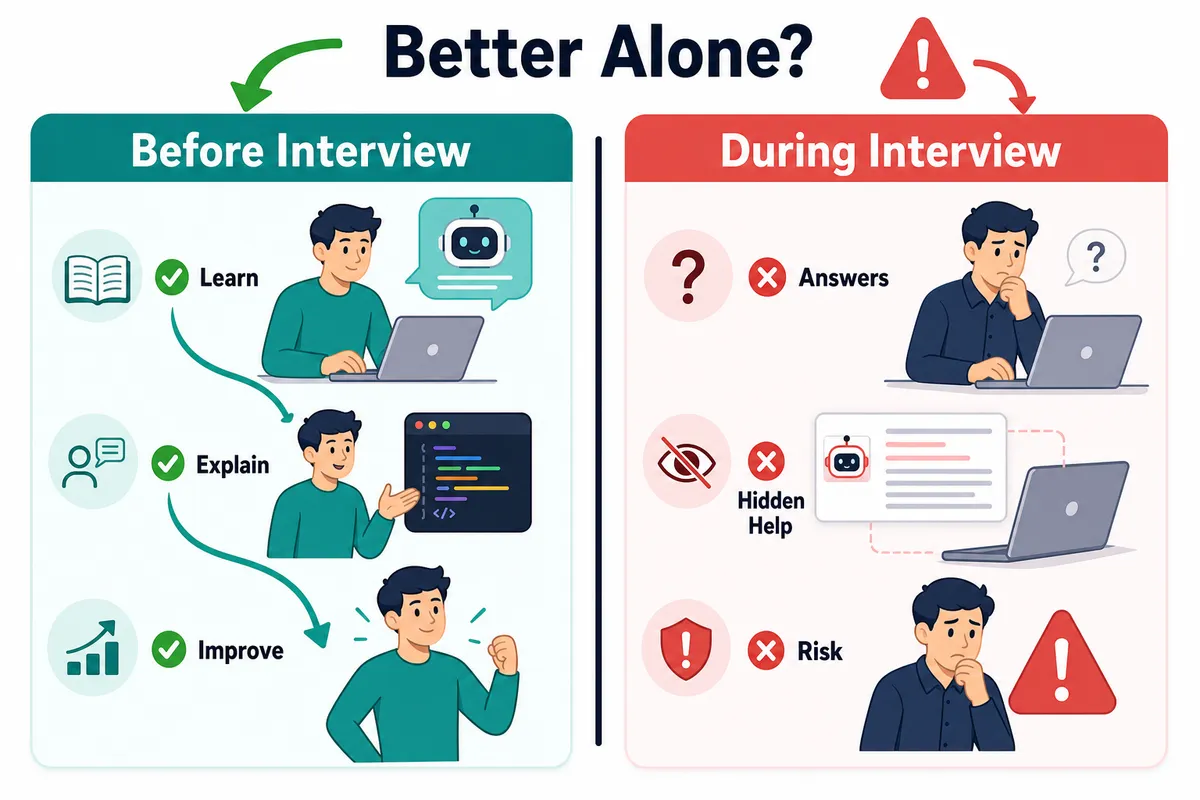
The line is simple: does the tool make you better before the interview?
A useful test is to ask what happens when the tool is removed.
With legitimate AI pair programming practice, you should leave each session more capable without the tool. You should understand the pattern you missed, know why your first approach failed, and have practised explaining a trade-off in your own words. The next time you see a similar question, you can work through it yourself.
With a real-time answer tool, the value disappears the moment the tool is unavailable. You may get an answer on screen, but you have not built the ability to derive it, defend it, or adapt it when the interviewer changes one condition.
That is the practical difference:
- Practice tools are used before an interview to build skill and confidence.
- Interview assistants built for live answer feeding are used during an interview to conceal external help.
- Practice tools make errors visible so you can learn from them.
- Cheating tools attempt to hide errors, uncertainty, and dependence from the interviewer.
- Practice tools prepare you for follow-up questions.
- Cheating tools often make follow-ups harder because you are defending reasoning you did not develop.
This is why the question is not whether AI itself is allowed. AI can be a highly effective learning partner. The question is whether you are using it to rehearse independently or to misrepresent independent performance.
💡 Pro Tip: A good practice session should occasionally feel uncomfortable. If the AI asks “why does that work?”, “what is the complexity?”, or “what changes if input is empty?”, that pressure is useful. It is exactly the pressure you want to meet before the real conversation.
Is AI interview help cheating?
It depends on when, how, and what the employer has asked you to do.
Using AI before an interview is generally preparation. You can use it to review concepts, generate practice questions, simulate a behavioural round, identify gaps in a system design answer, or run mock coding interviews. That is comparable to using a textbook, course, mentor, or coding platform.
Using AI during a live interview without permission is different. If the interviewer expects you to solve, explain, and communicate independently, then receiving hidden suggestions or generated answers changes what they are evaluating. Even if the response is technically correct, it is no longer a reliable signal of your own ability.
Some companies explicitly allow certain tools in take-home tasks or AI-enabled assessments. Others prohibit them. Some ask candidates to disclose their usage. The sensible approach is not to guess: read the instructions, ask the recruiter if they are unclear, and follow the stated rules.
⚠️ Important: “Everyone uses AI now” is not a permission model. An employer may welcome AI fluency in day-to-day work while still requiring an interview to measure your unaided reasoning, communication, and coding process.
There is also a difference between an open-book task and a live technical interview. In an open-book environment, you may be encouraged to consult documentation, search, or use AI as long as you explain your choices. In a live interview where external tools are not permitted, a hidden assistant crosses the line because it conceals the source of the work.
The best outcome is not merely passing one round. It is reaching a role where your actual skills match what the team believes it hired.
Why real-time answer feeding is a career risk
The moral argument is straightforward enough, but the practical argument is more useful: using hidden assistance can create problems long after the interview ends.
First, interviews rarely consist of one isolated coding question. A candidate might get through a screen with a supplied answer, then face deeper follow-ups in the next round. They may be asked to alter the solution, explain a design decision, estimate memory usage, or debug a version of the code with a new constraint. Those are difficult moments to navigate if the original reasoning was not yours.
Second, interviews are increasingly designed to assess process rather than final output alone. Interviewers look at how you clarify requirements, choose an approach, identify edge cases, test assumptions, and respond when something fails. An answer overlay may generate a solution, but it cannot reliably create a natural, consistent trail of thought that holds up under probing.
Third, employers are becoming more alert to unusual interview behaviour. That does not mean every candidate using AI will be detected by a single technical signal. It means interviewers, proctoring systems, assessment platforms, and later rounds can all expose a mismatch between the work presented and the candidate’s underlying capability.
Finally, there is the job itself. If you enter a role having overstated your ability to write and explain code independently, the first weeks can become unnecessarily stressful. You may be expected to contribute in areas you have not yet learned, and the support you need may not be the support you receive.
None of this means you must be perfect before you interview. Nobody is. It means the safer strategy is to practise honestly, find your gaps, and close as many as you can before the stakes are real.
For more on the difference between useful preparation and unhelpful dependence, read how to use AI tools for interview preparation without becoming dependent.
AI interview assistant vs practice tool: what should you look for?
The phrase “AI interview assistant” is vague. It may describe a legitimate simulator, a speech coach, a code reviewer, an interview notes tool, or software intended to provide live answers. Before signing up, look beyond the label.
A candidate-focused practice tool should make its intended use clear: you start a session before your real interview, answer questions yourself, and receive feedback intended to improve the next attempt.
Here are practical signs you are looking at a genuine practice product.
It simulates the interview, not bypasses it
A useful tool asks you to think aloud. It does not jump straight to a polished answer. It may challenge your first approach, ask why you selected a data structure, or introduce a constraint that changes the solution.
That matters because real interviews reward reasoning. As explained in our guide to how interviewers judge problem-solving in live coding rounds, a correct final answer is only part of what an interviewer sees.
It gives feedback after you attempt the work
Feedback is most useful after you have committed to an approach. You need the chance to make the mistake, notice it, explain it, and improve it. A tool that solves everything for you before you begin may feel efficient, but it removes the learning loop.
It tests real output where appropriate
For coding interviews, the editor should compile and run code. A discussion-only assistant can comment on an approach, but it cannot replace the experience of seeing a test fail and debugging it under pressure.
It makes the boundaries obvious
The product should be designed for preparation, mock interviews, study, and feedback — not for covert use during a live employer interview. Clear boundaries are a positive sign. They show that the tool is trying to help you build a durable skill, not create a fragile shortcut.
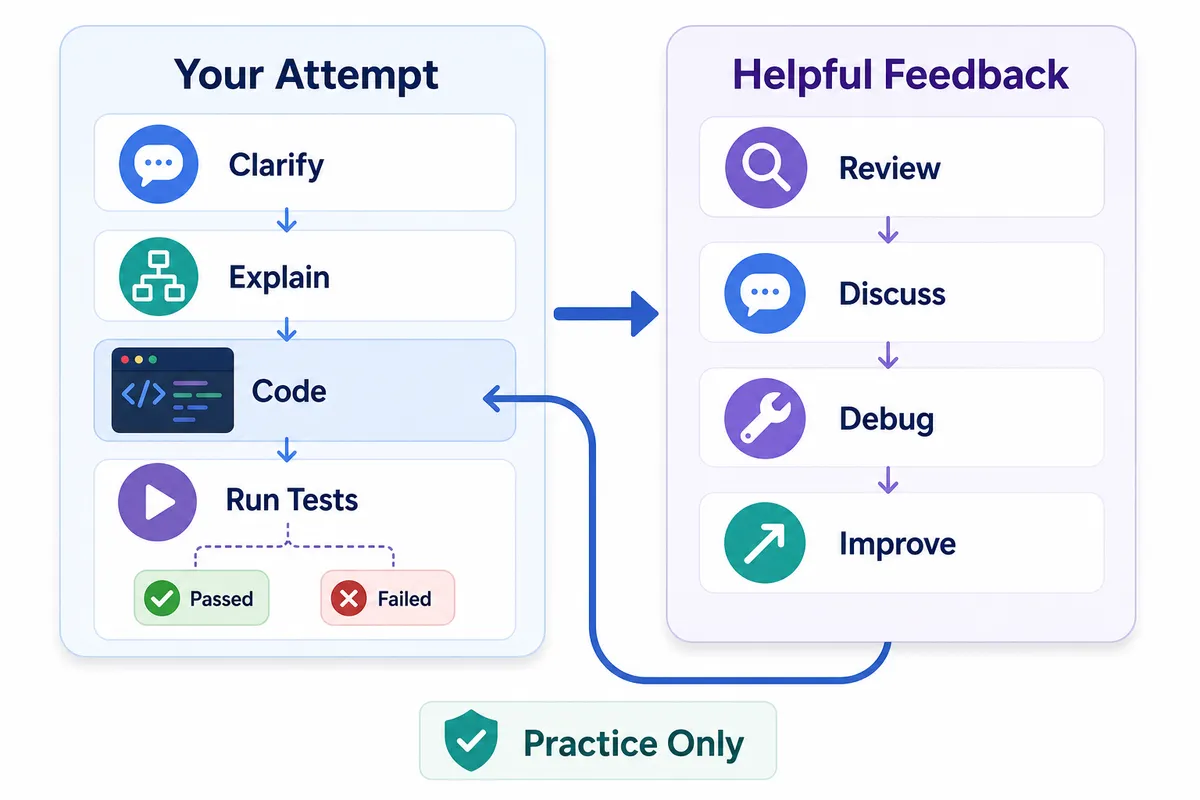
What honest AI pair programming practice should feel like
The strongest mock sessions do more than ask you to solve a familiar problem. They recreate the decisions and interruptions that make interviews difficult.
For a coding round, that might mean:
- You hear a problem and ask clarifying questions.
- You explain a brute-force approach before optimising it.
- You write code in an editor and run it against examples.
- A test case fails, so you debug while narrating your thinking.
- The interviewer asks a follow-up that changes the constraints.
- You reflect on what you would improve next time.
That sequence is valuable because it trains the whole performance, not just answer recall. If you have solved many problems alone but freeze when asked to explain one, focus on thinking out loud in coding interviews as a separate skill.
The same principle applies outside DSA. In system design, you should have to produce and defend an architecture, not simply read a model answer. In behavioural interviews, you should practise making your own experiences specific and structured. In product management, data science, AI and machine learning interviews, you should be challenged to prioritise, make assumptions explicit, and communicate trade-offs.
Thita provides live voice AI interviews across DSA, system design, low-level design, machine coding, behavioural, product management, data science, AI and ML, CS fundamentals, and resume-based interviews generated from your own CV. The resume-based format also works for non-technical roles because it starts from the experience you actually have.
For technical practice, there is a real code editor that compiles and runs code in Python, C++, Java, JavaScript, Go and C#. You can practise in six languages. System design sessions use a canvas, and the AI evaluates the architecture you submit rather than only discussing an imagined design.
You can practise with a live AI interviewer whenever you have time, without arranging a session with a peer.
A better way to use AI before your interview
AI is most useful when it increases the quality of your practice rather than reducing the amount of thinking you do.
✅ Do ask the AI to play interviewer and withhold hints until you have explained an approach.
✅ Do ask for adaptive follow-ups after you finish the first solution. For example: “What would you ask next if you were testing this answer more deeply?”
✅ Do run your code and inspect failures yourself before asking for help. Describe your hypothesis first, then compare it with the feedback.
✅ Do practise explaining trade-offs, not just producing code. Say why you chose a hash map, queue, cache, index, or service boundary.
❌ Don't ask for complete answers before you have spent time reasoning independently.
❌ Don't memorise model responses word for word. They tend to fall apart when the question changes slightly.
❌ Don't use an AI assistant secretly during an interview where outside help is not allowed.
❌ Don't confuse a smooth practice transcript with genuine readiness. Challenge, feedback, and failed attempts are part of progress.
If your preparation feels scattered, start with a defined schedule rather than adding more tools. Our comparison of 7-day, 30-day and 90-day coding interview preparation plans can help you choose a realistic structure.
Frequently asked questions
What is AI pair programming interview practice?
It is a mock interview format where an AI acts as an interviewer while you explain your approach, write code, run tests, and handle follow-up questions. The aim is to build skills before a real interview, not receive answers during one.
Is AI interview help cheating?
Using AI to prepare before an interview is generally legitimate. Using hidden AI assistance during a live interview without permission is cheating because it misrepresents your independent performance. Always follow the employer’s instructions.
Can I practise coding with an AI interviewer?
Yes. A useful AI interviewer can ask a coding question, listen to your explanation, assess your approach, and follow up based on what you do. For the most realistic practice, choose one with an editor that compiles and runs your code.
Why are real-time interview answer tools risky?
They can leave you unable to explain, modify, or defend an answer when interviewers ask follow-ups. They also create a mismatch between the skill you present and the skill needed in later rounds and on the job.
Can employers detect AI assistance in interviews?
Detection is not limited to one method. Interviewers may notice inconsistent explanations, assessment platforms may use integrity measures, and later interviews can reveal gaps in understanding. The safest approach is to prepare without hidden assistance.
What interview topics can I practise with Thita?
You can practise DSA, system design, low-level design, machine coding, behavioural, product management, data science, AI and ML, CS fundamentals, and resume-based interviews generated from your own CV.
Do I need to find a practice partner?
No. AI mock interviews are useful when you want live practice without coordinating with a peer. You can start a session when your schedule allows and repeat difficult rounds as often as needed.
Practise the skill you want to bring into the room
The goal of interview preparation is not to look capable for one hour. It is to become more capable, more composed, and more ready to explain your work when the answer is not obvious.
Choose AI pair programming practice that makes you do the thinking, run the code, defend the design, and learn from the mistakes. That preparation transfers.
Start a live AI interview practice session to rehearse coding, system design, behavioural questions, and more on your own schedule. If you want a structured warm-up first, browse the free DSA patterns sheet or try in-browser code practice with AI feedback.
If you are hiring rather than interviewing, visit https://interviews.thita.ai.
Topics
Related on Thita
Your next step
Practise with AI mock interviews
A spoken interview that asks follow-up questions, runs your code and ends with a written report.