
Interview
ByteDance Interview Questions and Process: The Complete Guide (2026)
ByteDance interview questions, process and rounds explained: coding, system design, ByteStyle and a practical 30-day preparation plan for software engineers.
ByteDance interview questions are commonly reported to centre on progressively harder coding rounds, followed by system design for senior or L4+ roles, a hiring-manager discussion, and a separately scored ByteStyle culture round. The defining feature is the sequence: rounds are reportedly unlocked one at a time, so clearing an earlier stage is necessary before the next begins. Prepare coding fluency first, then practise explaining technical decisions and project ownership. ByteDance's interview kit holds 66 mapped DSA questions to help you rehearse the coding portion by pattern.
Reported accounts vary by team, geography and seniority, so treat this guide as the commonly reported shape rather than a fixed company policy. Confirm the exact schedule, format and level expectations with your recruiter.
The ByteDance interview process at a glance
| Stage | Round | Commonly reported format | What it screens for |
|---|---|---|---|
| 1 | Recruiter screen | Initial conversation | Role fit, experience and motivation |
| 2 | Online assessment | HackerRank coding test | Timed problem solving |
| 3 | Coding round one | Live coding, shorter format | Fundamentals and clear reasoning |
| 4 | Coding round two | Live coding, higher difficulty | Depth, speed and complexity judgement |
| 5 | System design | Discussion-led, senior or L4+ | Scalable technical decisions |
| 6 | Hiring-manager round | Technical and project discussion | Ownership, scope and collaboration |
| 7 | HR and ByteStyle | Culture and values conversation | Working style and values alignment |
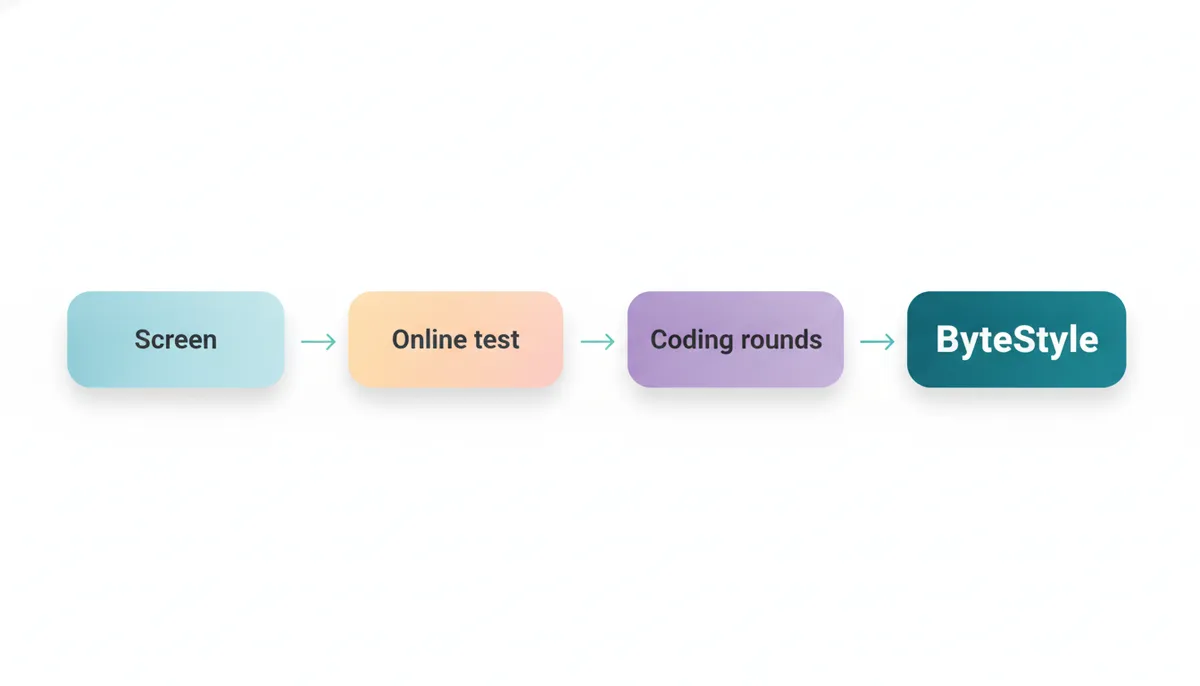
The reported sequence is strict rather than a conventional one-day onsite loop. That makes consistency important: a strong late-round performance cannot compensate for an earlier round you do not clear.
Round 1 — recruiter screen
The recruiter screen is commonly reported as a short initial conversation about your experience, the role, availability and motivation. It is not usually the deepest technical evaluation, but it can determine whether your profile is routed to the right team and level.
Prepare a concise account of your current work: the product or system, the scale, your personal contribution and the kind of problems you want next. Avoid reciting a résumé. The useful version of an introduction gives the listener enough detail to ask a good follow-up question.
For ByteDance specifically, be ready to explain why the pace and product surface appeal to you. A generic “I want to work at a large technology company” answer leaves little for the recruiter to work with.
Round 2 — online assessment
Reported accounts describe a HackerRank assessment before the live technical stages. This is the first coding filter, where speed, correctness and familiarity with common data-structure patterns matter most.
The practical preparation is not to memorise a long catalogue of disconnected problems. Instead, train recognition: when you see a string constraint, a subarray condition or a graph relationship, identify the likely pattern before typing. The free-to-browse DSA Patterns Sheet is useful for practising that recognition by pattern rather than by topic label.
Use a timer. Write down edge cases before submitting: empty input, repeated values, boundary indices, overflow where relevant, and disconnected graph cases. A correct approach that fails on one untested edge case is still a poor assessment outcome.
For a structured way to improve that first-minute recognition, read how to identify the right DSA pattern in a coding interview.
Round 3 — coding round one
The first live coding round is reported as the shorter of the two technical conversations. It usually screens for the habits that a timed assessment cannot observe: clarification, communication, complexity reasoning and the ability to turn an idea into reliable code.
Start by restating the problem and asking about inputs, constraints and expected output. Then describe a simple baseline before moving to the efficient approach. This gives the interviewer a visible chain of reasoning and makes your trade-offs easier to assess.
Do not spend several silent minutes searching for a perfect solution. Interviewers can only credit reasoning they can follow. A clear candidate who revises an initial approach intelligently often creates a stronger impression than someone who produces a polished answer without explanation.
The guide to explaining your thought process clearly in coding interviews offers a useful speaking structure for this exact situation.
Round 4 — coding round two
The second coding round is commonly reported as longer and more difficult, with more problems or medium-to-hard follow-ups. This is the stage that tests whether your fundamentals hold once the obvious route is exhausted.
Expect pressure on optimisation. You may be asked to improve a working solution, compare time and space costs, or adapt it after a requirement changes. That does not mean reaching immediately for a complex technique. First establish the invariant your solution depends on, then show why it remains true as the input changes.
Graph and traversal fluency are particularly useful preparation because they combine modelling, implementation and edge-case discipline. Review graph traversal patterns with DFS and BFS if those choices are not yet automatic.
Use ByteDance's interview kit for company-mapped coding practice, then recreate solutions from a blank editor. The second attempt, without notes, is where recall becomes interview-ready skill. The in-browser code practice environment can help you rehearse implementation and feedback loops.
Round 5 — system design
A system-design conversation is reported for senior and L4+ candidates, usually after the coding stages. This round screens for how you turn a vague product need into a dependable technical system: scope, interfaces, storage, capacity assumptions, failure handling and trade-offs.
The first mistake is designing too much too early. Begin by agreeing on functional requirements and a few measurable constraints. Name the critical user flow, estimate the likely load only when it affects a decision, and draw the smallest architecture that supports the core path. Add caches, queues, partitioning or replication because a bottleneck calls for them, not because they are expected keywords.
Senior candidates are also likely to be evaluated on judgement. A sound design explains what it deliberately does not solve in the first version and how it could evolve if demand changes.
The free-to-browse System Design Sheet is a practical place to revisit core building blocks. If you are unsure how much depth your level needs, how much system design is enough for SDE-1 versus SDE-2 interviews separates the expectations clearly.
Round 6 — hiring-manager round
The hiring-manager conversation commonly probes project depth, technical ownership and the judgement behind past decisions. It can include technical discussion, but its main purpose is often to establish whether you operated at the level the team needs.
Prepare two projects in detail. For each one, be able to explain the original problem, constraints, your specific responsibility, options considered, decision made, outcome and what you would change now. Use “I” accurately. Saying “we built” is fine when the work was shared, but be ready to identify the decisions you personally owned.
Good answers include failure. Describe an incident, a wrong assumption or a trade-off that aged badly, then show what changed in your approach. That is stronger evidence of judgement than presenting every project as a smooth success.
Round 7 — HR and ByteStyle
Reported accounts describe a final HR or culture round that evaluates ByteStyle, ByteDance’s named values framework. It is a separately scored gate, not merely an administrative close to the process.
The six reported ByteStyle values are: Always Day 1; Champion Diversity and Inclusion; Be Candid and Clear; Seek Truth and Be Pragmatic; Be Courageous and Aim for the Highest; and Grow Together.
Do not memorise these as slogans. Instead, prepare examples that demonstrate the underlying behaviours. For candid communication, describe a time you surfaced a difficult concern early. For pragmatism, explain a decision where you chose a smaller solution because it solved the immediate user problem. For growing together, show how you helped another engineer, accepted feedback or changed your approach after new evidence appeared.
Use AI mock interviews to practise project and values stories aloud. The aim is not a scripted answer; it is becoming comfortable enough to be specific, concise and honest under follow-up questions.
Is the ByteDance interview hard?
Yes, mainly because the process is both coding-heavy and sequential.
Reported accounts describe an initial screen, an online assessment, two coding rounds, a system-design round for senior or L4+ roles, a hiring-manager conversation and a ByteStyle culture round. That is a long chain of distinct evaluations, and a candidate must reportedly clear each stage before moving on.
The coding rounds are likely to feel difficult if you rely on solving familiar questions from memory. The later coding stage reportedly raises the difficulty and rewards clean implementation under pressure. For senior candidates, system design adds a different test entirely: structured technical judgement rather than puzzle solving.
How long does it take? Reported timelines commonly run four to six weeks, while wider candidate reports place the end-to-end process anywhere from four to twelve weeks. Scheduling, team matching and feedback cycles can all change that substantially.
The honest preparation takeaway is simple: do not spend every hour on algorithms. Keep coding sharp, but reserve time for design communication, project stories and ByteStyle examples.
A 30-day ByteDance preparation plan
Days 1–7 — build coding recognition
Work through arrays, strings, hashing, two pointers, sliding windows, trees and graphs. Focus on identifying the approach quickly, then implementing it without reference material. Review mistakes by cause: missed pattern, incorrect invariant, implementation bug or untested edge case.
Use the free computer networks sheet and the free operating systems sheet for a light refresh if your experience suggests fundamentals may come up in project discussion.
Days 8–14 — practise live-round communication
Complete coding sessions aloud. For every problem, state assumptions, propose a baseline, explain the improved solution, name complexity and test examples verbally. Record yourself if possible; unclear explanations are easier to notice when replayed.
Include at least one session where you deliberately receive a follow-up requirement halfway through. The goal is to practise adapting rather than defending your first answer.
Days 15–21 — add senior-level design and project depth
If you are interviewing for a senior or L4+ role, practise system-design prompts from start to finish. Start with requirements, identify the core path, sketch the architecture, then discuss reliability and scale. Do not jump into components before you know what they serve.
Alongside this, write brief outlines for two project stories: an ownership story and a difficult-decision story. Rehearse them until they sound natural rather than rehearsed.
Days 22–30 — simulate the sequence
Run a realistic sequence across several days: timed assessment practice, a short coding round, a harder coding round, a design discussion where relevant, and a behavioural mock. Leave a day between sessions to review recurring weaknesses.
Finish with ByteDance's interview kit and revisit problems you previously missed. Your final week should prioritise accuracy, communication and recovery after a mistake—not cramming unfamiliar techniques.
💡 Pro Tip: Keep a one-page error log. For every miss, write the trigger you failed to recognise and the sentence you should say next time. This turns review into a repeatable correction rather than vague revision.
What makes ByteDance different: the sequential unlock
The most company-specific feature of the reported ByteDance process is its strictly sequential structure. Unlike a compressed onsite day where several interviews may happen before a final debrief, the next ByteDance stage is reportedly unlocked only after the previous one is cleared.
That changes how you should prepare. There is little value in treating the loop as one final performance. Each stage requires a reset: timed correctness for the assessment, visible reasoning for coding, structured judgement for design, credible ownership for the manager, and evidence-led stories for ByteStyle.
It also means your recruiter communication matters. Ask what stage is next, whether the role is senior or L4+ for design expectations, and whether there is a particular project area to prepare. That is not trying to obtain answers; it is making sure your preparation matches the evaluation in front of you.
Frequently asked questions
How many rounds are in the ByteDance software engineering interview?
Reported accounts describe an initial recruiter screen, online assessment, two coding rounds, system design for senior or L4+ roles, a hiring-manager round and an HR or ByteStyle round. The exact sequence can vary.
Does ByteDance use an online assessment?
Candidate reports commonly describe a HackerRank online assessment before live technical interviews.
Are ByteDance coding interviews difficult?
They are commonly reported as coding-heavy, with a later round that increases in difficulty. Strong pattern recognition, implementation speed and clear complexity reasoning matter.
Does ByteDance ask system design questions?
Reported accounts describe a system-design round for senior and L4+ candidates. Confirm whether it applies to your role with your recruiter.
What is ByteStyle?
ByteStyle is the reported values framework assessed in the final culture round. Prepare concrete examples of candid communication, pragmatic decisions, ambition, inclusion and collaboration.
Is the ByteStyle round important?
Yes. Reported accounts describe it as a separately scored gate, so treat it as an evaluated conversation rather than a formality.
How should I prepare for the hiring-manager round?
Prepare detailed stories about projects you owned, difficult decisions, technical trade-offs, failures and collaboration. Be precise about your individual contribution.
How long does the ByteDance interview process take?
Four to six weeks is commonly reported, though broader candidate reports range from four to twelve weeks depending on scheduling and team needs.
Should I practise coding silently or aloud?
Practise aloud. In live rounds, interviewers need to hear your assumptions, approach, complexity reasoning and checks in order to evaluate them.
Where to start
Start with the coding stages, because they are the earliest technical gates and shape the rest of the process. Then add design practice if you are interviewing at senior or L4+ level, and rehearse concrete project stories for the hiring-manager and ByteStyle conversations.
Open ByteDance's interview kit to practise the 66 mapped DSA questions, then use AI mock interviews to rehearse the technical discussion and values-based rounds. Confirm the current process with your recruiter: reported interview formats can change by team, role and location.
Topics
Related on Thita
Your next step
Practise with AI mock interviews
A spoken interview that asks follow-up questions, runs your code and ends with a written report.