
Interview
Easy vs Medium vs Hard LeetCode: What Difficulty Level Actually Matters?
LeetCode has 972 Easy, 2,130 Medium and 984 Hard problems. See what each level means, which one interviews use and how to split your practice.
Most people discover LeetCode the same way: a looming interview, a flood of problem recommendations, and a simple but stressful question:
“Do I really need to grind Hard problems… or are Easy and Medium LeetCode questions enough to pass coding interviews?”
This post breaks down what LeetCode difficulty levels actually mean, how companies use them, and how you should structure your practice. We’ll look at Easy vs Medium vs Hard LeetCode from the perspective of real interview loops, not internet folklore.
Throughout, we’ll treat LeetCode as a tool—not a scoreboard—and focus on building the kind of reasoning that survives whiteboards, time pressure, and follow-up questions.
LeetCode difficulty levels at a glance
"Easy, medium, hard" is how LeetCode labels every problem. As of 20 October 2026 the catalogue holds 4,086 problems: 972 Easy, 2,130 Medium and 984 Hard (source: LeetCode's problemset). The average acceptance rate falls with difficulty, from about 70% for Easy to 57% for Medium and 48% for Hard (unweighted mean of each problem's published acceptance rate, same date).
| Level | Problems | Avg. acceptance | What it tests | Typical interview use |
|---|---|---|---|---|
| Easy | 972 (24%) | ~70% | Syntax, basic data structures, edge cases | Warm-ups, phone screens, online assessments |
| Medium | 2,130 (52%) | ~57% | Pattern recognition and optimisation | The core of most onsite rounds |
| Hard | 984 (24%) | ~48% | Multi-step insight, composing patterns | Differentiator at top-tier or senior loops |
If you are here for the general meaning of "easy, medium, hard" (games, workouts, exams), this page is only about coding problems. For LeetCode, the short version: do Easy to get fluent, spend most of your time on Medium, and use Hard selectively.
How hard is LeetCode?
Harder than most people expect at first, easier than its reputation once you learn patterns. A typical Medium needs one insight, such as a sliding window, a monotonic stack or a DP state, and most candidates get faster after 3-5 problems per pattern. A Hard stacks two or three ideas, which is why they are poor value early on. Our own mastery data suggests a median of 5 problems per pattern (how many LeetCode problems are enough).
How LeetCode Difficulty Levels Are Defined (and Why It Matters Less Than You Think)
LeetCode labels each problem as Easy, Medium, or Hard. Those labels are not an industry standard, and LeetCode does not publish an exact formula. They are best read as an approximation of:
- How many people solve the problem
- How long it takes
- How many advanced concepts are needed
Roughly:
- Easy: Straightforward logic, basic data structures, minimal edge cases
- Medium: Requires an insight or pattern (two pointers, sliding window, DFS/BFS, binary search variants, etc.)
- Hard: Multiple insights, complex invariants, or advanced data structures/algorithms
This is platform difficulty, not interview difficulty. Interviewers don’t say, “We only ask Mediums.” They say, “We ask questions that differentiate candidates.” Often those map to Mediums—with some Easies and the occasional Hard-style follow-up.
The more useful framing is:
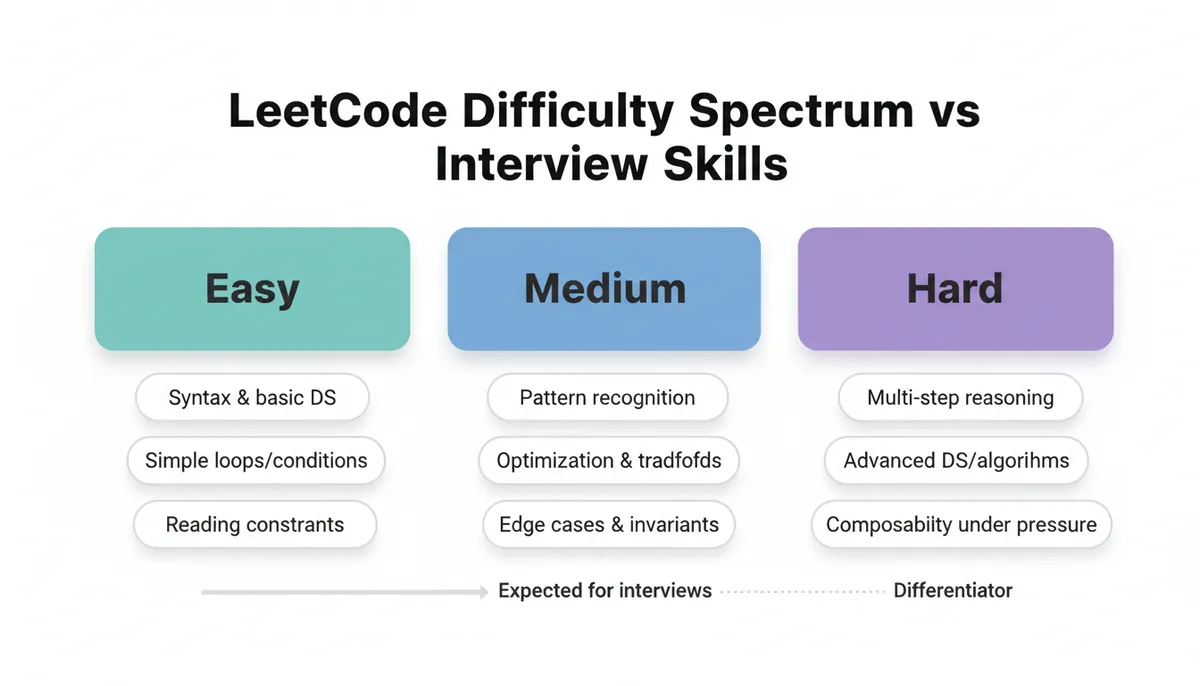
- Easies test: syntax, basic data structures, reading comprehension
- Mediums test: problem-solving patterns, optimization, tradeoffs
- Hards test: depth, composability, and comfort with complex abstractions
What Difficulty Levels Do Top Companies Actually Use?
Let’s ground this in what happens in real interviews. Across big tech and high-growth startups, a typical loop looks like this:
Phone screen / initial coding round
- 1–2 questions in 45–60 minutes
- Difficulty band: Easy–Medium, occasionally “low Hard” disguised as a Medium
- Goals:
- Can you write correct code end-to-end?
- Can you handle basic data structures and complexity?
- Do you communicate your thought process?
You will rarely see a pure “Hard LeetCode” here. Interviewers don’t want to fail strong candidates because of a single obscure trick.
Onsite / final rounds
- 3–4 coding rounds
- Difficulty band: Medium–Medium+, sometimes a “Hard-ish” problem or follow-up
- Goals:
- Can you recognize common patterns?
- Can you move from brute force to optimized solution?
- Can you handle follow-ups that change constraints or data models?
Often, a question starts at Easy/Medium and escalates:
- Solve a basic version (Easy)
- Optimize with a classic pattern (Medium)
- Extend to a trickier constraint (Medium+/Hard-)
So while the label might say Medium, the full conversation can feel like a Hard if you go deep.
System design / senior roles
For senior roles, pure LeetCode-style difficulty matters less. Interviewers care more about:
- Tradeoffs, scalability, and reliability
- Understanding of distributed systems
- Ability to reason under ambiguity
However, strong Medium-level problem-solving is still expected: you should be able to reason about complexity, invariants, and data structures quickly.
Key implication: For most software engineering interviews, Medium-level mastery is the core requirement. Easy-level fluency is assumed; Hard-level comfort is a differentiator, not a baseline.
Easy vs Medium vs Hard LeetCode: What Each Level Really Tests
Let’s make this concrete by looking at what each level tends to probe.
Easy LeetCode: Fundamentals and Execution
Typical characteristics:
- Single-pass loops
- Basic use of arrays, hash maps, stacks, or strings
- Straightforward brute-force solutions that already pass
What they test:
- Can you translate a problem statement into code without getting lost?
- Do you know standard library methods and syntax in your chosen language?
- Can you handle corner cases: empty input, single element, negative values?
Example (Easy → interview expectation)
Problem type: “Given an array of integers, return the indices of the two numbers that add up to a target.”
- Data structures: array + hash map
- Complexity: O(n) time, O(n) space
- Interview expectation: You should be able to write this in 5–10 minutes, with correct handling of duplicates and indexes.
If Easy problems feel hard, you’re not ready to think about difficulty strategy yet. You need:
- Language fluency
- Comfort with basic data structures
- Habit of checking edge cases
Medium LeetCode: Patterns and Optimization
Typical characteristics:
- Need to move beyond brute force to pass constraints
- Require a known pattern:
- Two pointers
- Sliding window
- Binary search on answer
- DFS/BFS on trees/graphs
- Backtracking
- Prefix sums / difference arrays
- Heaps / priority queues
- More involved edge cases and invariants
What they test:
- Can you recognize which pattern fits this problem?
- Can you justify why your complexity is optimal?
- Can you refactor a brute-force idea into something efficient?
Example (Medium → interview expectation)
Problem type: “Longest substring without repeating characters.”
- Naive: O(n²) with nested loops and a set
- Pattern: sliding window + hash map
- Optimal: O(n) time, O(min(n, charset)) space
- Interview expectation:
- Start with brute force thinking
- Recognize that you’re recomputing work
- Move to a sliding window and explain why each character is processed at most twice
This is where interviewers spend most of their time. If you can reliably solve Mediums with clear reasoning, you’re in good shape for most coding interviews. This aligns well with the Best Ways to Use AI for DSA and Coding Interview Preparation to enhance your pattern recognition and coding skills.
Hard LeetCode: Depth and Composability
Typical characteristics:
- Multi-step solutions:
- Combine several patterns (e.g., binary search + DP + prefix sums)
- Use advanced data structures: segment trees, Fenwick trees, union-find, specialized heaps
- Require clever invariants or state compression
- More complex proofs of correctness or non-obvious invariants
What they test:
- Can you hold a complex problem in your head?
- Can you design and maintain invariants across multiple components?
- Can you adapt when constraints change or the problem is generalized?
Example (Hard → interview expectation)
You’re unlikely to get a straight-up Hard LeetCode problem as-is in a 45-minute round. But you might get:
- A Medium-level problem with Hard-style follow-ups:
- “Now make it work in an online fashion.”
- “Now support updates and queries efficiently.”
- “Now handle this in distributed fashion / across machines.”
Practicing Hards is less about matching interview difficulty and more about:
- Expanding your mental models
- Getting comfortable with complex states and invariants
- Training for senior-level problem-solving and system design intuition, which ties into how AI Is Changing Technical Interviews in 2026 by emphasizing deeper reasoning and adaptability.
How to Interpret LeetCode Difficulty in the Context of Interviews
The crucial insight: difficulty labels are not linear measures of value. Instead, think in terms of skill coverage and return on time invested.
Easy: High coverage, low depth
- Great for:
- Warming up
- Practicing a new language
- Fixing basic gaps (e.g., off-by-one errors, null checks)
- Diminishing returns after:
- ~100 well-chosen Easy problems across core topics
If you’re stuck doing Easies for months, you’re probably avoiding the real work: pattern recognition and optimization.
Medium: Optimal ROI for interviews
- Great for:
- Building pattern-based problem solving
- Practicing under realistic constraints
- Simulating real interview conversations
- Diminishing returns after:
- You can look at a new Medium, identify the pattern category within a few minutes, and implement a correct solution in ~20 minutes consistently.
Most of your serious prep time should be here.
Hard: Selective, targeted practice
- Great for:
- Top-tier companies with very competitive bars
- Strengthening weak algorithmic areas (e.g., advanced graphs, DP)
- Building confidence and composure under complexity
- Use sparingly:
- Choose Hards that extend a pattern you already know
- Avoid random, one-off trick problems that don’t generalize
If you’re grinding Hards but still missing basic patterns on Mediums, your prep is backward.
A Pattern-Based Strategy for Easy vs Medium vs Hard LeetCode
Rather than thinking in terms of counts (“I solved 300 Mediums”), think in terms of patterns mastered.
A pattern is a reusable mental template: “When I see X structure and Y constraint, I try Z approach.”
Platforms like Thita’s DSA patterns sheet organize problems this way; you can replicate a similar structure in your own tracking.
Step 1: Use Easies to lock in fundamentals
Goal: No friction on language or basic data structures.
Focus areas:
- Arrays & strings
- Hash maps and sets
- Stacks and queues
- Simple linked lists
- Basic tree traversals (preorder, inorder, postorder, BFS)
Stop when:
- You can implement these from memory under time pressure
- You don’t get stuck on syntax
- You rarely miss obvious edge cases
Step 2: Use Mediums to master patterns
Goal: Recognize and apply the core 20–30 patterns that cover 80% of interview questions.
Representative patterns:
- Two pointers: sorted arrays, partitioning, merging
- Sliding window: substrings/subarrays with constraints
- Binary search variants: on answer space, rotated arrays, first/last occurrence
- DFS/BFS: trees, graphs, grids, topological sort
- Backtracking: permutations, combinations, subsets
- Greedy: interval scheduling, resource allocation
- Prefix sums / difference arrays: range queries, cumulative counts
- Heaps / priority queues: k-th element, running medians
- Dynamic programming: knapsack, LIS, grid paths, string edit distances
For each pattern, your workflow should be:
- Learn the core idea (1–2 canonical problems)
- Practice variations (3–5 Mediums per pattern)
- Summarize:
- When to apply this pattern
- Typical pitfalls
- Time/space tradeoffs
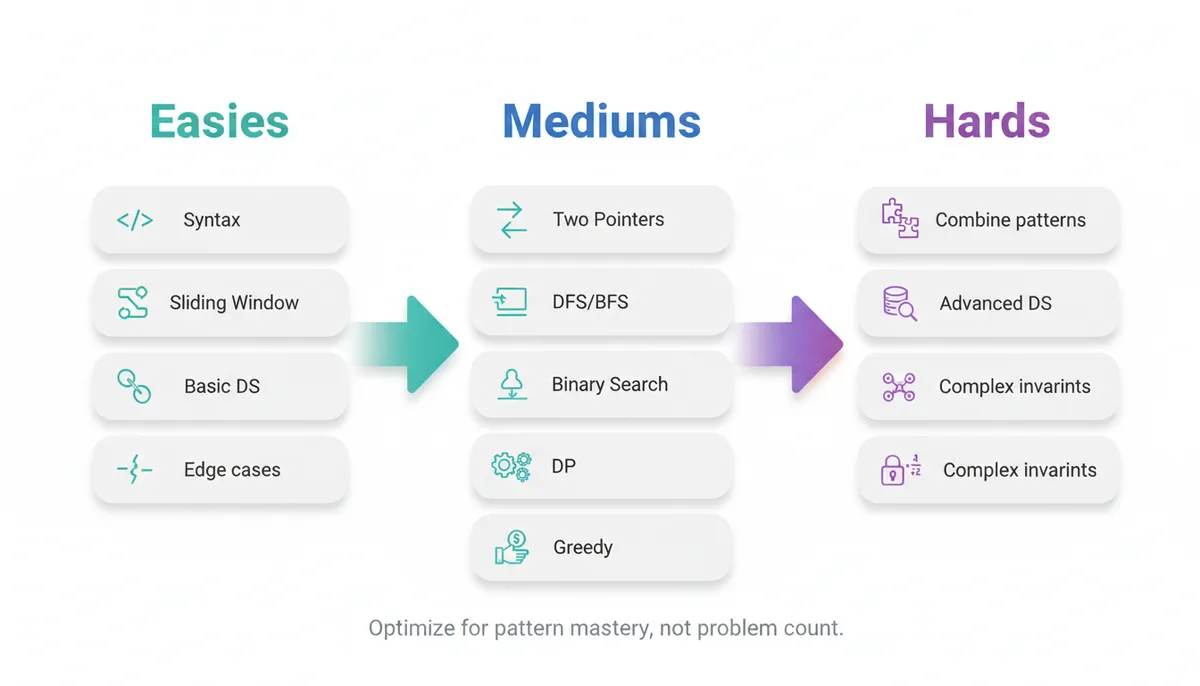
Step 3: Use Hards as capstones, not the main course
Goal: Stress-test your understanding of patterns and your ability to compose them.
Pick Hards that are:
- Natural extensions of patterns you know
- Frequently referenced in discussions or editorial solutions
- Representative of topics your target companies care about (e.g., graphs for infra teams, DP for ML optimization roles)
For each Hard:
- Don’t brute-force your way through dozens of attempts
- Spend more time on:
- Understanding the editorial
- Re-deriving the solution from first principles
- Explaining the invariants out loud as if in an interview
Example: Same Pattern, Different LeetCode Difficulty
Let’s walk through a simple pattern—two pointers on a sorted array—and see how it appears across difficulties.
Easy-level: Pair sum equals target (sorted array)
Given a sorted array of integers and a target, return true if there exist two numbers that sum to the target.
Pattern: two pointers from ends.
PYTHON
- Time: O(n)
- Space: O(1)
- Interviewer expectation: You should find this quickly once you notice the array is sorted.
Medium-level: 3Sum
Given an integer array
nums, return all unique triplets[nums[i], nums[j], nums[k]]such that they sum to 0.
Pattern: sort + two pointers inside a loop, plus duplicate handling.
Key ideas:
- Sort the array
- Fix one number, then use two pointers to find the remaining pair
- Skip duplicates for both the fixed index and the moving pointers
This is conceptually just an extension of the Easy version, but:
- You must manage more indices
- You must handle duplicates carefully
- You must reason about complexity: O(n²)
Hard-level: 4Sum / k-Sum generalized
Given an array
numsand an integertarget, return all unique quadruplets[a, b, c, d]such thata + b + c + d == target.
General pattern:
- Sort the array
- Use recursion to reduce k-Sum to (k-1)-Sum
- Base case: 2-Sum with two pointers
- Prune impossible branches based on remaining min/max sums
Now you’re composing:
- Sorting
- Two pointers
- Recursion + pruning
- Duplicate handling
The underlying pattern is the same; the difficulty is in composition and bookkeeping. This is exactly how “Medium vs Hard” often plays out in interviews: same building blocks, more moving parts.
Common Mistakes in Using LeetCode for Interview Prep
1. Treating problem count as a KPI
“I solved 500 problems” is meaningless if:
- You can’t explain why your solution is optimal
- You can’t recognize a pattern in a new problem
- You can’t code under time pressure without copy-pasting from memory
Track patterns mastered, not problems completed.
2. Avoiding Mediums because they’re uncomfortable
If you’re “saving Mediums for later” and only doing Easies:
- You’re optimizing for comfort, not growth
- You’re not simulating real interview difficulty
- You’re delaying the pattern-recognition phase you actually need
Push into Mediums early, even if it feels slow.
3. Grinding Hards too early
Jumping into Hards when you haven’t:
- Mastered basic DP patterns
- Gotten comfortable with graph traversals
- Internalized sliding window / two pointers
…will mostly train frustration, not skill. You’ll end up memorizing editorials instead of building reusable mental models.
4. Ignoring constraints and complexity
Many candidates:
- Jump straight into coding without estimating complexity
- Don’t read or use input constraints
- Fail to notice that their O(n²) solution will TLE
Make it a habit:
- Before coding: state your expected time/space complexity
- After coding: validate against constraints (“n up to 10⁵, O(n²) is too slow”)
5. Practicing only in “offline” mode
Solving LeetCode with unlimited time, no pressure, and no explanation is very different from:
- Thinking out loud
- Handling interruptions and hints
- Answering “what if we change X?” follow-ups
Do at least some practice in interview-like conditions—timed, spoken reasoning, and feedback. Tools like mock interviews or an AI interview coach can approximate this.
Best Practices: Building an Effective LeetCode Strategy
Here’s a practical, pattern-first plan that respects Easy vs Medium vs Hard LeetCode difficulty levels and aligns with real interviews.
1. Set clear goals per phase
-
Phase 1 (2–3 weeks): Fundamentals
- 50–80 Easy problems across core topics
- Goal: no syntax friction, solid grasp of arrays, maps, stacks, queues, basic trees
-
Phase 2 (4–8 weeks): Pattern mastery
- 150–250 Medium problems, grouped by pattern
- Goal: for each core pattern, be able to:
- Recognize when to use it
- Implement it quickly
- Handle typical edge cases
-
Phase 3 (ongoing): Depth and resilience
- Selective Hards in weak areas
- Mock interviews
- Goal: composability, communication, and handling follow-ups
2. Use a feedback loop, not just repetition
For each problem, especially Medium/Hard:
- Attempt (15–25 minutes):
- If stuck, write brute force and analyze why it’s too slow
- Review:
- If you used a known pattern, name it explicitly
- If you didn’t, ask: which pattern would have helped?
- Summarize:
- One or two sentences: “This is a sliding window where we track X to maintain invariant Y.”
- Re-solve later:
- After a week, re-implement from scratch without looking
This turns each problem into a pattern rep, not a one-off exercise.
3. Maintain a pattern notebook
Keep a lightweight log (notion, markdown, paper) with sections like:
- Pattern name
- When to use
- Skeleton code (language of choice)
- 2–3 representative problems (with LeetCode IDs)
- Common pitfalls
Over time, this becomes more valuable than your raw problem count.
4. Calibrate with realistic mock interviews
Even if you’re strong on LeetCode, you might:
- Freeze under time pressure
- Struggle to verbalize your thinking
- Miss follow-up implications
Schedule periodic mocks (with peers or tools) where:
- You get 1–2 Medium-level questions
- You must think out loud
- You receive feedback on both solution and communication
This closes the gap between “LeetCode difficulty” and “interview difficulty.”
Practice by level with a pattern-first plan
Skip the endless scrolling: group problems by pattern and difficulty. On thita, the DSA patterns sheet shows every problem under its pattern with its difficulty, and the curated lists (Blind 75, NeetCode 150, NeetCode 250) mix Easy, Medium and Hard in sensible proportions. Compare them in NeetCode 150 vs 250 vs Blind 75. Practise spoken explanations with an AI mock interview.
FAQ
What are the LeetCode difficulty levels?
Easy, Medium and Hard. As of 20 October 2026 there are 972 Easy, 2,130 Medium and 984 Hard problems.
How hard is LeetCode?
Medium is where interviews live and where most people spend most of their time. Hard problems combine several ideas and are optional for most roles.
How hard are LeetCode Hards?
Much harder than Mediums: they typically need two or more combined insights or an advanced structure such as a segment tree or union-find, and have lower acceptance (about 48% on average, with a very wide spread by problem).
Do I need to solve LeetCode Hards to pass interviews?
Usually not. Most coding rounds use Easy to Medium problems, sometimes with a Hard-style follow-up. Hards help most for top-tier companies and senior roles.
What mix of Easy, Medium and Hard should I solve?
A reasonable split inside a 150-250 problem plan is about 20% Easy, 65-70% Medium and 10-15% Hard, adjusted to your target companies.
Is Medium enough for FAANG?
Medium-level mastery is the core requirement; add some Hards in your weakest patterns if you have time.
Key Takeaways: What Difficulty Level Actually Matters?
-
Easy problems are table stakes. Use them to:
- Get comfortable with your language and basic data structures
- Clean up implementation details and edge-case handling
-
Medium problems are the core of interview prep. They:
- Map most closely to real interview questions
- Train pattern recognition and optimization
- Should consume the majority of your focused practice time
-
Hard problems are accelerators, not prerequisites. They:
- Help you compose patterns and handle complex invariants
- Are useful for top-tier roles and deep algorithmic comfort
- Should be chosen selectively, not farmed indiscriminately
Most importantly, optimize for pattern mastery and interview-like reasoning, not for a raw count of solved problems or a vanity mix of Easy/Medium/Hard.
If you can:
- Breeze through Easies without friction
- Consistently solve new Mediums by recognizing and applying patterns
- Occasionally tackle Hards to stretch your boundaries
…you’re aligned with what real coding interviews actually test, regardless of the labels on LeetCode.
Topics
Related on Thita
Your next step
Practise with AI mock interviews
A spoken interview that asks follow-up questions, runs your code and ends with a written report.