
Interview
Flipkart Interview Questions and Process: The Complete Guide (2026)
A full breakdown of Flipkart's SDE interview process — every round, the 90-minute machine coding test, difficulty, timelines, and a 30-day preparation plan.
Flipkart's software engineering loop is unusual in how clearly one round dominates it. The algorithmic stages are real, the managerial round matters, and system design appears from SDE-2 upward — but the ninety-minute machine coding round is what candidates remember, prepare for, and get rejected at. It is graded on object-oriented design, not on whether the output happens to be correct.
This guide walks the full process — every round, what each screens for, how hard it is, and how to prepare with the time you have. To practise against the design problems evidenced at Flipkart, Flipkart's interview kit holds nine low-level design problems attributed to the company, each with a worked editorial and AI-evaluated practice.
The process at a glance
| # | Round | Format | What it screens |
|---|---|---|---|
| 1 | Online assessment | Timed algorithmic problems | Baseline coding ability |
| 2 | Data structures & algorithms | Live coding with an engineer | Problem solving, complexity reasoning |
| 3 | Machine coding | 90 min, graded on object-oriented design | Design under pressure, code quality |
| 4 | System design (SDE-2 and above) | Architecture discussion | Scale, trade-offs, distributed thinking |
| 5 | Techno-managerial / HR | Project depth and fit | Ownership, collaboration, level |
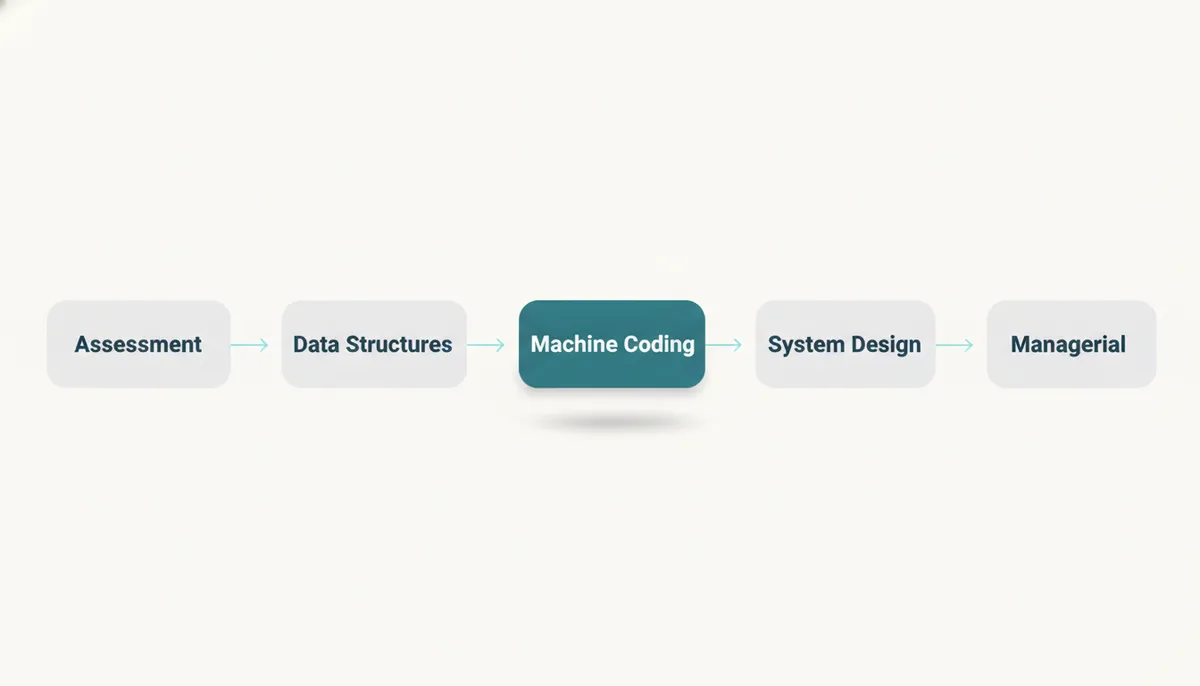
Round counts vary by level, team and hiring channel — campus loops in particular differ from lateral ones. Treat this as the shape and confirm specifics with your recruiter.
Round 1 — the online assessment
Timed algorithmic problems, sat remotely, used to reduce volume. The material is standard: arrays and strings, hash maps, two pointers, sliding windows, sorting, binary search, trees and graphs.
The bar is competence within the clock rather than depth. What separates candidates who clear it is recognition speed — seeing quickly which shape of problem is in front of them — which is exactly what pattern-based preparation builds. The DSA Patterns Sheet is free to browse and organises problems by the pattern each one actually tests, and how to identify the right DSA pattern covers the skill directly.
💡 Pro Tip: Always practise with a timer. The usual failure here is finishing with no minutes left to check edge cases, not being unable to solve the problem.
Round 2 — data structures and algorithms, live
One or two problems with an engineer, harder than the assessment, and now your process is being marked as well as your answer.
Clarify before coding. State the approach and its complexity before typing. Narrate the choice when you pick between two approaches. Find your own edge cases. Being nudged is fine; being carried is not. Our guide to what interviewers actually look for in live coding rounds covers the mechanics, and thinking out loud covers how to narrate without losing the thread.
Round 3 — the ninety-minute machine coding round
Flipkart's signature stage. One under-specified problem, ninety minutes, running code expected at the end, in-memory state, your choice of language, and a driver demonstrating the flows.
The grading criterion is the important part: object-oriented design quality, not merely correct output. That inverts the priorities most candidates bring from algorithmic practice. A working system with a muddled design scores below a working system with a clean one.
What graders look for:
- A real domain model — classes representing the things in the problem, with behaviour, not a single procedural block.
- One responsibility per class.
- Interfaces where behaviour genuinely varies — not everywhere, which reads as pattern application without judgement.
- Clean extension. The near-inevitable "how would you add X?" should be answerable with a new implementation, not a rewrite.
- Readability, as a proxy for your production code.
Get the core flow running early, then improve its structure. Arriving at ninety minutes with an elegant hierarchy that does not execute is the most common way to fail.
We cover the format, grading and failure modes in depth in Flipkart's machine coding round: the 90-minute test.
⚠️ Important: Spend the first five minutes clarifying the spec. The gaps in the problem statement are deliberate, and how you handle them is marked.
Round 4 — system design, from SDE-2 upward
A separate architecture-level round for mid and senior roles. Expect to reason about scale, data modelling, caching, queues and failure behaviour, and to justify trade-offs rather than recite a reference diagram.
Given Flipkart's own product surface, catalogue, inventory, order and pricing systems are natural territory — problems where read volume vastly exceeds write volume and consistency requirements differ sharply between subsystems.
The System Design Sheet is free to browse; how much system design is enough for SDE-1 vs SDE-2 will tell you how much of this applies at your level. For rehearsal, an HLD mock interview with AI evaluation of the submitted design is closer to the real thing than reading.
Round 5 — techno-managerial and HR
Project depth, ownership and fit. Have two or three projects you can discuss for ten minutes each without notes: what you personally decided, what went wrong, what you would do differently.
The failure mode is vague ownership. "We migrated the service" invites the follow-up "what did you decide?", and candidates who cannot answer that tend to get levelled down rather than rejected outright.
Is the Flipkart interview hard?
Moderately, with the difficulty concentrated in one place.
The algorithmic rounds sit at standard interview difficulty — medium problems, familiar patterns, no tricks in most accounts. Systematic preparation clears them.
The machine coding round is the hard part, and its difficulty is structural rather than intellectual. Ninety minutes of unassisted building from an empty file, judged on design quality, is a skill almost nobody trains — and months of algorithmic practice build very little of it. That gap is what makes Flipkart's loop selective.
How many rounds? Typically four to five stages after the assessment, varying by level.
How long does it take? Commonly two to four weeks end to end, though campus processes compress considerably.
A 30-day preparation plan
Week 1 — algorithmic foundations. Core patterns for recognition speed, not problem count. Short daily sessions of code practice with AI feedback.
Week 2 — design vocabulary. Object-oriented design patterns and class-design idioms. Two design problems implemented end to end with no clock, prioritising structure, then compared against the editorials. Design patterns for interviews and the free Low Level Design Sheet cover it.
Week 3 — the ninety-minute clock. One problem per session, running code by the end, no exceptions. The nine low-level design problems evidenced at Flipkart are the most directly relevant set to work through.
Week 4 — integration. Keep algorithmic practice ticking. If you are interviewing at SDE-2 or above, add two system design mocks. Otherwise: one algorithmic mock, one machine coding mock, one behavioural, and your project stories written out and said aloud.
Campus and lateral loops differ
Flipkart hires through both campus and lateral channels, and the loops are not the same shape. Knowing which one you are in changes how you should prepare.
Campus loops compress. Rounds are often scheduled across a single day or two, with less gap for recovery between them. The online assessment carries more of the filtering load because applicant volume is high, and the machine coding round tends to be the pivotal technical stage. Project depth matters less simply because candidates have less of it, so the managerial conversation leans more on fundamentals, learning ability and how you handled academic or internship work.
Lateral loops go deeper on experience. With a few years behind you, the questions shift. The system design round becomes real rather than nominal, the machine coding round is judged against a higher expectation of production instincts, and the managerial round becomes a serious examination of what you have actually owned. Vague ownership is far more costly here than at campus level.
Two practical implications:
- If you are interviewing from campus, weight your time toward the assessment and the machine coding round, and rehearse talking about your projects even if they feel small. Being able to explain a modest project precisely beats gesturing at an ambitious one.
- If you are interviewing laterally, do not let the design rounds catch you cold. Candidates with strong delivery records sometimes assume experience substitutes for design preparation, and it does not — the round has a format, and format is rehearsable.
Confirm which channel and level you are being considered for. It is a reasonable question to ask a recruiter and the answer changes your preparation.
Frequently asked questions
How many rounds does Flipkart have for SDE roles? Typically an online assessment, a live data structures round, the machine coding round, a system design round for SDE-2 and above, and a techno-managerial round.
Which round matters most? The machine coding round. It is the most discussed stage in candidate accounts and the one most decisive to outcomes.
How long is the machine coding round? Ninety minutes is the commonly reported duration. Confirm with your recruiter.
What is machine coding graded on? Object-oriented design quality alongside working code. Correct output is necessary but not sufficient.
Does Flipkart ask data structures and algorithms questions? Yes — in the online assessment and in a separate live round. Both are real gates, not formalities.
Do I need system design for SDE-1? Class-level design, yes — that is what machine coding examines. Architecture-level system design appears from SDE-2 upward.
What language should I use? Whichever you are most fluent in. Java is most common in reported accounts, but fluency beats the choice.
How long does the process take? Commonly two to four weeks, with campus processes considerably faster.
Does Flipkart hire from campus and laterally? Both, and the loops differ in shape — campus processes compress into fewer days and lean harder on the assessment, while lateral loops go considerably deeper on system design and on what you have personally owned. Ask your recruiter which channel and level you are being considered for.
Can I use my own IDE for the machine coding round? Usually yes, and you should — use the editor and language you are quickest in. Confirm the setup with your recruiter beforehand so there are no surprises on the day.
Where to start
If you have a Flipkart loop coming up, put your preparation where the loop actually concentrates: ninety minutes, no assistant, running code at the end, judged on design. That is the round that decides it and the one almost nobody rehearses.
Open Flipkart's interview kit for the nine low-level design problems evidenced at Flipkart, each with an editorial and AI-evaluated practice. Read the machine coding deep dive for the grading detail, and use an AI mock interview to rehearse.
Interview processes change. Confirm round structure and timings with your recruiter, and check Flipkart's careers site for current openings.
Topics
Related on Thita
Your next step
Practise with AI mock interviews
A spoken interview that asks follow-up questions, runs your code and ends with a written report.