
Interview
How Long Does It Really Take to Crack a Software Engineering Interview?
Most people underestimate one thing about coding interviews: they’re not a single event, they’re a **timeline**.
Most people underestimate one thing about coding interviews: they’re not a single event, they’re a timeline.
“How long to prepare for coding interviews?” is one of the most common questions candidates ask. Some people say two weeks is enough. Others grind LeetCode for a year. Both can be right—or very wrong—depending on where they’re starting from and what they’re aiming for.
This post breaks down the software engineer interview timeline in a practical, data-driven way:
- How to estimate your interview preparation time
- What a realistic 4–16 week plan looks like
- How long each interview stage actually takes
- Where people waste the most time
- How to shorten the path without burning out
No hype, no “just grind harder.” Think of this as a design doc for your interview prep.
1. The Real Question: Time to Readiness, Not Time to Offer
When people ask “how long does it take to crack a software engineering interview?”, they usually mix up two different timelines:
-
Time to readiness
How long it takes you to reliably pass:- Standard coding interviews (DSA, algorithms)
- System design (for mid/senior)
- Behavioral / past-project deep dives
-
Time to offer
How long it takes from “I’m ready” to signing an offer:- Applying → recruiter screens → interviews → offer → negotiations
- Often 4–10 weeks even if you’re fully prepared
This post focuses on time to readiness—how long you need to prepare for coding interviews and the broader software engineer interview loop.
But you should mentally add another 1–2 months for the actual interview pipeline.
2. The Four Variables That Determine Your Interview Preparation Time
There is no single correct answer to “how long to prepare for coding interviews.” There are four main variables:
- Current level
- Target companies / roles
- Available weekly hours
- Depth of fundamentals
2.1 Current Level
Rough categories:
-
Beginner (0–1 years experience or weak CS background)
- Maybe bootcamp or self-taught
- Little algorithm practice
- Not fluent with Big-O, recursion, or common data structures
- Prep time: 12–24 weeks (part-time)
-
Intermediate (1–4 years experience, some DSA exposure)
- Comfortable coding, but rusty on interview-style problems
- Knows arrays, hash maps, trees, but not patterns
- Prep time: 8–16 weeks
-
Experienced (4+ years, strong CS fundamentals)
- Has seen many patterns before
- Maybe previously interviewed at big tech
- Prep time: 4–8 weeks (focused refresh)
2.2 Target Companies and Roles
-
FAANG / top-tier product companies
- Higher bar, more algorithm-heavy
- System design for mid/senior
- Expect upper range of prep times
-
Mid-sized / startups
- Often more practical coding and product-focused design
- Less emphasis on tricky puzzles
- Prep time can be closer to lower range
-
Specialized roles (infra, ML, security)
- Need both DSA + domain depth
- May require extra 4–6 weeks for domain projects / reading
2.3 Available Weekly Hours
Roughly linear relationship:
- 10 hrs/week (busy full-time job, family)
- Expect: longer timeline, less room for experimentation
- 20 hrs/week
- Sustainable for most working engineers
- 30+ hrs/week
- Aggressive; can accelerate learning but high burnout risk
2.4 Depth of Fundamentals
Two candidates can both “know trees,” but:
- Candidate A: remembers definitions, needs to look up traversals
- Candidate B: can derive solutions from first principles under pressure
Candidate B will need less prep time because they’re building on solid foundations instead of memorizing.
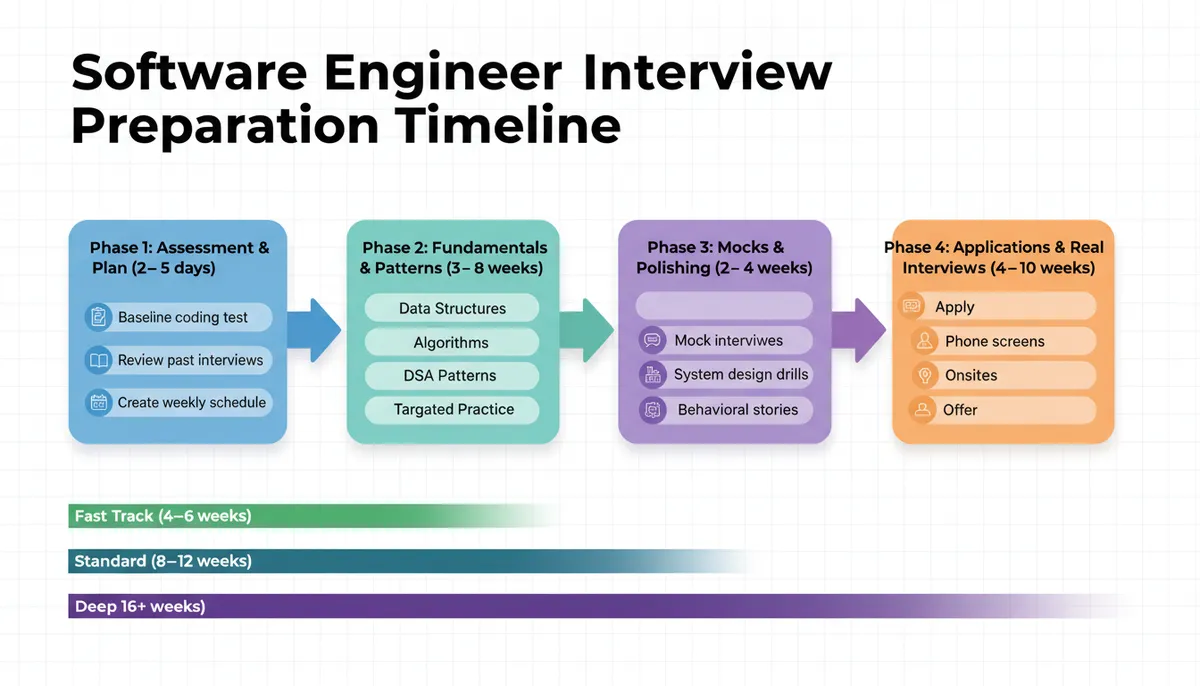
3. A Realistic Interview Preparation Timeline (4–16 Weeks)
Let’s define three sample timelines. You can adjust based on your profile:
- Fast track (4–6 weeks) – Experienced, strong fundamentals, 20–30 hrs/week
- Standard track (8–12 weeks) – Most working engineers, 10–20 hrs/week
- Deep track (16+ weeks) – Beginners or those rebuilding fundamentals
3.1 High-Level Phases
Regardless of track, the phases are similar:
- Assessment & Planning (2–5 days)
- Fundamentals & Patterns (3–8 weeks)
- Full Mock Loops & Polishing (2–4 weeks)
- Parallel: Applications & Real Interviews (4–10 weeks)
4. Phase 1: Assessment – How to Estimate Your Interview Prep Time
Before asking “how long,” you should answer “from where to where?”
4.1 Quick Self-Assessment Checklist (1–2 days)
Do a realistic baseline test:
-
Coding
- Pick 3 problems:
- 1 easy array/string
- 1 medium involving a tree or graph
- 1 medium involving dynamic programming or backtracking
- Give yourself 45 minutes per problem.
- Score yourself:
- 0: cannot approach
- 1: brute force only
- 2: near-optimal with hints
- 3: optimal independently
- Pick 3 problems:
-
Core CS Concepts
- Can you explain:
- Time/space complexity of common operations?
- How hash maps work under the hood?
- Difference between BFS/DFS and when to use each?
- Big-O of common sorting algorithms?
- Can you explain:
-
System Design (if applicable)
- Try designing:
- A URL shortener
- A rate limiter
- Evaluate: do you talk about APIs, data models, scaling, consistency, trade-offs?
- Try designing:
-
Behavioral
- Can you tell 3–5 structured stories (STAR format) about:
- Conflict
- Failure
- Ambiguity
- Leadership
- Impact
- Can you tell 3–5 structured stories (STAR format) about:
4.2 Estimating Your Timeline
Rough mapping:
- If you scored mostly 0–1 on coding + weak CS → 16–24 weeks
- If you scored mostly 1–2 → 8–16 weeks
- If you scored mostly 2–3 → 4–8 weeks
This is not exact, but it’s better than guessing.
5. Phase 2: Fundamentals & Patterns – Where Most Time Is Spent
This is where you answer: how long to prepare for coding interviews specifically?
For most candidates, this is 3–8 weeks of focused work.
5.1 What You Actually Need to Know
At a minimum:
- Data Structures
- Arrays, strings
- Hash maps / sets
- Linked lists
- Stacks, queues, heaps
- Trees (BSTs, tries), graphs
- Algorithms
- Sorting, searching
- BFS, DFS, topological sort
- Two pointers, sliding window
- Binary search (including on answers)
- Greedy strategies
- Dynamic programming (1D, 2D, subsequences)
- Backtracking
Patterns-based approaches (like Thita’s 94 DSA patterns) matter because:
- Interviews rarely require brand-new ideas.
- Most problems are variations of a small set of patterns.
5.2 Example: Pattern-Based Thinking vs Problem Memorization
Consider this problem:
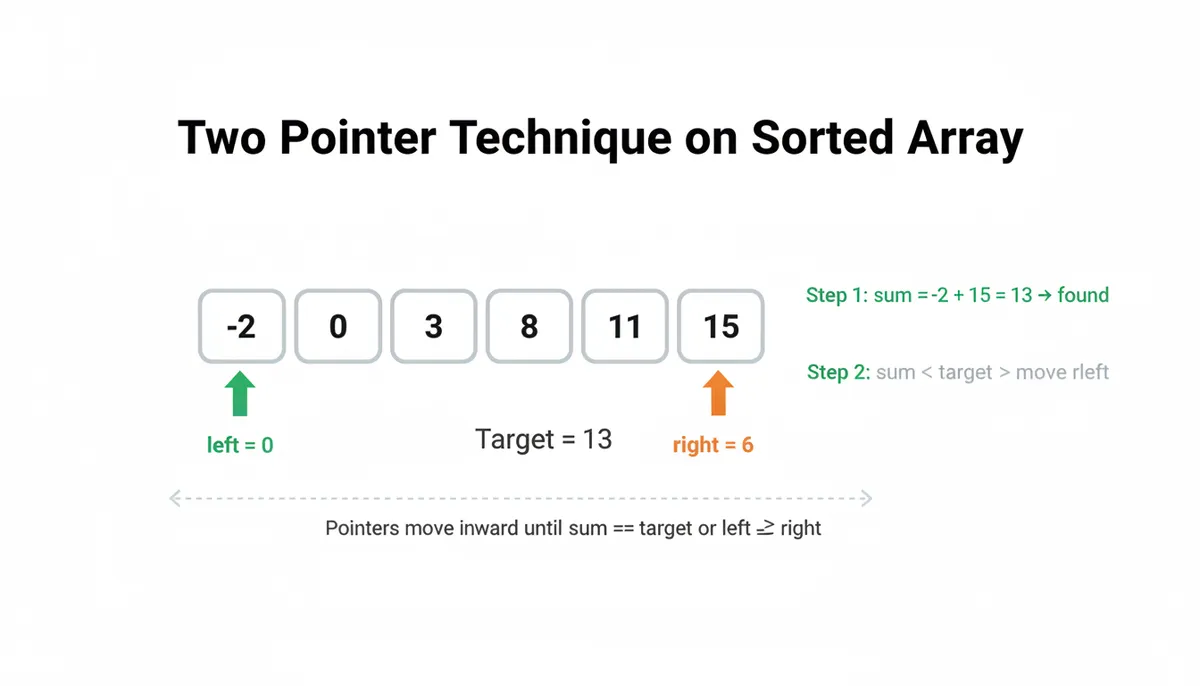
Given a sorted array of integers and a target sum, find a pair of numbers that add up to the target.
Two approaches:
Brute Force (Nested Loops)
PYTHON
Pattern-Based (Two Pointers on Sorted Array)
PYTHON
If you recognize this as a two-pointer pattern on sorted input, you can derive the solution under pressure rather than memorizing it.
5.3 How Many Problems Do You Actually Need?
You don’t need to do 500+ problems.
What matters:
- Coverage of patterns, not raw count
- Depth of understanding, not memorization
Rough guideline:
- Beginner: 120–180 problems across all patterns
- Intermediate: 80–120 problems
- Experienced: 40–80 targeted problems
Spread over 6–10 weeks, this is manageable at 10–20 hours/week.
6. Phase 3: Mocks & Polishing – Converting Knowledge into Performance
Knowing DSA is necessary but not sufficient. You must also be able to:
- Communicate clearly
- Manage time in a 45–60 minute window
- Handle pressure and unknowns
This phase typically takes 2–4 weeks.
6.1 What to Practice
-
Timed Coding Sessions
- 45-minute sessions
- 1 medium or 2 easy problems
- Simulate real interview environment:
- No autocomplete
- No copy-paste from old code
- Talk through your thought process
-
Mock Interviews
- With peers, mentors, or AI-based mock interviewers (e.g., AI Mock Interviews vs Real Interviews: Do They Actually Help?)
- Focus on:
- Clarifying requirements
- Explaining trade-offs
- Testing and edge cases
- Handling hints gracefully
-
System Design Drills (for mid/senior)
- 45–60 minutes per design
- Practice:
- Requirements gathering
- API design
- Data modeling
- High-level architecture
- Scaling and trade-offs
-
Behavioral Story Rehearsal
- Prepare 6–8 stories
- Use STAR or similar structure
- Practice concise, 2–3 minute answers
7. Phase 4: Applications & Real Interviews – The Overlooked Timeline
Even if you’re fully ready, the process itself takes time:
- Resume updates, referrals, applications: 1–2 weeks
- Recruiter screens: 1–3 weeks
- Technical phone screens: 1–3 weeks
- Onsite loop: 1–2 weeks
- Offer + negotiations: 1–2 weeks
This is why you should start applying before you feel 100% ready—usually around the start of Phase 3. Real interviews will inform where to focus your remaining prep.
8. How Long Does Each Interview Stage Actually Take?
Breaking down the coding interview duration and related stages:
8.1 Typical Coding Interview (45–60 minutes)
Time allocation:
- 5–10 min: Introductions, resume quick scan
- 25–35 min: Main problem (understanding, solution, coding)
- 5–10 min: Testing, edge cases, minor improvements
- 5–10 min: Questions from you
Your internal time budget for the problem:
- First 5–7 min: Clarify, explore brute force, identify pattern
- Next 10–15 min: Implement core solution
- Next 5–7 min: Test & handle edge cases
- Last few min: Small optimizations / discussion
8.2 System Design Interview (45–60 minutes)
Typical flow:
- 5–10 min: Clarify requirements, define scope
- 10–15 min: High-level design (APIs, components)
- 10–15 min: Deep dive into 1–2 components (e.g., storage, caching)
- 5–10 min: Non-functional requirements (scaling, reliability)
- 5–10 min: Wrap-up, trade-offs, questions
8.3 Behavioral Interview (30–45 minutes)
Typical structure:
- 5–10 min: Background, “tell me about yourself”
- 20–25 min: 3–5 behavioral questions
- 5–10 min: Your questions
9. Common Mistakes That Waste Months
A lot of “I’ve been preparing for a year” stories are actually 6 weeks of focused work spread over 12 months of inefficient effort.
9.1 Mistake: Grinding Random Problems Without a Plan
Symptoms:
- Solving problems by difficulty, not by pattern
- Forgetting solutions after a week
- Struggling to generalize from past problems
Fix:
- Organize by patterns (e.g., sliding window, binary search on answer) like those in the Master the Sliding Window Pattern: Complete Guide with Examples
- Track which patterns you’re weak on
- Review and re-solve selected problems after 1–2 weeks
9.2 Mistake: Ignoring Weak Fundamentals
If you can’t:
- Explain time complexity confidently
- Implement a basic DFS/BFS from scratch
- Reason about recursion and iteration trade-offs
…then no amount of LeetCode will fix it.
Fix:
- Spend 1–2 weeks explicitly on:
- Re-implementing core data structures
- Walking through algorithm traces by hand
- Writing small, focused snippets (e.g., “implement a min-heap”)
9.3 Mistake: Over-Focusing on Edge Cases Before You Have a Working Plan
In interviews, candidates often:
- Dive into off-by-one and null checks
- Worry about input constraints
- …before having a clear high-level approach
Fix:
- First 5 minutes: only clarify and choose an approach
- After approach is agreed: then care about edge cases
- Communicate this explicitly: “I’ll first outline the main idea, then we can discuss edge cases and constraints.”
9.4 Mistake: Not Doing Mocks
Reading solutions and coding alone is not enough.
You need to practice:
- Thinking out loud
- Handling hints without panicking
- Recovering from mistakes in real time
Fix:
- Schedule 1–2 mocks per week in the last 3–4 weeks:
- With peers
- With senior engineers
- Or an AI coach like those described in Best Ways to Use AI for DSA and Coding Interview Preparation that can simulate interviewer behavior
10. Best Practices to Shorten Your Interview Preparation Time
You can’t compress learning arbitrarily, but you can remove waste.
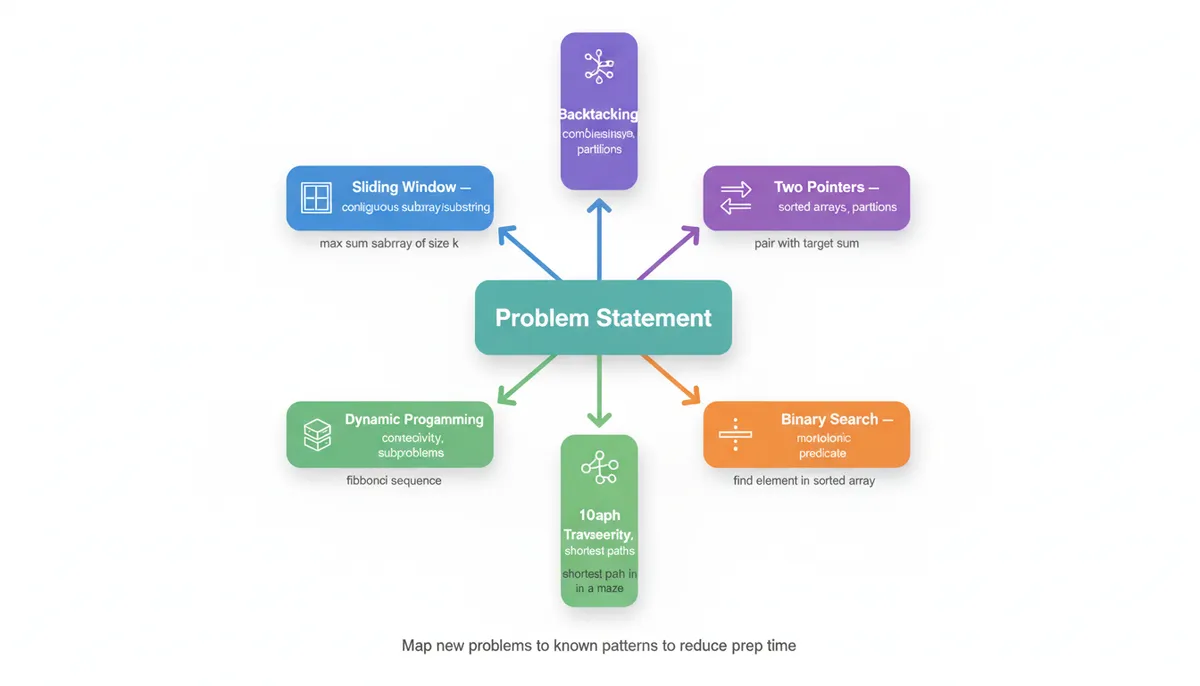
10.1 Use a Pattern-First Approach
Instead of:
“I solved 200 LeetCode questions.”
Aim for:
“I understand and can apply 25–30 core patterns across arrays, graphs, DP, and design.”
Benefits:
- Faster recognition in interviews
- Less cognitive load
- Easier to recall under pressure
10.2 Weekly Planning, Not Daily Guilt
Plan in weekly units, not daily streaks:
- Example (Standard Track, 10–15 hrs/week):
- 4–5 hrs: New DSA patterns + problems
- 3–4 hrs: Review + re-solve old problems
- 2–3 hrs: System design or project review
- 1–2 hrs: Behavioral prep
Check progress weekly:
- Are certain patterns consistently difficult?
- Are you slower than 30–35 min on mediums?
- Adjust next week’s plan accordingly.
10.3 Focus on Feedback Loops
Fast feedback shortens timelines:
-
After each problem:
- Could you derive the idea independently?
- Did you choose the right data structure?
- Did you communicate clearly?
-
After each mock:
- What 1–2 behaviors hurt you most?
- What’s the single biggest thing to fix before the next one?
10.4 Build Reusable Mental Templates
For each common pattern, build a template in your head:
-
Sliding Window
- When: contiguous subarray/substring optimization
- Template:
- Expand right pointer
- Shrink left pointer when constraint violated
- Track best window
-
Binary Search on Answer
- When: “min/max value that satisfies condition”
- Template:
- Define
can(x)predicate - Binary search over value space
- Use monotonicity of
can(x)
- Define
These templates reduce the time you spend “staring at the problem” and increase time spent implementing.
11. Sample Timelines by Profile
Here are concrete examples of how long to prepare for coding interviews and related rounds, by profile.
11.1 New Grad / Bootcamp (Beginner, 10–15 hrs/week)
- Weeks 1–2: Fundamentals
- Data structures: arrays, hash maps, linked lists, stacks/queues
- Big-O notation and simple complexity analysis
- Weeks 3–6: Core patterns
- Sliding window, two pointers, binary search, basic recursion, BFS/DFS
- 40–60 problems
- Weeks 7–10: Advanced patterns + mocks
- Trees, graphs, basic DP, backtracking
- 40–60 more problems
- 1 mock per week
- Weeks 11–12: System design lite + behavioral
- High-level reasoning about simple systems
- Prepare 6–8 behavioral stories
- Start real interviews
Total: 10–14 weeks + 4–8 weeks for actual interview pipelines.
11.2 Mid-Level Engineer (2–5 YOE, 10–20 hrs/week)
- Weeks 1–2: Assessment + refresh
- Identify weak areas in DSA
- Refresh core patterns
- Weeks 3–6: Focused DSA & system design
- 40–60 targeted problems in weak patterns
- 1–2 system design problems/week
- Weeks 7–8: Mocks & applications
- 2 mocks/week (coding + design)
- Start applying and taking phone screens
Total: 6–10 weeks + 4–8 weeks for pipelines.
11.3 Senior Engineer (5+ YOE, Strong Fundamentals, 10–15 hrs/week)
- Weeks 1–2: DSA refresh
- 20–30 problems across key patterns
- Weeks 3–4: System design focus
- 2–3 designs/week
- Weeks 5–6: Mocks, behavioral, applications
- 2 mocks/week (with emphasis on design and leadership)
Total: 4–8 weeks + 4–8 weeks for pipelines.
12. Key Takeaways: How Long Does It Really Take?
If you remember nothing else:
-
Time to readiness is usually:
- 4–8 weeks for experienced engineers
- 8–16 weeks for most mid-level
- 12–24 weeks for beginners or weak CS backgrounds
-
Time to offer adds another:
- 4–10 weeks for applications, interviews, and negotiations
-
You can shorten your interview preparation time by:
- Focusing on patterns, not raw problem count
- Fixing fundamentals early
- Doing regular mock interviews
- Planning weekly and using feedback loops
-
The coding interview duration (45–60 minutes) is a constraint you must practice under:
- 5–7 minutes: understand and choose an approach
- 15–20 minutes: implement
- 5–10 minutes: test, optimize, discuss trade-offs
Interview prep is more like training for a marathon than cramming for an exam. With a clear plan, pattern-based practice, and deliberate feedback, most engineers can reach “interview ready” far faster than they expect—without needing to pause their life for a year.
Read next
- How Many LeetCode Problems Are Enough to Crack Top Tech Interviews? — once you have a timeline, this sets a realistic problem-count target instead of an anxiety-driven one.
- One Week to Prepare for an Interview: A Day-by-Day Plan — for when your timeline has compressed to seven days.