
Interview
One Week to Prepare for an Interview: A Day-by-Day Plan
A realistic seven-day interview plan with one focused task and one live practice round each day. Prioritise what can improve before your interview next week.
One week is not enough time to become a different candidate. It will not build years of engineering judgement, fill every gap in data structures, or turn a weak resume into a strong one overnight.
It is enough time to become more interview-ready.
A focused week can help you identify the rounds that matter, refresh your strongest material, remove avoidable communication mistakes, and practise under conditions that resemble the real thing. The aim is not coverage. It is reliable performance when the interview starts.
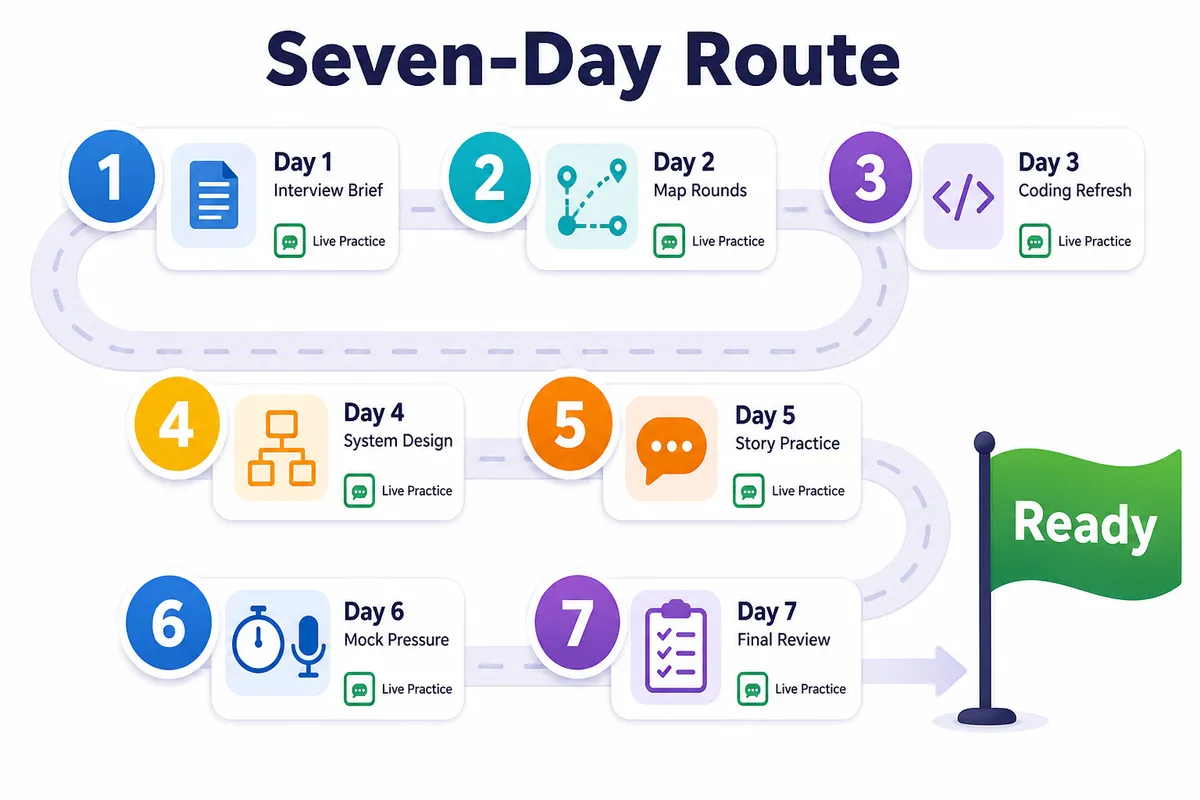
This plan gives you one focus and one live practice round each day. Use a live AI interview practice session for the practice round so you have to explain, respond to follow-ups and work under some pressure rather than only reading notes.
If you have more time than seven days, use the broader 7-day, 30-day and 90-day coding interview preparation plans to choose a longer route. This article is for the candidate whose interview is close enough that triage matters more than ambition.
Before day one: decide what you are preparing for
Do not begin by opening twenty tabs of questions. Spend 20 minutes making a one-page interview brief.
Write down:
- The company and job title
- The interview date, time zone and format
- The known rounds: coding, system design, behavioural, case study, hiring manager or recruiter
- Your seniority level
- The language you will use for a coding round
- Your three strongest experience stories
- Your two least confident areas
Then divide everything into three lists:
- Must prepare: likely interview rounds and high-frequency weaknesses.
- Nice to prepare: useful material if time remains.
- Skip: interesting but unlikely topics that will not improve this interview.
⚠️ Important: The week before interview preparation is not the time to learn every graph algorithm, memorise ten system design templates, or rebuild your portfolio. Panic creates fake productivity. Triage creates progress.
For an entry-level software role with a 60-minute coding screen, coding communication and common patterns deserve most of the week. Deep distributed systems design probably does not. If you are a product manager facing a product case, shift the emphasis towards product sense, metrics and structured communication rather than recursion drills.
Day 1: Map the interview and choose your highest-return work
Focus: turn uncertainty into a realistic seven-day target.
Today is about choosing what you will not do. Read the job description carefully. Look for signals in the interview invitation, recruiter messages and company process information. If you know the company, check its likely round mix. If you do not, prepare for the most common format for your role.
For technical candidates, pick one core technical lane for the week:
- DSA and live coding
- System design
- Low-level design or machine coding
- Data science or AI/ML
- Product and technical product management
You may have more than one round, but every day needs a dominant focus. Trying to improve coding, behavioural answers, system design and salary negotiation equally in seven days usually means improving none of them enough.
Create a scorecard with five areas: technical correctness, communication, speed, structure and confidence. Score yourself honestly from one to five. The lowest two scores are your priority.
✅ Do: choose a narrow goal such as “explain a coding approach before writing code” or “give structured behavioural answers without rambling”.
❌ Don't: set a vague goal such as “master interviews”. It gives you no way to judge whether a practice session helped.
Live practice round: baseline interview
Do one live mock in the round closest to your real interview. Do not prepare answers immediately before it. You need an honest baseline.
A live AI interview simulation can give you adaptive follow-ups without needing to schedule a peer. Technical candidates can practise DSA in an editor that compiles and runs code in Python, C++, Java, JavaScript, Go and C#. For behavioural and non-technical roles, choose a resume-based or behavioural session instead.
After the session, write only three notes:
- What went well?
- Where did you lose clarity or time?
- What single change would help most tomorrow?
Day 2: Rebuild your answer structure
Focus: make your thinking easy to follow.
Many candidates know more than they demonstrate because their answers arrive in the wrong order. They start coding before confirming requirements, describe details before stating the conclusion, or tell a behavioural story without explaining their individual contribution.
For coding, use this sequence:
- Clarify inputs, outputs and constraints.
- State a simple approach first.
- Explain why it works.
- Discuss complexity.
- Code while narrating meaningful decisions.
- Test normal and edge cases.
For behavioural questions, use a concise STAR structure: situation, task, action and result. Give context quickly. Spend most of the answer on what you did, why you chose it and what changed as a result.
For system design, clarify scope and scale, define requirements, sketch the high-level architecture, explain data flow and trade-offs, then deepen the components that matter most.
Review examples of strong behavioural answers before you practise. Do not memorise the wording. Borrow the structure and make the examples yours.
💡 Pro Tip: A structured answer is not a scripted answer. Pausing for ten seconds to organise your response often sounds more senior than speaking continuously without direction.
Live practice round: communication-first session
Do a live interview in your primary interview type. Judge yourself less on whether you reached the ideal answer and more on whether another person could follow your reasoning.
Ask yourself afterwards:
- Did I state my plan before diving in?
- Did I check assumptions aloud?
- Did I answer the question asked?
- Did I summarise before moving on?
If you struggled with one moment, repeat only that moment out loud three times after the session. For example, explain your complexity, give your introduction, or present the first two minutes of a system design response.
Day 3: Fix one technical weakness, not five
Focus: choose one pattern or concept that is likely to appear.
Today is your technical repair day. Pick one weakness that is both common and close enough to improve in a few hours.
Good candidates for this day include:
- Two pointers or sliding window
- Binary search
- Trees and traversal
- Hash maps and frequency counting
- Intervals
- SQL joins and aggregation
- Product metrics
- Experiment design
- Caching, queues or rate limiting
- Object-oriented design fundamentals
Use active revision: solve or outline three representative problems from the same family. For each one, say what signals reveal the pattern. This is more useful than completing unrelated questions all afternoon.
For coding candidates, this guide to practising coding interview questions effectively is a useful reminder that volume without reflection does not transfer well to interviews.
✅ Do: revisit mistakes until you can explain the corrected reasoning.
❌ Don't: jump to hard problems because they feel more impressive. In one week, fluency on common medium-level questions is usually worth more than one heroic solution you cannot reproduce.
Live practice round: targeted technical round
Choose a live mock that forces your selected weakness to appear. If you chose coding, narrate the pattern recognition before writing code. Run your code, test edge cases and respond to follow-ups.
If you chose system design, draw the architecture and defend one trade-off. If you chose data science, explain assumptions, metrics and how you would validate a result.
The goal is not a perfect score. The goal is to make today’s weak area feel familiar enough that it does not derail you.
Day 4: Practise pressure and recovery
Focus: what you do when you get stuck.
Every candidate imagines the interview where they recognise the question immediately. Better preparation includes the other version: you misunderstand something, your code fails, the interviewer challenges a decision, or you lose your train of thought.
Today, practise recovery language.
For a coding interview:
- “I want to revisit the constraint because it changes the approach.”
- “This test exposes an edge case I did not handle.”
- “My current solution is correct but not optimal. I can improve it by…”
- “I am going to trace this example before changing the code.”
For a behavioural answer:
- “The key lesson from that situation was…”
- “I would handle the stakeholder communication earlier next time.”
- “My contribution specifically was…”
⚠️ Important: Do not bluff when you are stuck. Interviewers can often forgive a gap in recall. They are less likely to forgive confident reasoning that collapses under one follow-up.
Live practice round: deliberately difficult mock
Take a mock in which you expect to struggle slightly. Set a realistic timer. If you are coding, do not abandon the session when your first attempt fails. Stay with the failure and narrate your debugging process.
A live voice AI interview is useful here because adaptive follow-ups expose whether you understand the answer or only recognise the opening pattern.
Your review question is simple: when pressure arrived, did you become quieter, faster, defensive or more disorganised? Pick one response to improve tomorrow.
Day 5: Make your stories and resume interview-ready
Focus: prepare proof, not claims.
Your resume may say you improved performance, led a project or worked across teams. In an interview, each claim can become a question. Today, make sure you can support the strongest lines on your CV.
Choose four stories:
- A difficult problem you solved.
- A conflict, failure or setback.
- A collaboration or leadership example.
- A project you know deeply.
For each, write five bullets only:
- Context
- Your specific responsibility
- Decision or action
- Measurable result
- Lesson learned
Then inspect your resume for weak spots: unexplained career changes, a project you barely remember, a vague metric, or a tool listed that you cannot discuss. You do not necessarily need to remove these items before the interview, but you need an honest answer ready.
Live practice round: resume-based interview
Run a resume-based mock using your own CV. This is especially useful for a hiring manager, recruiter or non-technical discussion, but it helps engineers too.
Thita can generate questions from your resume for a resume-based AI interview, including for non-technical roles. Treat the session as a fact-check: can you explain every achievement without exaggerating, and can you connect your experience to the role?
Afterwards, refine only the two stories that felt least convincing.
Day 6: Rehearse the real interview format
Focus: simulate the day, not just the question.
By now, you should know where you are strong and what still needs protection. Today is not for major new learning. It is for rehearsal.
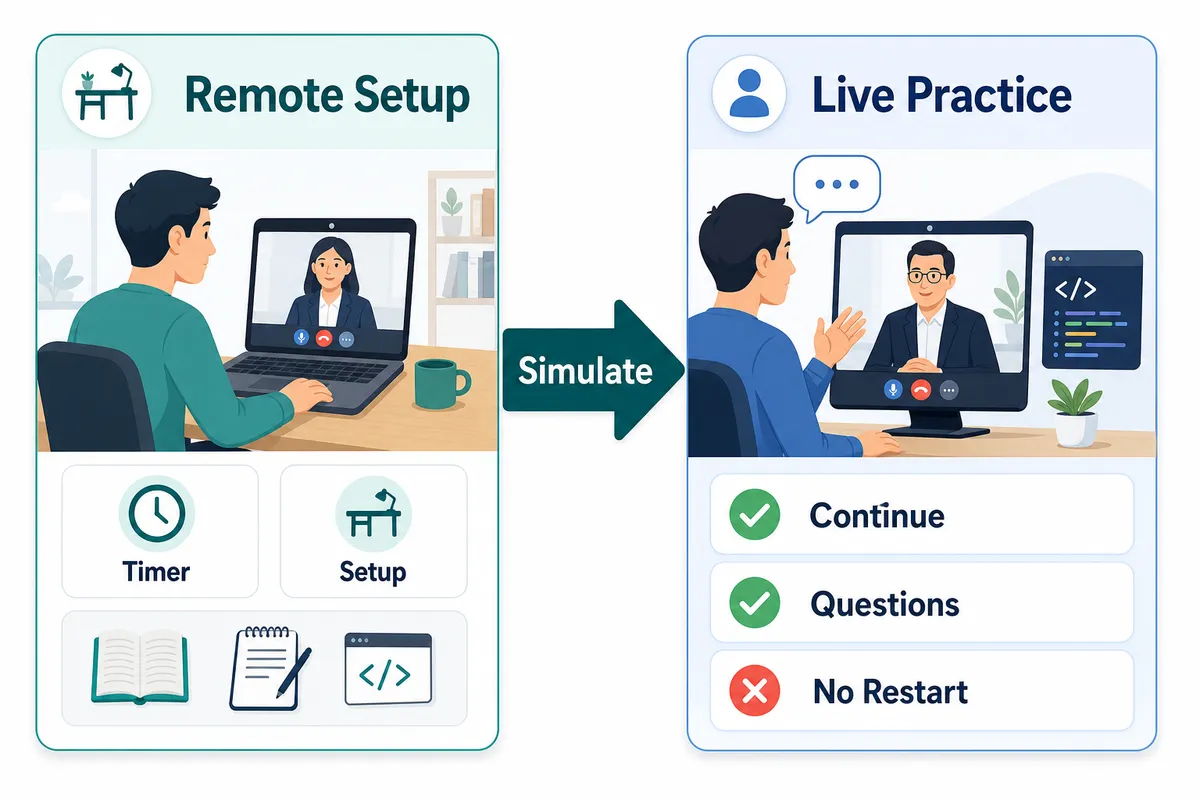
Match the real conditions as closely as you can:
- Use the language you will use in the interview.
- Sit at the desk you will use if it is remote.
- Use a timer.
- Keep only permitted resources nearby.
- Start with a brief introduction.
- Finish with questions for the interviewer.
Prepare two or three questions that show genuine interest in the work: team goals, success in the first six months, technical challenges, decision-making process or how the role collaborates with adjacent teams.
Live practice round: full-length simulation
Do your closest possible full mock. If your interview includes coding and behavioural questions, choose the weaker of the two for the full simulation and spend 15 minutes afterwards rehearsing the other.
Do not stop to look things up. Do not restart because an answer was awkward. The point is to practise continuing.
✅ Do: note one final technical adjustment and one final communication adjustment.
❌ Don't: turn the review into another revision marathon. Sleep will help tomorrow more than one extra hour of anxious problem-solving.
Day 7: Protect confidence and prepare the logistics
Focus: arrive clear, rested and ready.
The final day is for light review and practical preparation. You are not trying to gain new knowledge. You are trying to avoid losing access to knowledge you already have through fatigue or stress.
Spend no more than 60 to 90 minutes preparing:
- Review your one-page interview brief.
- Rehearse your introduction once.
- Review your four stories.
- Revisit one coding or role-specific framework.
- Check the interview link, device, internet, camera, audio and charger.
- Confirm the time zone and travel route if relevant.
If you have a technical interview tomorrow, read the night-before interview checklist rather than searching for more questions.
💡 Pro Tip: End the day with a problem you can solve or a story you can tell well. The final rehearsal should reinforce competence, not create a fresh failure to dwell on.
Live practice round: short confidence round
Keep this final live practice round short: 20 to 30 minutes. Choose a familiar format and aim for a calm, structured performance.
Finish by saying out loud how you will begin, how you will handle a difficult moment and how you will close the interview. Then stop. Eat, rest and sleep.
What to skip when you have only one week
The discipline of a 7 day interview preparation plan is deciding what produces the highest return now.
Skip or reduce:
- Starting entirely new advanced topics unless they are definitely in the process
- Random question lists with no pattern or purpose
- Rewriting your resume repeatedly when the interview is already scheduled
- Watching hours of interview advice without speaking answers aloud
- Taking several mocks a day and reviewing none of them
- Memorising perfect scripts that will collapse after a follow-up
- Comparing yourself with candidates who had months to prepare
One week cannot replace a long preparation cycle. It can prevent common failures: unclear explanations, untested code, weak examples, poor time management and avoidable interview-day stress.
Frequently asked questions
Is one week enough to prepare for an interview?
One week is enough to improve interview performance, but not enough to master every possible topic. Prioritise likely rounds, repair your largest weaknesses and practise explaining your thinking live.
How many mock interviews should I do in one week?
One live practice round per day is enough for most candidates if you review each session properly. Seven unfocused mocks can be less useful than four sessions with specific improvements between them.
Should I solve as many coding problems as possible?
No. In the final week, pattern recognition, explanation and debugging matter more than raw quantity. Choose representative problems and practise talking through your approach.
What should I do if I do not know the interview format?
Prepare a balanced baseline: one coding or role-specific mock, one behavioural session, a resume review and a short company research block. Ask the recruiter for format details if there is time.
Should I prepare behavioural questions for a technical interview?
Yes. Even technical interviewers often ask about projects, decisions, collaboration and setbacks. Prepare a few truthful stories you can adapt to different questions.
What should I do the night before the interview?
Review lightly, prepare your logistics and sleep. Avoid cramming unfamiliar material late into the evening. A clear, rested explanation is more valuable than one more half-learned topic.
Start your seven-day interview plan today
The best use of one week is not to prepare everything. It is to practise the moments most likely to decide your interview: explaining your approach, handling follow-ups, recovering from mistakes and speaking clearly about your experience.
Start a live AI interview practice session today, use the first round to find your biggest gap, and let each following day address one specific improvement.
If you are reading this as someone hiring rather than interviewing, visit interviews.thita.ai.
Topics
Related on Thita
Your next step
Practise with AI mock interviews
A spoken interview that asks follow-up questions, runs your code and ends with a written report.