
Interview
Interviewing After a Career Break: A Practice Plan, Not Just Tips
Build confidence for an interview after a career break with a clear practice plan, gap answers, skills refreshers and realistic mock interview rehearsal.
Returning to interviews after time away can feel unfamiliar. You may know your work well, have a strong record, and still hesitate when someone asks, “So, talk me through what you have been doing recently.”
That hesitation is not proof that you are behind. Interviewing is a performance skill, and performance skills get rusty when they are not used. The answer is not to memorise a perfect explanation for your gap. It is to build interview practice after a career break into a routine that becomes progressively more realistic.
Start with a live voice AI interview practice session when you are ready to say answers out loud, handle follow-up questions, and get used to the pace of a real conversation again.
This guide covers how to explain a career break without over-explaining it, refresh skills that have moved on, and practise in stages until an interview feels familiar rather than daunting.
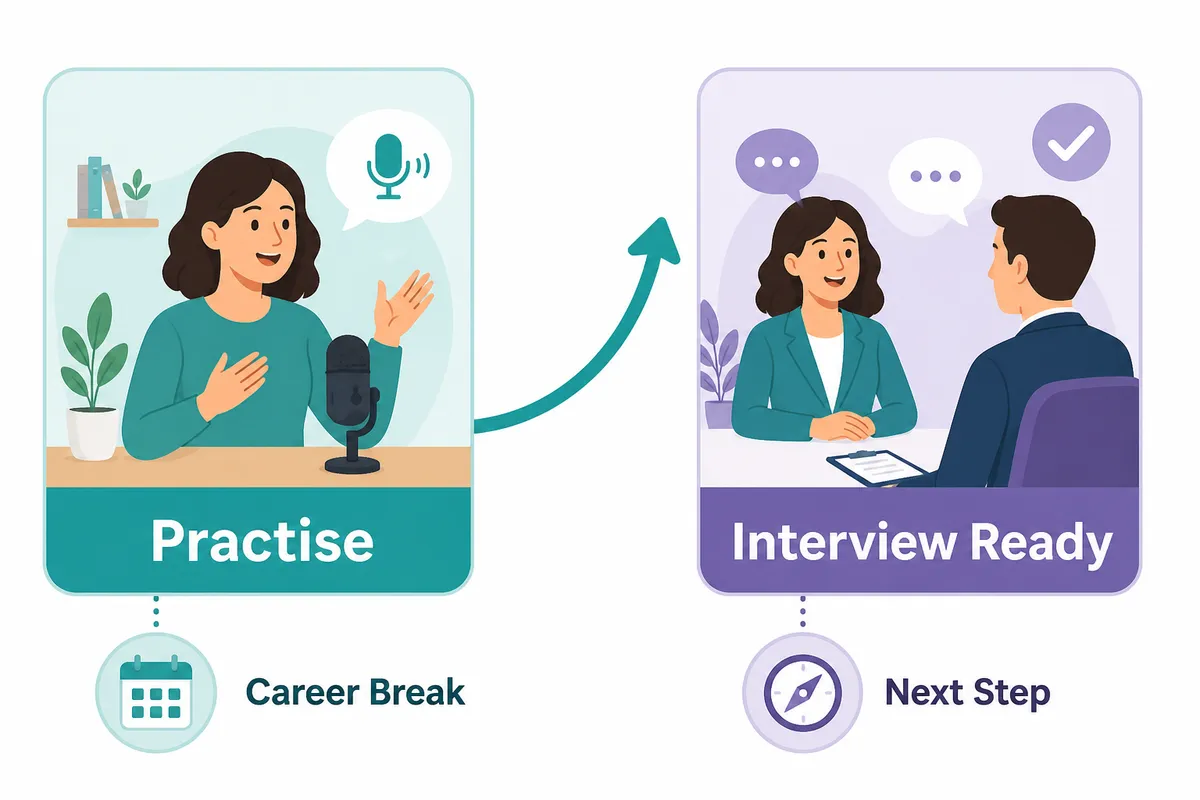
Treat the gap as context, not a defence
A career break is a period in your history. It is not a problem you need to argue away.
Interviewers usually ask about a gap because they need to understand your timeline, availability, and current direction. They are not automatically looking for a dramatic explanation. A long, apologetic answer can make the topic feel larger than it needs to be.
The strongest answer is usually brief, truthful, and forward-looking:
- State the break simply.
- Mention what you did during that time if it is relevant.
- Connect it to why you are returning now.
- Move towards the role and value you can bring.
For example:
“I took a planned career break to care for my family. During that time, I kept up with developments in my field and completed a few structured refreshers. I am now ready to return to a full-time role, and I am particularly interested in this position because it combines the delivery work and cross-functional collaboration I enjoyed in my previous role.”
That is clear, professional, and easy for an interviewer to follow.
For an interview after maternity break, you do not need to offer details about childcare arrangements, medical history, or family circumstances unless you genuinely want to. You can say you took parental leave or a family-focused break, explain that you are ready to return, and move on to your experience.
⚠️ Important: You do not need to prove that your reason for taking a break was acceptable. Your task is to show that you are prepared for the role now.
Aim for 30 to 60 seconds for your initial answer. If the interviewer wants more context, they can ask. If they do not, you have left room to discuss what matters most: your capability, judgement, and interest in the work.
Prepare for career gap interview questions before they surprise you
Most career gap interview questions are predictable. That is useful, because predictable questions deserve rehearsed answers.
You do not need a script that sounds memorised. You do need a clear structure that prevents you from rambling, apologising, or accidentally undermining yourself.
“Can you tell me about your career break?”
Keep this answer factual and short. Name the broad reason, mention relevant learning or responsibilities, and turn towards your return.
Avoid turning the answer into a full biography. The interviewer does not need every event that happened during the break to assess whether you can do the job.
“Why are you returning to work now?”
This is your opportunity to speak with intent. Explain what has changed and why this is the right moment.
You might mention that your circumstances now support a return, that you miss a particular kind of work, or that you have chosen a new direction after reflecting on your career. Be specific about the role where possible.
“How have you kept your skills current?”
You do not need to pretend nothing changed while you were away. Some tools, frameworks, expectations, and market language probably moved on. The useful response is to show that you recognise this and have a plan.
Try a structure like:
“The field has moved on in a few areas, particularly around cloud tooling and AI-assisted workflows. I have been refreshing my knowledge through a structured course, hands-on projects, and regular practice. I am not claiming to know every new tool already, but I have rebuilt the core skills and I am comfortable learning quickly in a working environment.”
That is more credible than claiming complete fluency in everything new.
“Are you concerned about being out of practice?”
It is fine to acknowledge that interviews are different from doing the job. Then explain what you are doing about it.
“I was initially out of practice with formal interviews, which is why I have been treating preparation as a separate skill. I have been practising concise examples, technical explanations, and follow-up questions so I can communicate my experience clearly.”
💡 Pro Tip: Do not wait for a recruiter to ask about the break before you practise the answer aloud. A well-structured answer feels natural only after you have said it several times.
For a deeper guide to practising under realistic conditions, read mock interviews: how to use them effectively for faster improvement.
Refresh skills without trying to relearn your whole career
The fear behind many returning to work after career break interview worries is not really the gap itself. It is the feeling that the workplace changed while you were away.
Some things may have changed. That is normal. But you do not need to catch up on every trend before applying. You need to identify the skills that matter for your next role and refresh those deliberately.
Start with three lists.
Skills you still have
These are your foundations: stakeholder management, problem-solving, domain knowledge, programming fundamentals, customer understanding, leadership, analysis, writing, or delivery discipline.
A break does not erase professional experience. Your previous projects, decisions, outcomes, and ways of working are still yours. Start here because confidence grows faster when you can see what remains solid.
Skills that need a refresh
These are things you knew before but have not used recently. For a software engineer, that might include data structures, testing, Git workflows, SQL, APIs, or system design. For a product manager, it might be product metrics, prioritisation frameworks, and case-study communication.
Choose a small number of high-value topics. Rebuild fluency through active practice rather than passive reading.
Skills that are genuinely new
This is where you acknowledge changes in the market. Perhaps your target jobs mention a cloud platform, analytics tool, AI workflow, or newer framework.
You do not need mastery before an initial interview. You do need enough familiarity to explain what it is, why it matters, and how you are learning it.
✅ Do connect refresher work to the job description.
✅ Do build a small project, work sample, or practice exercise where it helps demonstrate current skills.
❌ Don't spend months studying every possible tool before applying.
❌ Don't dismiss older experience because the technology stack has changed.
For technical candidates, a structured set of problems is often more useful than random practice. The 7-day, 30-day and 90-day coding interview preparation plans compared can help you choose a timeline based on how much interview readiness you need to rebuild.
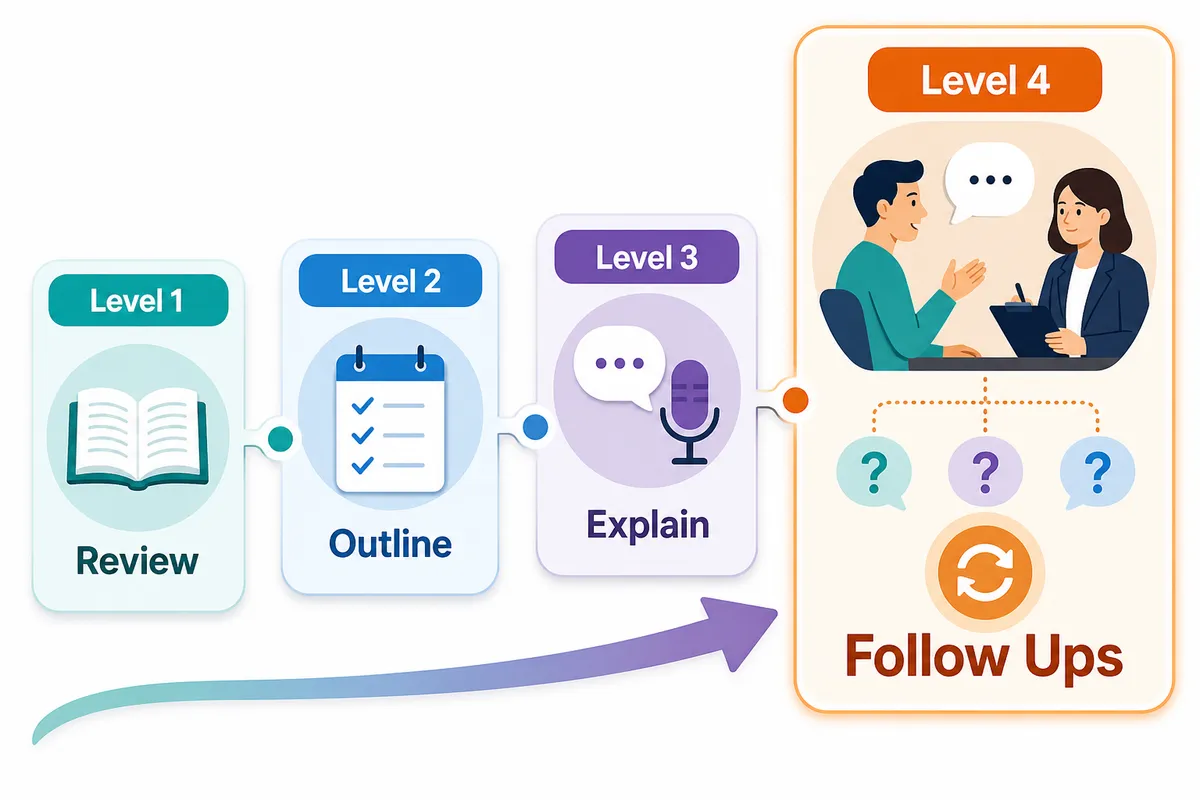
Your graded practice plan
Advice is useful, but confidence comes from repetition under gradually increasing pressure. Do not jump straight into a difficult mock interview on day one. Build up in stages.
Level 1: Rebuild your story privately
Start with notes, not interviews.
Write short answers to these prompts:
- What did I do before my break?
- Why did I take the break?
- Why am I returning now?
- What kind of role am I targeting?
- What skills am I bringing back?
- What have I done recently to refresh my knowledge?
- Which three examples best show my impact?
Then reduce each answer until it is clear and spoken-language friendly. Your notes should guide you, not become a speech.
Practise your “tell me about yourself” answer first. A useful structure is your previous professional identity, the career break in one sentence, your current preparation, and why this opportunity interests you.
Level 2: Practise answers out loud
Set a timer for two minutes. Answer one question without notes. Then ask yourself a follow-up:
- “What did you learn from that?”
- “What would you do differently?”
- “How does that experience prepare you for this role?”
- “What have you done to update your skills?”
At this stage, do not aim for perfection. Aim to become comfortable discussing the break in a calm, matter-of-fact way.
Level 3: Add role-specific practice
Once your career narrative is steady, add the skills your role requires.
For technical roles, that may mean coding, system design, debugging, low-level design, or CS fundamentals. For data roles, practise SQL, statistics, experimentation, and project walkthroughs. For product roles, rehearse product sense, prioritisation, metrics, and stakeholder scenarios.
Your practice should match the job you want, not just the job you had before your break.
If you are preparing for coding rounds, do not only solve questions silently. Explain assumptions, narrate trade-offs, and practise recovering when you get stuck. This guide on how to explain your thought process clearly in coding interviews is useful when you know the material but feel rusty talking through it.
Level 4: Rehearse realistic follow-ups
Reading sample questions and preparing bullet points helps, but it does not recreate the experience of being interrupted, asked for evidence, or challenged on an answer.
A realistic mock should ask follow-ups based on what you actually say. If you mention updating your skills, expect questions such as:
- “Which resources did you use?”
- “What did you build or practise?”
- “What was difficult?”
- “How would you apply that learning in this role?”
If you discuss an old project, expect questions about your specific contribution, how you measured success, and what you would change now.
 A live AI interview that adapts its follow-up questions is useful here because you can repeat this kind of rehearsal without arranging a peer mock or asking a friend to keep finding new questions.
Thita.ai supports behavioural, technical, product management, data science, AI and ML, and resume-based interviews generated from your own CV. The resume-based format is useful for non-technical roles too.
For coding interviews, you can practise in six languages: Python, C++, Java, JavaScript, Go and C#. The real editor compiles and runs code, so you can rebuild the habit of testing, debugging, and explaining under pressure rather than simply recalling an answer.
A two-week return-to-interview routine
If you have interviews coming up soon, use this simple plan. Adjust the volume to your available time, but keep the progression.
Days 1-3: Clarify the story
- Draft your career-break explanation.
- Choose three professional examples.
- Update your CV language for your target role.
- Practise “tell me about yourself” aloud each day.
- Identify the two or three skills needing the most refreshing.
Days 4-6: Rebuild role confidence
- Review one core skill area each day.
- Complete one practical exercise, project improvement, or case study.
- Prepare answers about how you kept current.
- Practise common behavioural questions with a timer.
- Ask yourself follow-up questions after every answer.
Days 7-10: Simulate interview conditions
- Complete at least two timed practice sessions.
- Include one session focused entirely on your CV and past projects.
- Identify repeated weak points: vague examples, missing metrics, rushed delivery, or gaps in technical explanation.
- Improve one weak point at a time.
Days 11-14: Make practice more demanding
- Do one full mock interview.
- Practise answering unexpected follow-ups.
- Review the job description before each session.
- Prepare thoughtful questions for the interviewer.
- Rehearse ending the conversation confidently.
💡 Pro Tip: Keep a short evidence bank. For each major skill, write one example, one outcome, one challenge, and one lesson. This prevents you from searching your memory under pressure.
What not to do when talking about a break
❌ Don't apologise repeatedly. You can be warm and honest without framing the break as a failure.
❌ Don't over-explain personal circumstances. A concise explanation is professional. Extra detail is optional, not required.
❌ Don't pretend your skills never needed refreshing. Acknowledge changes, then explain the work you have done to catch up.
❌ Don't make the gap the centre of every answer. Your experience, judgement, and current motivation should take up more space.
✅ Do speak about the break calmly and consistently.
✅ Do show evidence of recent learning or practice.
✅ Do focus on the contribution you can make next.
The tone matters. You are not asking permission to return. You are explaining a transition and showing that you have prepared for it.
Frequently asked questions
How do I explain a career break in an interview? Keep the explanation brief, truthful, and forward-looking. State the broad reason for the break, mention relevant learning or responsibilities if appropriate, and explain why you are ready for the role now.
Should I mention a maternity break in an interview? You can if you want to, but you do not need to share personal details. It is enough to say you took parental leave or a family-focused career break and are now ready to return to work.
What are common career gap interview questions? Expect questions about why you took the break, why you are returning now, how you kept skills current, and what you are looking for next. Prepare concise answers and practise follow-up questions as well.
How can I rebuild confidence for an interview after a career break? Use graded practice. Start by writing your story, then speak answers aloud, add role-specific preparation, and finally complete realistic mock interviews with follow-up questions.
What if my technical skills are out of date? Identify the skills most relevant to your target role, refresh the fundamentals, and complete practical exercises. Be honest about what has changed while showing a clear learning plan and recent evidence of progress.
How many mock interviews should I do before applying? Aim for enough sessions to make your career-break explanation, key examples, and role-specific answers feel familiar. Two to four realistic mocks can reveal more than repeated silent preparation.
Can I practise interviews if I am changing careers as well as returning to work? Yes. Start with transferable skills, clarify the direction you are moving towards, and prepare evidence that you have taken practical steps into the new field.
Practise until the interview feels like a conversation again
A career break may change your timeline, but it does not erase your experience or define your ability. What matters in an interview is whether you can explain your direction clearly, show that your skills are current enough for the role, and respond thoughtfully when the conversation moves beyond your prepared answer.
That is why interview practice after a career break should be more than a list of tips. It should include actual rehearsal: saying the answer, handling the follow-up, recovering from a difficult question, and doing it again until the process feels familiar.
Start a live voice AI interview practice session to rehearse your career story, role-specific questions, and CV-based follow-ups whenever you have time. ai, and the platform also supports non-technical resume-based interviews.
If you are hiring rather than interviewing, visit interviews.thita.ai.
Topics
Related on Thita
Your next step
Practise with AI mock interviews
A spoken interview that asks follow-up questions, runs your code and ends with a written report.