
Interview
Is DSA Still Required for Software Engineering Interviews in 2026?
The question “Is DSA still required for software engineering interviews in 2026?” usually comes up right after someone hears about AI coding assistants and “...
The question “Is DSA still required for software engineering interviews in 2026?” usually comes up right after someone hears about AI coding assistants and “system design–heavy” interview loops. If tools can write code and real-world work is more about APIs and architecture, does it still make sense to grind arrays and trees?
Short answer: yes, DSA (Data Structures and Algorithms) is still required for most serious software engineering interviews in 2026—but how it’s used and how much it matters is changing.
This post breaks down what’s actually happening in coding interview trends, where DSA is still critical, where it’s less relevant, and how to prepare efficiently rather than blindly grinding problems.
Why Companies Still Ask DSA in 2026
1. DSA is a proxy for problem-solving under constraints
Most interviewers don’t care if you can reverse a linked list in production. They care if you can:
- Understand a problem quickly
- Model it with the right abstractions
- Navigate trade-offs (time vs space, simplicity vs performance)
- Communicate your thinking clearly
DSA questions are a convenient way to test all of those in a 45–60 minute block.
Example:
“Given a stream of integers, design a data structure that returns the median at any time.”
You might reach for:
- Two heaps (max-heap for lower half, min-heap for upper half)
- Insert in O(log n), get median in O(1)
The interviewer learns:
- You know core data structures (heaps)
- You can combine them in a non-trivial way
- You can reason about complexity and invariants
That’s the real goal—not the specific problem.
2. DSA is language- and domain-neutral
Companies hire for many teams at once. DSA-based coding interviews:
- Work across backend, frontend, ML, infra, and mobile
- Avoid deep domain-specific questions that might be unfair
- Allow standardized evaluation rubrics
Even as AI tools get better, this standardized evaluation remains useful: it’s easier to calibrate “this candidate solved a medium graph problem with minimal hints” than “this candidate could probably use an LLM effectively with our internal tools.”
3. AI assistance changes implementation, not thinking
By 2026, many teams allow (or expect) AI assistance in day-to-day work. But interview loops are more conservative:
- Some companies explicitly ban AI tools during live interviews
- Others allow AI for take-homes but still include a “no-tools” session to test fundamentals
Even when AI is allowed, you still need to:
- Specify the algorithm precisely
- Validate complexity and edge cases
- Debug when the AI’s first attempt is wrong
If you don’t understand DSA, you can’t reliably supervise AI-generated code. This is why understanding how AI is changing technical interviews in 2026 is crucial for modern candidates.
How DSA for Software Engineer Interviews Has Evolved
1. From trivia to patterns
Most reputable companies have moved away from:
- “What is the time complexity of quicksort’s worst case?”
- “Define a red-black tree.”
And toward:
- “Design an autocomplete system.”
- “Find the k most frequent items in a log stream.”
These map to DSA patterns:
- Tries, heaps, hash maps
- Sliding windows, two pointers, prefix sums
- BFS/DFS, topological sort, union-find
- Dynamic programming (knapsack, subsequences, paths)
The emphasis is less on memorizing rare data structures and more on recognizing and applying patterns. For a structured approach, following a beginner to advanced DSA roadmap for software engineers in 2026 can help you master these essential patterns efficiently.
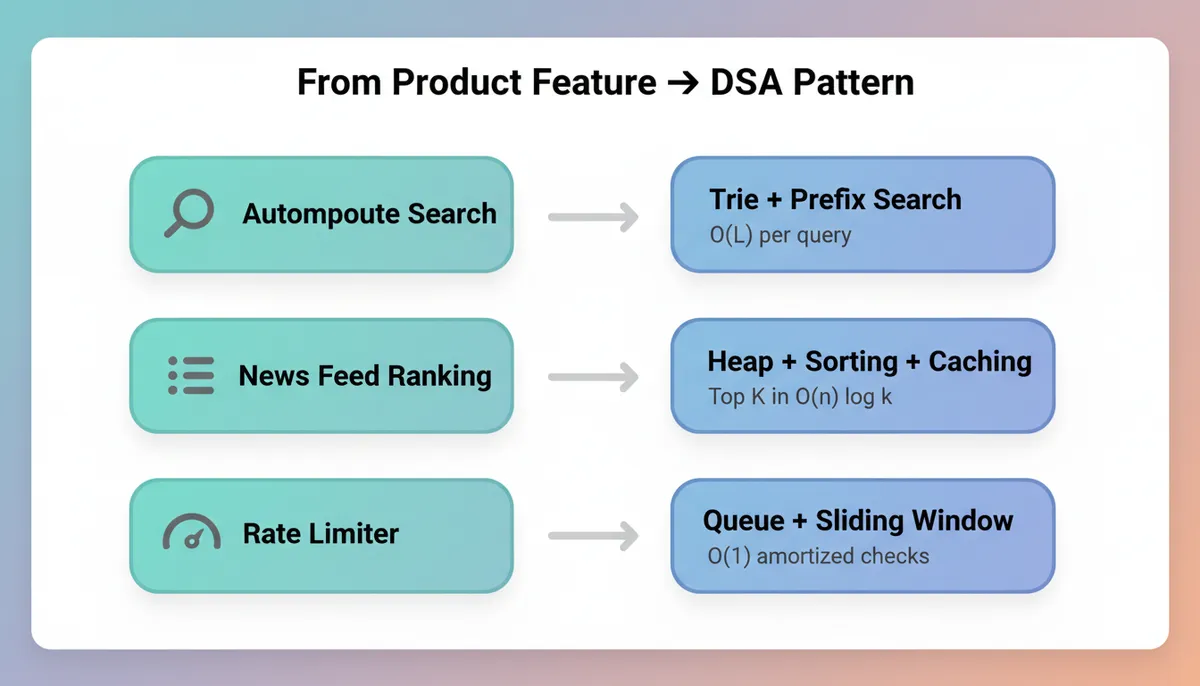
2. More “product-shaped” algorithm problems
Interview questions increasingly resemble simplified product scenarios:
- News feed ranking → heaps + sorting + caching
- Rate limiter → queues + sliding window
- Search suggestions → tries + prefix matching + caching
You still need DSA, but framed within realistic constraints and UX requirements.
3. More differentiation by level and role
In 2026, what you’re expected to know depends heavily on:
- Level (new grad vs senior vs staff)
- Track (backend, frontend, infra, ML, data, SRE)
Roughly:
- New grads / junior: Classic DSA-heavy rounds (arrays, strings, trees, graphs, basic DP)
- Mid-level: Mix of DSA + systems / architecture + practical coding
- Senior+: One DSA-ish round plus multiple design, leadership, and “how you’ve scaled X” conversations
DSA doesn’t disappear as you get more senior; it just becomes one signal among many.
Is DSA Required? Company Types and What They Actually Ask
1. Big tech and “big-tech-like” companies
Think: FAANG(+), large unicorns, infrastructure companies, top fintechs.
Reality in 2026:
- Still have 1–2 core DSA rounds
- Expect comfort with:
- Arrays, strings, hash maps/sets
- Trees, graphs (BFS/DFS, shortest path variants)
- Heaps, priority queues
- Classic DP patterns (subset, sequence, path)
- Increasing use of “design a feature” style algorithm problems
If you’re targeting these, DSA is absolutely still required.
2. Mid-sized product companies and startups
Here the picture is more varied:
- Some copy big-tech interview loops (including DSA)
- Some prioritize:
- Take-home assignments
- “Work sample” pair programming
- System design over tricky algorithms
But even when questions are practical, DSA shows up implicitly:
- Efficient pagination → offset vs cursor, indexes, time complexity
- Searching logs → using appropriate data structures or indexes
- Handling spikes → queues, rate limiting, backpressure
You might not be asked to implement Dijkstra, but you’re expected to reason about complexity and choose appropriate data structures.
3. Specialized roles (ML, data, SRE, frontend)
-
ML / Data
- Less emphasis on obscure algorithms
- More on:
- Complexity of training/inference pipelines
- Vectorization, batching
- Graphs (for recommendation systems, lineage)
- Still helpful to know core DSA for coding rounds
-
SRE / Infra
- Often need:
- Understanding of queues, priority queues
- Scheduling algorithms
- Load balancing strategies
- DSA questions may be more “systems flavored”
- Often need:
-
Frontend
- Trend toward:
- UI/UX implementation tasks
- State management and performance
- But many companies still keep one general coding round—DSA light but not absent (arrays, strings, maps, simple trees)
- Trend toward:
What Level of DSA Is Actually Needed in 2026?
You don’t need to be a competitive programmer. You do need to be fluent in a core set of patterns.
Core DSA topics that still matter
Think in terms of patterns rather than individual problems:
-
Arrays & Strings
- Two pointers
- Sliding window
- Prefix sums
- In-place modifications
-
Hash Maps & Sets
- Frequency counting
- Deduplication
- Lookups and caching
-
Linked Lists
- Reversal
- Cycle detection
- Merge / split lists
-
Stacks & Queues
- Balanced parentheses
- Monotonic stack (next greater/smaller)
- BFS with queues
-
Trees & Graphs
- DFS / BFS
- Tree traversals
- Lowest common ancestor (LCA) basics
- Topological sort
- Connected components
-
Heaps & Priority Queues
- Top K elements
- Merge K sorted lists
- Streaming medians
-
Dynamic Programming
- 1D DP (knapsack, coin change)
- 2D DP (grid paths, edit distance)
- Subsequence problems (LCS, LIS)
-
Intervals & Sorting
- Merge intervals
- Meeting rooms / scheduling
- Custom sort with comparators
These roughly align with pattern-based approaches like Thita’s DSA pattern sheets, which group problems by recurrence rather than surface story.
A Concrete Example: From Naive to Interview-Ready
Let’s walk through a typical DSA-for-software-engineer-interviews example and how a 2026 interviewer might evaluate it.
Problem:
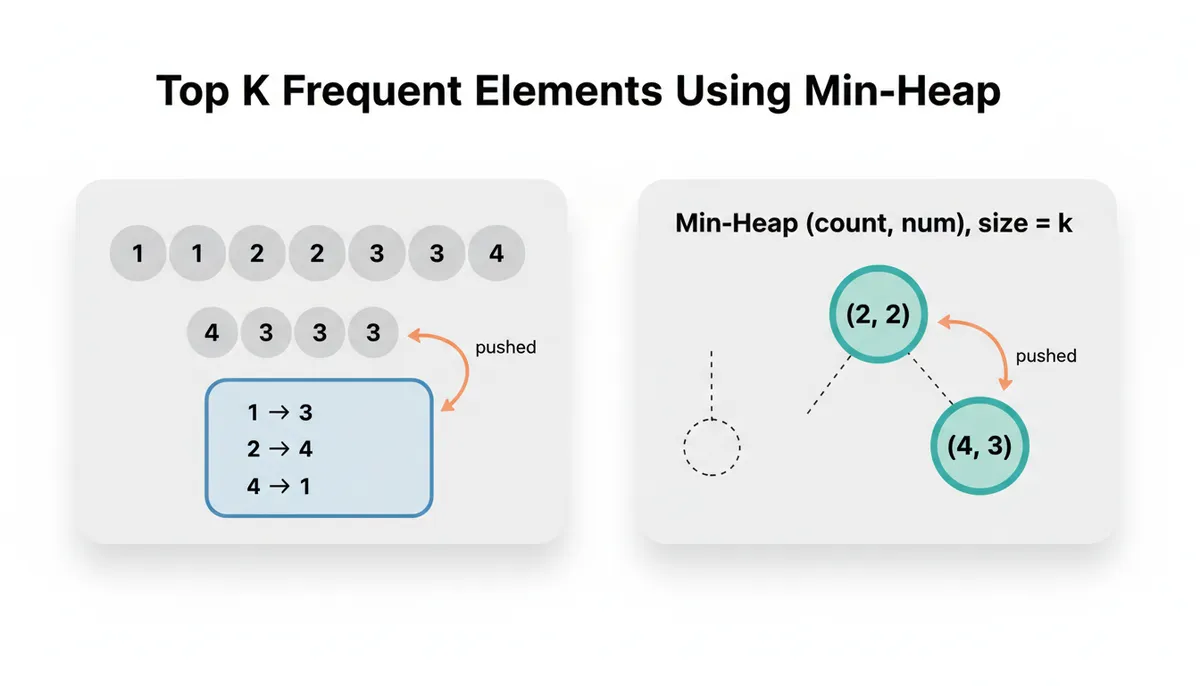
You’re given an integer array nums and an integer k. Return the k most frequent elements. Assume k is always valid, and the answer can be in any order.
This is a common question because it tests:
- Hash maps
- Heaps or bucket sort
- Complexity trade-offs
Naive approach: sort by frequency
PYTHON
- Time complexity: O(n + m log m)
- Space complexity: O(m)
For many inputs, this is fine. But an interviewer might push:
Can we do better than sorting all unique elements if k is small?
Optimized approach: min-heap of size k
PYTHON
- Time complexity: O(n + m log k)
- Space complexity: O(m) for frequency map + O(k) for heap
This is a classic example of “DSA in 2026”:
- You’re not implementing a heap from scratch; you’re using a standard library
- The value is in choosing the right data structure and reasoning about complexity
- The interviewer sees your ability to optimize when k ≪ m
Common Mistakes Candidates Make with DSA in 2026
1. Treating DSA as a memorization exercise
Red flag behaviors:
- Memorizing specific LeetCode questions and solutions
- Failing to adapt when the problem is slightly modified
- Struggling to explain why an approach works
Interviewers can detect this quickly by:
- Tweaking constraints
- Asking you to generalize the solution
- Asking you to design test cases that break naive approaches
Better approach: Focus on understanding patterns and invariants, not just final code.
2. Ignoring complexity analysis
In 2026, many candidates rely on AI tools during practice and stop doing manual complexity analysis. In interviews, this shows as:
- Hand-wavy “I think it’s O(n log n)?”
- Inability to reason about worst-case vs average-case
- No understanding of how input size affects performance
Interviewers still expect:
- Clear Big-O analysis
- Justification: “We iterate once over the array O(n), then maintain a heap of size k, each push/pop is O(log k), so overall O(n log k).”
3. Over-optimizing prematurely
Another common pitfall: jumping to complex data structures before clarifying requirements.
Example:
- Designing a full-blown trie + LRU cache for autocomplete
- When constraints are small enough that a sorted list + binary search is sufficient
Interviews reward appropriate solutions for stated constraints, not maximal cleverness.
4. Poor communication
Even if your DSA knowledge is solid, you can fail an interview by:
- Coding silently without explaining your thinking
- Not clarifying edge cases or constraints
- Ignoring interviewer hints
In 2026, with more remote interviews and AI-based mock interviews, communication is even more critical—your thought process must be visible. Using AI mock interviews vs real interviews can help you practice this communication under realistic conditions.
Best Practices: How to Prepare DSA Efficiently (Not Endlessly)
1. Learn by patterns, not by problem count
Instead of “I solved 500 problems,” aim for:
- “I understand sliding windows and can apply them to any substring/subarray constraint problem.”
- “I can recognize when a problem is actually a graph problem in disguise.”
A pattern-based curriculum (like a structured DSA pattern sheet) helps you:
- Map new problems to known patterns
- Retain concepts longer
- Reduce anxiety when you see unfamiliar problem statements
2. Use a deliberate practice loop
A simple but effective loop:
- Attempt a problem without looking at hints
- Explain your approach out loud (or to a rubber duck)
- Implement clean, readable code
- Analyze time and space complexity
- Refactor for clarity, not just speed
- Generalize: what pattern is this? How would you vary it?
Tools like AI mock interviews (e.g., Thita’s /ai-interview) can simulate this loop: you get real-time feedback on both your solution and how you communicate it.
3. Practice “interview-realistic” constraints
When studying DSA for software engineer interviews, optimize for the interview environment:
- 45–60 minutes per problem, including:
- Clarifying questions
- Designing approach
- Coding
- Testing and complexity analysis
- No AI tools while practicing (at least for some sessions)
- Talk through your thinking as you code
This conditions you to operate under the same constraints you’ll face in an actual loop.
4. Focus on depth over breadth for senior roles
If you’re mid-level or senior:
- You don’t need to grind every obscure algorithm
- You do need to:
- Be fluent in core patterns
- Avoid basic mistakes under pressure
- Show clear, structured communication
Your leverage comes from combining solid DSA with strong system design and experience narratives, not from solving the hardest possible DP problem.
What About AI? Will It Replace DSA in Interviews?
AI coding assistants are very good at:
- Boilerplate
- Syntax
- Implementing standard algorithms when clearly specified
They’re still weak at:
- Fully understanding ambiguous product requirements
- Making architectural trade-offs
- Guaranteeing correctness under all edge cases
- Explaining why a solution is correct and optimal
In 2026, realistic scenarios include:
-
No AI allowed during live coding rounds
You must rely on your own DSA understanding. -
AI allowed for take-homes or extended tasks
You’re evaluated on:- How you decompose the problem
- How you validate and test AI-generated code
- How you refactor and improve solutions
In both cases, DSA remains the substrate for reasoning about code behavior and performance. For guidance on balancing AI tools without becoming overly dependent, see how to use AI tools like ChatGPT for interview preparation (without becoming dependent).
Quick Checklist: Is Your DSA Level “Interview Ready” for 2026?
You’re likely in good shape if you can:
-
Identify patterns
- Given a new problem, quickly map it to 1–2 candidate patterns (e.g., sliding window vs two pointers vs prefix sum).
-
Implement core structures using libraries
- Use language-standard data structures idiomatically (maps, sets, heaps, queues).
-
Explain complexity confidently
- Provide clear O() analysis and justify each term.
-
Handle edge cases systematically
- Empty inputs, duplicates, negative numbers, large values, etc.
-
Communicate clearly
- Talk through trade-offs, verify requirements, and respond to hints.
If you’re shaky on any of these, targeted DSA practice is still one of the highest-ROI ways to improve your interview performance.
Key Takeaways: DSA Importance in 2026
To directly answer the original question—is DSA still required for software engineering interviews in 2026?
-
Yes, for most competitive roles.
Big tech, infrastructure, top product companies, and many startups still rely on at least one DSA-focused coding round. -
The emphasis is on patterns and reasoning, not trivia.
You’re evaluated on how you think, not whether you’ve memorized rare algorithms. -
AI hasn’t removed the need for DSA; it’s raised the bar on understanding.
You’re now expected to supervise and improve AI-generated code, which requires solid fundamentals. -
Depth in core topics beats breadth in obscure ones.
Arrays, strings, maps, trees, graphs, heaps, and basic DP patterns are still the workhorses. -
Preparation should mimic the interview environment.
Time-boxed practice, spoken reasoning, and pattern-based learning are more effective than raw problem count.
If you approach DSA as a toolkit for modeling and solving problems—not as a checklist of questions to memorize—it will remain valuable long after the interview, in the systems you design and the code you ship.