
Interview
LinkedIn Coding Interview Questions: Patterns and Round Guide (2026)
Prepare for LinkedIn coding interviews with the pattern families behind its algorithmic rounds, system design expectations, and live-round tactics.
LinkedIn coding interview questions are best prepared as pattern-recognition exercises, not as a long list to memorise. Reported accounts describe a loop with coding rounds at its centre, followed by a system design discussion and a behavioural or project-focused conversation. For experienced candidates, the shift between those formats matters: quick algorithmic recognition gets you to a correct solution, while structured communication shows an interviewer how you make engineering decisions.
LinkedIn's interview kit holds 34 mapped DSA questions and 2 system design problems. That mix reflects the technical shape candidates commonly report: algorithmic fluency first, then the ability to discuss a scalable product-facing system with sensible trade-offs.
The goal is not to guess an exact prompt. It is to recognise the family quickly, choose a reliable approach, explain it before implementation, and leave time to test. This guide covers the pattern families worth prioritising, the likely assessment and live-round shape, what recognition speed really means, and a practical preparation plan.
The LinkedIn interview shape at a glance
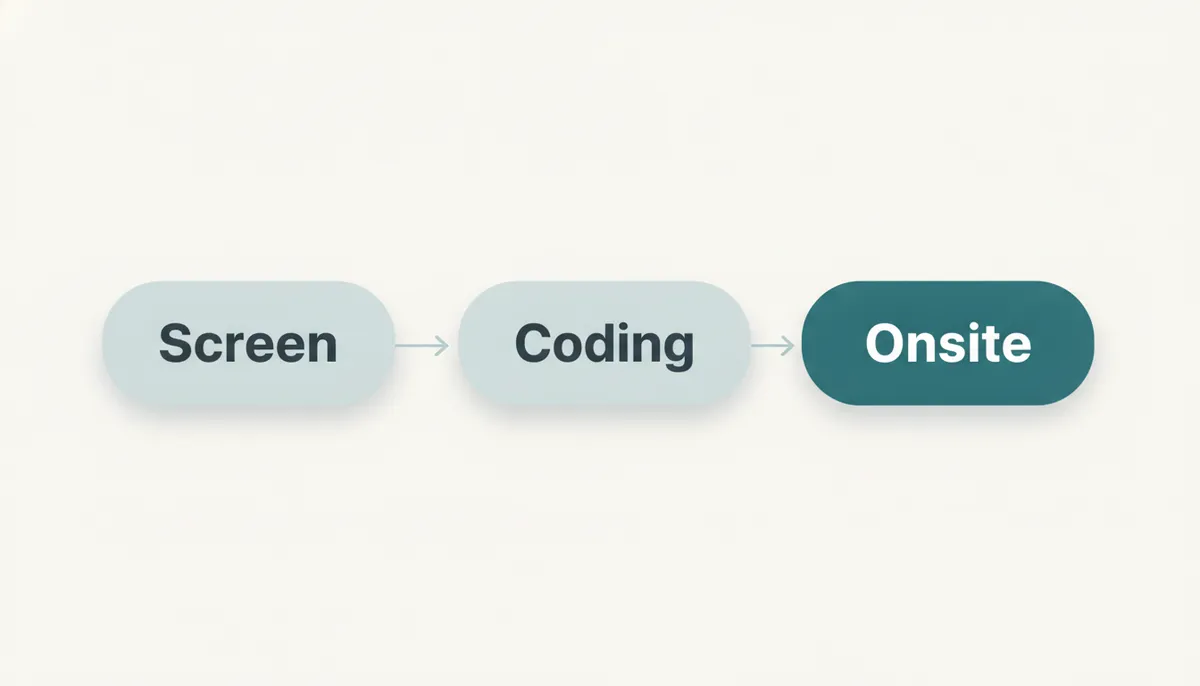
Reported accounts describe a recruiter phone screen followed by an onsite loop containing two coding rounds, one system design round, and one behavioural round. Some candidates also report a past-project presentation, where technical communication and ownership are assessed alongside your answers.
Exact sequencing varies by level, team and hiring location. Treat this as a commonly reported structure rather than a fixed company policy, and confirm the format with your recruiter.
| Stage | Typical focus | What it reveals |
|---|---|---|
| Recruiter conversation | Role, experience, motivation | Fit and process alignment |
| Coding rounds | Data structures, algorithms, complexity | Problem solving and implementation |
| System design | Product architecture and trade-offs | Scope, judgement and communication |
| Behavioural or project discussion | Ownership and collaboration | How you work with others |
The coding rounds and system design round are different tests, but they share one expectation: make your reasoning visible. LinkedIn is a product and platform company, so a clear explanation of constraints, users, data flow and trade-offs is as useful in a design discussion as it is in a live coding exercise.
The pattern families to prioritise
The strongest signal in the LinkedIn kit is not a niche topic. It is breadth across the core families that repeatedly appear in technical interviews. Your preparation should therefore build fast recognition across familiar shapes, then deepen the areas where you hesitate.
Arrays, strings and hash-based lookup
These are often the first family to master because they reward clean modelling. The central decision is usually whether repeated lookup, counting, grouping or membership checking should be constant-time rather than repeatedly scanned.
Practise spotting language in a prompt that implies a map or set: duplicates, matching values, frequencies, distinct elements, fast lookup, or a need to retain prior state while traversing once. The implementation is usually straightforward after that recognition, but edge cases still matter: empty input, repeated values, ordering requirements and unexpected characters or keys.
Do not treat arrays and strings as “easy” practice. They are where interviewers can clearly see whether you begin with a brute-force baseline, improve it deliberately, and can justify the resulting time and space complexity.
The DSA Patterns Sheet is free to browse and is useful here because it groups work by the underlying approach rather than a broad topic label. For a deeper framework, read how to identify the right DSA pattern in a coding interview.
Two pointers and sliding windows
When the input is ordered, contiguous, or naturally processed from both ends, two pointers should be one of your first instincts. When the prompt describes a running range, substring, subarray, or bounded condition, think sliding window.
The important distinction is whether the condition can be maintained incrementally. A fixed-size window usually moves predictably. A variable-size window needs a clear invariant: expand until a condition breaks, contract until it is valid again, then update the answer at the correct point.
Candidates commonly lose time here by coding before they can state the invariant. Before typing, say what the window represents, what data structure tracks its state, and exactly what causes each pointer to move. That small pause prevents off-by-one errors and makes your explanation easier to follow.
Binary search and monotonic reasoning
Binary search is not only for locating a value in a sorted array. In interviews, its broader use is to find a boundary when a yes-or-no feasibility condition changes only once.
Recognition speed means noticing monotonicity early. If a candidate solution can be framed as “can this target be achieved under this limit?” and making the limit larger never turns a feasible answer infeasible, binary search may fit. The same reasoning appears in scheduling, capacity, thresholds and optimisation-style tasks.
State the search space before the code. Explain what each midpoint represents, what predicate you evaluate, and why the chosen half can be discarded. If that explanation is fuzzy, the code will usually be fragile too. The binary search patterns guide is a useful refresher when this family still feels like a collection of disconnected tricks.
Trees, graphs and traversal
LinkedIn’s product context can make relationship-heavy data feel intuitive, but the coding round still evaluates fundamentals: choosing a traversal, tracking visited state, defining a recursive contract, and handling cycles or disconnected components.
The key early question is whether the task is about depth, breadth, reachability, ordering, shortest progression in an unweighted graph, or aggregating information from children to parents. Breadth-first search and depth-first search are tools with distinct strengths; choosing one because it is familiar rather than because it matches the structure costs time.
For graphs, verbalise your representation. Is an adjacency list appropriate? What does the visited set prevent? Does the task require a queue, stack or recursion? For trees, define what each call returns before writing the base case. The graph traversal patterns for DFS and BFS explains the recognition cues that separate these approaches.
Dynamic programming and state design
Dynamic programming is less about memorising recurrences than about identifying repeated decisions with overlapping subproblems. If a straightforward recursive approach repeatedly solves the same suffix, prefix, index, capacity or state, there may be a dynamic programme underneath it.
Start by defining the state in plain English. Then explain the transition: how does one state depend on earlier valid states? Finally, decide whether you need a full table or can retain only the previous layer. Interviewers are more likely to trust a modest, well-explained recurrence than an optimised solution you cannot derive aloud.
Use dynamic programming patterns to practise translating a problem narrative into state, transition, base case and iteration order.
What recognition speed actually means
Recognition speed is not rushing. It is reducing the time between hearing a problem and forming a testable model of it.
In a live coding round, a strong candidate usually moves through a repeatable sequence:
- Restate the task and clarify the inputs, outputs and constraints.
- Offer a simple baseline, even if it is too slow.
- Identify the bottleneck in that baseline.
- Name the pattern that removes the bottleneck.
- State complexity and edge cases before implementation.
- Code in small sections, narrating the invariant as it changes.
- Test with ordinary and awkward cases.
That sequence is useful because it makes the interviewer a partner in your reasoning rather than a silent observer. It also makes recovery easier. If you notice a flaw, you can point to the assumption that failed and adjust it rather than silently rewriting half the solution.
Recognition improves through deliberate comparison. After each practice session, ask: what phrase in the prompt should have made this pattern obvious? What wrong family did I consider? Could I have ruled it out sooner? The guide to explaining your thought process clearly in coding interviews can help turn that private reasoning into an interview-ready narrative.
The assessment and live coding rounds
An online assessment, when used, is primarily a throughput test. You need enough pattern fluency to select a direction quickly, implement reliably, and reserve time for testing. The best preparation is timed practice with familiar core families, not a last-minute attempt to cover every advanced technique.
Live rounds add a second layer: judgement under conversation. The interviewer can change a constraint, ask about an alternative, or probe the complexity of your chosen data structure. They are assessing whether you can collaborate through uncertainty, not merely submit a correct result.
A useful live-round habit is to announce checkpoints:
- “I will first confirm the brute-force complexity.”
- “The repeated scan is the bottleneck, so I will store prior values.”
- “The invariant is that this range remains valid.”
- “Before coding, I want to test the empty and repeated-value cases.”
This is not performative narration. It lets the interviewer assess your decision-making and gives them a natural moment to correct a misunderstanding early. Our guide to what interviewers actually look for in live coding rounds covers the signals beyond a final answer.
Use timed sessions in in-browser code practice to build implementation reliability. Then use an AI mock interview to practise explaining choices, responding to follow-ups and recovering from a nudge without losing your structure.
The system design round: product scale and trade-offs
Reported accounts commonly place one system design round in the LinkedIn loop, particularly for experienced hires. Product-feed and recommendation-engine-style discussions are often associated with this kind of conversation, but the transferable skill is not a memorised architecture. It is scoping.
Start by clarifying the product requirement and success criteria. Who uses the system? Is freshness more important than consistency? What reads and writes dominate? What scale assumptions are reasonable? From there, work through APIs, data ownership, storage, caching, asynchronous processing, failure handling and observability.
A strong design conversation is layered. Begin with the simplest end-to-end flow, then expand only where the constraints require it. Do not open with a catalogue of technologies. Explain why a component exists and what trade-off it introduces.
LinkedIn's interview kit includes 2 system design problems alongside its mapped coding practice, making it a useful bridge from algorithmic rounds to architecture discussion. The System Design Sheet is free to browse if you want to strengthen the vocabulary around APIs, data stores, queues, caching and reliability.
The level of depth should match the role. For a more detailed guide to calibrating that depth, see how much system design is enough for SDE-1 versus SDE-2 interviews.
A focused preparation plan
Begin by establishing a baseline. Attempt a handful of representative coding sessions without notes and record where time goes: recognising the pattern, selecting a data structure, coding, debugging, or explaining. Your plan should address the slowest step rather than treating all practice as equal.
Next, organise practice by family. Spend a session on hash-based reasoning, then one on windows, then traversal, then binary-search boundaries, then state-based dynamic programming. Keep a short error log. Write down the recognition cue, the invariant, and the edge case that caught you out. Revisiting that log is more valuable than repeatedly solving problems you already recognise instantly.
After that, alternate between timed individual work and spoken mock rounds. Timed work develops speed. Spoken practice develops the habits that live interviewers can observe: clarifying assumptions, presenting alternatives, checking complexity and testing methodically.
Finally, rehearse system design and project discussion separately. For design, practise turning a vague product requirement into an ordered conversation. For project discussion, prepare examples that show ownership, disagreement, a difficult trade-off, an incident or failure, and what you learned. Be precise about what you decided rather than relying on “we”.
The LinkedIn interview kit is a focused place to track this work across 34 mapped DSA questions and 2 system design problems. Use it to identify weak pattern families, review editorials after a genuine attempt, and repeat work under realistic constraints.
Frequently asked questions
What are LinkedIn coding interview questions usually like?
Reported accounts describe algorithmic coding rounds that test core data structures, pattern recognition, complexity reasoning and clear implementation. Prepare families such as hash-based lookup, windows, traversal, binary search and dynamic programming rather than memorising prompts.
Does LinkedIn have an online assessment?
An online assessment is not consistently reported across candidate accounts. Ask your recruiter about the current process and prepare for timed coding regardless, since the same recognition and implementation skills apply.
How many coding rounds does LinkedIn typically have?
Reported accounts commonly describe two coding rounds within the onsite loop, alongside a system design discussion and a behavioural or project-focused round.
Is system design important for LinkedIn interviews?
Yes, particularly for experienced candidates. Reported accounts commonly include a system design round where structure, trade-offs, scale and technical communication are assessed.
What DSA topics should I prioritise?
Prioritise arrays and strings, hash maps, two pointers, sliding windows, binary search, trees, graphs and dynamic programming. The order should depend on the areas where your recognition is slowest.
How difficult are the coding rounds?
Difficulty depends on level and team, but the challenge is usually a combination of sound algorithmic reasoning and clear live communication. A correct solution is stronger when you can explain why it works and test it carefully.
Do I need to speak while coding?
Yes. Live interviewers need to understand your assumptions, approach, complexity reasoning and testing plan. Silence can hide good judgement that would otherwise be credited.
How should I prepare for the behavioural round?
Prepare detailed stories from your own work that demonstrate ownership, collaboration, disagreement, impact and learning. Practise answering follow-up questions without slipping into vague team-level descriptions.
Should I practise system design before coding is fully fluent?
Work on both, but allocate more time to the round nearest your current weakness and target level. Keep coding practice active while learning to structure a design conversation.
Start with patterns, then rehearse the conversation
The most efficient preparation for LinkedIn coding interview questions is to make the core pattern families automatic enough that you can spend the live round communicating, validating and adapting. Fast recognition creates time; clear reasoning turns that time into a stronger interview.
Explore LinkedIn's interview kit for 34 mapped DSA questions and 2 system design problems, then practise the explanation layer in an AI mock interview. The free-to-browse DSA Patterns Sheet and System Design Sheet are useful companions when you want to reinforce a weak family before returning to timed practice.
Topics
Related on Thita
Your next step
Practise with AI mock interviews
A spoken interview that asks follow-up questions, runs your code and ends with a written report.