
Interview
Mock Interview for Non-Technical Roles: Practise by Voice, Not by Reading
Prepare for non-technical interviews by speaking, not memorising. Learn each round shape and practise adaptive, CV-based questions aloud with feedback.
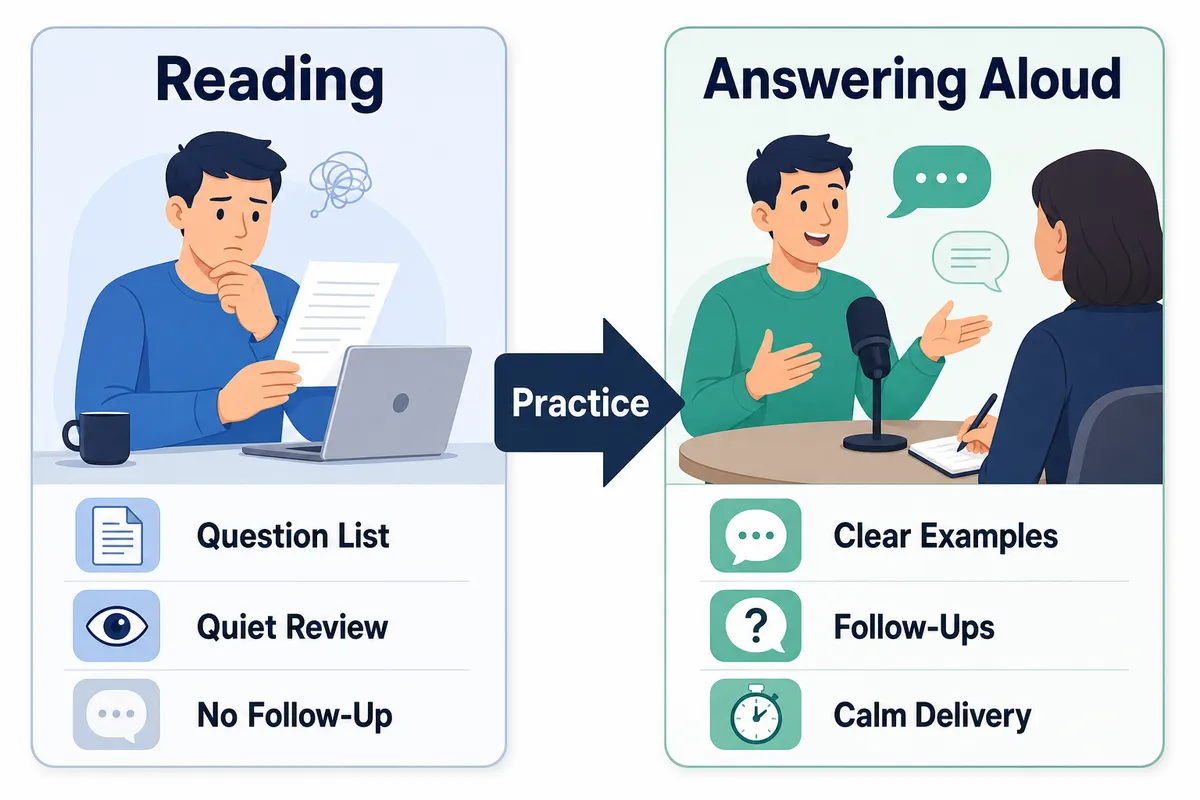
A list of interview questions can help you notice what may be asked. It cannot show you what happens when you have ten seconds to answer, your example starts wandering, and the interviewer asks, “What was your contribution?” That is why a useful mock interview for non-technical roles should happen by voice, not only through reading and typing.
Non-technical interviews assess how you think, communicate, prioritise, influence and reflect on your work. Those skills only become visible when you explain them aloud to another person. With a live voice AI interview, you can practise answering in real time, handle adaptive follow-up questions and build confidence before the actual conversation.
Whether you are applying for HR, operations, sales, marketing, customer success, recruiting, consulting, finance, business analyst or generalist roles, the interview is rarely a quiz with one correct response. It is a conversation. Your practice should resemble one.
Why reading question lists is not enough
Question lists are a reasonable starting point. They help you find recurring themes:
- Tell me about yourself.
- Why do you want this role?
- Describe a difficult stakeholder.
- Tell me about a time you made a mistake.
- How do you prioritise competing work?
- Why are you leaving your current job?
The problem is that recognising a question is not the same as answering it well.
When you read a prompt, you can pause indefinitely. You can mentally edit your response before anyone hears it. You can avoid the uncomfortable parts: the vague opening, the overlong context, the missing result, the unclear ownership, or the moment you cannot remember a useful example.
A real interviewer does not experience your polished internal draft. They hear the answer you give.
That distinction matters especially in non technical interview practice. Most candidates do not fail because they have never seen the words “Tell me about a conflict.” They struggle because their answer is too broad, too rehearsed, too detailed in the wrong place, or unable to survive a follow-up.
For example, compare these two forms of practice.
Reading practice: “Prepare an answer about handling conflict.”
Voice practice: “Tell me about a disagreement with a colleague. What did you disagree on? What did you do personally? Why did you choose that approach? What changed afterwards? What would you do differently now?”
The second version reveals whether you can produce a clear, credible story under pressure. It also resembles the way a real interview unfolds.
💡 Pro Tip: If your answer only works when you can read notes, it is not ready yet. Practise until you can explain the same example clearly without memorising every sentence.
What voice practice trains that question banks cannot
Speaking out loud changes the task. It exposes the parts of your interview performance that are otherwise easy to miss.
1. Your opening structure
Many candidates lose control of an answer in the first 20 seconds. They begin with too much background, bury the situation, and make the interviewer wait for the point.
Voice practice helps you develop a dependable rhythm:
- State the situation briefly.
- Explain the challenge or goal.
- Describe your specific action.
- Share the measurable or observable result.
- Reflect on what you learned, where appropriate.
This does not mean every answer should sound identical. It means you know how to give an interviewer enough context without turning a two-minute response into a ten-minute history lesson.
2. Your ability to think while speaking
Interviewers are not looking for flawless scripts. They are looking for judgement. A candidate who pauses, thinks and gives a specific answer often performs better than someone delivering a polished but generic speech.
General interview practice by voice lets you get comfortable with short pauses. Instead of filling space with “um”, “basically”, or “you know”, you learn to say: “Let me think of the most relevant example.” That sounds composed because it is honest.
3. Your response to follow-ups
The strongest answers create follow-up questions. If you mention improving a process, expect to be asked how you measured improvement. If you say you influenced a stakeholder, expect to be asked what resistance you faced. If you describe a missed deadline, expect to be asked what you changed afterwards.
Reading lists rarely press you on these details. An interviewer does.
4. Your delivery under mild pressure
You do not need to become a different person for an interview. You do need enough repetition that a difficult question does not make you rush, freeze or give up halfway through a useful example.
Practising aloud builds familiarity with the feeling of being asked directly. That familiarity is valuable in a screening call, an HR round, a hiring manager conversation or a panel interview.
The four common shapes of non-technical interviews
A mock interview for non-technical roles works best when it matches the round you are preparing for. Not every conversation tests the same things, even when the job title looks similar.
1. Screening calls: clarity, motivation and fit
The screening call is often the first live conversation after your application. It may be led by a recruiter, HR representative or talent partner. It is usually shorter than later rounds, but it can determine whether you proceed.
Expect questions about:
- Your current role and career path
- Why you are considering a move
- Why this company and role appeal to you
- Your notice period, location or work preferences
- Salary expectations, if relevant
- A brief overview of relevant experience
The risk in a screening call is treating it as casual. It may feel conversational, but your answers still signal preparation, communication and interest.
A good response to “Tell me about yourself” is not a biography. It is a relevant professional summary: where you are now, the experience that prepared you for this opportunity, and why this next step makes sense.
⚠️ Important: Do not recite your CV line by line. The interviewer has it already. Use the call to connect the important parts of your background to the role.
For candidates returning after time away, changing industries or entering the workforce for the first time, preparation matters even more. Our guide to your first job interview ever can help you structure the basics before you start live practice.
2. Hiring manager interviews: evidence and judgement
The hiring manager usually wants to know whether you can do the work, work with the team and make sound decisions in realistic situations.
This round tends to explore your past experience more deeply:
- How you managed a difficult project
- How you dealt with ambiguity
- How you prioritised when everything seemed urgent
- How you influenced people without formal authority
- How you handled feedback or a mistake
- How you measured success
The hiring manager is often listening for ownership. “We did this” may be true, but they need to know what you did within the team.
Use “I” accurately. Explain the decision you owned, the analysis you completed, the conversation you led, or the process you changed. Then acknowledge collaboration where it mattered.
For behavioural answers, the STAR structure remains useful: Situation, Task, Action and Result. But it should be a guide, not a rigid script. The same principles of specificity, ownership and reflection apply across non-technical roles.
3. Panel interviews: consistency and audience awareness
A panel interview can feel more intimidating because several people are listening at once. You may speak with cross-functional colleagues, senior leaders, a prospective peer, a recruiter and the hiring manager in a single session.
Panels often test whether you can communicate with different stakeholders. A finance lead may care about cost and trade-offs. An operations lead may care about execution. A customer-facing colleague may care about impact on users. A senior leader may care about priorities and strategic judgement.
The challenge is not giving a different identity to every interviewer. It is adapting the emphasis of your answer while staying clear and consistent.
✅ Do make eye contact with the person who asked the question, then include the wider group as you answer.
✅ Do pause if multiple people ask questions at once. Choose one question, answer it, then return to the other.
❌ Don’t assume the most senior person is the only person who matters. Every panellist may provide feedback.
Voice practice helps here because it trains you to answer a question directly before adding supporting detail. In a panel, concise structure creates room for the conversation to continue.
You can practise a live voice mock interview whenever you are ready, without arranging a peer session or waiting for a convenient slot.
4. Case and scenario interviews: reasoning, not magic answers
Consulting, operations, product, business analyst, strategy, sales and management roles may include a case, exercise or scenario question. You might be asked how to improve a process, respond to a customer problem, enter a market, prioritise a limited budget, or investigate declining performance.
The interviewer is usually not looking for a hidden perfect answer. They want to hear how you approach uncertainty.
A strong approach is to:
- Clarify the goal.
- State your assumptions.
- Break the problem into manageable parts.
- Explain the information you would seek.
- Compare options and trade-offs.
- Recommend a next step.
- Explain how you would measure success.
For product-focused candidates, how to answer product case study questions in PM interviews offers a useful framework for structuring messy problems without sounding mechanical.
The key is to narrate your reasoning. Silence may feel safer while you think, but the interviewer cannot assess reasoning they cannot hear.
Why resume-based practice is especially useful for non-technical roles
Generic questions have a place, but most interviewers will spend significant time on your own experience. They will ask about the campaign you listed, the account you managed, the process you improved, the market you researched, the team you supported, or the career change you made.
That is why the most relevant practice starts with your actual CV.
A resume-based mock interview from your own CV generates questions from your background, and it works for non-technical roles too. Rather than only preparing broad answers to “What is your greatest strength?”, you can practise explaining the specific claims on your resume.
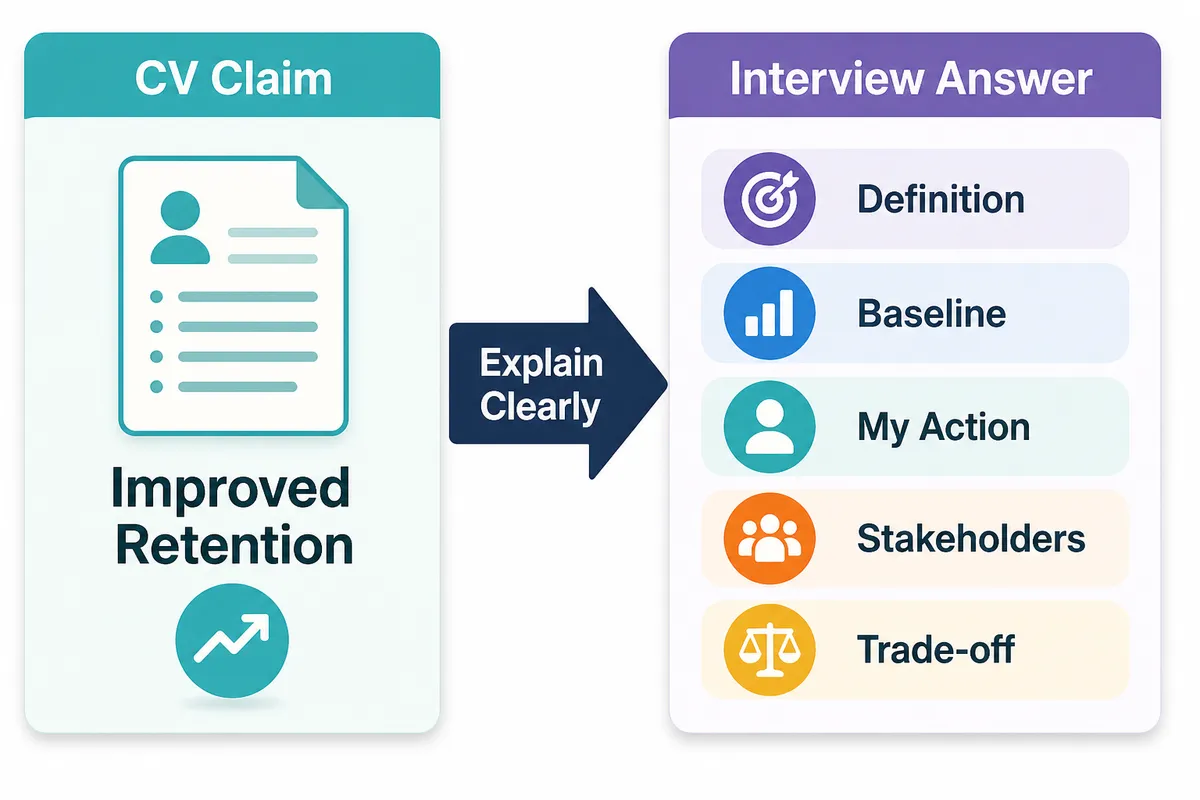
If your CV says you “improved customer retention”, be ready for:
- How did you define retention?
- What was the baseline?
- What did you personally change?
- Which stakeholders were involved?
- What trade-off did you have to make?
- What would you do differently with more time?
If your CV says you “led a project”, be ready to describe the project’s goal, your authority, the obstacles, the result and the evidence behind it.
This is not about catching you out. It is about helping you turn compressed resume statements into clear spoken evidence before an interviewer asks.
A practical voice-practice routine
You do not need to complete hours of practice every day. You need sessions with a clear purpose.
Try this 30-minute routine:
Minutes 1-5: Choose one interview shape.
Decide whether you are practising a screening call, hiring manager interview, panel-style behavioural questions or a case discussion. Do not mix everything at once.
Minutes 5-15: Answer three core questions aloud.
Use questions relevant to your role and CV. Record the themes that caused you to hesitate, ramble or become vague.
Minutes 15-25: Repeat with follow-ups.
The first answer is rarely the issue. The follow-up is where missing details appear. Practise evidence, ownership and reflection.
Minutes 25-30: Improve one thing only.
Choose one target: shorter openings, stronger results, fewer filler words, clearer numbers or more direct ownership. Do not attempt to fix every weakness at once.
A guide to using mock interviews effectively for faster improvement can help you turn individual sessions into a repeatable routine.
The goal is not to memorise a catalogue of answers. It is to build flexible stories you can adapt to the question in front of you.
What to say when you do not have a perfect example
Candidates often think they need an extraordinary story for every competency. They do not.
A useful example can come from a routine project, a small process improvement, a customer interaction, a volunteer role, university work, a career break, a side project or a difficult collaboration. The value lies in how clearly you explain the situation and what you learned.
If the question is unfamiliar, do not panic or invent an answer. You can say:
- “I have not faced that exact situation, but the closest example is…”
- “I would approach that by first clarifying…”
- “Let me take a moment to choose the most relevant example.”
- “The result was not what I wanted, but here is what I changed afterwards.”
That kind of honesty demonstrates judgement. It is much stronger than forcing a rehearsed story into a question where it does not fit.
Frequently asked questions
What is a mock interview for non-technical roles?
It is a practice interview designed for roles where communication, judgement, experience, stakeholder management and problem-solving matter more than coding. It can include screening, HR, behavioural, hiring manager, panel and case-style questions.
Why should I practise interviews by voice rather than read question lists?
Speaking reveals whether you can organise your thoughts, explain examples clearly and handle follow-up questions under time pressure. Reading helps you recognise topics; voice practice helps you perform in the conversation.
Can I use Thita for HR round practice online?
Yes. A live voice AI interview can help you practise common HR and recruiter questions, including your introduction, career motivations, strengths, achievements, transitions and workplace preferences.
Does resume-based interview practice work for non-technical jobs?
Yes. Resume-based practice works from any CV, including resumes for sales, marketing, operations, consulting, HR, customer success, business and generalist roles. It helps you prepare for questions about your own experience.
How should I prepare for a hiring manager interview?
Prepare specific examples that show ownership, problem-solving, collaboration, prioritisation and results. Practise explaining what you personally did, what changed and what you learned.
What should I do if I ramble in interviews?
Start with the conclusion or context in one sentence, then use a simple structure: situation, action and result. Practise aloud with a timer, and ask yourself whether each detail helps answer the question.
Are case interviews only for consulting roles?
No. Many non-technical roles use scenario questions, practical exercises or cases. Operations, product, strategy, sales, business analysis and leadership roles may all test how you structure a problem and make decisions.
Practise the conversation, not just the questions
The interview you want is not a reading test. It is a live conversation where your examples, judgement and communication have to hold up when someone asks the next question.
Use a live voice AI interview for non-technical roles to practise screening calls, behavioural questions, hiring manager conversations and case-style reasoning aloud. Then use the feedback to make your next answer shorter, clearer and more specific.
Bring your CV, speak through your experience, and let the follow-ups show you what still needs work.
If you are hiring rather than interviewing, visit https://interviews.thita.ai.
Topics
Related on Thita
Your next step
Practise with AI mock interviews
A spoken interview that asks follow-up questions, runs your code and ends with a written report.