
Interview
The Night-Before Interview Checklist, Plus a 20-Minute Mock Round
Use this night before interview checklist to prepare your kit, space, notes and questions, then build confidence with one focused 20-minute mock round.
If you are searching for night before interview what to do, the answer is probably not another three-hour revision session.
The night before is for reducing avoidable risk: a missing meeting link, a flat laptop, an example you cannot recall under pressure, or the question you meant to ask but forgot. It is also for doing one short, realistic rehearsal so tomorrow does not feel like the first time you have spoken an answer out loud.
This guide is deliberately narrower than a full preparation plan. If your interview is tomorrow and you need a broader view of the remaining time, read what to do the night before a technical interview. Then come back here and work through this practical checklist.
Your one active task tonight: complete one focused AI mock interview session in 20 minutes. Not five practice problems. Not a new framework course. One realistic round, followed by a clear stopping point.
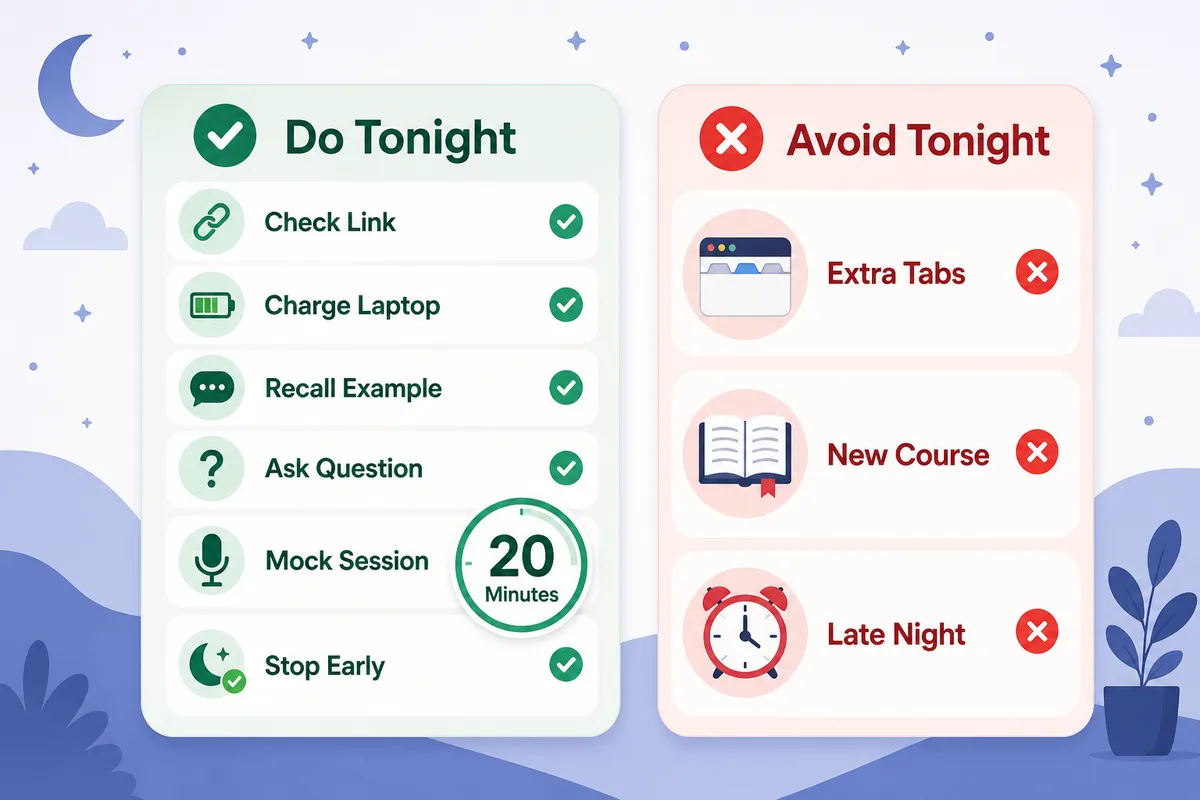
The rule for tonight: reduce uncertainty, do not create more
There is a particular kind of panic that appears the night before an interview: you realise how much you do not know, open six browser tabs, start revising unrelated topics, and go to bed later than planned with less confidence than you started with.
You will not transform your technical level overnight. You can arrive tomorrow with a working setup, a clear opening introduction, a few memorable examples, and recent evidence that you can think aloud under mild pressure.
Think of tonight as preparation for the first ten minutes and the awkward moments:
- joining the call quickly and calmly;
- introducing yourself without rambling;
- understanding the first question before rushing into an answer;
- explaining your approach while you work;
- recovering if you get stuck;
- ending with thoughtful questions.
⚠️ Important: Do not use this checklist as an excuse to keep working until 2am. Put a real finish time in your calendar. Sleep is part of interview preparation, especially when the interview requires recall, reasoning and clear communication.
Your night before interview checklist
Use the list below in order. Most candidates can complete it in 45 to 75 minutes, including the mock round. If you have less time, prioritise the first four sections and the 20-minute rehearsal.
1. Confirm the interview logistics
Start with the boring items because they are easy to fix tonight and distracting tomorrow.
✅ Do
- Re-read the confirmation email and calendar invitation.
- Check the date, start time, time zone and expected duration.
- Save the meeting link somewhere easy to find, not only in a crowded inbox.
- Note the interviewers' names and roles if they were provided.
- Confirm whether the interview is video, phone, in person, coding, system design, behavioural, presentation-based or a combination.
- Check whether you were asked to use a particular platform, browser, code editor or collaborative document.
- Plan your route if the interview is in person, including realistic travel time and a backup route.
- Set two alarms: one to wake up and one to begin getting ready.
❌ Don't
- Assume the calendar time is in your local time zone.
- Open an unfamiliar interview platform for the first time one minute before the call.
- Rely on a single low-battery phone alarm.
- Leave travel decisions until the morning.
For a technical role, identify the likely round rather than trying to revise everything. A coding round needs different preparation from a system design conversation. A behavioural round needs your examples and reflection more than another algorithm problem.
2. Prepare your environment
Your environment does not need to look like a studio. It needs to support a clear, uninterrupted conversation.
For a remote interview, choose the quietest available space. Tell people you live with the interview time and ask not to be interrupted. If outside noise is unpredictable, close windows early and have headphones ready.
Check these items:
- Laptop charger connected and a nearby power socket working.
- Battery charged even if you expect to stay plugged in.
- Stable internet connection.
- Phone hotspot available as a backup if possible.
- Camera at roughly eye level.
- Light in front of you rather than directly behind you.
- Microphone, speakers and headphones tested.
- Notifications disabled on your laptop and phone.
- Browser tabs closed except for what you may genuinely need.
- Desk cleared enough that you can write notes without searching for space.
- Water nearby.
💡 Pro Tip: Record a 30-second test video. Watch it once with sound. You will spot poor lighting, an echo, a distracting background or a camera angle much faster than you will by looking at yourself in a preview window.
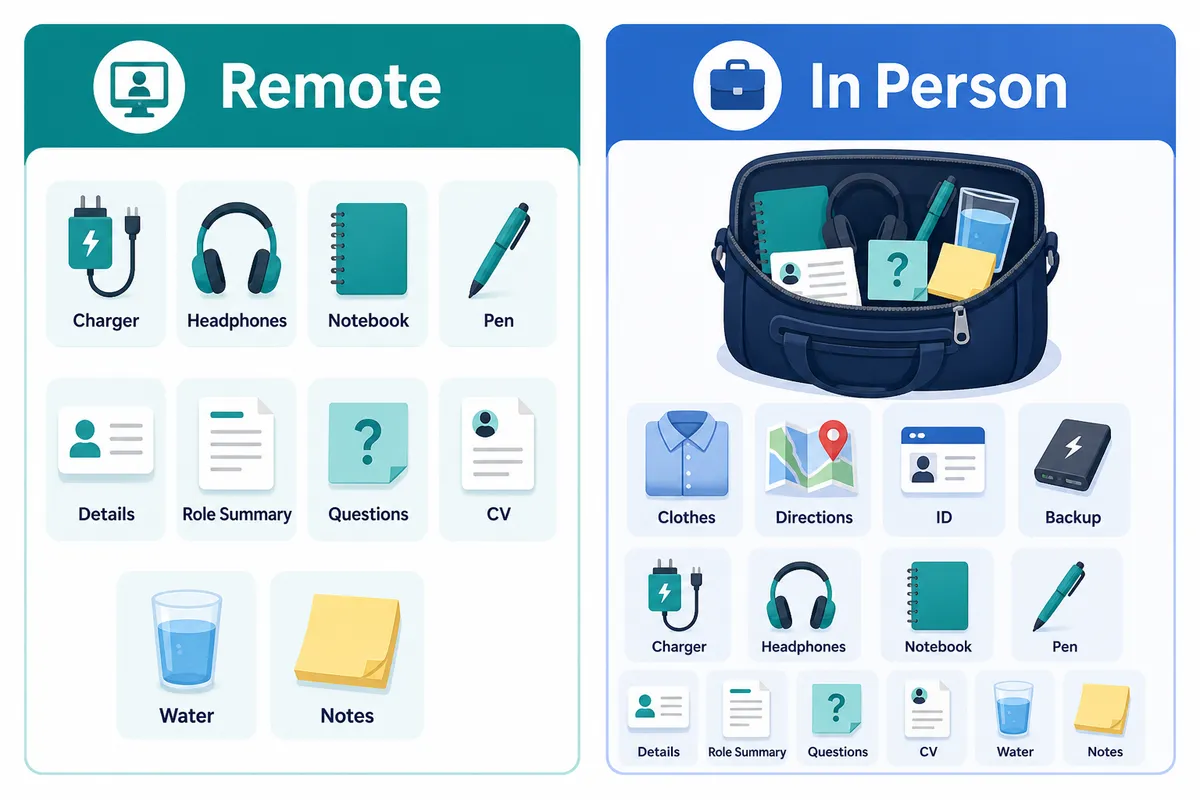
If you are interviewing in person, apply the same principle to your physical kit: clothes ready, directions saved, notebook packed, ID located, and travel backup planned.
3. Make a small interview kit
A good interview kit is small enough to use without making you look as though you are reading a script.
For a remote interview, keep these beside you:
- charger and headphones;
- notebook and pen;
- interviewer details;
- a one-page role and company summary;
- a short list of questions to ask;
- a copy of your CV;
- a glass or bottle of water;
- any permitted notes for a presentation or case exercise.
For an in-person interview, pack the equivalent in one bag tonight. Do not depend on your morning self to find a pen, print a CV, charge headphones and choose clothes while also trying to stay calm.
Your notes should be prompts, not paragraphs. The point is to jog your memory, not to replace it.
4. Create one page of useful notes
This part of the night before interview checklist often makes the biggest difference. Your page should cover only what you are likely to need when nerves make recall harder.
Write the following headings:
Your 60-second introduction
Include your current or most recent role, the kind of work you have done, one or two
relevant strengths, and why this opportunity interests you. Keep it natural. You are not
delivering a biography; you are giving the interviewer a useful starting point.
Three achievement stories
Choose examples that show ownership, collaboration, conflict, learning, impact or
problem-solving. Use a light structure: situation, action, result and what you learned.
For technical candidates, include the constraints, trade-offs and measurable outcome where
possible.
Two projects or experiences from your CV
Expect questions about anything you listed. Refresh your memory on your role, your specific
contribution, the hardest decision, the outcome and what you would improve.
Role and company notes
Write three facts you can genuinely connect to your interest in the role. Avoid vague
statements such as “it is a great company”. Be specific about the product, team, mission,
technical challenge, customers or stage of growth.
Questions to ask them
Prepare these now, then choose two or three based on how the conversation goes.
For advice on communicating clearly under pressure, see how to explain your thought process clearly in coding interviews. The same storytelling discipline helps candidates in non-technical roles too.
Questions worth asking the interviewer
The best questions show that you are trying to understand how you would do good work, not merely collecting facts already visible on the company website.
Pick a few from this list and adapt them to the role:
- What would a strong first 90 days look like for the person in this role?
- What problems is the team most focused on solving right now?
- How does the team decide what to prioritise when there are competing requests?
- What distinguishes people who do especially well on this team?
- How is feedback usually shared during projects?
- What is the biggest technical, product or operational challenge the team expects this year?
- How does this role work with adjacent teams?
- Is there anything about my experience that you would like me to clarify before we finish?
That final question is particularly valuable. It gives the interviewer an opening to raise a concern while you still have the chance to address it.
❌ Don't ask every question on your list. A rapid-fire set of ten questions can make the end of the interview feel transactional. Listen carefully during the conversation; one of your prepared questions may already be answered.
The 20-minute mock round to do tonight
Reading notes can make you feel prepared. Speaking your answers and handling a follow-up is much better evidence.
Use one 20-minute mock round as your final active practice. The goal is not a perfect score. The goal is to rehearse starting cold, thinking aloud, receiving a follow-up and finishing clearly.
A live voice format is useful because it removes the temptation to silently edit your answer until it looks polished. In a real interview, the interviewer hears your assumptions, pauses, trade-offs and recovery.
You can practise a live voice AI interview on Thita with adaptive follow-ups. Choose the round closest to tomorrow's interview: DSA, system design, low-level design, machine coding, behavioural, product management, data science, AI and ML, CS fundamentals, or a resume-based interview built from your own CV.
Here is the full 20-minute plan.
Minutes 0-2: Set the conditions
Sit where you will sit tomorrow. Use the same headphones if you can. Put your phone away, open your notebook and set a visible timer.
Say your introduction aloud once. Do not restart it because it was imperfect. The aim is to sound present and conversational, not rehearsed.
Minutes 2-12: Answer one realistic question
For a coding question, begin by clarifying the problem and stating a simple approach before you code. Narrate your reasoning. If the platform allows it, run your code and inspect the result rather than assuming it works.
For system design, start with requirements and constraints. Name the users, the scale assumption, the core flow and the components you would prioritise. Do not try to draw every possible box.
For behavioural or resume-based practice, choose a real example. Explain what you did, not just what the team did. Include a decision, a challenge and an outcome.
If you have a technical coding round tomorrow, remember that you can practise in six languages: Python, C++, Java, JavaScript, Go and C#. Choose the language you expect to use in the real interview rather than switching tonight for novelty.
Minutes 12-16: Handle a follow-up
This is the most valuable part. Ask yourself, or let the interviewer ask:
- What edge case did you miss?
- Can the time or space complexity improve?
- What changes if the input scale grows?
- What trade-off did you make?
- What would you monitor after launch?
- What did you learn from that experience?
A follow-up is not proof that you failed. It is usually the interviewer checking how you reason beyond your first answer. Practise saying, “That is a good constraint to add. I would change my approach by…” rather than becoming defensive or rushing.
The ability to narrate this calmly matters. Our guide on how to think out loud in coding interviews has practical examples if this is the part you find hardest.
Minutes 16-20: Review, write one note, stop
Write down only three things:
- One thing you did well.
- One answer or explanation to tighten tomorrow.
- One reminder for the first five minutes of the real interview.
Examples might be: “Clarify constraints before coding”, “Pause before answering motivation questions”, or “State the trade-off before choosing a database”.
Then stop. Do not turn the review into a new study session. Your final hour should leave you calmer, not more alert and overloaded.
Match the mock round to tomorrow's format
How to prepare the night before an interview depends partly on what is being assessed.
For coding interviews: choose a familiar difficulty level. Tonight is not the time to prove you can solve the hardest graph problem you have ever seen. Rehearse clarification, a baseline approach, implementation, testing and complexity explanation.
For system design interviews: rehearse structure. Requirements first, then rough scale, core components, bottlenecks, trade-offs and monitoring. A clear framework is more useful than memorising architecture diagrams.
For behavioural interviews: rehearse concise examples with outcomes. Make sure your stories show your contribution, not only team activity. Prepare one example of failure or feedback; it is commonly asked and difficult to invent convincingly on the spot.
For product management interviews: rehearse how you define users, identify the problem, prioritise options and measure success. Do not jump to features before explaining why the problem matters.
For data science or AI and ML interviews: refresh the assumptions behind your projects, metrics, data quality decisions, model trade-offs and how you would evaluate results in production.
For resume-based interviews: read every line of your CV. If a bullet says you improved performance, know how it was measured. If it names a tool, know why it was chosen. You can also use a resume-based AI interview from your own CV to rehearse the questions your background naturally invites.
Frequently asked questions
Should I practise the night before an interview?
Yes, but keep it short and realistic. One 20-minute mock round is usually more useful than
hours of passive revision because it rehearses speaking, reasoning and handling pressure.
What should I review the night before a technical interview?
Review the interview format, your own CV and projects, a few familiar patterns, and the
mistakes you commonly make. Avoid broad new topics that create panic without enough time to
learn them properly.
Should I prepare questions for the interviewer?
Yes. Prepare three to five questions, then ask the two or three that remain relevant after
the conversation. Focus on team goals, expectations, collaboration and what success looks
like.
What if I get stuck during the mock round?
Treat it as useful rehearsal. Say what you understand, identify the uncertainty, suggest a
smaller example or baseline approach, and explain what you would test next. Recovery is a
skill you can practise.
Should I use notes in a remote interview?
Use short prompts, not scripts. A one-page sheet with your introduction, stories, project
details and questions can help, but reading full answers usually makes you sound less
natural.
How late should I prepare the night before?
Set a stopping time that protects your sleep. Finish logistics and your mock round early
enough to wind down. Clear thinking tomorrow is worth more than one extra late-night
question.
Can non-technical candidates use a mock interview too?
Yes. Resume-based, behavioural and product-oriented mock sessions are useful for candidates
outside software engineering as well. The core benefit is still the same: practise answering
out loud and responding to follow-up questions.
Finish tonight with one realistic rehearsal
You do not need to solve everything tonight. You need to make tomorrow easier: know where to join, know what to bring, know what you want to say, and remind yourself that you can answer a question aloud even when it is not perfect.
Start a 20-minute AI mock interview tonight, choose the round closest to tomorrow's format, and finish with one clear note for your real interview.
Then close the laptop, set your alarms and let the preparation do its work.
Read next
- One Week to Prepare for an Interview: A Day-by-Day Plan — if you still have more than one night, this spreads the same preparation across seven focused days instead.
Topics
Related on Thita
Your next step
Practise with AI mock interviews
A spoken interview that asks follow-up questions, runs your code and ends with a written report.