
Interview
Pinterest Interview Questions and Process: The Complete Guide (2026)
Pinterest interview questions, reported rounds and preparation: learn the SDE coding and design focus, likely difficulty, and a practical 30-day plan.
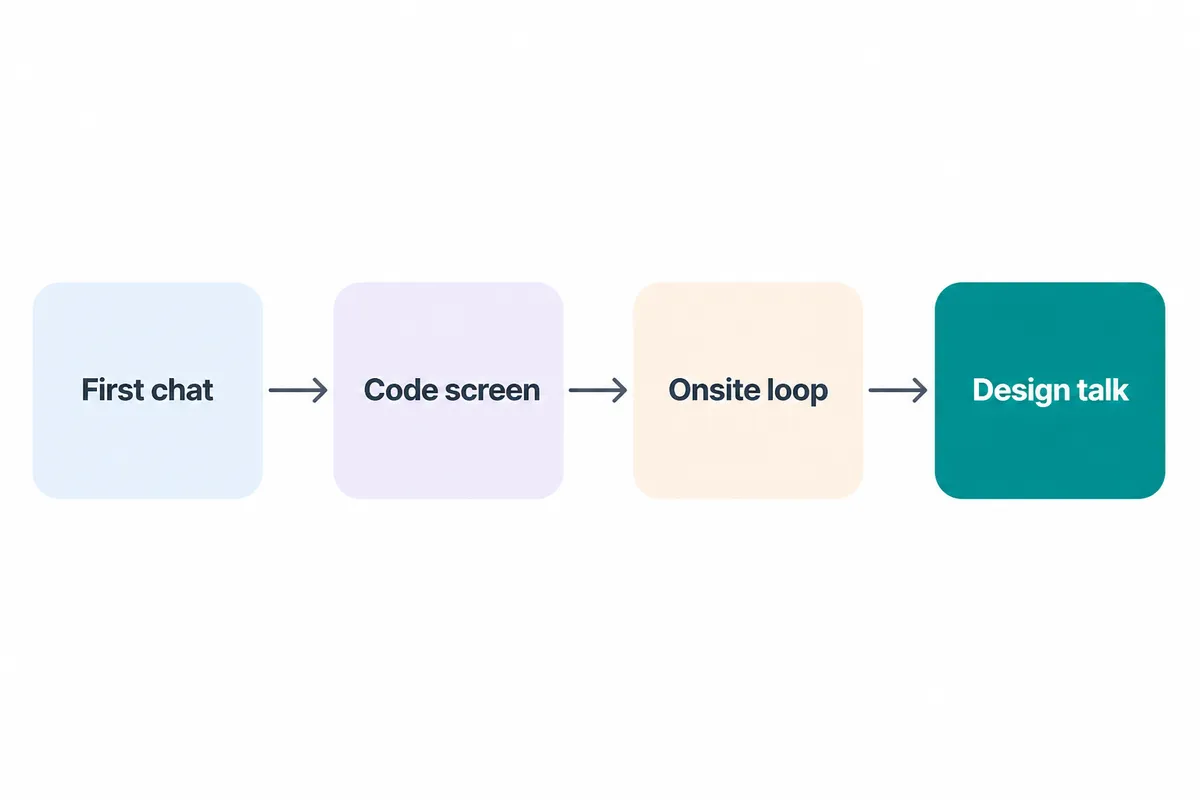
Pinterest interview questions commonly span an initial screen, a technical coding conversation, and an onsite loop where software engineering fundamentals meet product-shaped design reasoning. Reported accounts describe a recruiter screen, an assessment or phone screen, a CoderPad technical screen, and an onsite of four to six interviews. The most Pinterest-specific preparation is being able to discuss trade-offs in feeds, visual search, relevance and ranking—not merely produce a correct implementation.
For focused practice, Pinterest's interview kit holds eight mapped DSA questions. Use it alongside the free sheets and mock practice below, then confirm the precise loop, role expectations and schedule with your recruiter.
Pinterest interview process at a glance
| Stage | Common format | What it screens for | How to prepare |
|---|---|---|---|
| Recruiter screen | Initial conversation | Role fit and experience | Tell a clear story about your work |
| Assessment or phone screen | Early technical filter | Core coding ability | Revise common DSA patterns |
| Technical screen | CoderPad discussion | Live problem solving | Narrate decisions as you code |
| Onsite coding | Technical interviews | Correctness and complexity | Practise testable solutions |
| Onsite design | Product and systems discussion | Trade-offs and relevance | Connect design to user outcomes |
| Onsite conversations | Team and experience depth | Ownership and collaboration | Prepare detailed project stories |
Reported accounts are anecdotal rather than a published Pinterest specification. Team, level and hiring needs can change the order or emphasis of these stages, so treat this as a useful working model rather than a guaranteed script.
Round 1 — recruiter screen
The recruiter screen is usually the first checkpoint. The conversation moves beyond your CV into the role, team needs, availability and the kind of engineering work you want to do.
It is not a coding test, but it still matters. A clear account of your experience helps the recruiter match you to a suitable loop and level. If you say you built ranking infrastructure, be ready to explain what you personally owned. If your work was product-facing, explain the user problem as well as the implementation.
Pinterest is a visual discovery product, so make your motivation concrete. “I like the product” is weaker than explaining why discovery, recommendation quality, creator experiences or large-scale content systems interest you as an engineer.
Prepare concise answers to these questions:
- What systems have you worked on?
- Which technical decisions did you personally influence?
- What scope are you seeking next?
- Why does Pinterest’s product surface connect to that direction?
Keep it specific. The recruiter needs enough signal to understand where you fit, not a memorised speech.
Round 2 — assessment or phone screen
Reported accounts describe either an assessment or phone screen before the later technical stages. The format can vary, but the preparation target is familiar: translate a problem into a correct solution, reason about complexity and communicate without losing structure.
Do not rely on memorised code. First identify the problem shape. Is the task asking for a lookup structure, sliding window, graph traversal, binary search over an answer, or dynamic programming? Once you recognise the pattern, implementation becomes less stressful.
The DSA Patterns Sheet is free to browse and helps you practise recognition rather than treating every question as a new puzzle. Pair it with how to identify the right DSA pattern in a coding interview.
A strong operating sequence is simple:
- Restate the problem and ask about constraints.
- Describe a straightforward solution.
- Improve it only when you can explain why.
- State time and space complexity.
- Test edge cases aloud before you finish.
💡 Pro tip: Do not wait until the end to test. Walk through a normal example, a minimal input and a boundary case while you are still coding.
Round 3 — technical screen in CoderPad
Candidate reports describe a CoderPad technical screen. The medium makes your working process visible: the interviewer can see whether you clarify requirements, organise code, recover from a wrong turn and verify what you have written.
The screen is not solely about arriving at an optimal answer. It is also a communication round. Interviewers need to understand why you chose a data structure, what invariant your loop maintains, and which cases could break the implementation.
Practise coding in a way that leaves a readable trail:
- Name variables for their role, not typing speed.
- Say what you are about to implement before writing it.
- Explain trade-offs where more than one route works.
- Add a small test case before declaring completion.
- Treat hints as information rather than a sign of failure.
Pinterest's interview kit is a direct place to rehearse company-mapped coding questions. For the interview behaviour around them, read what interviewers actually look for in live coding rounds.
Round 4 — onsite coding conversations
Reported accounts describe an onsite loop of four to six interviews. Coding remains important, but the onsite usually gives interviewers more room to probe your reasoning than an early screen does.
Expect follow-up questions. A solution that works for a small input may be challenged with larger data, changing constraints or a requirement to reduce memory use. The point is not always to force a new answer; it is to see whether you can evaluate your own solution under pressure.
After every practice question, ask:
- What if the input becomes much larger?
- What if data arrives continuously?
- What if everything cannot fit in memory?
- What if latency matters more than throughput?
- What would change in production?
That habit builds the bridge between a coding puzzle and engineering judgement. It also avoids a common failure mode: treating a correct first answer as the end of the conversation.
For timed repetition, Code Practice can help you write and test solutions in the browser. Aim for clear explanation and dependable execution, not maximum problem volume.
Round 5 — onsite design and product reasoning
This part of the Pinterest loop is least interchangeable with a generic software interview. Reported accounts describe design cases shaped around Pinterest’s product world: feeds, visual search and ranking. Interviewers reportedly weigh reasoning about relevance and ranking trade-offs alongside computer science fundamentals.
Do not try to predict one exact prompt. Design attribution is less certain than the broad process shape, so prepare for the kind of design problem evidenced at Pinterest rather than assuming a fixed question bank.
A feed or discovery conversation can involve competing goals:
- relevance to the individual user;
- freshness and diversity of content;
- latency and infrastructure cost;
- quality and safety signals;
- the ability to measure and improve ranking outcomes.
A strong answer makes those tensions explicit. A highly personalised feed may improve immediate engagement but reduce discovery or diversity. A richer ranking model may improve relevance while increasing serving latency. The interviewer is looking for someone who can surface these choices rather than claiming there is one best design.
For broader architecture preparation, the System Design Sheet is free to browse. If you are unsure how much depth your level needs, how much system design is enough for SDE-1 versus SDE-2 interviews offers a practical distinction.
Round 6 — experience, collaboration and judgement
Within an onsite loop, discussion of your past work can carry as much signal as another coding exercise. Prepare for questions about ownership, collaboration, disagreement, delivery under uncertainty and the consequences of your technical decisions.
Use a structured story, but do not turn it into a script. The useful detail is what you did:
- What was the actual problem?
- What constraints shaped the decision?
- What did you propose or implement?
- Who disagreed, and how did you respond?
- What happened after launch?
- What would you change with hindsight?
Pinterest’s reported focus on relevance and ranking trade-offs makes product judgement especially useful here. If you worked on a feature with measurable user impact, be ready to discuss how you defined success and what signal told you the feature was working.
An AI mock interview is a practical way to rehearse behavioural answers aloud. It is particularly useful for catching vague phrases such as “we decided” when the interviewer will naturally ask what you personally owned.
Is the Pinterest interview hard?
Yes, but the difficulty is broader than coding-question difficulty alone.
Reported accounts describe several stages before an onsite of four to six interviews. That makes the process demanding because you need to sustain performance across coding, design and discussion of your experience—not because every stage necessarily contains an obscure trick.
The coding bar rewards sound fundamentals: selecting suitable data structures, producing correct code and explaining complexity. The design bar adds a second kind of pressure: making trade-offs under ambiguity. At Pinterest, that ambiguity is often product-shaped. You may need to reason about what makes content relevant, how ranking quality is measured, or how a visual discovery experience changes the system design.
How many rounds are there? Reported accounts describe a recruiter screen, an assessment or phone screen, a CoderPad technical screen and an onsite of four to six interviews. The exact sequence varies by team and level.
How long does the process take? The available reports do not establish a reliable company-wide timeline. Ask your recruiter for the current schedule, expected gaps between stages and whether the onsite is virtual or in person.
The difficult part is preparation breadth. Candidates who only practise DSA may struggle in design. Candidates who only rehearse system design may lose points in live implementation.
A 30-day Pinterest interview preparation plan
Days 1–7 — rebuild coding pattern recognition
Start with arrays, strings, hashing, two pointers, sliding windows, trees, graphs and binary search. Do not chase difficult problems immediately. Build a dependable method for recognising what each prompt is testing.
Use the Pinterest interview kit for targeted practice, then revisit any question you could solve only after seeing the pattern. Your aim is to explain the route to a solution before you type.
Days 8–14 — practise live coding habits
Move from private solving to interview-style solving. Set a timer, speak your reasoning aloud and test deliberately. Recording yourself can expose silent jumps in logic.
Read how to explain your thought process clearly in coding interviews and practise its core habit: narrate assumptions, choices and checks rather than every keystroke.
Days 15–21 — build design fluency
Study the difference between component-level design and broader system design. The Low Level Design Sheet is free to browse, as is the system-design material. Both help you practise naming responsibilities and trade-offs.
Use Pinterest-shaped themes: a personalised feed, visual search results, ranking signals, saving content, notifications or content quality. Focus on requirements first. Ask what success means before choosing databases, queues or caches.
Days 22–26 — connect design to product outcomes
For each practice design, add a product lens. How would you measure relevance? What metrics might mislead? How would you balance freshness against precision? What happens when a new user has little history?
This is the distinctive Pinterest preparation step. You are not trying to become a ranking researcher in a week. You are demonstrating that technical decisions affect what users discover and how the product behaves.
Days 27–30 — simulate the full loop
Run a coding mock, a design mock and a behavioural mock on separate days. Spend the final day reviewing project stories, common edge cases and questions for the interviewer.
Do not learn a new framework at the end. Prioritise calm repetition, clear explanations and rest. The final improvement usually comes from making existing knowledge easier to demonstrate.
The Pinterest-specific edge: relevance is a technical trade-off
Many companies can ask you to design a feed. Pinterest’s reported interview shape gives that familiar topic a different centre of gravity: visual discovery, relevance and ranking trade-offs.
A useful answer separates stages of the experience. Content may be retrieved from a large candidate set, filtered for quality or policy needs, ranked for relevance, then diversified so the feed does not become repetitive. Each stage has a different job, and mixing them into one vague “recommendation algorithm” weakens the design.
Then make the trade-offs visible. A ranking system can optimise engagement, but engagement alone may not represent a satisfying discovery experience. Fresh content can be valuable, but too much freshness can lower immediate relevance. Greater model complexity may improve ranking quality while harming latency or operability.
This is where strong candidates stand out: they connect the system mechanism to the user outcome, explain what they would measure and acknowledge what could go wrong. That combination of CS fundamentals and relevance reasoning is preparation that would not belong unchanged in every company interview guide.
Frequently asked questions
What are the main Pinterest interview questions about?
Reported accounts describe coding, computer science fundamentals, design reasoning and discussion of past experience. Design conversations can be shaped around feeds, visual search and ranking trade-offs.
How many rounds does the Pinterest interview have?
Reported accounts describe an early screen sequence followed by an onsite of four to six interviews. The exact structure varies by team, level and hiring process.
Does Pinterest use CoderPad?
Candidate reports describe a CoderPad technical screen. Confirm the current platform and format with your recruiter because interview tooling can change.
Is Pinterest coding interview preparation mostly DSA?
DSA preparation matters for the coding stages, but it is not the whole plan. You should also practise communicating clearly and reasoning about design trade-offs.
What system design topics should I prepare for Pinterest?
Prepare the kind of design problem evidenced at Pinterest: feeds, visual discovery, relevance and ranking. Focus on requirements, metrics, latency, quality and user outcomes.
Is system design required for every Pinterest engineering role?
The available reports do not establish a universal level-by-level rule. Prepare foundational design reasoning and ask your recruiter what the role’s loop includes.
How should I prepare for behavioural conversations?
Prepare specific stories about ownership, disagreement, delivery and learning. Use “I” accurately, explain constraints and describe the outcome rather than giving a high-level team summary.
How long does the Pinterest interview process take?
No reliable company-wide timeline is established in the available reports. Ask your recruiter for the current schedule and expected timing between stages.
What should I do if I do not know an answer in a live round?
Clarify the problem, state your assumptions, propose a simple route and improve it through discussion. Clear reasoning is more useful than silent guessing.
Start with the skills Pinterest can see
The strongest Pinterest preparation combines coding accuracy with product-aware engineering judgement. Practise recognising DSA patterns, writing clear code under observation and discussing how relevance, ranking and discovery choices affect users.
Open Pinterest's interview kit to work through the eight mapped DSA questions for Pinterest. Then use the free-to-browse DSA Patterns Sheet, practise a design discussion with the System Design Sheet, and rehearse your delivery in an AI mock interview.
Interview processes change, so confirm the latest format with your recruiter before building your final practice schedule.