
Interview
Qualcomm Interview Questions and Process: The Complete Guide (2026)
Prepare for Qualcomm interview questions with a round-by-round guide to live coding, embedded C depth, difficulty, and a focused 30-day prep plan.
Qualcomm interview questions commonly combine live coding with a close examination of the systems knowledge behind your code. Reported accounts describe an engineer screen focused on your experience and CV projects, followed by onsite technical rounds with live coding. For embedded roles especially, expect C fundamentals to matter: pointers, memory manipulation, operating-system concepts, scheduling, virtual memory, and how software interacts with hardware.
The practical preparation split is therefore broad: practise coding patterns, explain trade-offs aloud, and revisit the low-level systems knowledge that supports embedded work. Qualcomm's interview kit holds eight mapped DSA questions to help you rehearse the coding side in a company-focused set.
The process at a glance
| Stage | Reported format | What it screens for | Best preparation focus |
|---|---|---|---|
| Engineer screen | Experience and CV-project discussion | Project depth, technical judgement, role fit | Know your own decisions in detail |
| Technical rounds | Live coding with engineering discussion | Problem solving, code quality, complexity reasoning | Pattern recognition and clear narration |
| Embedded depth | C and systems discussion, especially for embedded roles | Memory safety, OS knowledge, hardware awareness | C, memory, scheduling and debugging |
| Final conversations | Team and role-specific discussion | Collaboration, ownership and practical fit | Clear project stories and thoughtful questions |
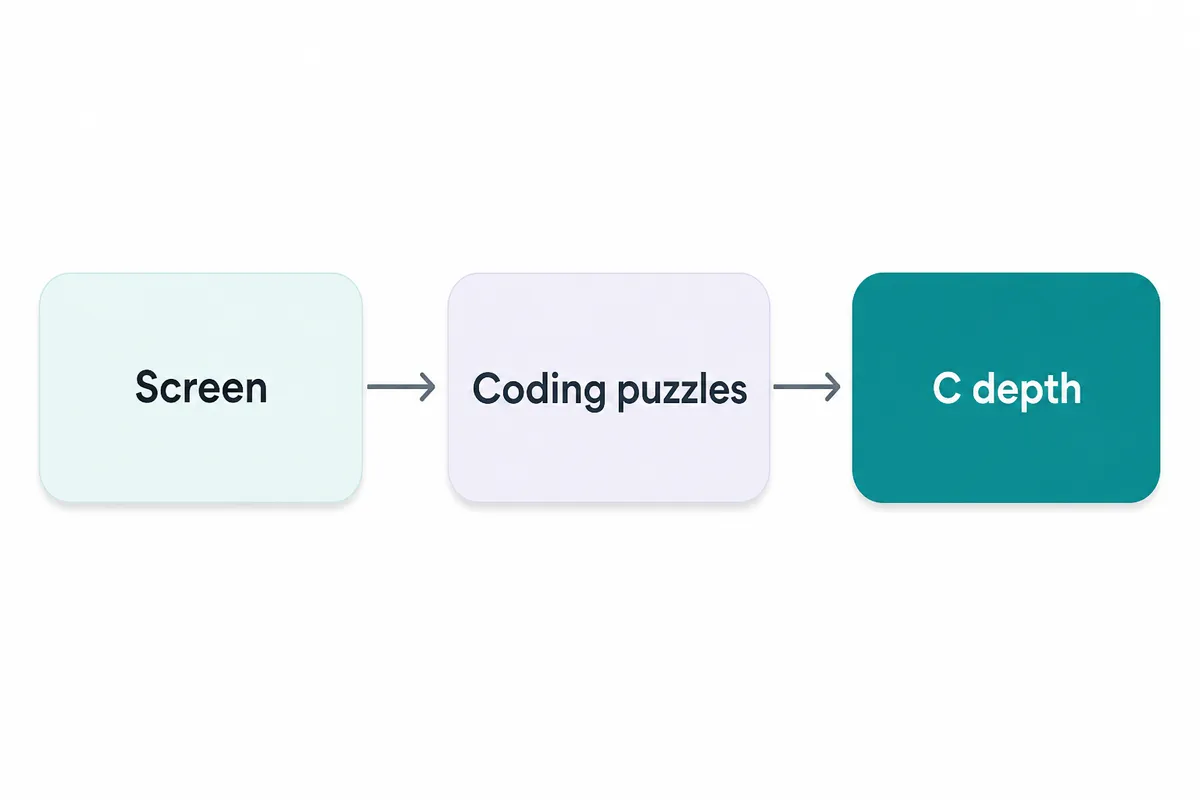
Reported accounts are limited and can vary substantially by team, location and role. Treat this as the likely shape rather than a fixed script, and ask your recruiter which areas will be emphasised for your particular position.
Round 1 — engineer screen and project discussion
The first conversation is commonly reported as an engineer screen that covers your experience and the projects on your CV. It is tempting to treat this as a light introduction before the “real” technical rounds. That is a mistake.
This screen lets an interviewer test whether your claimed work survives useful follow-up questions. If you mention a performance improvement, be ready to explain the baseline, the bottleneck, the measurement method, the change you made, and the trade-off it introduced. If you built a service, expect questions about failure modes, testing, deployment, observability and the limits of your ownership.
For embedded or systems-adjacent work, project depth can become a route into fundamentals. A discussion about a driver, a real-time feature or a performance issue may lead naturally to memory layout, synchronisation, interrupts, scheduling or device constraints. You do not need a theatrical answer. You do need a precise one.
Prepare two projects in detail:
- one where you made a technical decision with visible consequences;
- one where something failed and you had to diagnose or revise your approach.
Use a simple structure: context, your responsibility, options considered, decision, result and what you would change now. Rehearsing this aloud in an AI mock interview helps expose vague phrases such as “we improved it” before an interviewer does.
Round 2 — live coding
Reported Qualcomm accounts describe onsite technical rounds with live coding. The coding prompt may be an ordinary data-structures problem, but the evaluation is wider than getting to a final implementation. Interviewers can see whether you clarify the input, select an appropriate data structure, reason about complexity, write readable code and test your own assumptions.
A strong live-coding approach has a repeatable rhythm:
- Restate the problem and confirm constraints.
- Work through a small example before choosing an approach.
- Explain the data structure and time-space cost.
- Implement in small, testable pieces.
- Walk through edge cases aloud.
- Revisit complexity and possible improvements.
This structure matters because it makes your judgement visible. A technically correct answer reached in silence gives the interviewer little evidence about how you would work with colleagues. Conversely, talking without progressing can look like uncertainty. Aim for short, useful narration tied directly to the code on screen.
The DSA Patterns Sheet is free to browse and is useful for rebuilding recognition speed across common coding shapes. Start with arrays, hash maps, two pointers, sliding windows, binary search, trees and graphs. If you routinely solve problems by trying ideas at random, read how to identify the right DSA pattern in a coding interview before adding more questions to your list.
💡 Pro Tip: Do not wait until the final minute to test. As soon as the main path works, test an empty input, a smallest valid input, repeated values and any boundary condition the prompt implies.
Round 3 — C, memory and systems depth
This is the Qualcomm-specific part of preparation that should change how you spend your time.
Reported accounts describe C as the bedrock for embedded roles, alongside pointer risks, memory manipulation, OS and RTOS internals, virtual memory, scheduling, and the mapping between code and hardware. That does not mean every Qualcomm software role has the same emphasis. It means candidates for embedded-oriented work should not prepare as though the interview is a standard DSA loop with a few language trivia questions added on.
The useful distinction is between knowing a definition and being able to reason from it.
For example, do not merely memorise what a pointer is. Be prepared to discuss:
- how invalid pointers arise;
- stack versus heap allocation;
- ownership and lifetime;
- buffer boundaries and defensive checks;
- what undefined behaviour can look like in practice;
- how you would investigate a crash or memory corruption issue.
The same applies to operating systems. Rather than reciting a scheduling definition, explain what a scheduler is trading off: responsiveness, throughput, fairness, latency and predictability. In a real-time context, the important question is often not simply whether work completes, but whether it completes within a deadline.
The free-to-browse Operating Systems Sheet is a good revision route for processes, threads, virtual memory, scheduling and synchronisation. Pair it with the Computer Networks Sheet if the role description touches connectivity, modem software, distributed services or protocol work.
What good systems answers sound like
Good systems answers usually begin with assumptions. If asked how you would share data across execution contexts, say what must be protected, what the performance constraints are, and whether correctness or latency has priority. Then compare options.
Avoid treating every question as a chance to name a sophisticated mechanism. Clear reasoning about a mutex, queue, memory boundary or scheduling constraint is more convincing than an overcomplicated answer that ignores the actual problem.
Named rituals and process variation
No named company-wide ritual surfaced in the available Qualcomm research. That absence is worth handling honestly: reported accounts point to an engineer screen and onsite live coding, but do not establish a universal platform, time limit, fixed number of rounds or branded final stage.
Do not interpret this as permission to under-prepare. It means recruiter confirmation is unusually valuable. Ask direct questions before the loop:
- Will the role include C or C++ coding?
- How much embedded, OS or hardware discussion should I expect?
- Is there a design or debugging component?
- Should I prepare for a project deep dive with the hiring team?
- Will coding be language-specific or language-flexible?
Those questions help you allocate preparation time without relying on generic internet assumptions.
Is the Qualcomm interview hard?
It can be hard because it tests two forms of fluency at once: interview problem solving and technical depth relevant to the role.
Candidates who have practised coding puzzles may still struggle if they cannot explain memory behaviour, reason about pointers safely, or connect operating-system concepts to real engineering constraints. Equally, experienced embedded engineers can be caught out if they have not practised writing and explaining code under interview conditions.
How many rounds are there? Reported accounts establish an engineer screen followed by onsite technical rounds with live coding, but do not support a universal fixed round count. It can vary by team and role.
How long does the process take? The available research does not establish a reliable Qualcomm-wide timeline. Ask your recruiter about scheduling and decision timing for your team.
The fairest way to think about difficulty is this: the coding bar rewards structured thinking, while the systems discussion rewards genuine understanding. Neither is reliably passed through memorisation alone.
A 30-day Qualcomm preparation plan
Week 1 — rebuild coding fundamentals
Spend the first week on the patterns that appear most often in live technical interviews: arrays, strings, hash maps, linked lists, binary search, trees and graph traversal. Focus on explaining why an approach works, not only implementing it.
Use in-browser code practice for short daily sessions. The goal is to make your workflow automatic: clarify, plan, code, test and explain complexity.
For graph revision, DFS and BFS traversal patterns is a useful companion. Do not chase difficult problems yet. Build accuracy and recognition first.
Week 2 — make C and memory practical
Shift half your preparation time towards C and systems fundamentals, especially if the role is embedded. Write small programs that exercise pointers, arrays, strings, dynamic allocation and memory lifetime. Debug intentionally broken code rather than only reading explanations.
Review stack and heap behaviour, process versus thread distinctions, locks, race conditions, paging, virtual memory and scheduling. The aim is to translate theory into an engineering explanation.
At the end of each session, ask yourself: “What would fail in production, and how would I find it?” That habit is more valuable than collecting definitions.
Week 3 — combine coding with explanation
Now practise live-round conditions. Choose a coding question, set a realistic timer, and narrate from the first clarification to the final test case. Record yourself if possible. You will quickly notice where your explanation becomes vague or where you stop speaking when the problem gets difficult.
Work through Qualcomm's interview kit during this week. The eight mapped DSA questions provide a focused set for practising pattern recognition, complexity analysis and communication in one place.
Also do two systems drills. Pick a prompt such as diagnosing a memory issue or choosing between threads and processes. State assumptions, identify risks, compare options and make a recommendation.
Week 4 — simulate the actual conversation
Use the final week to integrate everything. Alternate between coding practice, project storytelling and systems discussion. Run at least two full rehearsals:
- a live-coding simulation where you explain every decision;
- a project-and-systems simulation where follow-up questions challenge your assumptions.
Keep answers concise. Real interviews reward candidates who can go deep when asked without giving a lecture before the interviewer has chosen a direction.
The Low Level Design Sheet is free to browse if your recruiter confirms a class-design component. For role-level expectations, how much system design is enough for SDE-1 versus SDE-2 interviews can help you avoid over-preparing the wrong depth.
Qualcomm-specific preparation: think from code to hardware
At many companies, it is enough to explain code in terms of inputs, outputs and complexity. For embedded Qualcomm roles, reported accounts suggest you should be ready to extend that explanation one level lower.
What does this allocation do to memory? What happens when the code runs concurrently? Which behaviour depends on the operating system? What assumptions are being made about timing? How might hardware constraints affect the design?
That code-to-hardware chain is the distinctive preparation lens.
Practise taking an ordinary C function and discussing it in layers:
- Correctness: Does it produce the intended result?
- Safety: Could it access invalid memory or exceed a buffer?
- Performance: Does allocation, copying or cache behaviour matter?
- Execution: Which thread or process runs it, and what can interrupt it?
- System fit: What hardware, driver or timing assumption does it rely on?
You will not need every layer for every answer. But being able to move between them shows the kind of engineering judgement that a purely puzzle-focused preparation plan can miss.
Frequently asked questions
What are the most important Qualcomm interview questions to prepare for?
Prepare for live coding questions alongside C, pointers, memory management, OS concepts, scheduling and project-depth questions. The precise mix varies by team and role.
Does Qualcomm ask DSA questions?
Reported onsite technical rounds include live coding. Practise common data-structures patterns, complexity analysis and explaining your approach aloud.
What should embedded candidates focus on?
Reported accounts point to C, pointer safety, memory manipulation, OS and RTOS internals, virtual memory, scheduling and the relationship between code and hardware.
How many Qualcomm interview rounds are there?
Available reports establish an engineer screen followed by onsite technical rounds, but do not support one fixed company-wide count. Confirm the loop with your recruiter.
Is C required for Qualcomm interviews?
C is reported as especially important for embedded roles. The expected language depth depends on the role, so ask the recruiter what the team uses.
Are Qualcomm coding interviews harder than normal coding interviews?
The challenge is often the combination of coding and systems depth. Candidates need to solve problems clearly while demonstrating sound engineering judgement.
Does Qualcomm ask operating-system questions?
Reported accounts describe OS and RTOS internals, virtual memory and scheduling as relevant areas for embedded roles.
How should I explain my solution in live coding?
Clarify the problem, describe the approach, state complexity, code in small steps and test edge cases aloud. See our guide to explaining your thought process clearly in coding interviews.
How long does the Qualcomm interview process take?
The available research does not establish a dependable Qualcomm-wide timeline. Scheduling can vary by team, location and hiring need.
Where to start
Start with the preparation that transfers across the reported loop: solve coding problems with clear narration, refresh C and systems fundamentals, and prepare project stories that show real ownership.
Open Qualcomm's interview kit to practise the eight mapped DSA questions associated with Qualcomm. Then use the free-to-browse sheets for DSA, operating systems and networks to strengthen the foundations that support live coding and embedded systems discussion.
Interview processes change and teams vary. Confirm the format with your recruiter, then practise the specific skills your role is most likely to test.
Topics
Related on Thita
Your next step
Practise with AI mock interviews
A spoken interview that asks follow-up questions, runs your code and ends with a written report.