
Interview
Resume-Based Mock Interview: An AI Interview Built From Your Own Resume
Upload your resume and an AI interviewer asks about your own projects, metrics and claims out loud, then follows up. How it works and how to prepare.
Most interview preparation begins with generic prompts: tell me about yourself, describe a challenge, explain a project, or talk about a conflict. Those questions are useful, but they miss the part of the interview that is often hardest to rehearse.
Your interviewer has your resume open.
They can see the project you say you built, the campaign you launched, the process you improved, the research you completed, the team you supported, and the percentage beside an achievement. Every line on your CV can become the start of a deeper conversation.
A live AI interview based on your resume helps you practise those conversations before they happen for real. Rather than preparing only for questions that could be asked of anyone, upload your CV and begin a resume-based practice interview built from your own experience.
That is the difference between receiving a list of questions and facing an interview. A list may ask, “Tell me about a project.” A resume-based mock interview asks about your project, listens to your answer, and follows up when a claim is vague, impressive, incomplete, or worth exploring.
How a resume mock interview works on Thita
| Step | What happens |
|---|---|
| 1. Add your resume | Upload a PDF, DOC or DOCX file up to 5 MB, or pick a resume you have already run through the resume analyzer. |
| 2. Choose the role | Pair the resume with the role and round you are preparing for, so the questions match the job rather than your CV alone. |
| 3. Talk it through | A voice AI interviewer reads your resume, asks about specific projects and bullets, and points to the section of your CV it is asking about. When an answer is vague it follows up instead of moving on. |
| 4. Read the report | The session runs for up to 45 minutes and ends with a written report kept in your history, so you can rerun it after you rewrite a weak bullet. |
If you only want to test the format first, the free 3-question AI mock interview needs no account. The resume-based round needs a free account because it stores your file.
What is a resume-based interview?
A resume-based interview is one where questions are drawn from your own CV rather than selected from a standard question bank.
The interviewer uses your resume as evidence of your experience, then tests that evidence. They may ask about:
- A project you built, managed, researched, designed, or launched
- A quantified result, such as revenue, conversion, time saved, costs reduced, or users reached
- A tool, platform, framework, process, or methodology you listed
- A leadership, collaboration, or stakeholder-management claim
- A promotion, career transition, gap, or change in direction
- A difficult decision and the trade-offs behind it
- The difference between your own work and your wider team’s work
The first question is often simple. The useful part comes next.
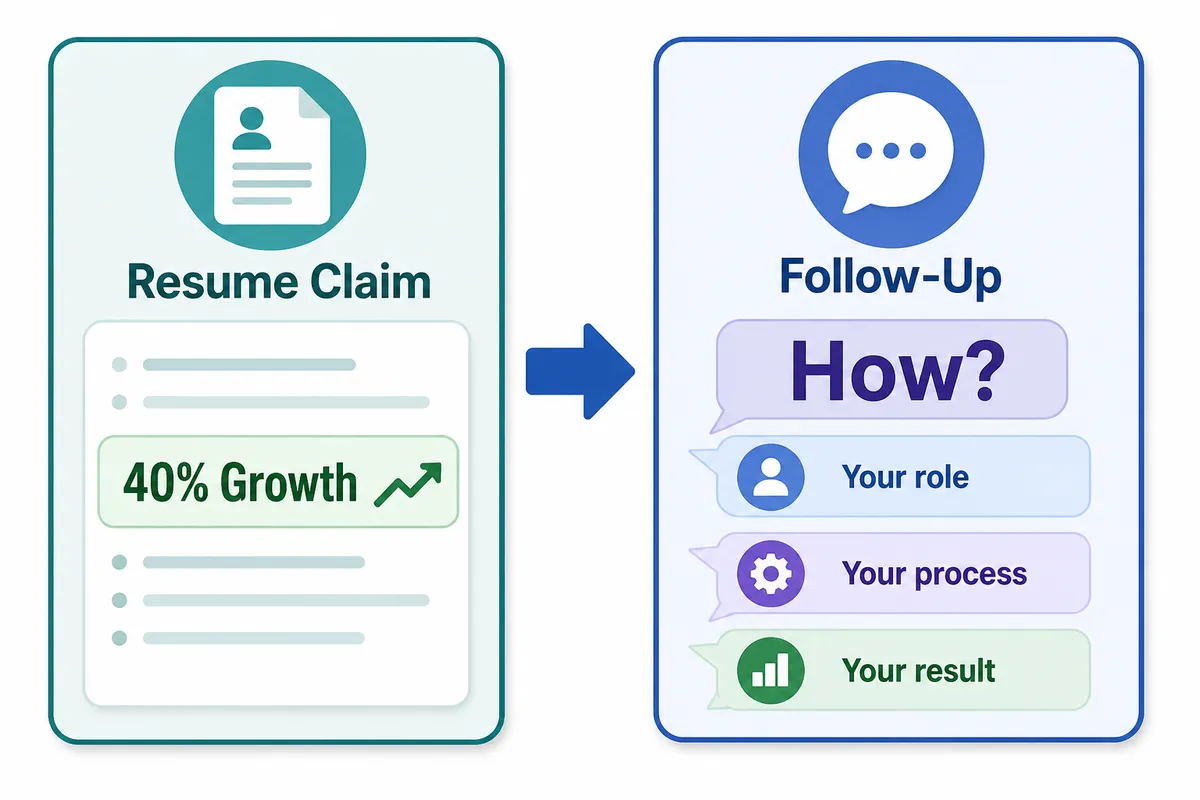
If your CV says, “Scaled a reporting workflow used by 12 teams,” an interviewer may ask:
“You say you scaled this. Scaled from what to what?”
Then:
“What was breaking before the change?”
Then:
“Which part did you personally own?”
Then:
“How did you know the workflow was better?”
Then:
“What would you change if usage doubled again?”
These are not trick questions. They are evidence questions. The interviewer is trying to understand whether you can explain your work with precision, judgement, and honesty.
Why resume based interview questions are harder and more useful
Generic interview questions help you build fluency. They teach you to structure stories, speak clearly, and avoid freezing when you hear, “Tell me about a time when…”
But generic practice has a ceiling. You can prepare a polished answer, repeat it five times, and still be caught off guard when someone asks about one phrase in the third bullet of your internship.
Resume based interview questions are harder because they remove the safety of a memorised script.
You are expected to know the detail
If you list a metric, expect someone to ask how it was calculated.
If you say you improved performance, expect someone to ask for the baseline.
If you say you led a project, expect someone to ask who else was involved and what you decided independently.
If you say you used a tool, expect someone to ask why you chose it, what its limitations were, and what you would choose now.
You do not need to remember every historical number to several decimal places. But you should understand the source, approximate range, and meaning of every claim on your resume. If you need to strengthen the evidence behind achievements, read our guide to quantifying impact on a developer resume.
Follow-ups test ownership
Candidates often say “we” when describing team work. That is normal and frequently accurate. The problem begins when “we” hides uncertainty about “I”.
An interviewer may ask:
- “What was your specific responsibility?”
- “Which decision did you make?”
- “What did another teammate own?”
- “Can you walk me through the part you implemented or managed?”
Strong candidates do not claim credit for everything. They separate team outcomes from their own contribution clearly and without becoming defensive.
They test judgement, not just memory
A resume records what happened. An interview often asks why it happened.
A marketing candidate may be asked about audience segmentation, creative testing, attribution, budget limits, and what they learnt from a campaign that underperformed.
A product candidate may be asked why a metric mattered, which user problem took priority, and what they would deprioritise with half the resources.
A software engineer may be asked why they selected a database, how they measured latency, which trade-off they accepted, or what would happen at ten times the traffic.
The subject changes. The pattern does not.
💡 Pro Tip: For every important resume bullet, prepare the context, action, result, evidence, trade-off, and lesson. If you can cover those points, you can usually handle several follow-ups.
How interviewers probe a claim on your CV
Take a bullet point such as:
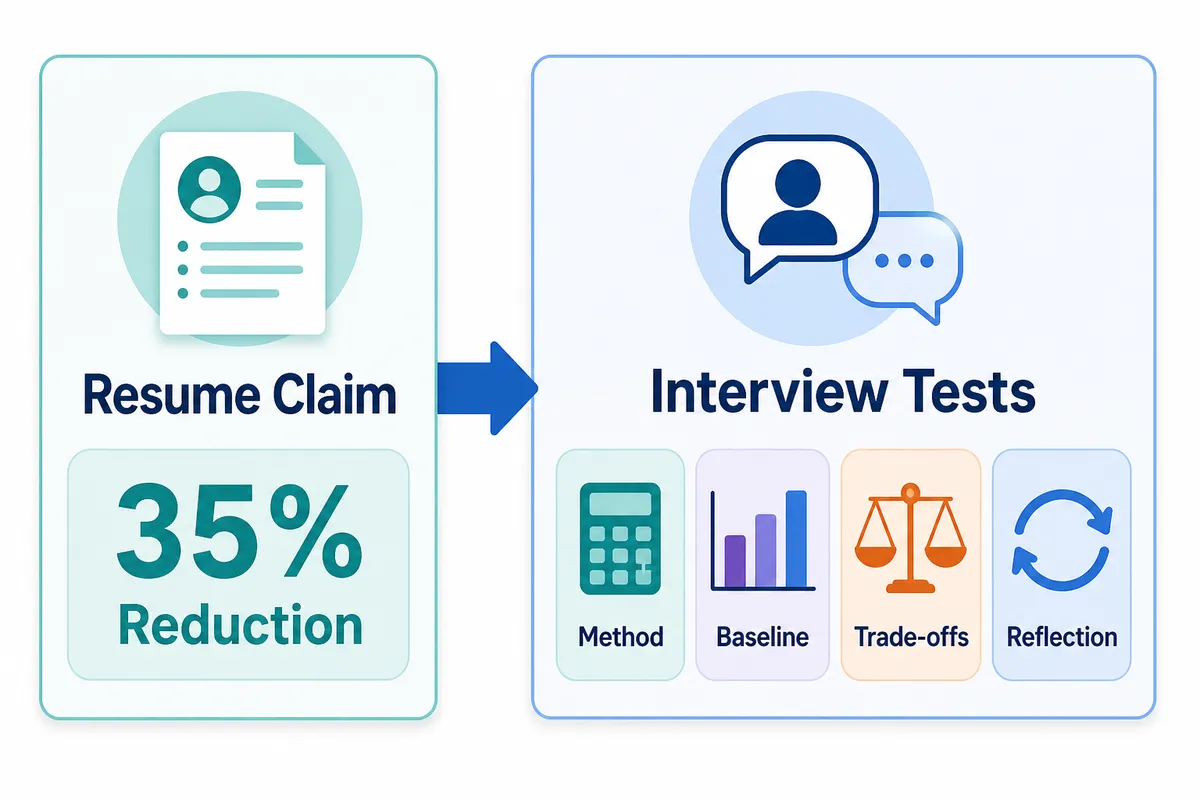
“Reduced customer support response time by 35% by redesigning ticket triage workflows.”
That one line can create a full interview segment:
- Context: “What was the response-time problem before you changed anything?”
- Scope: “How many tickets and teams were involved?”
- Ownership: “What did you personally design or implement?”
- Decision-making: “Why change triage rather than hire more support staff?”
- Measurement: “How did you calculate the 35% reduction?”
- Trade-offs: “Did faster routing create quality problems?”
- Reflection: “What would you do differently now?”
For a technical project, questions may focus on architecture, testing, debugging, constraints, and scale. For a finance role, they may focus on assumptions, analysis, risk, and stakeholder decisions. For an HR role, they may focus on adoption, communication, policy, and outcomes.
For graduates, questions may concern coursework, societies, part-time work, volunteering, or group projects. You do not need years of experience for an interviewer to assess ownership. They can ask what you chose to do, what you learnt, and how you handled uncertainty.
This is why a mock interview based on resume content works for non-technical roles too. The goal is not to find programming keywords. It is to examine the evidence you present about your own work.
Resume lines most likely to attract follow-ups
You do not need to prepare every line equally. Start with claims that are impressive, specific, or ambiguous.
Numbers and percentages
Metrics make a resume more credible, but they invite scrutiny.
If you write “increased engagement by 40%”, be ready to explain what engagement meant, the comparison period, the baseline, the measurement source, and whether the result lasted. You may also be asked whether another metric worsened while this one improved.
Leadership verbs
Words such as led, owned, drove, launched, and managed signal responsibility. Use them when they are true, but define the scope.
“Led a cross-functional initiative” is only convincing if you can explain who was involved, how decisions were made, what disagreement arose, and what you did when priorities differed.
Skills and tools
Listing a skill means you may be asked to use it, compare it, or explain a decision involving it.
For engineers, that may mean a data structure, model choice, API decision, or production issue. For analysts, it may mean SQL, dashboards, spreadsheets, statistics, or visualisation choices. For designers, it may mean research, accessibility, prototyping, or hand-off decisions.
Do not remove every skill you are still learning. Instead, describe your level honestly. Exposure is not expertise, and most interviewers can recognise the difference quickly.
Grand project language
“Built an AI platform”, “created an automated system”, and “developed an end-to-end solution” may be broadly true, but they are also broad claims.
The more ambitious the wording, the more important it becomes to explain the boundaries. What did the system actually do? What did it not do? Who used it? What remained manual? Was it a prototype, an internal tool, or a production service?
⚠️ Important: An interviewer does not expect you to have completed everything alone. Saying, “I owned the analysis while another teammate built the integration,” is much stronger than implying you owned work you cannot explain.
What to do when you cannot defend a line on your resume
This happens more often than candidates admit. You may have forgotten an older project. A number may have come from a team presentation. A template may have made your contribution sound larger than it was. Or you may have listed a skill because you thought recruiters expected it.
Fixing this before an interview is a strength.
Identify the real gap
Ask which of these is true:
- I cannot remember the detail.
- I know the project, but not the metric source.
- I contributed, but the wording overstates my ownership.
- I understand the theory but have not used the tool in practice.
- I do not know what a phrase on my resume actually means.
A forgotten detail can often be recovered through project notes, repositories, dashboards, documents, or conversations with former teammates. An inflated claim needs rewriting.
Correct the wording where needed
You are not locked into a line because it sounded impressive once.
Change “Led migration to a new reporting system” to “Supported migration by documenting workflows and validating reports” if that is more accurate.
Change “Improved retention by 25%” to “Contributed to retention analysis that informed changes associated with a 25% improvement” if you cannot prove direct causation.
Change “Expert in Python” to “Python: working proficiency” if you can use it practically but are not ready for deep technical probing.
Before applying again, review these common resume red flags and remove claims that create avoidable risk.
Practise an honest recovery
Sometimes you will still be asked something you cannot answer fully. The goal is not to bluff. It is to respond clearly.
Try this structure:
- State what you know.
- State the limit of your ownership or recall.
- Explain how you would verify the missing detail.
- Return to the decision or learning you can defend.
For example:
“I do not want to overstate my role in that number. The wider team tracked the final conversion metric, while I owned the experiment analysis and recommendations. I can explain the analysis and changes we proposed, but I would need to check the dashboard to confirm the exact reporting window.”
That answer is far stronger than an invented explanation that fails under a second follow-up.
How to practise with your own resume
Reading your CV silently will not reveal where your explanation becomes vague. Effective resume based interview practice is spoken, active, and a little uncomfortable.
Start by uploading your CV to Thita’s resume-based interview practice. Questions are generated from your own background, and the conversation can adapt when an answer creates a useful thread to explore. If you want a broader warm-up first, read how many mock interviews to do and how to prepare for them.
Use three focused rounds.
Round one: explain every important bullet plainly
Answer likely questions without trying to sound polished. Your goal is to locate fuzzy metrics, unexplained acronyms, unclear ownership, and missing context.
Round two: prepare for the second question
Assume every significant claim will receive two deeper follow-ups. Practise moving from a headline result to the evidence beneath it.
Round three: shorten the first answer
Many candidates know too much and say too much. Aim for a clear first answer of roughly 60 to 90 seconds, then let the interviewer decide where to go deeper. This sounds more structured and leaves room for a natural conversation.
Your resume will not be the whole interview. Technical candidates may also face coding, system design, low-level design, behavioural, or CS fundamentals rounds. Product, data, and business candidates may face cases, metrics, analysis, and role-specific questions.
A live AI interview practice session lets you rehearse these round types without needing to schedule a peer, and resume-based interviews work for non-technical candidates too.
✅ Do keep a note of questions that expose a weak resume line.
✅ Do revise claims you cannot support clearly.
✅ Do practise using “I” and “we” accurately.
❌ Don't memorise a speech for every bullet.
❌ Don't invent precise numbers you cannot verify.
❌ Don't assume non-technical interviews will be less detailed.
Frequently asked questions
What is a resume mock interview?
A resume mock interview is a practice interview whose questions come from your own CV: your projects, metrics, tools and career moves. It rehearses the part of a real first round or hiring-manager screen where the interviewer works through your resume line by line.
Can I do an AI mock interview based on my resume?
Yes. On Thita you upload your resume (PDF, DOC or DOCX, up to 5 MB) or reuse one from the resume analyzer, choose the role, and a voice AI interviewer asks about your experience and follows up on vague answers. You get a written report at the end.
What should my resume look like for a mock interview?
Use the exact version you are sending to employers. A mock interview is only useful if it tests the claims recruiters will actually read, so do not polish a separate "practice" copy.
What are resume based interview questions?
They are questions created from the projects, achievements, skills, education, and experience on your CV. They test whether you can explain and support the claims you chose to include.
Can I get interview questions from my resume automatically?
Yes. You can upload a CV to receive questions based on your background. A stronger experience includes adaptive spoken follow-ups rather than stopping at a static question list.
Why are questions from my resume harder than generic questions?
They test specific evidence. You may need to explain your contribution, the source of a metric, a decision you made, a trade-off, and what you learnt when something did not work.
What if I cannot remember an old project?
Use notes, documents, repositories, dashboards, or former teammates to refresh your memory. If you still cannot support the wording, revise the claim before the interview instead of bluffing.
Does a resume-based mock interview work for non-technical roles?
Yes. It works for marketing, sales, operations, finance, HR, consulting, design, product, graduate roles, and career changers. The focus is on evidence, ownership, judgement, and communication.
Should I remove skills I am still learning from my resume?
Not always. List them accurately. It is reasonable to include a working skill if you can explain how you used it and what you are learning, but avoid presenting beginner exposure as advanced expertise.
How often should I practise resume interview questions?
Practise after every meaningful resume revision and before each interview cycle. Two or three focused sessions can reveal which claims need clearer evidence, better wording, or stronger examples.
Turn your resume into a real interview rehearsal
Your resume is not only the document that gets you shortlisted. It is the evidence file an interviewer will use to assess whether your experience is as strong as it appears on paper.
Do not wait for the real conversation to discover which line you cannot explain, which metric you cannot trace, or which project you cannot describe without drifting into jargon.
Start a live AI interview from your own resume, or upload your CV for a resume-based mock interview. Practise the follow-up behind every important claim until your answers are specific, honest, and easy to trust.
For a broader mock-interview plan, read our guide to AI interview practice and mock simulators.
If you are hiring rather than interviewing, visit interviews.thita.ai.
Topics
Related on Thita
Your next step
Practise with AI mock interviews
A spoken interview that asks follow-up questions, runs your code and ends with a written report.