
Interview
Service-Based to Product-Based: The Rounds That Actually Change
Moving from a service firm to a product company? Learn the interview rounds that change, a realistic prep runway, and how to practise for every round.
A service-based to product-based company switch is not simply a matter of solving harder coding questions. The interview itself changes shape.
If you have worked at a service firm, you may already have strong delivery habits: handling client requirements, working within established processes, fixing production issues and coordinating with teams. Those are useful strengths. But in a product-company interview, the interviewer often asks a different question underneath every round: can this person make sound technical decisions when the problem is incomplete, the scale is unclear and no one has supplied the process?
That is why candidates can feel confident after clearing service-company assessments, then struggle in a product-company loop. The issue is rarely intelligence or experience. It is that they prepared for the wrong format.
A live AI interview practice session for DSA, LLD and system design can help you rehearse the format rather than only revise concepts. You need practice with follow-up questions, incomplete requirements, code that must run, and decisions you have to defend aloud.
This guide explains what actually changes in a service to product company interview, how much runway you realistically need, and what to prioritise if you are planning a TCS to product company switch or a move from any large IT services employer.
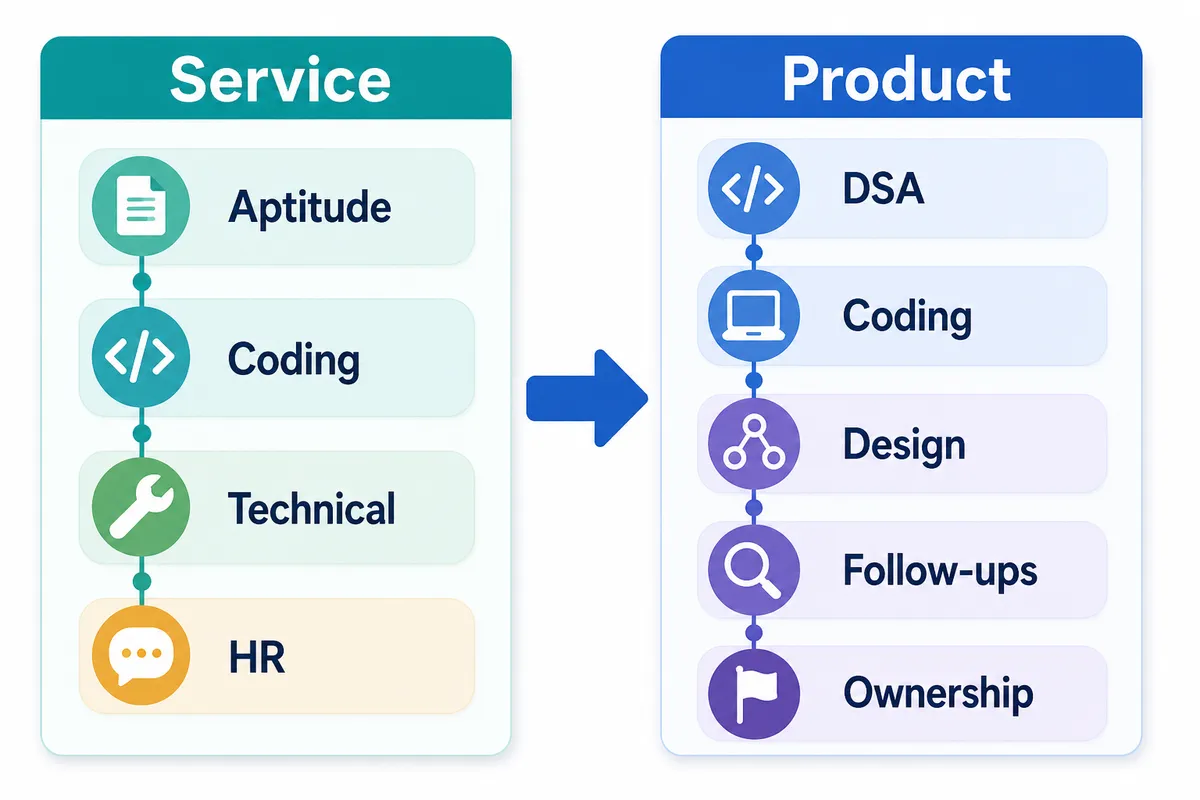
The real difference: execution versus ownership
It is tempting to describe service-company and product-company interviews as “easy versus hard”. That is too simplistic and not especially useful.
Many service organisations hire excellent engineers, and many product companies use straightforward coding questions for some roles. The more reliable distinction is what the interview is trying to measure.
A service-company process may place more weight on:
- Aptitude, communication and role-fit screening
- Core programming syntax and basic DSA
- Familiarity with technologies named in the job description
- Ability to work with defined requirements
- Understanding of delivery models, clients and team processes
A product-company process is more likely to test:
- DSA depth under time pressure
- The ability to clarify vague requirements
- Code quality, edge cases and testing discipline
- Machine coding or low-level design
- System design earlier than candidates expect
- Ownership, trade-offs and technical judgement in behavioural rounds
The shift is not that process stops mattering. It is that process compliance alone is not enough. An interviewer wants evidence that you can identify a problem, frame it, choose an approach, communicate trade-offs and take responsibility for the result.
⚠️ Important: Do not assume that your years of experience automatically reduce the technical bar. For many SDE-2 and experienced-engineer roles, more experience means the interviewer expects stronger ownership stories, more design depth and more mature engineering judgement.
Round one: DSA gets deeper, faster and more conversational
The first visible change in product based company interview preparation is usually the coding round.
You may already be comfortable with arrays, strings, sorting, linked lists and basic recursion. That is a good starting point. Product-company interviews tend to go further in three ways: pattern recognition, pace and follow-ups.
The problem is often only the beginning
A typical question might begin as a sliding-window or hash-map problem. Once you produce a working solution, the interviewer may ask:
- Can you reduce the memory use?
- What happens when the input is streamed?
- How would you handle duplicate values?
- Can you explain why your complexity is O(n)?
- What would change if the data cannot fit in memory?
- Can you write tests for empty input and extreme values?
That follow-up sequence matters. It tests whether you understand the solution rather than remembering a pattern.
Candidates moving from service roles often lose time in one of two places:
- They begin coding before confirming constraints.
- They write a solution silently, then cannot explain the trade-offs when questioned.
A stronger approach is to state your assumptions, outline a brute-force route, explain why you are improving it, then code the optimised version. If you get stuck, say what you are checking. Interviewers are evaluating how you reason, not just whether the final code passes.
For a structured revision path, use a pattern-based resource rather than jumping randomly between problems. This guide to identifying the right DSA pattern in a coding interview is useful when you know the topics but struggle to recognise the approach quickly.
💡 Pro Tip: In timed DSA rounds, practise saying your plan before you type. If you cannot explain the data structure and complexity in thirty seconds, you are probably not ready to implement it cleanly.
Round two: machine coding and LLD may appear at all
For many candidates, the biggest surprise in a service-based to product-based company switch is that coding does not end with DSA.
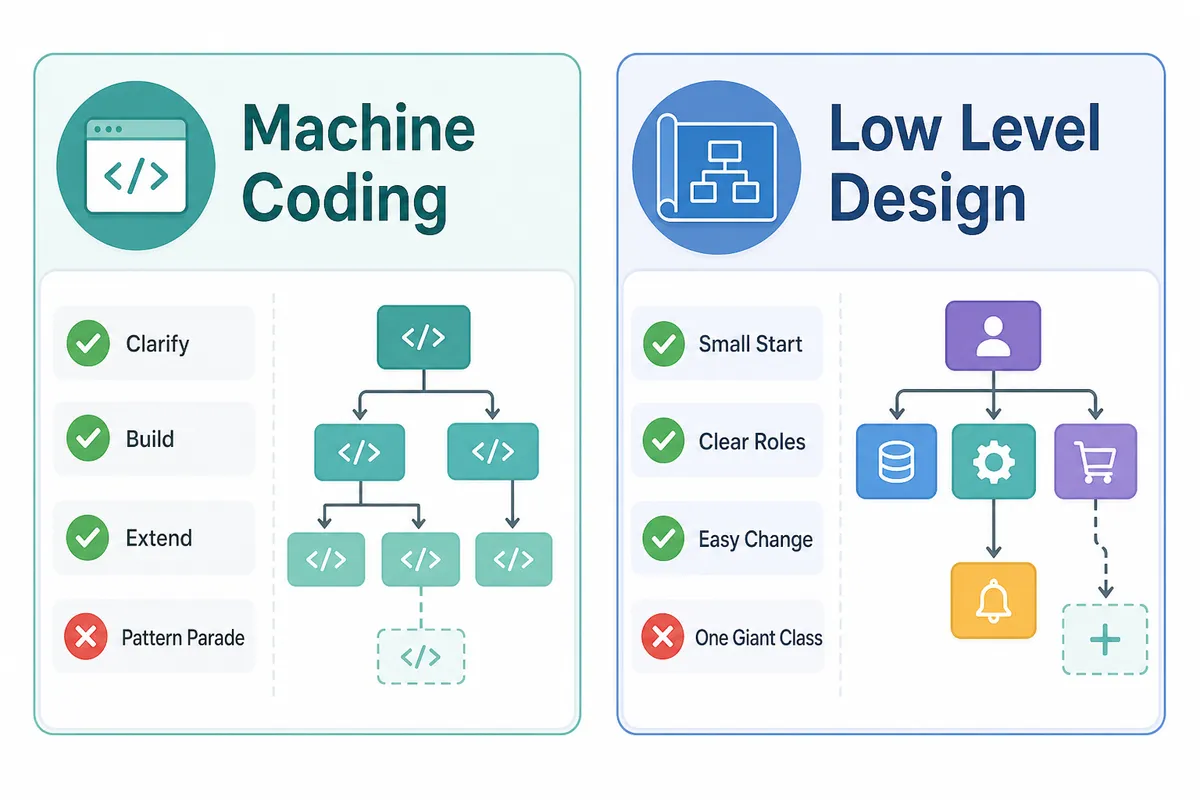
A machine coding round asks you to build a small working application or component within a time limit. Low-level design asks you to model objects, classes, interfaces and relationships for a problem such as a parking lot, splitwise-style expense manager, elevator system, inventory service or notification platform.
These rounds test skills that standard DSA preparation does not fully cover:
- Breaking requirements into entities and responsibilities
- Designing clean interfaces
- Choosing useful abstractions without over-engineering
- Writing readable, extensible code
- Handling validation and edge cases
- Explaining what you would improve with more time
You do not need to build a production-grade application in forty-five minutes. You do need to demonstrate that you can turn a vague product requirement into sensible, maintainable code.
What interviewers usually notice
They notice whether all your logic is placed in one large class. They notice whether you ask about expected behaviour before writing code. They notice whether a new payment method, booking rule or notification channel can be added without rewriting everything.
They also notice whether you are using design patterns as decoration.
❌ Don't begin by announcing five patterns you plan to use.
✅ Do start with the smallest working design, then explain where interfaces or strategies would help when requirements expand.
For an experienced engineer, this can be more important than a perfect class diagram. Product teams need people who can make progress with imperfect information, not people who can recite object-oriented terminology.
Round three: system design enters earlier than expected
Many engineers believe system design is reserved for senior candidates. That is no longer a safe assumption.
Some product companies introduce lightweight system design even for candidates with two to four years of experience. The question may not be “design a global video platform”, but it can still require you to think about APIs, data models, caching, queues, rate limits, availability and scale.
You may be asked to design:
- A URL shortener
- A food-delivery order tracker
- A chat application
- A notification service
- A rate limiter
- A file-upload system
- A booking platform
- A basic social feed
The interviewer does not expect you to memorise a single correct diagram. They expect a structured conversation.
A good answer usually follows this order:
- Clarify users, core actions and scale assumptions.
- Define the API or major user flow.
- Identify the key data entities.
- Draw the high-level components.
- Explain storage, caching and asynchronous processing.
- Discuss bottlenecks and trade-offs.
- Deepen one area when the interviewer asks.
This is where candidates who have only prepared DSA can feel exposed. They jump directly to databases and load balancers without establishing requirements. Or they name every possible technology without explaining why it belongs in the design.
The goal is not to sound like an architect. The goal is to make deliberate choices and show that you understand their consequences.
If system design is new territory, start with this beginner-friendly system design concepts guide before attempting large end-to-end questions. It gives you the vocabulary needed to make your answers coherent.
Round four: behavioural interviews probe ownership, not compliance
This is the round that experienced service-company candidates most often underestimate.
You may expect questions such as “tell me about yourself” and “where do you see yourself in five years?” Those can appear. But product-company behavioural rounds usually go deeper into how you work when things are unclear, difficult or unpopular.
Expect questions such as:
- Tell me about a time you disagreed with a technical decision.
- Describe a project where requirements changed late.
- When did you take ownership beyond your assigned task?
- Tell me about a production incident you helped resolve.
- Describe a time you influenced someone without authority.
- What is a technical decision you would make differently now?
- Tell me about a project that failed. What did you learn?
The difference is subtle but important. A weak answer centres on process:
“The manager assigned me the work, I followed the timeline and the project was delivered.”
A stronger answer centres on agency:
“I noticed that the existing integration would fail under a new traffic pattern. I raised the concern, gathered evidence, proposed a fallback, aligned the team and owned the rollout.”
You do not need a dramatic story. You need a specific one. Use context, action, result and reflection. Include the constraint you faced, what you decided, and what changed because of your contribution.
For more examples, read our guide to common technical interview mistakes that reject strong candidates.
A realistic runway for the switch
How long does product based company interview preparation take? It depends on your current baseline, target level and available time. But for most working professionals, the honest answer is longer than two weekends and shorter than a year of endless preparation.
Here is a practical runway.
If you have solid basics: 8 to 12 weeks
This applies if you can already solve easy and some medium DSA problems, write production code regularly and can explain your projects reasonably well.
Focus on:
- DSA patterns and timed coding practice
- Two machine coding exercises each week
- LLD fundamentals and common design problems
- One system design question each week
- A library of six to eight behavioural stories
- Two mock interviews per week in the final month
If your DSA is rusty: 12 to 16 weeks
This is common for engineers who have spent several years focused on framework work, support, testing, configuration or client delivery.
Spend the first four to six weeks rebuilding fundamentals: arrays, strings, hashing, binary search, recursion, trees, graphs, heaps, sliding window and dynamic programming. Then move into interview simulation rather than staying in learning mode forever.
If you are targeting a senior role: 16 to 24 weeks
For senior roles, DSA still matters, but design and leadership stories become decisive. You need to be comfortable defending architecture decisions, discussing failures and showing influence across teams.
A useful benchmark is not “how many questions have I solved?” It is: can you complete a mixed interview loop without avoiding your weakest round?
Our comparison of 7-day, 30-day and 90-day coding interview preparation plans can help you shape the timeline around your actual notice period and application schedule.
A practical weekly plan for working professionals
You do not need six hours every day. You need repeatable practice across all the rounds that changed.
A realistic weekly plan might look like this:
- Monday: Two timed DSA problems and review
- Tuesday: One LLD or machine coding exercise
- Wednesday: One system design question on a canvas
- Thursday: Two DSA follow-up drills and behavioural story practice
- Friday: Review errors, patterns and weak concepts
- Saturday: One full mock interview
- Sunday: Resume review, project deep dive and one targeted revision block
The important part is the mix. Candidates often spend ninety per cent of their time on DSA because it is easy to measure. Then they encounter machine coding or behavioural questions and realise they have no prepared process.
Midway through your plan, use a live AI interview simulator with adaptive follow-ups to test whether your knowledge transfers under interview conditions. Thita.ai supports live voice practice across DSA, machine coding, low-level design, system design and behavioural rounds. The code editor compiles and runs code, and you can practise in six languages: Python, C++, Java, JavaScript, Go and C#.
System design sessions use a canvas where the AI evaluates the architecture you submit. That matters because describing a design in your head is easier than explaining and defending one on a visible diagram.
Frequently asked questions
Is it difficult to switch from a service-based company to a product-based company?
It is challenging, but very achievable with focused preparation. The main adjustment is preparing for more than aptitude and basic coding: expect DSA depth, machine coding, design rounds and ownership-focused behavioural questions.
How much DSA is needed for a product company interview?
You should be comfortable with common patterns across arrays, strings, hashing, trees, graphs, heaps, recursion, dynamic programming, binary search and sliding window. More important than raw problem count is solving medium-level questions under time pressure and explaining your choices clearly.
Do product companies ask machine coding for experienced candidates?
Many do, especially for backend, full-stack and mobile roles. The format varies, but you should be ready to build a small working feature, organise the code well and discuss how you would extend it.
Is low-level design required for a TCS to product company switch?
It is not required by every company, but it is common enough that skipping it is risky. Prepare core object-oriented design principles, common modelling exercises and the ability to explain responsibilities between classes.
Can system design be asked for an SDE-1 role?
Yes, although it is usually lighter than a senior-level system design round. You may be asked to design a basic service, explain a simple API, model data or discuss how an application would handle growth.
What should I say in behavioural rounds if my work was client-driven?
Client-driven work gives you useful stories. Focus on situations where you clarified requirements, identified a risk, improved a process, influenced a decision, resolved an incident or took responsibility beyond the task assigned to you.
How many mock interviews should I take before applying?
Aim for at least four to six mixed mock sessions before serious interviews. Include coding, LLD or machine coding, system design and behavioural practice. Review repeated mistakes between sessions instead of simply doing more rounds.
Prepare for the rounds that actually changed
The product-company interview is not asking you to erase your service-company experience. It is asking you to present that experience differently: with stronger technical depth, clearer decisions and more visible ownership.
Build your DSA speed. Learn to write and explain maintainable code. Start system design before you feel “senior enough”. Turn your project work into concrete ownership stories. Then practise the whole loop, not just the round you enjoy most.
Start a live AI interview for your product-company switch and practise DSA, low-level design, machine coding, system design and behavioural rounds in one preparation workflow. The fastest improvement usually comes when you stop preparing in separate silos and start rehearsing the actual interview.
If you are hiring engineers rather than preparing for an interview, visit interviews.thita.ai.
Topics
Related on Thita
Your next step
A placement plan you can follow day by day
Start with the free DSA patterns sheet (410 problems in 99 patterns). The 90-day College roadmap adds OS, DBMS and computer networks, and is included with Pro while you are subscribed.