
Interview
Snapchat Interview Questions and Process: The Complete Guide (2026)
Prepare for Snapchat interview questions with a round-by-round guide to coding, system design, cross-functional chats, difficulty, and a 30-day plan.
Snapchat interview questions are commonly reported to test hard coding ability, practical system-design judgement, and how well you communicate with people outside your immediate engineering function. Reported accounts describe a recruiter screen, a technical screen, and an onsite loop of four to five conversations, with coding said to be tougher than many comparable large-company loops. The most effective preparation is to combine timed problem solving with clear explanation, product-aware design trade-offs, and rehearsal for an informal cross-functional conversation.
For the coding portion, Snapchat's interview kit contains 15 mapped DSA questions to help you practise the patterns connected to the company. Pair that work with live mock practice, because a correct solution is only part of what an interviewer can evaluate.
The Snapchat interview process at a glance
| Stage | Commonly reported format | What it screens for | How to prepare |
|---|---|---|---|
| Recruiter screen | Initial conversation | Role fit, motivation, communication | Know your experience and interests |
| Technical screen | Live coding conversation | Problem solving, code quality, reasoning | Practise patterns aloud |
| Onsite coding | One or more technical discussions | Depth, correctness, complexity, collaboration | Use timed mock rounds |
| System design | Design discussion in the onsite | Trade-offs, scale thinking, product judgement | Structure requirements before solutions |
| Cross-functional chat | Informal conversation in the loop | Communication and collaboration | Explain decisions for mixed audiences |
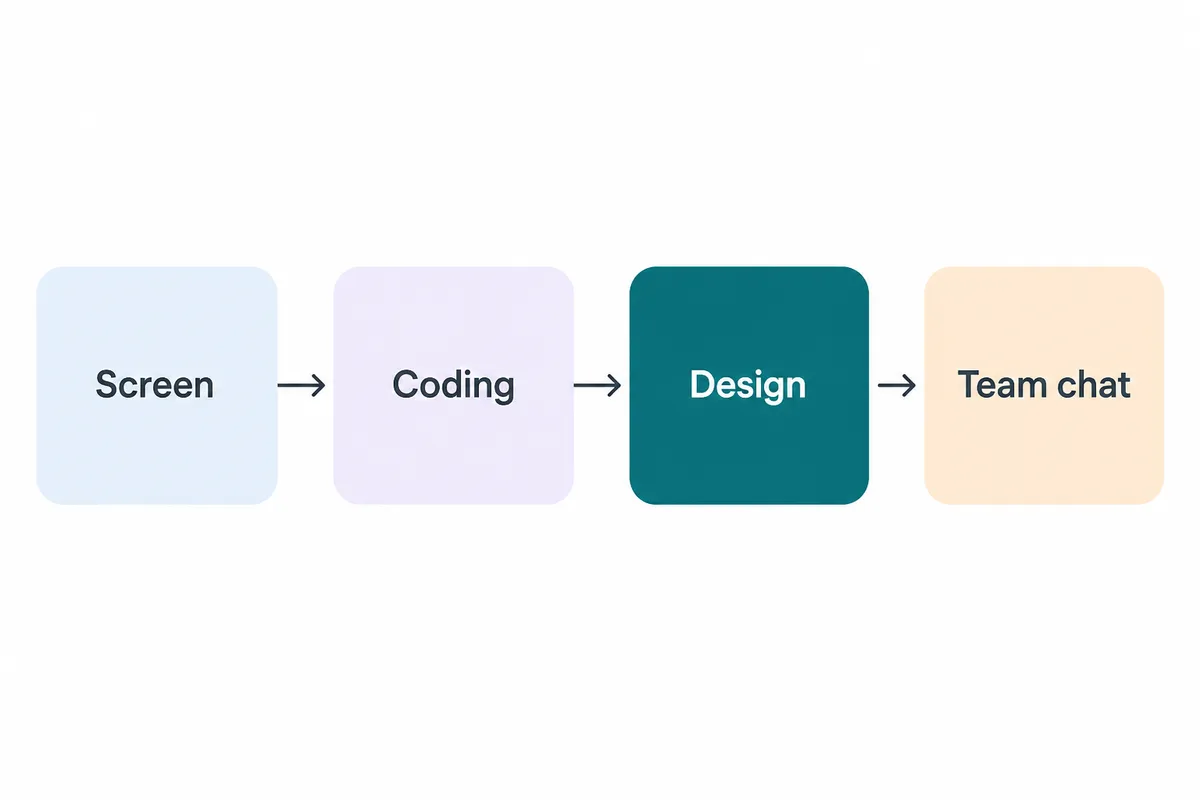
Reported accounts are estimated rather than company-published policy, so treat this as the likely shape of a software engineering loop rather than a fixed script. Team, level, location and hiring need can all change the sequence. Confirm the format with your recruiter when you receive interview information.
Round one — recruiter screen
The recruiter screen is commonly reported as a 30 to 45 minute conversation. It is not usually a coding test, but it matters because it establishes whether your experience, level and motivations fit the role before technical interviews begin.
Prepare a concise account of the work you have done recently. You should be able to explain the systems you owned, the decisions you influenced, the constraints you worked under, and what you would improve if you had another chance. Avoid a rehearsed life story. A useful answer links your experience to the work you want to do next.
For Snapchat specifically, it is sensible to show interest in building products where performance, privacy, user experience and rapid iteration may all pull in different directions. You do not need to pretend you know the exact team’s roadmap. You do need to show that you can think beyond an isolated coding task.
A good recruiter-screen answer has three parts:
- The kind of engineering work you have done.
- The technical problems you want to work on next.
- Why Snapchat’s product and engineering environment are relevant to that direction.
Keep it direct. This is an alignment conversation, not a design presentation.
Round two — technical screen
Candidate reports describe a technical screen of around 60 minutes. This is likely to be where Snapchat interview questions first test your coding process under observation: clarifying the problem, selecting an approach, writing correct code and discussing complexity.
Reports characterise Snapchat coding as harder than many FAANG-peer loops. That does not mean every problem is obscure. It means you should be ready for an interviewer to probe beyond the first workable answer: edge cases, complexity limits, alternate approaches, test cases and the consequences of changing the input constraints.
The most useful preparation is pattern recognition with explanation. Before writing code, say what you notice:
- What are the inputs and constraints?
- Is there an obvious brute-force baseline?
- Which data structure removes repeated work?
- What complexity is acceptable?
- Which edge cases could invalidate an otherwise good solution?
The free-to-browse DSA Patterns Sheet is useful for practising recognition rather than memorising disconnected answers. Read how to identify the right DSA pattern in a coding interview if you find yourself solving problems only after a long period of trial and error.
💡 Pro Tip: Make your first minute visible. State your assumptions, describe a baseline, and explain why you are improving it. An interviewer can assess judgement they can hear.
Onsite coding — correctness is not enough
Reported accounts describe an onsite of four to five conversations. Coding remains central, but the format can test more than whether you reach a final answer. Interviewers can observe how you deal with ambiguity, whether you accept feedback, and whether your code is understandable to another engineer.
Treat every coding round as a collaborative session. A strong rhythm looks like this:
- Restate the task and ask about ambiguous constraints.
- Give a straightforward approach before jumping to an optimised one.
- Explain the chosen data structures.
- State time and space complexity.
- Write readable code with deliberate names.
- Walk through examples and edge cases aloud.
Candidates often lose ground by silently typing for too long. Silence makes it difficult to distinguish a thoughtful approach from a lucky one, and it prevents the interviewer from redirecting you early. The guide to what interviewers actually look for in live coding rounds explains why communication is part of technical performance.
Use in-browser code practice to rehearse implementation and feedback loops. Then practise without looking at editorials until after you have completed your explanation, code and tests. The goal is not merely to solve problems; it is to make your reasoning inspectable.
System design — explain the trade-offs
System design is commonly reported as part of the Snapchat onsite, with discussion tied to real Snap infrastructure. The key implication is not that you should memorise a speculative list of product-specific architectures. It is that you should be ready to connect engineering decisions to product behaviour: responsiveness, reliability, privacy, growth, operational simplicity and the experience of users.
A strong design discussion starts before diagrams. First establish the problem:
- Who uses the system and what is the primary action?
- What matters most: latency, consistency, availability or cost?
- What scale assumptions are reasonable?
- Which data needs durable storage?
- Where might abuse, failure or sudden demand occur?
Then build from a narrow core flow. Describe clients, services, storage and interfaces. Only introduce queues, caches, partitioning or asynchronous processing when you can explain the pressure they relieve and the trade-off they introduce.
The System Design Sheet is free to browse and can help you practise the building blocks. For level expectations, read how much system design is enough for SDE-1 vs SDE-2 interviews. Junior candidates are usually better served by clear requirements, sensible components and honest limitations than by forcing advanced distributed-systems vocabulary into every answer.
⚠️ Important: Do not present every component as mandatory. A design becomes credible when you can say what you would defer, what you would measure first, and what would cause you to revisit the architecture.
The cross-functional chat — Snapchat’s less formal signal
One Snapchat-specific feature in reported accounts is an informal cross-functional chat within the loop. It may feel less technical than a coding round, but it can reveal whether you can work productively with people who do not share your exact engineering perspective.
This is not the moment to turn every question into a technical monologue. Prepare examples of collaboration that show practical judgement:
- A time you changed a plan after learning more from a partner team.
- A disagreement you resolved by clarifying user or business impact.
- A technical risk you explained to a non-specialist audience.
- A situation where speed and quality were in tension.
- A decision where you made trade-offs explicit rather than hiding them.
Use a simple structure: context, your responsibility, the disagreement or constraint, your action, and the outcome. Be specific about what you did. “We decided” is often followed by “what did you personally decide?”
This conversation also rewards audience awareness. A design choice that makes sense to an engineer may need a different explanation for a product, design or operations partner. Practise giving the same example at two levels: a technical version and a plain-language version.
Is the Snapchat interview hard?
Yes. Reported accounts describe Snapchat coding as harder than many comparable large-company interview loops, and the onsite adds design and collaboration signals beyond raw problem solving.
How many rounds are there? Reported accounts describe a recruiter screen, a technical screen and an onsite of four to five conversations. The informal cross-functional chat is also reported within the process. Exact sequencing and total conversations can vary by team and level.
How long does it take? The sourced material establishes the early screen durations and onsite shape, but does not support a reliable end-to-end timeline. Ask your recruiter about scheduling, feedback windows and whether all onsite conversations occur on one day.
The difficulty is best understood as breadth. You may need to demonstrate hard coding ability, system-level judgement and collaborative communication in the same process. Preparing only for puzzle solving leaves too much to chance.
A 30-day Snapchat preparation plan
Days one to seven — rebuild coding fluency
Start with the fundamentals: arrays, strings, hash maps, two pointers, sliding windows, trees, graphs, heaps and binary search. Work in short timed sessions and explain every solution aloud.
Use Snapchat's interview kit for the 15 mapped DSA questions, then branch into adjacent patterns where you feel slow. Do not measure progress only by solved volume. Track whether you can identify the likely pattern, state complexity and test edge cases without prompting.
Days eight to fourteen — practise harder follow-ups
Move from isolated questions to interview-style follow-ups. After solving a problem, ask yourself what happens if inputs grow, memory is restricted, duplicate values appear, updates become frequent or the result must be streamed.
Read how to explain your thought process clearly in coding interviews, then record yourself solving two problems. Listening back will reveal rushed explanations, missing assumptions and moments where you code before deciding.
Days 15 to 21 — build design structure
Practise one system-design prompt every other day. Focus on requirement gathering, interfaces, data flow, failure handling and trade-offs. Keep each session structured:
- Five minutes for requirements.
- Ten minutes for the core design.
- Ten minutes for scale and failure discussion.
- Final time for trade-offs and follow-ups.
The Operating Systems Sheet and DBMS Sheet are free to browse if you need to refresh foundations behind caching, storage, processes, transactions or concurrency decisions.
Days 22 to 30 — simulate the full loop
Alternate coding, design and communication days. Complete at least two mock technical sessions under realistic constraints. On separate days, practise project stories and cross-functional examples aloud.
Use an AI mock interview to rehearse both technical explanation and behavioural communication. In the final few days, revisit mistakes rather than cramming unfamiliar topics. Confidence comes from recognising your own repeat failure modes and correcting them.
Frequently asked questions
What are Snapchat interview questions like?
Reported accounts describe a mix of hard coding questions, system-design discussion and communication-focused conversations. The exact content varies by team and level.
How many interview rounds does Snapchat have?
Reported accounts describe a recruiter screen, a technical screen and an onsite with four to five conversations. Confirm the specific sequence with your recruiter.
Is Snapchat coding harder than FAANG?
Candidate reports describe Snapchat coding as harder than many FAANG-peer loops. Prepare for follow-up questions, complexity discussion and edge-case testing rather than only a first correct solution.
Does Snapchat have a system-design round?
Yes, system design is commonly reported as part of the onsite. Reports tie design discussion to real Snap infrastructure, so practise practical product and scale trade-offs.
What should I study for the technical screen?
Focus on core DSA patterns, complexity analysis, clear coding and verbal reasoning. The free-to-browse DSA Patterns Sheet is a useful starting point.
What is the cross-functional chat at Snapchat?
Reported accounts mention an informal cross-functional conversation in the loop. Prepare examples that demonstrate collaboration, trade-offs, conflict resolution and clear communication.
Do I need to know Snapchat’s product in detail?
You do not need insider knowledge. You should understand the broad product context well enough to discuss sensible engineering trade-offs around user experience, reliability, privacy and scale.
How should I prepare for system design?
Start with requirements, design the smallest viable core, then discuss scaling and failure modes. Explain why each component exists rather than listing technologies.
What language should I use for Snapchat coding interviews?
Use the language in which you can write clean, correct code quickly and explain your choices comfortably. Confirm any language constraints with your recruiter.
Where to start
The strongest Snapchat preparation combines hard coding practice with the ability to explain decisions clearly. Begin with Snapchat's interview kit and its 15 mapped DSA questions, then rehearse your delivery in timed conditions.
Use the free-to-browse sheets to strengthen fundamentals, practise a design conversation before your onsite, and run an AI mock interview before the real loop. Finally, confirm the current format with your recruiter: reported processes are useful preparation signals, not a substitute for the interview plan for your specific role.