
Interview
Practise a Coding Interview in Six Languages, With Code That Runs
Practise coding interviews in Python, C++, Java, JavaScript, Go and C# with an AI interviewer that runs your code and asks adaptive follow-ups.
The programming language you choose in a coding interview is not a cosmetic setting. It changes how quickly you can express an idea, how you manage edge cases, which library calls you reach for, and how much mental energy you have left for explaining your decisions.
That is why Thita lets you practise in six languages during live coding rounds: Python, C++, Java, JavaScript, Go and C#. More importantly, the editor does not merely display your code while an AI discusses it. It compiles and runs it.
A useful AI mock interview with real code execution should put you in the same uncomfortable, valuable position as a real interview: you have written a solution, you think it works, and then a test reveals that it does not. What do you do next? Can you identify the bug, explain your reasoning, repair the code, and still keep the conversation moving?
That is what practice should train.
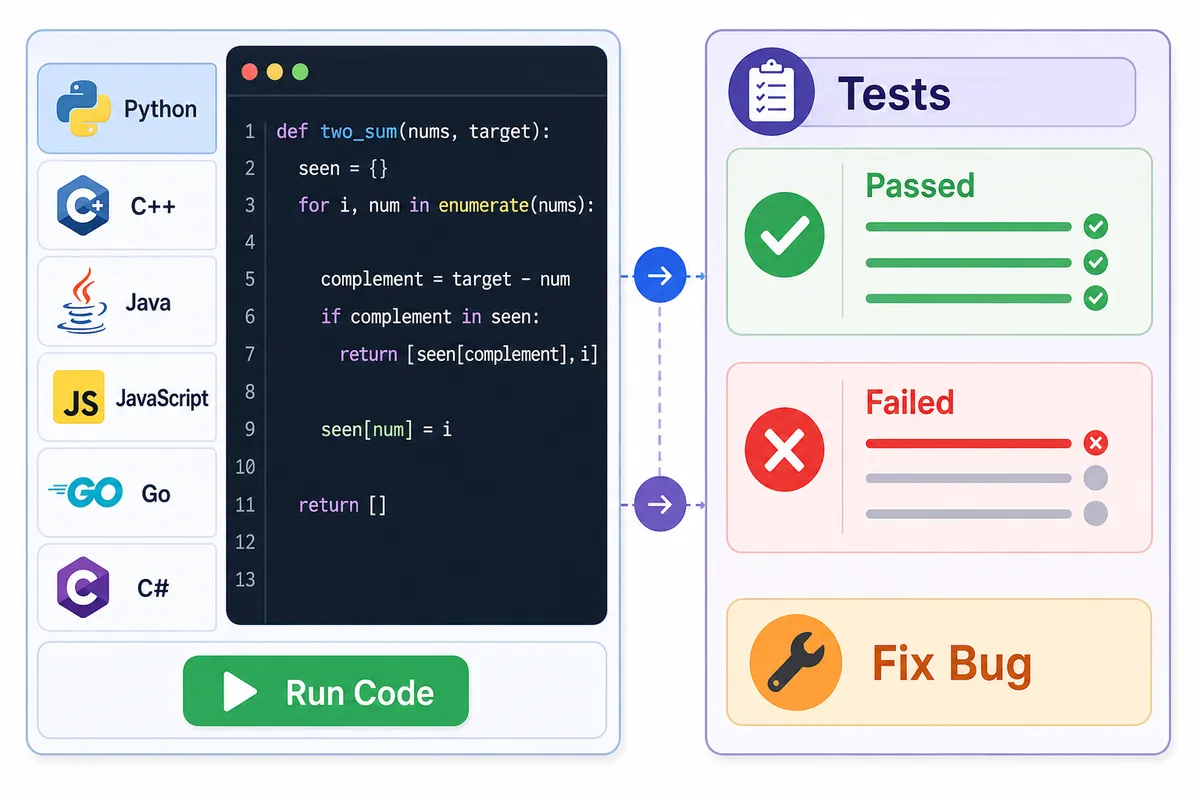
The six languages you can use in Thita coding interviews
Thita's live voice AI coding interviews support:
- Python
- C++
- Java
- JavaScript
- Go
- C#
You can practise in six languages, selecting the one that best matches your target company, upcoming assessment, professional experience, or strongest interview reflexes.
That does not mean every individual problem is available in every language. The point is broader and more useful: you are not locked into one language while preparing. You can build interview fluency in the language you expect to use when it matters.
Python: fast expression and clear problem-solving
An AI mock interview Python session is often the most direct way to practise algorithmic thinking. Python reduces syntax overhead, which can make it easier to focus on the actual interview work: clarifying constraints, selecting an approach, proving correctness, and responding to follow-ups.
Python is particularly comfortable for:
- Hash map and set-heavy problems
- String processing
- Graph traversal with dictionaries and lists
- Heap-based problems using standard libraries
- Rapid prototyping during timed rounds
But Python has its own traps. Candidates sometimes assume convenience methods are always cheap, overlook recursion limits, or explain complexity too casually. A real interview may ask whether slicing copies data, whether membership checks are linear, or whether a solution will scale with large inputs.
Running the code matters because these assumptions are easier to catch when the program responds to real test cases, rather than when a tool simply says that your approach “looks good”.
C++: control, performance and implementation detail
C++ remains a popular choice for candidates who want strong control over performance and familiar standard-library tools. It is common in competitive programming, lower-level engineering roles, and interviews where candidates are comfortable discussing memory, references, object lifetime, and complexity in more detail.
C++ practice can expose a different class of mistakes:
- Incorrect iterator handling
- Accidental copying instead of passing by reference
- Indexing errors with vectors
- Uninitialised values
- Confusing pointer and reference behaviour
- Compilation errors caused by type mismatches or headers
These are not theoretical errors. They are exactly the kind that cost minutes in an interview. A code editor that compiles and runs your implementation lets you practise resolving them while speaking clearly, rather than discovering them only when a real interviewer is waiting.
Java: structured, explicit and widely used
For many candidates, an AI mock interview Java session closely resembles the environment they expect in a professional software engineering interview. Java is strongly associated with backend development, enterprise systems, object-oriented design, and coding rounds that reward clean structure.
Java brings useful strengths: clear types, reliable collections, established conventions, and a familiar object-oriented model. It also brings more ceremony. You may need to write a class, define method signatures carefully, use the right generic types, and make decisions about mutability or helper methods under time pressure.
Practising Java helps you build fluency in the things that can otherwise derail a solid algorithm:
- Choosing between
HashMap,HashSet,ArrayListandArrayDeque - Handling primitives versus wrapper types
- Avoiding avoidable null errors
- Writing comparators correctly
- Keeping code readable despite more syntax
- Explaining why your implementation is efficient
A live interviewer can ask why you chose a specific collection. Code execution can show whether that choice actually works.
JavaScript: interview practice for a language with sharp edges
JavaScript is a natural choice for many front-end, full-stack and Node.js candidates. It can also be an excellent interview language when you know its collections, sorting behaviour, closure rules, and asynchronous model well enough to avoid surprises.
For algorithmic rounds, JavaScript often feels concise. Yet candidates can lose time on details that do not appear in pseudocode: truthy and falsy values, default sorting behaviour, object-key caveats, mutation, and differences between arrays, sets and maps.
Use JavaScript practice to rehearse:
- Explicit numeric comparators when sorting
MapandSetusage- Array mutation versus copying
- Queue implementation choices
- String and character handling
- Explaining trade-offs without relying on vague language
The purpose is not to memorise language trivia. It is to make your implementation habits dependable enough that they do not compete with your problem-solving during the interview.
Go: simplicity, explicitness and practical engineering habits
Go is increasingly relevant for backend, infrastructure, platform and distributed-systems roles. It rewards clear code and a practical understanding of slices, maps, interfaces, error handling and concurrency concepts.
Candidates who are comfortable in Go often appreciate its directness. But interviews can reveal uncertainty around slice capacity, map defaults, pointer receivers, package imports, or whether an operation mutates shared data.
Practising in Go is useful when you want to become faster at:
- Initialising and growing slices
- Building queues and stacks cleanly
- Using maps safely
- Writing helper functions without overengineering
- Managing string and rune considerations
- Explaining implementation choices in a concise way
If your upcoming role uses Go, switching into it before the interview is more valuable than solving every practice problem in a language you will not use on the day.
C#: a strong option for modern software engineering interviews
C# is a practical interview language for candidates working with .NET, game development, enterprise applications, cloud services, and modern backend stacks. It offers strong tooling, expressive collections and clear object-oriented patterns.
In a coding round, C# candidates need more than an algorithm. They need enough fluency with generic collections, LINQ trade-offs, nullability, loops, strings and class structure to keep implementation smooth.
C# practice can help you rehearse:
- Selecting the right collection type
- Avoiding unnecessary LINQ overhead in hot paths
- Managing nullable values carefully
- Writing readable helper methods
- Handling input and output assumptions
- Explaining time and space complexity precisely
The language itself will not win the interview. Your ability to use it comfortably, test it, and recover from mistakes might.
Why code execution matters more than discussing code
A coding interview is not a conversation about an algorithm that might work. It is an evaluation of how you reason, implement, test, communicate and recover.
An AI can read your code and produce polished feedback without ever executing it. It may recognise a familiar pattern and infer what you intended. That can be helpful for learning, but it is not the same as discovering whether your submitted solution actually compiles, handles an empty input, returns the right value, or loops forever.
The difference becomes obvious when you make a deliberate mistake.
Write an off-by-one error. Return the wrong variable. Forget a base case. Use a loop condition that skips the final element. A tool that runs your code can surface a concrete failure. A tool that only comments on code may tell you that the solution is “well structured”.
For a deeper look at how to test this distinction, read Does Your AI Mock Interview Actually Run Your Code?. It is the proof piece: what to look for, how to test a tool yourself, and why general feedback is not evidence of execution.
⚠️ Important: A passing explanation is not a passing program. In a real interview, the gap between those two things is where many otherwise capable candidates lose momentum.
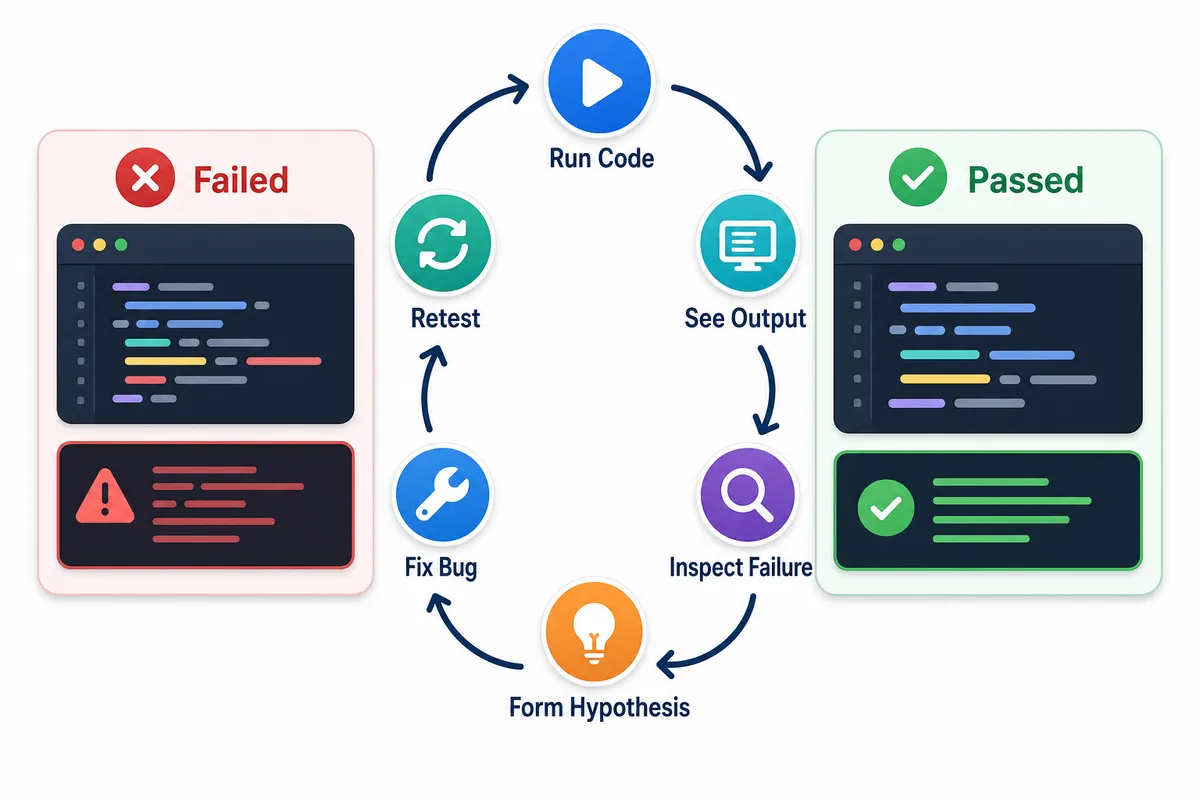
With genuine code execution, your practice includes the moments that matter:
- You see the output. Your confidence is tested against the behaviour of the program.
- You inspect a failure. A specific input gives you something concrete to reason about.
- You form a hypothesis. You explain what may be wrong before changing everything.
- You fix the bug. You make a targeted change under time pressure.
- You retest. You confirm that the repair did not create another problem.
That is not an interruption to the interview. It is the interview.
What changes when you switch languages mid-preparation?
Switching languages midway through preparation can be useful, but only if you do it deliberately.
The underlying DSA pattern does not change. A sliding-window problem remains a sliding-window problem whether you solve it in Python or Java. Breadth-first search remains breadth-first search whether you use C++ or Go. What changes is the implementation surface around the idea.
You may notice that:
- Your code becomes longer or shorter
- Your preferred data structures change
- Edge cases become easier or harder to express
- You need different standard-library knowledge
- Your debugging habits shift
- Your explanation needs more or less detail
For example, a Python solution may use a dictionary and a few lines of iteration. The Java version may require more explicit setup and type declarations. In C++, you may think about references and container operations. In JavaScript, you may be more cautious around sorting or mutation.
None of that means you should prepare every problem in every language. That is rarely the best use of time.
💡 Pro Tip: Pick one primary interview language and one secondary language. Use the primary language for most full mocks. Use the secondary language occasionally to make sure your understanding comes from the algorithm, not from memorised syntax.
A sensible progression looks like this:
- Start by learning patterns in your strongest language.
- Build speed on common question types.
- Run full interview sessions in the language you will most likely use.
- Switch languages only when a role, assessment or job stack makes it worthwhile.
- Return to your primary language before a high-stakes interview unless you have a clear reason not to.
If you are unsure which patterns to prioritise before you start switching, the DSA patterns sheet provides 98 patterns and 405 problems to browse.
A compiler changes how you practise, not just what you submit
Candidates often treat a compiler as a convenience. It is more useful than that. It changes the feedback loop.
Without execution, you can finish a problem and move on believing you have solved it. With execution, you can check the parts of your reasoning that are easiest to overestimate:
- Does your base case really work?
- Did you update the pointer in the right order?
- Does your queue behave as intended?
- Are duplicate values handled correctly?
- Does the code compile after the refactor?
- Did your optimisation quietly break an edge case?
A compiler also creates opportunities for better interview communication. Instead of silently changing lines until tests pass, practise narrating the process:
“This failure suggests I am not processing the final window. I think the right pointer condition is too strict, so I am going to adjust the loop boundary and rerun the example.”
That sentence tells an interviewer far more than a quiet edit. It shows diagnosis, judgement and control.
For practical techniques on making that narration clearer, see How to Explain Your Thought Process Clearly in Coding Interviews.
✅ Do run a small example before declaring the implementation complete.
✅ Do say what you expect the code to do before you run it.
✅ Do test one edge case that is not in the prompt.
❌ Don't wait until the final minute to compile for the first time.
❌ Don't hide a failed test by immediately rewriting large sections of code.
❌ Don't choose a language solely because it produces the shortest solution. Choose the one you can debug and explain.
From individual problems to interview-ready language fluency
Solving standalone coding questions is valuable, but a coding interview adds pressure that a problem list cannot reproduce on its own.
You need to clarify the question aloud. You need to state an initial idea, reject it if it is too slow, and guide the interviewer through the better approach. You need to write code while they watch. You may be asked to modify the solution after it works.
That is why an AI mock interview with code execution is different from a code judge alone. A judge can tell you that your solution failed. A live interviewer can ask why it failed, whether you can improve it, and what trade-off you would make if memory were limited.
Thita combines both elements: live voice follow-ups and a code editor that compiles and runs your work. You can practise a live AI coding interview in your chosen language without scheduling a peer or waiting for a mock-interview slot.
If you need a structured preparation schedule around those sessions, compare the 7-day, 30-day and 90-day coding interview preparation plans. The right cadence depends on how close your interview is and how much of the language syntax is already automatic for you.
Frequently asked questions
Which six languages can I practise coding interviews in?
You can practise in Python, C++, Java, JavaScript, Go and C#. Choose the language that fits your target role and the one you can implement and explain most confidently.
Does Thita run my code during an AI mock interview?
Yes. During DSA coding rounds, you work in a real editor where code compiles and runs. You can use execution results to test assumptions, inspect failures and practise debugging under interview conditions.
Can I switch languages between mock interview sessions?
Yes. You can use one language for a session and switch to another for a later session. This is useful if different companies, assessments or roles expect different technical stacks.
Should I practise every coding problem in all six languages?
No. Practise in six languages does not mean repeating every problem six times. Build most of your speed in one primary language, then use another language where it is relevant to a role or skill gap.
Is Python the best language for coding interviews?
Python is often a strong choice because it is concise and has useful built-in data structures. However, the best language is the one you can write, debug and explain reliably under pressure. Java, C++, JavaScript, Go and C# can all be excellent choices.
How is this different from coding interview practice with a compiler?
A compiler verifies whether your code runs. A live AI interview adds the communication layer: adaptive follow-ups, questions about complexity, pressure to explain decisions, and opportunities to practise recovery after a failure.
Can I practise other interview rounds on Thita?
Yes. Alongside DSA coding, Thita supports system design on an evaluated canvas, low-level design, machine coding, behavioural, product management, data science, AI and ML, CS fundamentals, and resume-based interviews generated from your own CV.
Practise in the language you will actually use
The most useful coding practice is not the kind where a solution merely sounds plausible. It is the kind where you write it, run it, find the defect, explain the repair and keep going.
Choose Python, C++, Java, JavaScript, Go or C#. Then put your implementation under the same kind of pressure you will face in an actual interview.
Start a live AI mock interview with code execution and practise a coding round in the language you trust most.
If you are hiring rather than interviewing, visit https://interviews.thita.ai/.
Topics
Related on Thita
Your next step
Practise with AI mock interviews
A spoken interview that asks follow-up questions, runs your code and ends with a written report.