
Interview
Twitter Interview Questions and Process: The Complete Guide (2026)
Twitter interview questions explained: reported rounds, technical presentation, difficulty, timing, and a 30-day plan for coding, design and behavioural prep.
Twitter interview questions commonly span an initial screen, a technical assessment, live coding, and an onsite sequence covering coding, system design, a technical presentation and a hiring-manager conversation. Reported accounts describe deliberate ambiguity in parts of the process, so strong preparation means more than reaching a correct answer: clarify assumptions, explain trade-offs and show how you make progress when the brief is incomplete.
For technical preparation, Twitter's interview kit holds seventeen mapped DSA questions and two system design problems. Use it to practise the coding patterns and design shapes evidenced at Twitter, then rehearse your communication separately: the reported loop gives candidates several chances to demonstrate how they think aloud.
Reported processes vary by team, level and hiring need. Treat this guide as a practical map of the commonly reported shape, then confirm your exact format with your recruiter.
The Twitter interview process at a glance
| Stage | Reported format | What it screens for | How to prepare |
|---|---|---|---|
| Recruiter screen | Conversation of roughly 30–45 minutes | Role alignment, experience and motivation | Explain your work clearly and ask about the team |
| Technical assessment | Timed assessment, sometimes a longer real-world scenario | Coding fundamentals and practical judgement | Practise under a timer and review edge cases |
| Live coding | Engineer-led coding conversation, roughly 45–60 minutes | Problem solving, communication and complexity reasoning | Narrate before and while coding |
| Onsite coding | Two coding conversations | Implementation skill and adaptability | Build correct solutions, then improve them |
| System design | Discussion-led design round | Trade-offs, scale thinking and technical judgement | Structure your answer before drawing components |
| Technical presentation | Presentation and follow-up discussion | Ownership, clarity and depth on past work | Prepare one project story with decisions and outcomes |
| Hiring manager | Experience and behavioural conversation | Collaboration, judgement and level fit | Be specific about what you personally owned |
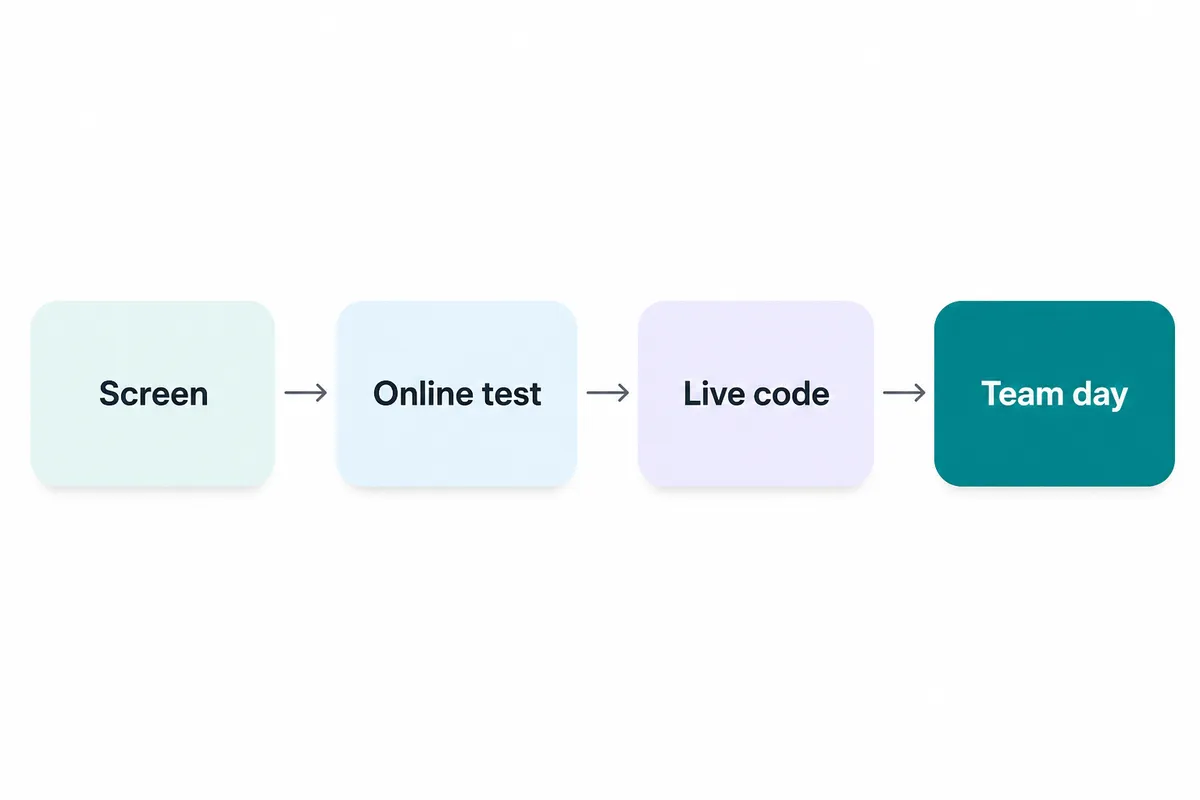
The onsite is best understood as a cluster of different evaluations rather than one long technical test. Coding competence matters throughout, but the presentation and hiring-manager discussion can change the outcome for a candidate whose implementation is otherwise solid.
Recruiter screen — establish the story behind your application
The recruiter screen is usually the first opportunity to make your experience legible. It is not a coding test, but it can determine whether you advance to one. Prepare a concise account of what you have built, what part of it you owned, the technical choices you made and what you want from the next role.
Avoid treating this as a recital of your CV. A recruiter should be able to leave the conversation with a clear picture of your scope: the systems you worked on, the problems you enjoy and the kind of team in which you do your best work.
Have sensible questions ready as well. Ask how the team is organised, whether the role is focused on product, platform or infrastructure work, and what the process will assess. Those answers help you tune your preparation without making assumptions about a team-specific loop.
Technical assessment — solve clearly under a clock
Reported accounts describe a technical assessment lasting roughly 60–90 minutes. Some candidates report a longer, real-world scenario rather than a sequence of disconnected coding puzzles. That distinction matters: an applied scenario can still test familiar data structures and algorithms, but it rewards reading carefully, modelling constraints and choosing an appropriately simple solution.
Start with transferable pattern recognition. Arrays, strings, hash-based lookups, traversal, sorting and complexity analysis remain useful foundations even when a prompt is framed as a product task. The free DSA Patterns Sheet is free to browse and groups practice by reusable problem-solving pattern, which is more useful than memorising solutions in isolation.
Use a timer in practice, but do not equate speed with rushing. A reliable sequence is:
- Restate the task in your own words.
- Identify inputs, outputs and constraints.
- Choose the simplest viable approach.
- Test ordinary and awkward cases before submitting.
If you tend to see a prompt and immediately start coding, read how to identify the right DSA pattern in a coding interview. The goal is to build a short pause into your process: enough time to recognise the shape, not enough time to overthink it.
Live coding — make your reasoning visible
The reported live coding round lasts roughly 45–60 minutes and adds a second task beyond solving the problem: helping an interviewer understand your decisions. They cannot credit reasoning that remains entirely in your head.
Start by asking clarifying questions. Then state a straightforward approach, explain its time and space complexity, and begin implementation only when the direction is clear. If you spot a flaw halfway through, say so and adjust openly. Recovering calmly from a mistaken assumption can demonstrate better engineering judgement than silently forcing an answer through.
A good spoken rhythm is simple:
- “I want to confirm what happens when this input is empty.”
- “The direct approach would be quadratic, so I am going to use a map.”
- “Before I optimise, I will get the core case working.”
- “I would test duplicates, missing values and the smallest input next.”
That narration sounds basic, but it makes your work easy to follow. For a deeper breakdown, see what interviewers actually look for in live coding interviews.
Onsite coding — adapt when the problem changes
Reported accounts describe two coding conversations in the onsite. This is where preparation should move beyond solving familiar questions. You may be given a conventional data-structures problem, an implementation task with practical constraints or a prompt that changes after you propose a first solution.
The useful habit is to separate correctness from refinement. First, get a clear and correct baseline. Then ask whether the constraints justify a more efficient approach, a more maintainable interface or more robust handling of invalid input. Do not attempt to anticipate every hypothetical requirement before you have solved the stated problem.
Practise in an environment that makes you write, run and inspect code rather than merely outline an approach. Code practice with feedback is useful for building that implementation discipline, particularly if you usually practise only on paper or in a notebook.
The strongest candidates also communicate their testing plan. Mention a normal case, a boundary case and a failure case. It signals that you regard implementation as a complete engineering task, not just a race to produce a plausible-looking function.
System design — organise the discussion before the diagram
A reported onsite system-design conversation tests how you reason about a larger system when there is no single correct architecture. The interviewer is likely interested in how you narrow ambiguity, identify the important constraints and make trade-offs explicit.
A dependable answer structure is:
- Clarify the user-facing goal and success criteria.
- Estimate the important traffic, storage or latency constraints.
- Sketch a minimal high-level design.
- Identify bottlenecks and likely failure points.
- Deepen one or two components where trade-offs matter most.
Avoid starting with a catalogue of fashionable infrastructure. A queue, cache or database only improves an answer when you can explain what problem it addresses and what cost it introduces. The free System Design Sheet is free to browse for structured design practice, while Twitter's interview kit gives you the system-design problems evidenced at the company.
For early-career candidates, the expected depth may differ from senior expectations. How much system design is enough for SDE-1 versus SDE-2 interviews explains how to calibrate the level of detail without either underselling or overbuilding your answer.
Technical presentation — Twitter's distinctive onsite signal
The technical presentation is the feature that makes the reported Twitter loop notably different from a standard coding-and-design sequence. It creates a direct test of how well you can explain real work to people who were not present when that work happened.
Choose a project where you made meaningful decisions. The ideal story has a clear problem, constraints that mattered, alternatives you considered, a decision you influenced and an outcome you can describe honestly. It does not need to be the largest project on your CV. A small service migration, an incident fix or a performance improvement can work well if you can explain the reasoning in depth.
Use this structure:
- Context: What problem existed, and why did it matter?
- Your role: What did you personally own or decide?
- Options: What approaches were available?
- Decision: Why did you choose this approach?
- Result: What changed, and what would you improve now?
Reported accounts also describe interviewers introducing ambiguity deliberately to see how candidates respond. Do not interpret an unclear follow-up as a trap that needs a perfect answer. State your assumption, explain what information would change it and continue with a reasonable path. This is exactly the behaviour that helps in design and coding rounds too.
Hiring manager conversation — show ownership without exaggeration
The hiring-manager discussion is likely to cover collaboration, motivation, project depth and level fit. Prepare examples where you handled disagreement, took responsibility for an outcome, changed your mind after new evidence or worked through an uncertain problem with others.
The key is precision. Replace “we improved reliability” with what you did: perhaps you investigated a failure pattern, proposed a rollback plan, changed an alert threshold or coordinated a release. Shared work is normal; vague ownership is what weakens an answer.
Practise aloud before the interview. An AI mock interview can help you rehearse behavioural answers, project follow-ups and concise explanations when you do not have a practice partner.
Is the Twitter interview hard?
Yes, chiefly because it evaluates several different skills rather than one narrow technical ability. A candidate can be strong at coding puzzles yet struggle when asked to defend a design decision, present prior work or respond to an unclear requirement.
How many rounds are there? Reported accounts describe a recruiter screen, technical assessment and live coding round before an onsite that includes system design, two coding conversations, a technical presentation and a hiring-manager discussion. The exact sequence can vary by team and level.
How long does it take? The available reports provide timings for individual stages rather than a reliable end-to-end timeline: the recruiter screen is reported at roughly 30–45 minutes, the assessment at 60–90 minutes and live coding at 45–60 minutes. Ask your recruiter for the current schedule and whether stages are combined.
The practical difficulty is ambiguity. You need enough technical fluency to solve problems, but also enough communication discipline to turn an under-specified prompt into a sensible working plan.
A 30-day Twitter interview preparation plan
Days 1–7: rebuild coding fundamentals
Work through core patterns: arrays, hashing, two pointers, sliding windows, trees, graphs and binary search. Focus on recognising why a pattern fits, not on reaching a daily problem quota. After each solution, explain it aloud in under two minutes.
Use the free DSA Patterns Sheet for structured revision and build a short error log: missed edge cases, complexity mistakes and moments where you chose the wrong pattern.
Days 8–14: practise live coding communication
Complete timed coding sessions with a spoken commentary. Clarify the prompt, state the baseline, discuss complexity and test the result. Record yourself if possible; silence, vague explanations and unexplained rewrites become obvious when you replay them.
Read how to explain your thought process clearly in coding interviews, then practise the same verbal structure until it feels natural rather than scripted.
Days 15–21: develop system-design structure
Choose several broad design prompts and practise a consistent answer framework: requirements, estimates, components, bottlenecks and trade-offs. Draw less at first and speak more. The aim is to learn how to steer an ambiguous discussion.
Use the free System Design Sheet alongside the two system-design problems in Twitter's interview kit. Focus on explaining why each component belongs in the design, not on naming every possible technology.
Days 22–26: prepare the technical presentation
Draft one presentation from a project you know deeply. Make a short version and a longer version, because follow-up questions can take the discussion in unexpected directions. Prepare for challenges: why did you reject another option, what failed, what metric mattered and what would you redesign now?
Ask a friend to interrupt with unclear or adversarial questions. Your goal is not to memorise replies. It is to become comfortable saying, “Here is the assumption I would make, and here is how the answer changes if that assumption is wrong.”
Days 27–30: simulate the whole loop
Run one coding mock, one design mock and one presentation rehearsal. Keep the final day lighter: review your notes, test your interview setup and revisit your project stories. Do not attempt to learn a new framework or cram unfamiliar material at the end.
Frequently asked questions
What are the main Twitter interview questions about?
Reported accounts describe coding, system design, project experience and behavioural judgement. Prepare for both implementation questions and discussion-led questions where you need to explain trade-offs.
Does Twitter have a technical assessment?
Reported accounts describe a timed technical assessment of roughly 60–90 minutes. Some candidates report a longer real-world scenario, so confirm the format with your recruiter.
How many coding rounds does Twitter have?
Reported accounts describe a live coding stage before the onsite, followed by two onsite coding conversations. The exact format can vary by team and level.
Does Twitter ask system-design questions?
Reported accounts include a system-design round in the onsite. Practise clarifying requirements, making estimates and explaining trade-offs rather than memorising diagrams.
What is the technical presentation round?
It is a reported onsite stage where you present previous technical work and discuss it in depth. Prepare a project story that makes your personal contribution, decisions and outcomes clear.
Why is ambiguity important in a Twitter interview?
Candidate reports describe interviewers introducing ambiguity deliberately. Respond by clarifying what you can, stating assumptions and explaining how you would proceed if key information remains unknown.
Is live coding more than getting the answer right?
Yes. In a live setting, communicate your approach, complexity and testing plan. The interviewer needs to see how you reason, not only the final code.
How should I prepare for the hiring-manager round?
Prepare specific stories about ownership, collaboration, setbacks and decisions. Explain what you personally did rather than relying on broad “we” statements.
Which language should I use for coding interviews?
Use the language in which you can write cleanly, explain choices confidently and handle common data structures without hesitation. Fluency matters more than novelty.
Where to start
Start with the technical foundation, then make communication part of every practice session. The reported technical presentation and deliberately ambiguous follow-ups mean that preparation should include your past work, not only coding exercises.
Open Twitter's interview kit to practise the seventeen mapped DSA questions and two system design problems evidenced at Twitter. Pair it with free-to-browse sheets and an AI mock interview to rehearse coding, design and behavioural communication before the real loop.
Topics
Related on Thita
Your next step
Practise with AI mock interviews
A spoken interview that asks follow-up questions, runs your code and ends with a written report.