
Interview
Why Coding Interview Simulator Searches Land on Pair-Programming Tools
Searching for a real time coding interview simulator? Learn why results often need a partner, and choose solo practice or pair programming for your stage.
Search for a real time coding interview simulator and you probably expect something simple: open a browser, receive a question, write code, explain your choices, get feedback, and repeat whenever you have an hour free.
Then the results often lead somewhere else. They lead to peer-matching platforms, shared editors, calendars, availability windows, and instructions for finding an interviewer. In other words, they lead to pair programming.
That is not necessarily a bad outcome. Human mock interviews can be excellent preparation. But it is an intent mismatch. A simulator sounds solo and on-demand; a pair-programming tool needs another person to schedule, prepare, and turn up.
If you want to practise alone while still facing live questions and follow-ups, a live AI coding interview on Thita is built for that use case. The important thing is not whether one format is universally better. It is knowing which kind of simulator you are actually looking for at your current stage.
The simulator mismatch: one word, two different expectations
When candidates type “coding interview simulator”, they usually mean one of two things.
The first meaning is a self-serve interview simulation. You want the interview conditions without depending on another person:
- A question selected for your level or target round
- A timer or realistic pace
- A code editor where you can write and run code
- Someone or something that asks what you are thinking
- Follow-up questions when your first solution is incomplete
- Feedback after the session
- The ability to start immediately, including late at night
This is the meaning behind searches such as “solo coding interview practice” and “interview simulator with feedback”. The candidate is trying to fit deliberate practice around work, university, applications, and real interview deadlines.
The second meaning is a live peer mock interview. Here, the simulation comes from another human being. You take turns as candidate and interviewer, often in a shared editor. One person asks a problem, watches the other solve it, probes the explanation, and gives feedback afterwards.
Both formats can simulate parts of a real interview. They simply simulate different things.
 The confusion happens because search engines group both under “mock interview” and “coding interview simulator”. But the practical question is not semantic. It is: do you need repetitions today, or do you need human unpredictability?
What pair-programming tools are genuinely good at
A peer mock is not a failed simulator. It is a different training environment, and at the right time it can be extremely valuable.
A human partner can react in ways no scripted question bank can fully predict. They may misunderstand your explanation, challenge an assumption you thought was obvious, ask why you selected a hash map over sorting, or push back when you skip an edge case. That social friction is useful because real interviews contain it too.
Pair programming also teaches skills that can be easy to neglect in solo problem-solving:
- Reading another person’s reasoning without interrupting
- Giving a concise clarification when your first explanation is unclear
- Working in a shared coding environment
- Thinking aloud when somebody is visibly waiting for an answer
- Managing the awkwardness of a wrong start without losing momentum
- Giving and receiving useful feedback after a session
Platforms such as Pramp and Exponent make this format accessible through peer matching and shared editors. The trade-off is structural: you need a compatible partner, a mutual time slot, and both people need to arrive ready to participate.
⚠️ Important: A scheduled peer mock can be high-value, but it is difficult to use as your only preparation method. If you can fit in one session per week, that gives you one realistic conversation. It does not give you enough repetitions to build fluency in coding, explaining, debugging, and handling follow-ups.
That is why candidates often search for a simulator even after trying pair programming. They are not rejecting human feedback. They are trying to increase the number of meaningful practice sessions between human mocks.
For a closer look at the communication behaviours interviewers notice, read how interviewers judge problem-solving skills in live coding rounds.
What solo simulators should do instead of merely showing questions
A useful solo simulator is more than a timer beside a coding problem.
A timer alone can create pressure, but it cannot tell whether you explained your approach clearly. A code judge can tell whether your output passes tests, but it cannot ask why your complexity is acceptable or what you would change if the input were too large for memory. A chat assistant can discuss an approach, but discussion is not the same as an interview.
The best solo experience combines several ingredients:
1. Real code execution
Your code should compile and run in an editor. That sounds obvious, but it matters because debugging under pressure is part of interviewing.
When a test fails, you need to identify what assumption failed, explain your hypothesis, make a targeted change, and verify it. Reading a model answer after a timer ends does not train that sequence.
A good coding interview simulator should let you practise in six languages: Python, C++, Java, JavaScript, Go and C#. That allows you to prepare in the language you actually plan to use in interviews rather than translating solutions mentally from another environment.
2. A live interviewer dynamic
Real interviewers do not simply reveal a prompt and disappear. They ask for clarification. They notice when you rush into code. They ask about complexity. They introduce a constraint after you have solved the easy version.
That does not mean every question needs to become adversarial. It means the next question should respond to what you said and did.
3. Feedback that identifies the gap
“Good job” is not feedback. Neither is a long generic checklist.
Useful feedback should help you locate the issue: perhaps your solution was correct but you did not establish constraints before coding; perhaps you used the right pattern but failed to test empty input; perhaps your explanation had the right content but arrived too late for the interviewer to follow it.
If you are solving plenty of questions but do not feel more confident in interviews, the issue may be the gap between solving and performing. LeetCode versus real interviews explains why those are related but different skills.
4. No dependency on another person’s calendar
This is the defining promise candidates expect from “simulator”.
You should be able to practise at 7am before work, after a late class, or the night before an interview. You should not have to hope your partner is available, prepared, and comfortable interviewing in your chosen language.
💡 Pro Tip: Treat on-demand sessions as your repetition engine and human sessions as your reality check. You do not need to choose one forever. You need the right ratio for the time you have.
The two formats serve different stages of preparation
The easiest way to choose is to identify where you are in your preparation cycle.
Early stage: build patterns and coding confidence
At the start, most candidates need volume. You are learning common patterns, revising data structures, rebuilding fluency in your strongest language, and discovering where you get stuck.
Solo work is usually more efficient here. Spend time on focused problem-solving, code execution, and short interview-style sessions. A human partner cannot replace the benefit of attempting ten similar pattern problems and seeing why your first instinct failed on three of them.
A structured list helps avoid random practice. The DSA patterns sheet includes 98 patterns and 405 problems to browse, which can make it easier to focus on recurring interview structures rather than chasing isolated questions.
Middle stage: convert solutions into interview answers
This is where many candidates plateau.
You can solve a medium problem when alone, but your real answers become messy when you have to narrate. You code before confirming the constraints. You forget to state complexity. You see an edge case only after the interviewer asks. Or you go quiet while debugging.
A real time coding interview simulator is especially useful in this stage because it turns each familiar skill into a combined task: understand, explain, code, test, adjust, and respond to follow-ups.
This is also the point at which feedback matters most. You do not merely need another list of problems. You need to see which part of your interview behaviour keeps breaking.
For candidates dealing with this exact plateau, how to break out of a coding interview preparation plateau offers a useful way to diagnose whether the problem is knowledge, timing, or communication.
Final stage: rehearse pressure and unpredictability
In the final one or two weeks before interviews, use both formats where possible.
Solo AI sessions let you complete more full rounds without waiting for anybody. You can target weak areas, rehearse your introduction, practise coding with a voice interviewer, and run several sessions across different question types.
Human mocks add social stakes. You cannot predict their pacing, their communication style, or whether they will challenge you in the same way an interviewer might. That makes them a valuable final check.
✅ Do use solo sessions to build repetitions quickly.
✅ Do schedule one or two peer or mentor mocks before an important loop if you can.
❌ Don't wait for a human partner before practising your weakest topic.
❌ Don't mistake one good peer session for evidence that you are ready across coding, system design, behavioural questions, and role-specific rounds.
Where AI interview simulators fit
AI changes the trade-off because it can provide a conversational format without requiring a second candidate to be online.
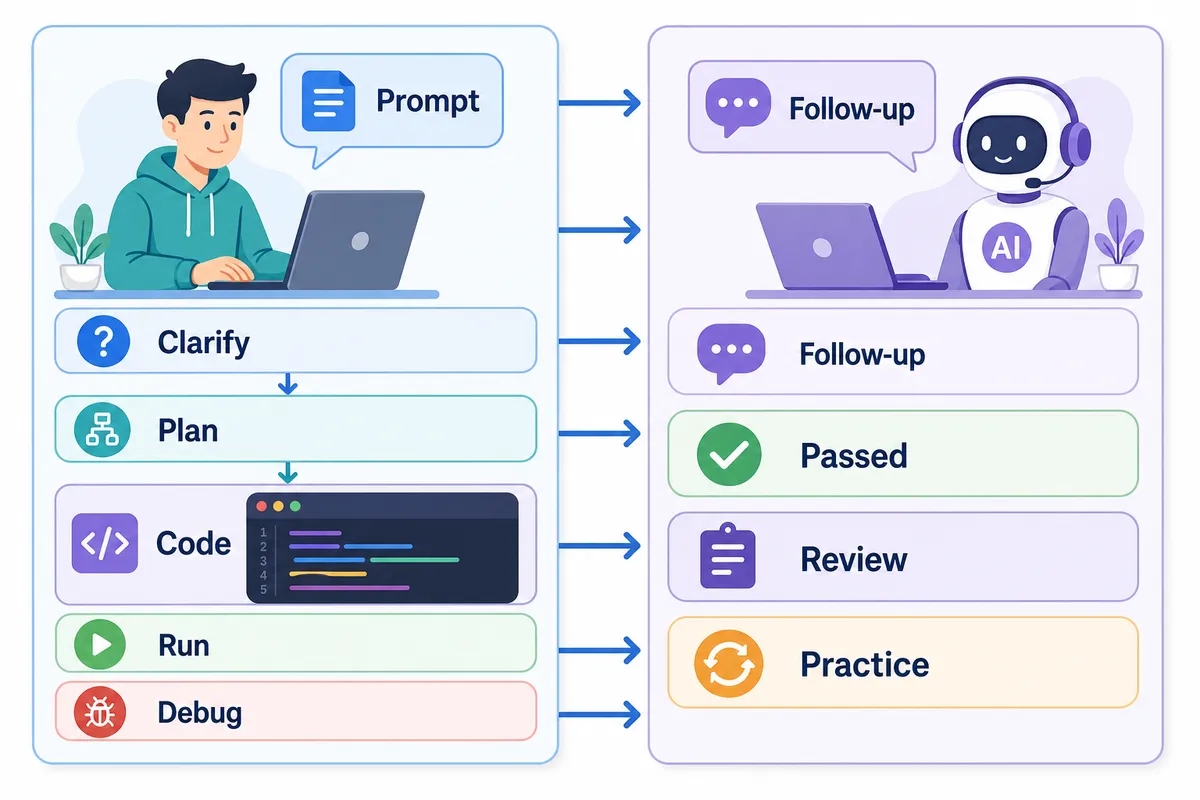
On Thita, you can practise a live voice AI interview with adaptive follow-ups, a real code editor, and code that compiles and runs. The aim is not to imitate a human voice for its own sake. It is to help you rehearse the sequence you face in an actual round: receive a prompt, clarify it, describe an approach, write code, run it, debug it, and handle the next question.
The same on-demand format extends beyond DSA. You can practise system design on a canvas where the AI evaluates the architecture you submit, as well as low-level design and machine coding. There are also behavioural, product management, data science, AI and ML, CS fundamentals, and resume-based interviews generated from your own CV. That resume-based format works for non-technical roles too.
For candidates, the practical advantage is simple: you can train the interview behaviour that needs repetitions without turning every practice session into a scheduling task.
A practical weekly mix for most candidates
If you have four to six hours a week, try this mix:
- Two focused coding sessions: Review patterns, solve problems, and run your code.
- Two short simulator sessions: Practise explaining and responding to follow-ups out loud.
- One review block: Revisit mistakes, especially questions you solved only after hints.
- One human mock every one or two weeks: Use it to test your communication with an unpredictable partner.
If your interview is close, increase full simulation sessions. If you are still learning fundamentals, increase focused coding time.
The format should follow the bottleneck. If you cannot identify a sliding-window problem, more mock interviews will not fix the knowledge gap. If you consistently solve problems but freeze when asked “why is this O(n)?”, more silent practice will not fix the communication gap.
For a timeline-based approach, compare the 7-day, 30-day, and 90-day coding interview preparation plans.
Frequently asked questions
Is a coding interview simulator the same as pair programming? No. Pair programming usually involves another human in a shared editor, while a simulator often means an on-demand environment that recreates interview conditions. Both can be useful, but one requires scheduling and the other does not.
Should I use solo coding interview practice or a human mock interview? Use solo practice when you need repetitions, flexible timing, and targeted work on weaknesses. Use human mocks when you want social pressure, unfamiliar communication styles, and feedback from another person. Most candidates benefit from combining both.
What should an interview simulator with feedback include? Look for a realistic prompt, a way to write and run code, live or adaptive questioning, feedback on your explanation and approach, and a clear review of what to improve. A timer alone is not a complete simulation.
Can an AI interview simulator ask follow-up questions? Yes, purpose-built AI interview tools can ask follow-ups based on your approach, code, and explanation. This matters because follow-up questions are a major part of real technical interviews.
Can I practise coding in my preferred programming language? On Thita, you can practise in six languages: Python, C++, Java, JavaScript, Go and C#. Choose the language you expect to use in your target interview and spend enough time testing and debugging in that environment.
Are pair-programming platforms useful for interview preparation? Yes. They can be especially useful near the end of preparation, when you want practice with a real person observing your reasoning. Their main limitation is availability: you need another prepared participant and a suitable time.
Can I practise more than DSA interviews? Yes. In addition to coding, Thita offers system design, low-level design, machine coding, behavioural, product management, data science, AI and ML, CS fundamentals, and resume-based interview practice.
Start with the simulator you meant to search for
If you searched for a real time coding interview simulator, you were probably looking for a way to practise now — not a way to coordinate another calendar.
Use peer sessions when you want human unpredictability. Use on-demand sessions when you need volume, consistency, code execution, adaptive follow-ups, and feedback without waiting for a partner.
Start a live AI interview practice session and rehearse the full loop: explain your approach, write and run code, respond to follow-ups, and learn what to improve before the real interview.
If you are hiring rather than interviewing, visit interviews.thita.ai.
Topics
Related on Thita
Your next step
Practise with AI mock interviews
A spoken interview that asks follow-up questions, runs your code and ends with a written report.