Opening system design
Progress is saved as you study.
Opening system design
Progress is saved as you study.
Research rank: #1 most asked
Asked at: Amazon, Google, Microsoft, Uber, Coinbase
Estimated interview time: 60 minutes
Concepts tested: hashing, database choice, caching, estimation
Related patterns: foundations, databases, caching
Design a URL shortener like Bitly.
Users submit a long URL and receive a short URL. When someone opens the short URL, the system redirects them to the original URL.
Assume:
Core flow:
Create unique ID -> encode with base62 -> store mapping -> redirect by key lookup
Start by separating writes from reads.
URL creation is the write path. Redirects are the read path. Redirects dominate the system by several orders of magnitude.
bit.ly/my-product.Say:
“The redirect path is the hot path. I’ll make it a key-value lookup backed by Redis and Postgres read replicas. URL creation goes to one Postgres primary because 1.2K writes/sec fits on one primary.”
Keep the API small. Spend time on creation, redirect, and analytics. Skip low-value admin endpoints unless asked.
POST /v1/urls
Content-Type: application/json
Authorization: Bearer <token>
Request:
{
  "long_url": "https://www.example.com/products/123?source=email",
  "custom_alias": "spring-sale",
  "expires_at": "2026-12-31T23:59:59Z"
}
Response:
{
  "id": 9384729384,
  "short_code": "b7Xk29Q",
  "short_url": "https://sho.rt/b7Xk29Q",
  "long_url": "https://www.example.com/products/123?source=email",
  "created_at": "2026-05-14T12:00:00Z",
  "expires_at": "2026-12-31T23:59:59Z"
}
If custom_alias is already taken:
409 Conflict
{
  "error": "custom_alias_already_exists"
}
GET /{short_code}
Successful response:
302 Found
Location: https://www.example.com/products/123?source=email
Cache-Control: no-store
Unknown code:
404 Not Found
Expired or disabled code:
410 Gone
GET /v1/urls/{short_code}/analytics?from=2026-05-01&to=2026-05-14
Authorization: Bearer <token>
Response:
{
  "short_code": "b7Xk29Q",
  "total_clicks": 184920,
  "daily_clicks": [
    { "date": "2026-05-13", "clicks": 10321 },
    { "date": "2026-05-14", "clicks": 12902 }
  ],
  "top_referrers": [
    { "referrer": "twitter.com", "clicks": 43000 }
  ],
  "top_countries": [
    { "country": "US", "clicks": 82000 }
  ]
}
PATCH /v1/urls/{short_code}
Authorization: Bearer <token>
Request:
{
  "status": "disabled",
  "expires_at": "2026-06-01T00:00:00Z"
}
Use the admin endpoint for status and expiration changes. Keep admin logic out of the redirect endpoint.
Use Postgres as the source of truth.
The core record is a durable mapping from short_code to long_url.
short_urlsCREATE TABLE short_urls (
id BIGSERIAL PRIMARY KEY,
short_code VARCHAR(16) NOT NULL UNIQUE,
long_url TEXT NOT NULL,
user_id BIGINT,
status VARCHAR(16) NOT NULL DEFAULT 'active',
created_at TIMESTAMPTZ NOT NULL DEFAULT now(),
expires_at TIMESTAMPTZ,
updated_at TIMESTAMPTZ NOT NULL DEFAULT now()
);
Indexes:
CREATE UNIQUE INDEX idx_short_urls_code ON short_urls(short_code);
CREATE INDEX idx_short_urls_user_created ON short_urls(user_id, created_at DESC);
CREATE INDEX idx_short_urls_expires_at ON short_urls(expires_at);
Redirect lookups use short_code.
User dashboards use (user_id, created_at).
Store custom aliases in short_urls.short_code.
Operationally, an alias is another short code with a uniqueness constraint. Add a separate alias table only if aliases need separate ownership, moderation, or billing rules.
Do not write every click into Postgres. At 100B redirects/day, row-by-row click writes will overload the database.
Emit clicks as events:
{
  "event_id": "01JZ...",
  "short_code": "b7Xk29Q",
  "url_id": 9384729384,
  "ts": "2026-05-14T12:00:01Z",
  "ip_hash": "7f83...",
  "user_agent": "Mozilla/5.0 ...",
  "referrer": "https://twitter.com/...",
  "country": "US"
}
Send events to Kafka. Consumers write to ClickHouse, Druid, BigQuery, or a warehouse-backed aggregation pipeline.
For dashboard reads, store aggregates:
CREATE TABLE url_daily_stats (
  url_id BIGINT NOT NULL,
  date DATE NOT NULL,
  clicks BIGINT NOT NULL,
  unique_visitors_estimate BIGINT,
  PRIMARY KEY (url_id, date)
);
Postgres can hold daily aggregates if dashboard load is modest. Keep raw click events outside Postgres.
Clients
  |
  | POST /v1/urls
  v
API Gateway
  |
  v
URL Creation Service
  |
  v
Postgres Primary
  |
  v
Postgres Read Replicas


Clients
  |
  | GET /{short_code}
  v
Edge / Load Balancer
  |
  v
Redirect Service
  |
  |-- GET short_code --> Redis Cluster
  |                       |
  |                       | cache miss
  |                       v
  |                  Postgres Read Replicas
  |
  |-- async click event --> Kafka
                            |
                            v
                     Analytics Consumers
                            |
                            v
                ClickHouse / Druid / BigQuery
                            |
                            v
                    Analytics API Service
API Gateway
URL Creation Service
Postgres Primary
Postgres Read Replicas
Redis Cluster
short_code -> redirect metadata mappings.Redirect Service
Kafka
Analytics Consumers
Analytics Store
Analytics API Service
Use:
Skip database sharding in the first version. The write load is too small to justify sharding.
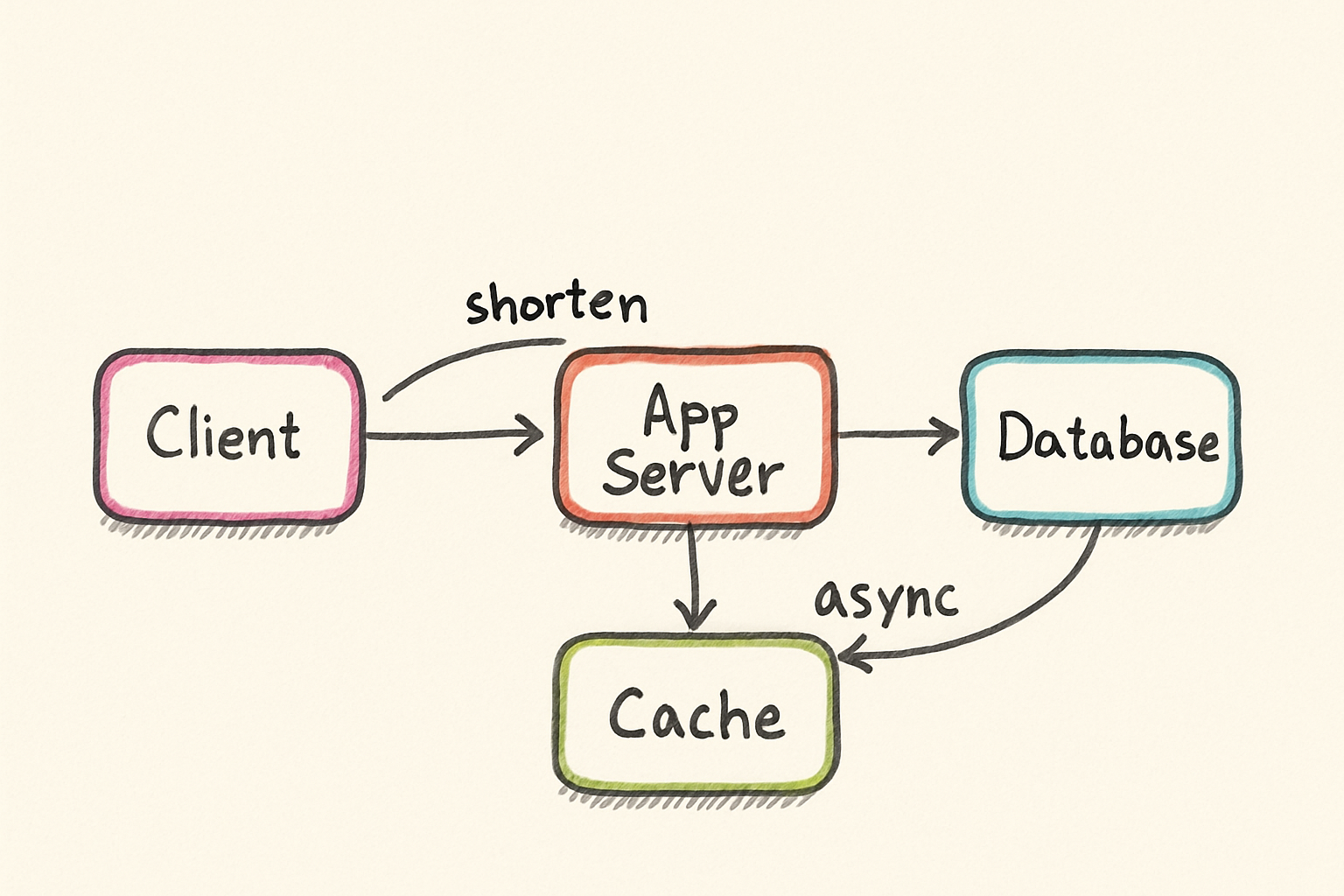
The short code must be unique, compact, and fast to generate.
Default design:
Postgres BIGSERIAL id -> base62(id) -> short_code
Base62 alphabet:
0-9, a-z, A-Z
Capacity:
62^6 ≈ 56.8B
62^7 ≈ 3.5T
62^8 ≈ 218T
At 100M new URLs/day:
100M/day * 365 = 36.5B/year
A 6-character code lasts about 1.5 years.
A 7-character code lasts about 96 years at this traffic.
Use 7 characters by default.
Use an auto-incrementing database ID and encode it with base62.
Example:
id = 125
base62(id) = "21"
short_url = https://sho.rt/21
In production, left-pad short codes or apply a reversible permutation so early URLs do not look short or sequential.
The ID must be unique before encoding.
Avoid hash(long_url) as the main ID strategy.
Hashing adds collision handling. It also forces a product decision: should the same long URL always return the same short URL?
Most real systems treat each shortened URL as a separate resource. Two users may shorten the same URL and need separate analytics, ownership, expiration, and abuse controls.
Use hashing only for deduplication checks or abuse detection.
Pros:
Cons:
Pick auto-increment by default.
If exposed volume is a concern, apply a reversible permutation before base62 encoding:
id -> permuted_id -> base62(permuted_id)
The permutation preserves uniqueness and avoids random collision handling.
Snowflake-style IDs combine timestamp, machine ID, and sequence number.
Pros:
Cons:
Use Snowflake only if the interviewer asks for independent ID generation across multiple write regions.
A pre-generation service creates random unused codes and stores them in a pool.
Pros:
Cons:
Skip this as the default. Use it only when the product requires random-looking codes or reserved code ranges from day one.
Say:
“I’ll use a database sequence and base62 encoding because the write load is small. If enumeration is a concern, I’ll permute the ID before encoding. I’ll avoid hashing the long URL because ownership and analytics make identical long URLs separate resources.”
A redirect response affects caching, analytics, and future edits.
A 301 Moved Permanently tells browsers and intermediaries they can cache the redirect.
Pros:
Cons:
A 302 Found tells the client to request the short URL again next time.
Pros:
Cons:
Use 302.
For a Bitly-style system, analytics, abuse handling, expiration, and editable destinations matter more than browser-side caching. Redis and replicas handle the read load.
Response:
302 Found
Location: https://www.example.com/products/123?source=email
Cache-Control: no-store
Use 301 only for an explicitly immutable link mode where reduced repeat traffic matters more than exact click tracking.
Say:
“I’ll default to 302 because it preserves analytics and allows destination changes. I’ll consider 301 only for immutable links where reducing repeat redirect traffic matters more than accurate click tracking.”
Redirects should never wait on analytics storage. The user is waiting for the destination page.
Redirect flow:
1. Resolve short_code.
2. Return 302.
3. Emit click event asynchronously.
The service may submit the event before the response is flushed, but the Kafka call needs a tight timeout. Downstream analytics must never block redirect completion.
graph TD
  subgraph Create["Create Short URL"]
    C1["Client"] -->|"POST /shorten"| API["API Server"]
    API --> IDGen["ID Generator\n(auto-increment or snowflake)"]
    IDGen --> Encode["base62(id) = short code"]
    Encode --> PG["Postgres\n(short_code, long_url, created)"]
    API -->|"201"| C1
  end

  subgraph Redirect["Redirect Flow"]
    C2["Browser"] -->|"GET /abc123"| LB["Load Balancer"]
    LB --> API2["API Server"]
    API2 --> Redis["Redis Cache\nhot short codes"]
    Redis -->|"MISS"| PG2["Postgres"]
    API2 -->|"302 redirect"| C2
  end

  subgraph Analytics["Analytics (async)"]
    API2 -->|"click event"| Kafka["Kafka"]
    Kafka --> Workers["Analytics Workers"]
    Workers --> Store["ClickHouse / TSDB"]
  end
Use Kafka for click events.
Redirect Service -> Kafka -> Analytics Consumers -> ClickHouse/Druid/BigQuery
At 100B redirects/day:
100B / 86,400 ≈ 1.16M events/sec average
Peak ≈ 2.3M to 3.5M events/sec
Kafka can handle this with a properly sized cluster. Size the cluster from peak traffic, replication factor, retention, and event size.
If each event is about 200 bytes:
100B * 200 bytes = 20 TB/day before replication
With replication factor 3:
≈ 60 TB/day written across brokers
Postgres row-by-row inserts cannot handle this click volume.
Keep the event small:
{
  "event_id": "01JZ7VZ3K7...",
  "url_id": 9384729384,
  "short_code": "b7Xk29Q",
  "timestamp": 1778760001000,
  "referrer": "twitter.com",
  "user_agent_hash": "abc123",
  "ip_prefix": "203.0.113.0/24",
  "country": "US"
}
Avoid storing full IP addresses unless the product and privacy requirements require them. Prefer hashes or prefixes.
Consumers produce time-bucketed aggregates:
(url_id, minute) -> clicks
(url_id, day) -> clicks
(url_id, country, day) -> clicks
(url_id, referrer, day) -> clicks
Dashboards should read aggregates.
If Kafka is slow or unavailable, redirects continue.
Recommended behavior:
For a URL shortener, losing a small percentage of analytics during an incident is better than delaying or failing redirects.
If the business sells strict analytics accuracy, add a local durable log on redirect hosts. That design adds complexity, so skip it unless the interviewer asks for stronger analytics guarantees.
Say:
“Analytics are async. The redirect succeeds even if Kafka is down. I’ll track dropped events and backfill only if the product requires strict analytics accuracy.”
The redirect path is a read-heavy key-value lookup:
short_code -> long_url, status, expires_at
At 100B redirects/day:
100B / 86,400 ≈ 1.16M redirects/sec average
Peak ≈ 2.3M to 3.5M redirects/sec
Postgres should not serve this read load directly. Redis protects the database and keeps redirect latency low.
Use Redis Cluster for hot mappings.
Cache key:
url:b7Xk29Q
Cache value:
{
  "url_id": 9384729384,
  "long_url": "https://www.example.com/products/123?source=email",
  "status": "active",
  "expires_at": "2026-12-31T23:59:59Z"
}
Set TTL to 1–24 hours. If the URL is updated or disabled, delete the cache key.
1. Redirect Service receives GET /b7Xk29Q.
2. Check in-process LRU cache.
3. Check Redis.
4. On Redis miss, query Postgres read replica.
5. Populate Redis.
6. Return 302.
7. Emit analytics event.
Use a small in-process LRU cache before Redis. Extremely hot links can route all traffic for one key to one Redis shard. Local caching reduces that hot-key pressure.
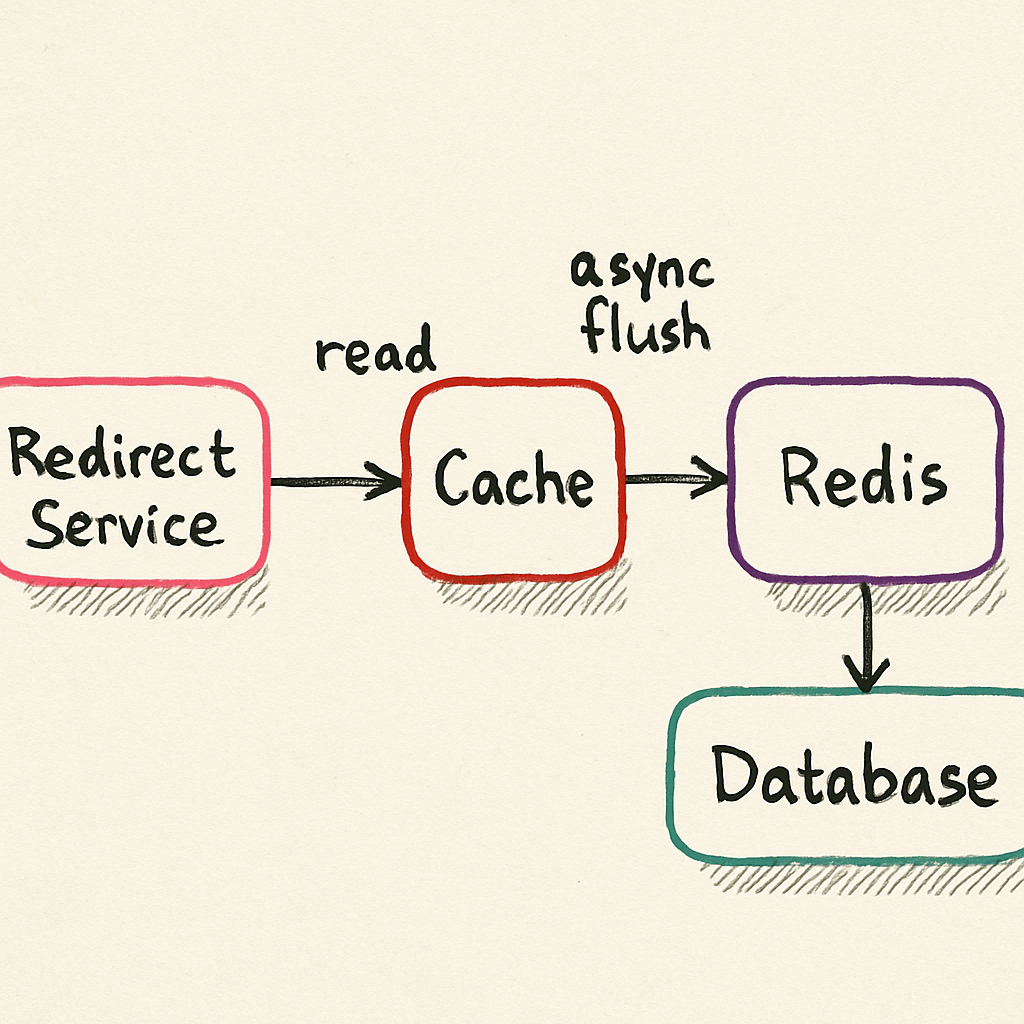
Redis can handle roughly 100K–500K ops/sec per instance, depending on command mix, value size, networking, and CPU.
At peak 3M redirects/sec, use multiple Redis shards and replicas.
A reasonable interview answer:
Redis Cluster with 12–24 nodes total:
- several primary shards for throughput
- replicas for read scaling and failover
Exact node count is less important than sizing Redis by throughput and hot-key behavior.
Cache misses go to Postgres read replicas.
Use negative caching for unknown short codes:
url:not_found:b7Xk29Q -> true, TTL 1-5 minutes
Negative caching prevents random-code scanning from hammering Postgres.
For updates:
1. Write new status or destination to Postgres primary.
2. Delete Redis key.
3. Future redirect reloads from Postgres.
TTL alone is too slow for admin changes. If a malicious URL is disabled, redirects must stop quickly.
Say:
“Redis handles hot redirects, Postgres replicas handle misses, and I’ll add in-process caching for hot-key protection. Updates delete cache keys so disabled URLs stop working quickly.”
Spend two or three minutes on estimation in the interview.
Given:
100M new URLs/day
Average write QPS:
100,000,000 / 86,400 ≈ 1,157 writes/sec
Peak write QPS at 3x:
≈ 3,500 writes/sec
A single Postgres primary can handle 10K–50K TPS on modern hardware. One primary is enough for URL creation.
Given:
100B redirects/day
Average read QPS:
100,000,000,000 / 86,400 ≈ 1.16M reads/sec
Peak read QPS at 3x:
≈ 3.5M reads/sec
Postgres should not handle this directly. Redis and in-process caches serve the hot path.
62^7 ≈ 3.5T codes
At 36.5B URLs/year, 7 characters lasts around 96 years.
Use 7 characters.
Assume one short_urls row averages about 1 KB after row overhead, indexes, metadata, and long URL storage.
100M rows/day * 1 KB = 100 GB/day
36.5B rows/year * 1 KB = 36.5 TB/year
36.5 TB/year is large, but a carefully operated Postgres deployment can handle it when writes are modest and reads mostly hit Redis.
Use table partitioning by creation time for maintenance, backups, and retention workflows.
Do not shard at 100 GB. Do not shard because the table sounds large.
Shard only when you hit a concrete limit:
For this scale, say:
“I’ll use one Postgres primary with partitioning and read replicas. I won’t shard the write path yet.”
Assume each redirect response is 500 bytes to 1 KB including headers.
Average:
1.16M/sec * 1 KB ≈ 1.16 GB/sec
Peak:
3.5M/sec * 1 KB ≈ 3.5 GB/sec ≈ 28 Gbps
Modern datacenter networking often supports 25–100 Gbps per machine class. You will run many redirect service instances behind a load balancer. Bandwidth is manageable.
Assume 200 bytes per click event:
100B events/day * 200 bytes = 20 TB/day
With Kafka replication factor 3:
≈ 60 TB/day written across brokers
Use Kafka retention for short-term buffering. Compact or aggregate into the analytics store.
Impact:
Mitigation:
Recommendation:
“Redirect availability should not depend on the primary database being up.”
Impact:
Mitigation:
Recommendation:
“If Redis is degraded, serve from local cache and replicas. Protect Postgres with rate limits and circuit breakers.”
Impact:
Mitigation:
Recommendation:
“Kafka failure must not break redirects.”
Impact:
Mitigation:
Recommendation:
“Use local cache for hot-key protection. Redis Cluster alone does not solve a single-key hotspot.”
Impact:
Mitigation:
Recommendation:
“Coalesce misses so only one request reloads a key from Postgres.”
Impact:
Mitigation:
http and https.Recommendation:
“Build abuse controls into URL creation, scanning, and fast disable flows.”
Impact:
Mitigation:
Recommendation:
“If enumeration matters, permute IDs. Keep the database-sequence design and add collision-free obfuscation.”
Impact:
Mitigation:
Recommendation:
“Start single-region with multi-AZ. Add active-passive multi-region for redirect resilience when needed.”
An L5 candidate should produce a clean, correct design:
A good L5 answer:
“Writes are small enough for one Postgres primary. Reads are huge, so redirects go through Redis and replicas. Analytics are async and must not block the redirect.”
An L6 candidate adds operational judgment:
A strong L6 answer:
“The durable path is simple: Postgres sequence to base62. The hot path is Redis-backed redirect lookup with local caching for viral links. Analytics go through Kafka with backpressure rules that prefer dropping events over delaying redirects. I won’t shard Postgres at this scale; I’ll partition for operations and add replicas for read misses.”
A worked system design answer for URL Shortener, timed at about 45 minutes — the length of the design portion of a real round. Reported asked at Amazon, Google, Microsoft.
It walks the same sequence an interviewer expects: clarify the requirements, size the load, settle the API, choose the storage and the caching, then defend the trade-offs. It builds on the Databases, Caching, Scalability families and belongs to Foundations.