
Data Science
Data Science vs Software Engineering Interviews: Key Differences Explained
Choosing between data science and software engineering can feel like choosing between two different careers and two different interview worlds. The roles ove...
Choosing between data science and software engineering can feel like choosing between two different careers and two different interview worlds. The roles overlap in code, systems, and impact—but the way companies evaluate you is very different. If you’re preparing for both, or deciding where to focus, understanding data science vs software engineering interviews at a detailed level will save you months of misdirected prep.
This guide breaks down DS vs SWE interviews systematically: what’s tested, how rounds differ, what “good” looks like, and how to prepare efficiently.
1. The Core Difference: What Each Role Is Optimized For
Before comparing interview formats, it helps to clarify what each role is actually hired to do.
Software Engineering: Ship Reliable Systems at Scale
Software engineers are evaluated primarily on their ability to:
- Design and implement correct, maintainable, scalable code
- Work with production systems (services, APIs, databases, infra)
- Collaborate in large codebases with other engineers
- Make tradeoffs (performance vs simplicity, latency vs throughput)
Interviews are optimized to answer:
“Can this person write production-quality code and reason about systems under constraints?”
Data Science: Generate Decision-Making and Product Value from Data
Data scientists are evaluated on their ability to:
- Frame ambiguous business problems as data problems
- Use statistics, experimentation, and ML to draw valid conclusions
- Communicate insights and recommendations to non-technical stakeholders
- (For ML-focused roles) Build and evaluate predictive models that work in practice
Interviews are optimized to answer:
“Can this person turn messy, real-world data into reliable insights or models that drive product and business outcomes?”
This difference in core objective drives everything about data science vs software engineering interviews: question types, evaluation criteria, and prep strategy.
2. High-Level Interview Structure: DS vs SWE
Most tech companies use similar stages, but with different content emphasis.
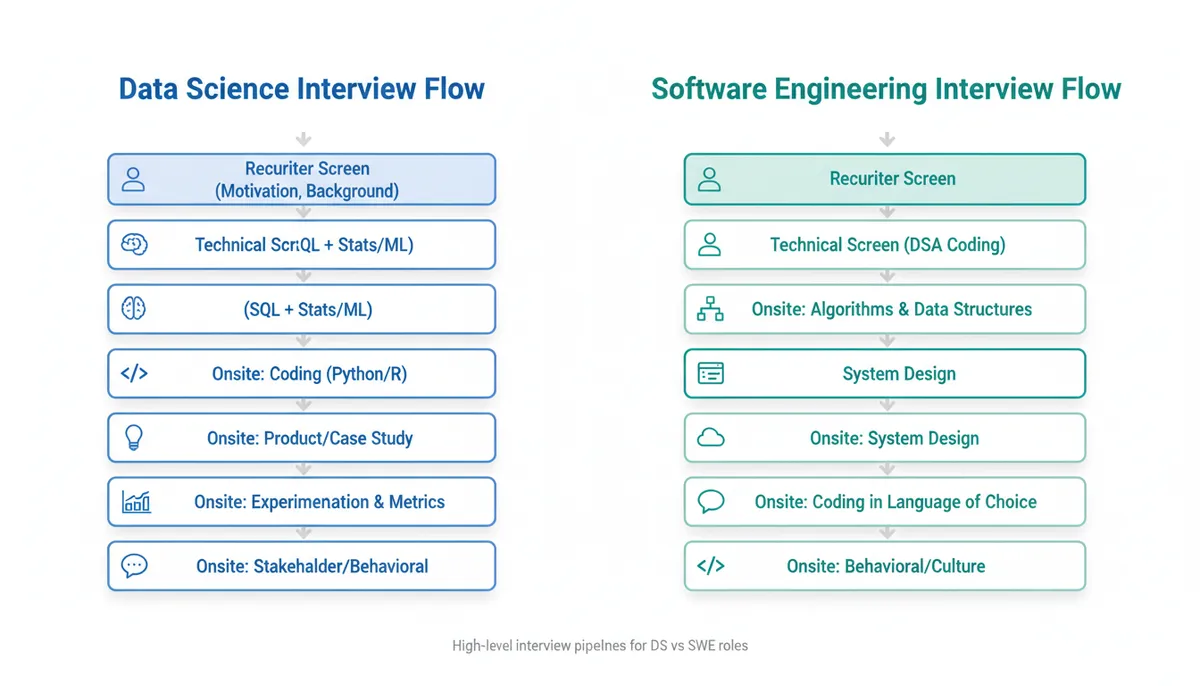
Typical Software Engineering Interview Loop
Common components:
- Online assessment / technical screen
- DSA coding problems (arrays, trees, graphs, DP)
- Time and space complexity analysis
- Onsite / virtual onsite
- 2–4 coding interviews (LeetCode-style)
- 1–2 system design interviews (mid/senior roles)
- 1 behavioral interview
Coding is central. System design is the second pillar for more senior roles.
Typical Data Science Interview Loop
Common components (for product/analytics DS; ML roles differ slightly):
- Technical screen
- SQL query questions
- Probability / statistics / basic ML
- Onsite / virtual onsite
- 1 coding interview (Python/R, sometimes SQL live coding)
- 1–2 analytics / product sense interviews
- 1 experiment design / A/B testing interview
- 1 case study / portfolio / project deep dive
- 1 behavioral / stakeholder interview
Coding is important, but statistics, experimentation, and product thinking are equally (or more) important.
3. Coding Interviews: How DS vs SWE Differ in Practice
This is where many candidates miscalibrate their prep.
SWE Coding: Algorithmic Depth and Patterns
Software engineering interviews are heavily focused on data structures and algorithms:
- Problem types:
- Arrays and strings
- Linked lists, stacks, queues
- Trees, graphs, BFS/DFS
- Dynamic programming
- Greedy algorithms
- Hashing, sorting, searching
- Evaluation focuses on:
- Correctness and edge cases
- Time and space complexity
- Code quality and structure
- Ability to iterate from brute force to optimal
Example SWE-style problem:
Given a binary tree, return the level order traversal of its nodes’ values (from left to right, level by level).
You’re expected to reach an O(n) BFS solution using a queue, explain complexity, and write clean code.
DS Coding: Practical Data Manipulation and Light Algorithms
Data science coding interviews are more about data wrangling, analysis, and simple algorithms than deep DSA.
Common expectations:
- Comfortable in Python (pandas, basic standard library) or R
- Can write readable, vectorized code for:
- Filtering, grouping, aggregations
- Joining datasets
- Computing metrics
- Simple simulations
- Can reason about runtime, but rarely asked to derive optimal asymptotic bounds as rigorously as SWE
- For SQL-heavy roles: complex joins, window functions, subqueries
Example DS-style coding prompt:
You are given a list of user events with columns:
user_id,event_type,timestamp.
Write Python code to compute the 7-day rolling active users per day.
Here, the interviewer cares more about:
- Whether you can transform data correctly
- Whether you use appropriate tools (e.g., pandas
groupby,rolling) - How you handle missing days, time zones, edge cases
Example: SWE vs DS Solutions Side-by-Side
SWE-style array problem (Python):
PYTHON
DS-style pandas problem:
PYTHON
The second example is much closer to what you’ll see in data science interview preparation: complete roadmap for coding: real-world-ish data, heavy on transformations, light on formal algorithm tricks.
4. SQL: Central for DS, Optional for SWE
For data science vs software engineering, SQL is one of the clearest dividing lines.
Data Science: SQL as a First-Class Skill
For many DS roles (especially analytics and product data science):
- SQL is mandatory and heavily tested.
- Expect questions involving:
- Multi-table joins (INNER, LEFT, FULL)
- Window functions (
ROW_NUMBER,RANK,LAG,LEAD) - Aggregations with
GROUP BY,HAVING - Subqueries and CTEs
- Complex filtering and conditional logic
Example DS SQL question:
Given tables
orders(order_id, user_id, created_at, amount)andusers(user_id, country),
write a query to compute the 7-day moving average revenue per country.
You’re evaluated on:
- Correctness under edge cases (users with no orders, missing days)
- Use of window functions and date logic
- Readability and structure (CTEs vs deeply nested queries)
Software Engineering: SQL as a Nice-to-Have
For SWE:
- SQL may appear in system design discussions (schema design, indexing).
- Some full-stack roles may ask basic SQL.
- But it’s rarely a core evaluation axis compared to DSA and system design.
If you’re targeting both DS and SWE, you can’t skip SQL for DS, but you can often get by with lighter SQL for SWE. For a deeper dive on what to prioritize, see SQL vs Python for Data Science Interviews: What to Prioritize.
5. Statistics, Experimentation, and ML: Unique to Data Science
This is where DS interviews diverge the most from SWE.
Statistics and Probability
Common topics:
- Distributions (normal, binomial, Poisson)
- Confidence intervals and hypothesis testing
- p-values, Type I/II errors, power
- Sampling, bias, variance
- Conditional probability, Bayes’ theorem
Example question:
You run an A/B test and observe a p-value of 0.03. What does this mean, and what assumptions are required for this interpretation to be valid?
You’re evaluated on:
- Conceptual clarity, not just formulas
- Understanding of assumptions (independence, distribution, randomization)
- Ability to explain in plain language
Experiment Design / A/B Testing
Highly common in product data science:
- Design an experiment to test a new feature
- Choose metrics and guardrails
- Handle sample size, duration, and stopping rules
- Interpret ambiguous or conflicting results
Example prompt:
We want to test a new recommendation algorithm on the homepage.
How would you design the experiment? What primary and secondary metrics would you track? What could go wrong?
SWE interviews almost never go this deep into experimental design.
Machine Learning and Modeling (for ML/DS roles)
For ML-heavy DS roles:
- Supervised vs unsupervised learning
- Bias-variance tradeoff
- Regularization (L1, L2)
- Feature engineering, cross-validation
- Overfitting, underfitting
- Evaluation metrics (AUC, precision/recall, log loss)
- Production concerns (drift, monitoring, retraining)
Example ML question:
You trained a model with high accuracy on the training set but poor performance on the test set.
Walk me through possible causes and how you’d debug this.
These topics are mostly absent from SWE interviews unless it’s an ML engineering role. For a detailed comparison of machine learning and data science interviews, check out Machine Learning vs Data Science Interviews: What's the Difference?.
6. System Design vs Data/Product Case Studies
Both DS and SWE have “design” interviews, but they’re very different in nature.
SWE System Design: Architecting Distributed Systems
System design interviews evaluate:
- Breaking down large systems (e.g., “design Twitter feed”)
- Choosing storage (SQL vs NoSQL), caching, queues
- API design, consistency/availability tradeoffs
- Scaling, sharding, replication
- Observability, reliability
Example SWE prompt:
Design a URL shortening service like bit.ly. Discuss the API, data model, and how you would handle scale.
You’re expected to draw high-level architecture diagrams and reason about tradeoffs.
DS Case Study / Product Sense: Framing and Solving Data Problems
Data science “design” interviews are more like case studies:
- Given an ambiguous product or business problem, how do you:
- Clarify the goal and constraints?
- Define metrics and success criteria?
- Propose analyses or models?
- Interpret hypothetical results?
- Make recommendations?
Example DS prompt:
Our signup conversion rate has dropped by 5% over the last two weeks.
How would you investigate the issue?
Evaluation focuses on:
- Problem decomposition
- Prioritization of analyses
- Understanding of product funnels and metrics
- Communication and stakeholder alignment
Some DS roles also include ML system design (e.g., “design a recommendation system”), but the emphasis is on:
- Problem framing
- Feature signals and data sources
- Offline vs online evaluation
- Feedback loops and drift
Not on low-level distributed systems details.
7. Behavioral and Communication: Higher Bar for DS
Both roles have behavioral interviews, but expectations differ subtly.
SWE Behavioral: Teamwork and Execution
Common themes:
- Collaboration in engineering teams
- Handling conflicting priorities
- Dealing with legacy systems, tech debt
- Ownership of features and incidents
Strong answers focus on:
- Clear STAR structure (Situation, Task, Action, Result)
- Technical depth where relevant
- Learning and iteration
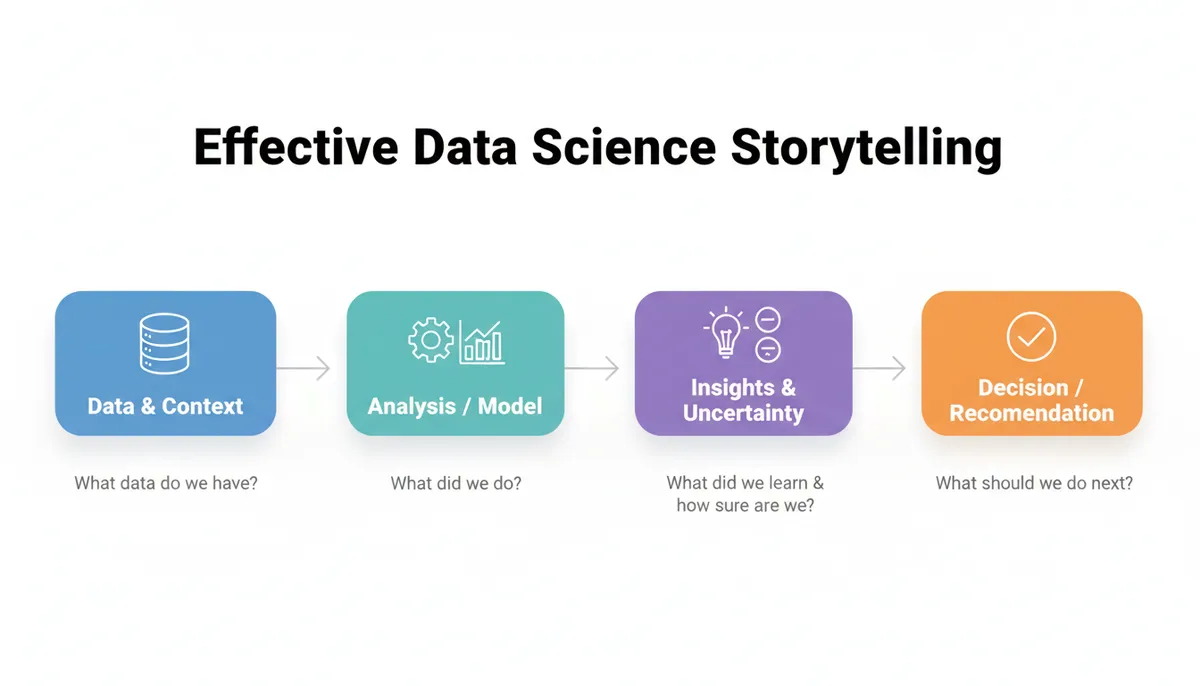
DS Behavioral: Stakeholder Management and Storytelling
Data scientists often sit at the intersection of:
- Product
- Engineering
- Business / operations / marketing
Behavioral evaluation includes:
- Ability to communicate technical findings to non-technical stakeholders
- Handling ambiguous problem statements
- Pushing back on poorly defined requests
- Translating between data and business outcomes
You’ll often be asked:
- “Tell me about a time when your analysis changed a product decision.”
- “Describe a time when stakeholders disagreed with your recommendation. What did you do?”
Clarity of communication and data storytelling is more heavily weighted in DS than in most SWE interviews.
8. Common Pitfalls When Preparing for DS vs SWE Interviews
Pitfall 1: Using SWE-Only Prep for DS Roles
Many candidates:
- Grind 300+ LeetCode problems
- Learn system design patterns
…but for DS roles, they:
- Fail basic SQL joins or window functions
- Misinterpret p-values or experiment results
- Struggle to define metrics or design A/B tests
If your target is DS, DSA alone is not enough.
Pitfall 2: Underestimating Coding Expectations for DS
On the other side, some DS candidates:
- Rely only on Jupyter notebooks and ad-hoc scripts
- Are uncomfortable writing clean functions/classes
- Struggle with basic complexity reasoning
Even for DS roles, you’re expected to:
- Write clean, modular code in Python/R
- Use basic data structures (lists, dicts, sets)
- Handle edge cases and test your code
Pitfall 3: Treating Statistics as Memorization
Memorizing formulas without understanding:
- Leads to brittle answers in follow-up questions
- Fails when the interviewer asks for intuition or assumptions
You need to be able to:
- Explain concepts in your own words
- Apply them to novel scenarios, not just textbook ones
Pitfall 4: Ignoring Communication Practice
Both DS and SWE candidates often:
- Focus only on solving problems
- Neglect thinking out loud, structuring explanations, and summarizing
In DS interviews especially, how you communicate is as important as the solution itself. For tips on effective communication, see How to Explain Your Thought Process Clearly in Coding Interviews.
9. Practical Prep Strategy: How to Study Efficiently for Each Path
If You’re Targeting Software Engineering Roles
Focus areas:
-
Data Structures and Algorithms
- Arrays, strings, hash tables, trees, graphs, heaps, DP
- Practice pattern-based problem solving (e.g., sliding window, two pointers, topological sort)
- Analyze time/space complexity consistently
-
System Design (for mid/senior)
- Learn common design building blocks (load balancers, caches, queues)
- Practice end-to-end designs: news feed, chat system, search, logging service
-
Language and Code Quality
- Get fluent in one interview language (Java, Python, C++, etc.)
- Practice writing bug-free code in one pass under time pressure
Platforms like Thita’s Beginner to Advanced DSA Roadmap for Software Engineers in 2026 can help structure DSA prep across patterns instead of random problem grinding.
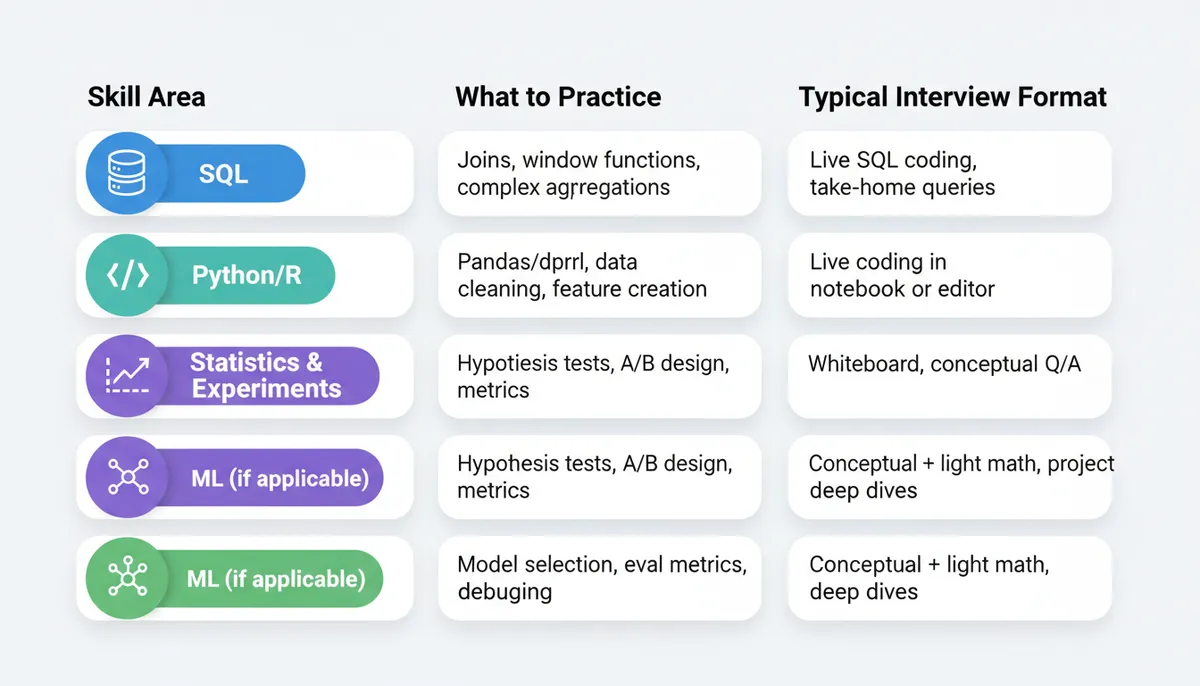
If You’re Targeting Data Science Roles
Focus areas:
-
SQL
- Joins, aggregations, window functions, CTEs
- Practice realistic analytics queries on multi-table schemas
-
Python/R and Data Manipulation
- Pandas or dplyr
- Groupby, joins/merges, pivoting, time series operations
-
Statistics and Experimentation
- Hypothesis testing, confidence intervals, p-values
- A/B test design, sample size, power
- Metric selection and pitfalls
-
Machine Learning (for ML roles)
- Core algorithms and when to use them
- Overfitting, regularization, evaluation metrics
- Model debugging and iteration
-
Case Studies and Product Sense
- Practice framing ambiguous product questions
- Define metrics, propose analyses, interpret hypothetical outcomes
If You’re Considering Both DS and SWE
You’ll need to be deliberate:
-
For SWE:
- Go deeper on DSA and system design
- Lighter on stats/experiments (unless ML engineering)
-
For DS:
- Go deeper on SQL, stats, experiments, product sense
- Moderate on coding and basic DSA (arrays, hash maps, simple trees)
A reasonable combined plan:
- 50–60%: SWE-style DSA coding (for general coding strength)
- 20–30%: SQL + pandas/R
- 20–30%: Stats, experiments, and DS case studies
Using an AI coach or mock interviews (like Thita’s AI Interview Practice: Free Mock Interview Simulator with Real-Time Feedback for Technical Interviews) can help simulate both DS and SWE interview styles and reveal where you’re actually weak.
10. Example Question Comparisons: DS vs SWE for the Same Scenario
To make the differences concrete, consider how each role might be quizzed about a user engagement feature.
Scenario: A New “Streaks” Feature in a Mobile App
SWE Questions Might Include:
- Design the backend API and data model to track streaks.
- How would you handle concurrent updates to streak counters?
- How would you scale this to 100M DAU?
- Write code to compute the current streak length given a sorted list of login dates.
DS Questions Might Include:
- How would you measure whether the streaks feature improves retention?
- Design an experiment to test the feature before full rollout.
- What metrics (primary, secondary, guardrail) would you track?
- Given this dataset of user logins and streak assignments, compute:
- Retention uplift for streak users vs non-streak users
- Confidence intervals around the uplift
Same product, very different evaluation lenses.
11. Best Practices to Excel in Each Interview Type
For Software Engineering Interviews
-
Verbalize your thought process:
- Start with clarifying questions.
- State a brute-force approach, then optimize.
- Explain tradeoffs as you choose data structures.
-
Use patterns, not memorization:
- Recognize problem families: sliding window, binary search on answer, topological sort, etc.
- Practice mapping new problems to known patterns.
-
Test your code:
- Run through edge cases out loud.
- Fix bugs proactively before the interviewer points them out.
For Data Science Interviews
-
Structure your answers:
- For case studies: Problem → Clarifications → Approach → Risks → Interpretation
- For stats/experiments: Setup → Assumptions → Method → Interpretation → Limitations
-
Tie everything back to business impact:
- Don’t stop at “the metric increased by X%”.
- Add: “…which likely translates to Y in revenue/engagement/retention.”
-
Be explicit about assumptions:
- In experiments and analyses, state what you’re assuming (randomization, independence, stationarity).
- This signals maturity and real-world thinking.
-
Practice communicating to non-experts:
- Explain p-values, A/B tests, or models as if to a PM or exec.
- Avoid jargon where possible; use analogies when helpful.
12. Key Takeaways: Data Science vs Software Engineering Interviews
-
Core focus differs:
- SWE: building and scaling reliable systems.
- DS: generating insights and decisions from data (and models, for ML roles).
-
Coding expectations:
- SWE: deep DSA and system design.
- DS: solid coding + strong SQL + data manipulation, lighter DSA.
-
Stats and experiments:
- Central to DS; largely absent in SWE.
-
Design interviews:
- SWE: system architecture (APIs, storage, scaling).
- DS: case studies, metrics, experiment design, product sense.
-
Communication:
- Important for both, but DS interviews place heavier weight on stakeholder communication and data storytelling.
When you plan your prep, align it with the actual evaluation criteria of the role you’re targeting—not just what’s popular on LeetCode or in generic interview guides. That alignment is the real difference between grinding for months and preparing effectively. For a comprehensive overview of how AI is transforming interview preparation, consider reading How AI Is Changing Technical Interviews in 2026.