
Data Science
Machine Learning Interviews: Theory vs Practical Expectations
If you’re preparing for a machine learning interview and feel torn between memorizing equations and building end‑to‑end projects, you’re not alone. Many cand...
If you’re preparing for a machine learning interview and feel torn between memorizing equations and building end‑to‑end projects, you’re not alone. Many candidates discover too late that the interview they studied for (heavy theory, lots of ML concepts) is not the interview they actually get (messy data, product constraints, practical ML tradeoffs).
This guide breaks down machine learning interviews through the lens of theory vs practical expectations: what you’re really tested on, how different roles emphasize different skills, and how to prepare efficiently.
1. Why Machine Learning Interviews Feel Confusing
Most ML interview loops span a wide spectrum:
- One round asks you to derive the gradient of logistic regression.
- Another asks how you’d ship a recommendation model to millions of users.
- A third is mostly SQL and data cleaning.
The confusion comes from a mismatch between:
- Academic ML: proofs, derivations, advanced architectures.
- Production ML: data quality, monitoring, metrics, tradeoffs, and iteration speed.
A strong candidate can move between these worlds: using theory to justify decisions, but speaking in the language of product impact and reliability.
This article will help you map what’s expected in a machine learning interview across that spectrum, and how to prepare both theoretical ML concepts and practical ML skills without wasting time.
2. Types of Machine Learning Roles and What They Test
Before you decide what to study, you need to know what you’re interviewing for. Different roles emphasize theory vs practice differently.
2.1 Common ML Role Archetypes
-
ML Engineer (Product-focused)
- Focus: shipping models into production, integrating with services, performance.
- Emphasis:
- Strong software engineering (Python, data structures, system design).
- Practical ML: feature pipelines, evaluation metrics, A/B testing, monitoring.
- Enough theory to choose and troubleshoot algorithms.
-
Applied Scientist / Applied ML Engineer
- Focus: designing and validating models for specific problems.
- Emphasis:
- Experiment design, model selection, error analysis.
- Deeper understanding of algorithms, optimization, and statistics.
- Often some research reading and adaptation of papers.
-
Research Scientist (ML / AI)
- Focus: new algorithms, architectures, or fundamental improvements.
- Emphasis:
- Strong theoretical grounding: optimization, generalization, learning theory.
- Ability to read, critique, and extend research.
- Less focus on production systems, more on novel contributions.
-
Data Scientist / Analytics-heavy ML
- Focus: business metrics, experimentation, sometimes lightweight models.
- Emphasis:
- Statistics, causal inference, A/B testing.
- SQL, data wrangling, dashboards.
- Some ML, often more classical than deep learning.
Most “machine learning interview” loops blend elements of at least two of these. Ask your recruiter explicitly which type of role you’re targeting.
For a comprehensive overview of machine learning interview preparation, including role-specific expectations, consider the Data Science Interview Preparation: Complete Roadmap.
3. Theoretical ML Concepts Interviewers Actually Care About
You do not need to memorize every equation in Bishop or Goodfellow. But you do need to understand core ML concepts well enough to reason under pressure.
3.1 Core Theory Topics (High ROI)
These come up across most ML interviews:
-
Bias–variance tradeoff
- How model complexity affects underfitting vs overfitting.
- How regularization, data size, and feature engineering change this balance.
-
Regularization
- L1 vs L2: effect on weights, sparsity, and optimization.
- Early stopping, dropout, data augmentation as regularization.
-
Optimization basics
- Gradient descent, stochastic gradient descent (SGD), mini-batch.
- Learning rate, momentum, Adam (high-level intuition).
- Why non-convex optimization is still tractable in deep learning.
-
Loss functions
- Regression: MSE, MAE, Huber.
- Classification: cross-entropy, hinge loss.
- When you’d choose one over another based on noise, outliers, or business objective.
-
Evaluation metrics
- Classification: accuracy, precision, recall, F1, ROC-AUC, PR-AUC.
- Regression: RMSE, MAE, R².
- Ranking/recommendation: NDCG, MAP, hit rate.
- Why accuracy can be misleading for imbalanced data.
-
Probability and statistics
- Conditional probability, Bayes’ rule.
- Distributions (Gaussian, Bernoulli, Binomial, Poisson).
- Confidence intervals, hypothesis testing (p-values, Type I/II errors).
-
Overfitting / underfitting
- How to detect (learning curves, validation performance).
- How to mitigate (more data, regularization, simpler model, better features).
These concepts show up as “why” questions:
- “Why might your validation loss go up while training loss goes down?”
- “Why is cross-entropy a better choice than MSE for classification?”
- “How would you handle a highly imbalanced dataset?”
You’re not expected to recite proofs, but you are expected to connect theory to behavior you’d see in practice.
4. Practical ML Expectations: From Notebook to Production
If theory explains why models behave a certain way, practical ML is about making them behave well in the real world.
4.1 The End-to-End ML Lifecycle
Interviewers increasingly expect you to reason through the entire lifecycle, not just model training.
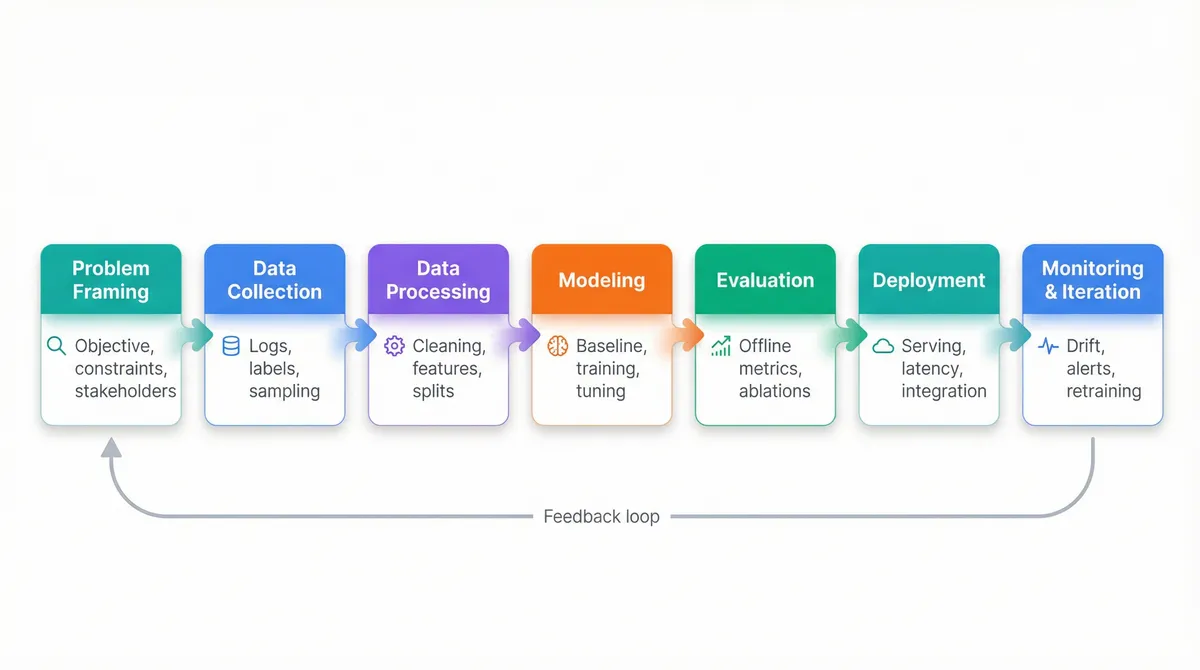
You should be able to walk through this lifecycle for a concrete problem, e.g., “predict user churn in a subscription app”:
-
Problem framing
- Define the prediction target (churn in next 30 days? 90 days?).
- Understand constraints (latency, fairness, interpretability).
- Translate business goals into ML metrics.
-
Data collection & labeling
- Identify relevant signals (usage logs, demographics, payments).
- Handle label leakage (avoid using future information).
- Manage sampling (avoid temporal leakage in time-series).
-
Data processing & feature engineering
- Handle missing values, outliers, categorical encodings.
- Train/validation/test splits (time-based vs random).
- Normalization/standardization where needed.
-
Modeling & training
- Start with simple baselines (logistic regression, gradient boosting).
- Compare against heuristic or rule-based baselines.
- Hyperparameter tuning (grid search, random search, Bayesian).
-
Evaluation
- Select metrics aligned with business goals (e.g., recall at fixed precision).
- Analyze error slices (by segment, geography, device).
- Check for distribution mismatch between train and test.
-
Deployment
- Batch vs online inference.
- Latency, throughput, cost constraints.
- Feature availability at inference time (training/serving skew).
-
Monitoring & iteration
- Data drift detection (feature distribution shifts).
- Model performance monitoring (live metrics, A/B tests).
- Retraining schedule, rollback strategy.
Interview prompts like “Design a churn prediction system” or “How would you build a recommendation engine for our product?” are testing this lifecycle thinking more than any specific algorithm.
For insights on how AI is transforming technical interviews and the practical skills expected in 2026, see How AI Is Changing Technical Interviews in 2026.
5. Machine Learning Interview Rounds: What’s Theory, What’s Practical?
Most machine learning interview loops have recurring patterns. Understanding them helps you allocate prep time.
5.1 ML System Design / Applied ML Round
Typical questions:
- “Design an ML system to detect fraudulent transactions.”
- “How would you build a ranking system for search results?”
What’s tested (practical):
- Problem framing and metric selection.
- Data sources, labeling strategy, handling noise.
- Model choice rationale (e.g., tree-based vs deep learning).
- Deployment architecture: batch vs real-time, online features, caching.
- Monitoring and iteration strategy.
What’s tested (theory):
- Why certain models are appropriate (e.g., tree ensembles for tabular data).
- Tradeoffs between interpretability, capacity, and training data size.
- Handling imbalanced data using appropriate metrics and techniques.
5.2 Algorithmic / Coding Round
Typical questions:
- General DSA (arrays, graphs, strings) similar to software engineering interviews.
- Occasionally ML-flavored coding (implement logistic regression training, vectorized operations, simple gradient descent).
What’s tested (practical):
- Clean, efficient code in Python/Java/C++.
- Ability to manipulate data structures, parse logs, join datasets.
- Comfort with libraries like NumPy/Pandas in some companies.
What’s tested (theory):
- Sometimes: understanding of numerical stability, vectorization, complexity of your approach.
If you’re rusty on algorithms, a structured patterns sheet (like a collection of common DSA patterns) can accelerate your prep; for example, see pattern-based resources like What Are DSA Patterns? A Complete Guide for Beginners to systematically cover gaps.
5.3 ML Theory / Concepts Round
Typical questions:
- “Explain bias–variance tradeoff.”
- “Why does L1 regularization lead to sparsity?”
- “How does batch normalization help training?”
What’s tested (theory):
- Understanding of core ML concepts, not rote memorization.
- Ability to give intuitive explanations and connect to real behavior.
What’s tested (practical):
- How you’d diagnose and fix real training issues (overfitting, vanishing gradients).
- How you’d choose hyperparameters and architectures in practice.
5.4 Data / Analytics Round
Typical questions:
- “How would you evaluate whether a new recommendation model improves user engagement?”
- “Design an A/B test for a new homepage ranking algorithm.”
What’s tested (theory):
- Hypothesis testing, confidence intervals, power, experiment design.
What’s tested (practical):
- Handling messy data in SQL/Pandas.
- Choosing the right metrics and guardrail metrics.
- Interpreting experiment results, dealing with biases.
6. Concrete Example: Theory vs Practice on the Same Problem
Consider a common interview scenario:
“We want to detect fraudulent credit card transactions. How would you approach this?”
6.1 Theoretical ML Concepts You Might Discuss
-
Imbalanced classification
- Why accuracy is misleading if 0.1% of transactions are fraud.
- Use precision, recall, F1, ROC-AUC, PR-AUC.
-
Bayes decision rule
- Conceptually: classify as fraud if posterior probability exceeds a threshold.
- How changing the threshold trades off false positives vs false negatives.
-
Cost-sensitive learning
- The cost of missing fraud vs falsely flagging legitimate transactions.
- Weighted loss functions or class weights.
-
Anomaly detection vs supervised learning
- When labels are scarce or noisy, unsupervised / semi-supervised methods.
6.2 Practical ML Considerations Interviewers Expect
-
Data and labels
- How to get ground-truth fraud labels (chargebacks, manual reviews).
- Label delay: you only know something is fraud days later.
-
Feature engineering
- Transaction amount, merchant category, device fingerprint, velocity features (number of transactions in last X minutes).
- Aggregated behavioral features over time windows.
-
Model choice
- Start with gradient boosted trees (XGBoost/LightGBM) for tabular data.
- Possibly add deep models later if justified by scale and complexity.
-
Serving constraints
- Latency: decisions must be made in milliseconds.
- Feature availability: some features may only be available post-transaction.
-
Monitoring
- Track fraud loss, false positive rate, and user complaints.
- Detect drift as fraudsters change behavior.
A strong answer weaves theory into practical decisions:
- “Because the data is highly imbalanced, I’d avoid accuracy and focus on recall at a fixed precision, or PR-AUC. I’d start with a gradient boosted trees model, which handles heterogeneous tabular features well. To handle the class imbalance, I’d use class-weighted loss and possibly oversampling of fraud cases. At serving time, I’d ensure that all features used are available in real time to avoid training–serving skew…”
7. Coding in ML Interviews: From Algorithms to Simple ML Implementation
While many machine learning interviews focus on design and concepts, you may also be asked to implement simple ML components.
7.1 Example: Implementing Logistic Regression Training
You might be asked to implement a basic logistic regression with gradient descent. This tests:
- Comfort with vectorization.
- Understanding of loss and gradient.
- Ability to write clear, correct code under time pressure.
PYTHON
Complexity:
- Training: Each iteration is O(n_samples × n_features).
- Prediction: O(n_samples × n_features).
Interviewers don’t expect production-ready code with all edge cases, but they do expect:
- Reasonable naming and structure.
- Correct math and vectorization.
- Awareness of complexity.
8. Common Mistakes in ML Interview Preparation
Many strong candidates underperform because they optimize for the wrong thing.
8.1 Over-indexing on Deep Learning
Memorizing every detail of transformer architectures or GAN variants is rarely necessary unless you’re interviewing for a research-heavy role.
Instead:
- Master fundamentals (bias–variance, regularization, optimization).
- Understand deep learning at a conceptual level:
- Why deeper networks help.
- Issues like vanishing gradients.
- Intuitive roles of components like attention or residual connections.
8.2 Neglecting Data and Evaluation
A recurring anti-pattern:
- Candidate jumps to “I’d use a deep neural network” before:
- Understanding label quality.
- Considering baselines.
- Choosing proper evaluation metrics.
Interviewers want to see data-centric thinking:
- “How do we know labels are correct?”
- “What’s the business metric we’re trying to move?”
- “What baseline do we need to beat to justify this complexity?”
8.3 Ignoring System Constraints
Designing an amazing model that can’t be deployed within latency or cost constraints is effectively a failed design.
You should ask:
- “What latency budget do we have?”
- “What are the QPS (queries per second) and cost constraints?”
- “Can we precompute features or scores offline?”
8.4 Treating ML Interviews as Pure Math Exams
You’re not being graded on derivation speed. You’re evaluated on:
- Clarity of explanation.
- Ability to connect math to behavior.
- Judgment in choosing appropriate tools.
If you forget a formula, say so and reconstruct the intuition instead of bluffing.
For common pitfalls when relying on AI tools during interview preparation, see Common Mistakes When Using AI for Interview Preparation.
9. Best Practices and Actionable Preparation Tips
9.1 Build One or Two End-to-End Projects
Instead of ten toy notebooks, build one or two real pipelines:
- Choose a problem: churn prediction, click-through rate, or a recommendation system.
- Implement data ingestion, cleaning, feature engineering, training, evaluation, and a simple serving layer (even if just a REST API).
- Add monitoring hooks (log predictions, track basic metrics over time).
These projects become excellent material for “describe a project you’re proud of” questions and demonstrate both theory and practical ML.
9.2 Practice Explaining Concepts Out Loud
For each core concept (e.g., regularization, cross-validation, ROC vs PR curves), practice:
- A 30-second explanation (high-level).
- A 2-minute explanation (with an example).
- A 5-minute explanation (with math and edge cases).
This mirrors how interviews flow: short answers, followed by deeper probing.
9.3 Use a Structured Approach to ML Design Questions
When asked to design an ML system, follow a consistent structure:
- Clarify objectives and constraints.
- Understand data sources and labeling.
- Propose baselines and metrics.
- Choose model families and justify them.
- Describe training, validation, and evaluation.
- Outline deployment and monitoring.
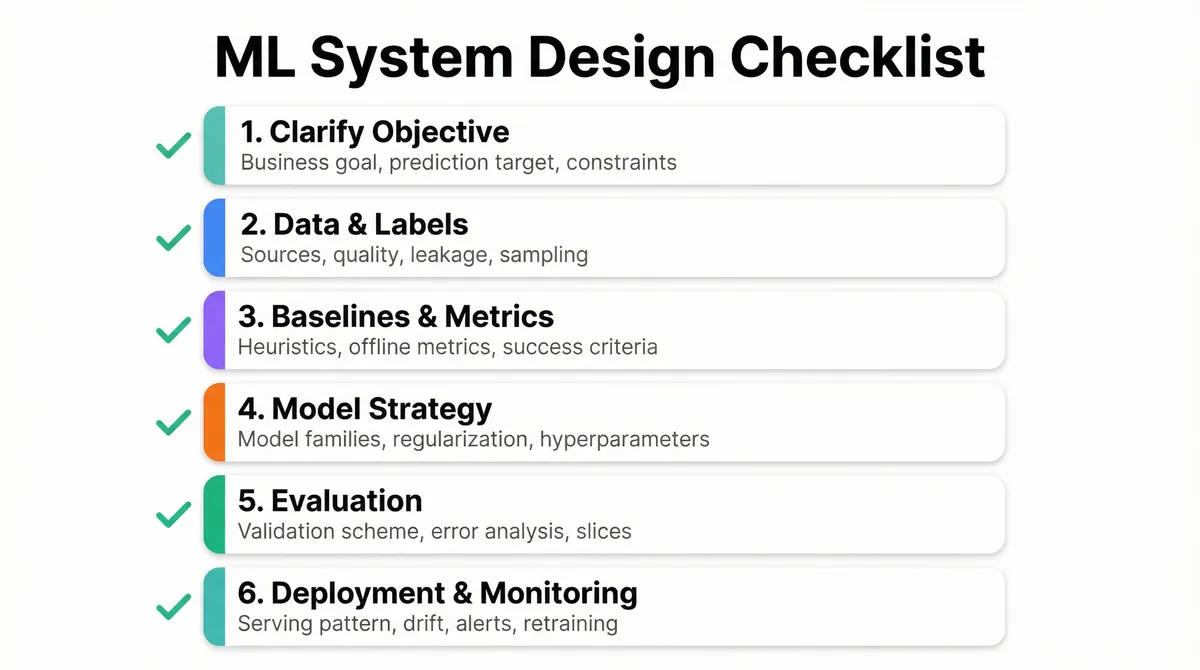
Memorize this structure so you can focus on content rather than organization during the interview.
9.4 Combine DSA Practice with ML-Flavored Problems
If your loop includes algorithmic rounds, use DSA practice that’s relevant to ML/data:
- Parsing logs, aggregating by key.
- Implementing moving averages or sliding windows.
- Designing efficient feature stores or caches.
Pattern-based practice (e.g., sliding window, two pointers, BFS/DFS, dynamic programming) is usually enough; you don’t need obscure puzzles. For a detailed guide on Master the Sliding Window Pattern: Complete Guide with Examples and other useful DSA patterns, check out our DSA resources.
9.5 Do Mock Interviews Focused on ML
Practicing with ML-specific interview questions and receiving real-time feedback is extremely helpful. Whether with peers, mentors, or AI-based mock interview tools (such as platforms that simulate ML interviewers at /ai-interview), focus feedback on:
- Clarity of explanation.
- Structure of design answers.
- Depth of tradeoff analysis.
For more on the effectiveness of AI mock interviews, see AI Mock Interviews vs Real Interviews: Do They Actually Help?.
10. Sample Q&A: Theory vs Practice Side-by-Side
To see how theory and practice interplay, here are a few representative questions and strong answer outlines.
10.1 “What is regularization and why is it useful?”
Theory:
- Regularization adds a penalty term to the loss function to discourage overly complex models:
- L2: adds λ‖w‖², encourages small weights.
- L1: adds λ‖w‖₁, encourages sparse weights.
- It reduces variance by constraining the hypothesis space, helping generalization.
Practice:
- In logistic regression, L2 regularization helps when you have many correlated features and limited data.
- In deep learning, techniques like dropout, weight decay, and data augmentation act as regularizers.
- You’d tune the regularization strength via validation performance, often on a log scale (e.g., 1e-4, 1e-3, …).
10.2 “How would you handle an imbalanced dataset for binary classification?”
Theory:
- Imbalance leads to biased classifiers if you optimize accuracy.
- Better metrics: precision, recall, F1, ROC-AUC, PR-AUC.
- Cost-sensitive learning and sampling strategies (over/under-sampling).
Practice:
- Start with class-weighted loss (e.g.,
class_weight='balanced'in scikit-learn). - Use stratified splits for train/validation/test.
- Choose a threshold based on business tradeoffs (e.g., maximize recall at a minimum precision).
- Evaluate performance across key segments (e.g., geography, user type).
11. Key Takeaways
- Machine learning interviews are not purely theoretical or purely practical. Strong candidates bridge both: they understand the math and can ship robust systems.
- Role type matters: ML Engineer vs Applied Scientist vs Research Scientist roles emphasize different parts of the theory–practice spectrum.
- Core ML concepts (bias–variance, regularization, optimization, metrics, overfitting) are universally important, but you rarely need full derivations.
- Practical ML skills—problem framing, data handling, evaluation strategy, deployment, and monitoring—are increasingly central to interview success.
- Preparation should be balanced:
- 30–40%: core theory and ML concepts.
- 30–40%: practical ML and system design.
- 20–30%: coding/DSA and data manipulation.
If you structure your preparation around this theory vs practice balance, you’ll be much closer to what modern machine learning interviews actually test: the ability to turn messy real-world problems into reliable, explainable, and impactful ML systems.
Your next step
Prepare for data science and ML interviews
A pattern sheet for statistics, machine learning, neural networks, transformers and LLMs, plus AI mock interviews for data roles.