
Interview
Career Switcher With No CS Degree? How to Practise the Technical Round
No CS degree? Build technical interview confidence with a practical plan for DSA, operating systems, databases, networks and realistic mock practice.
A technical interview can feel uniquely intimidating when you are changing careers into tech.
You may have built projects, completed a bootcamp, solved coding problems, contributed to an application at work, or taught yourself after hours for months. Yet one worry keeps returning: what if they ask me something that everyone with a computer science degree simply knows?
That fear is understandable. It is also usually broader than the reality of the interview.
Most interviewers are not trying to recreate a university final exam. They are trying to understand whether you can reason through a problem, write maintainable code, learn unfamiliar concepts, communicate trade-offs, and recover when your first answer is incomplete. Those are skills you can develop through structured preparation and realistic practice.
The fastest way to make the unknown feel manageable is to practise with a live AI technical interview that can ask follow-ups, challenge your assumptions, and let you explain your thinking aloud. For a career switcher into tech, mock interview practice with no CS background is less about proving you memorised a syllabus and more about making your knowledge usable under pressure.
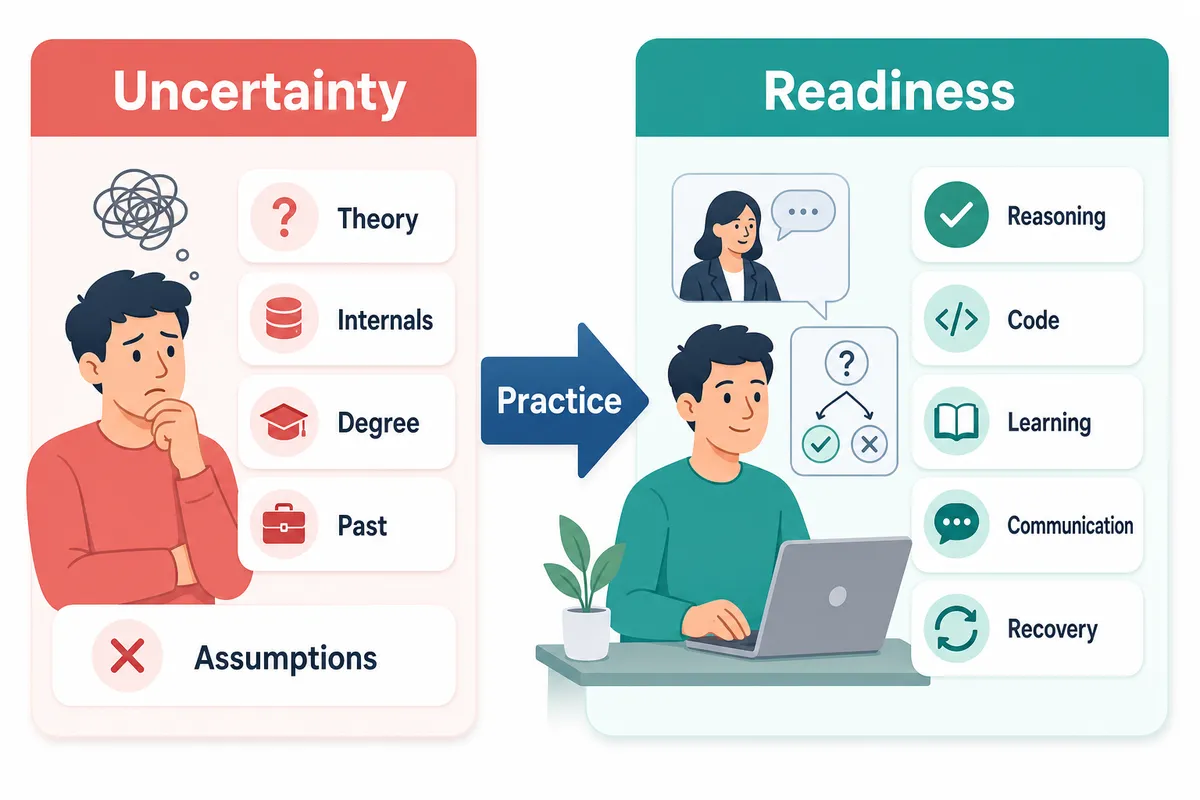
What candidates fear interviewers test versus what they actually test
The anxiety usually sounds like this:
- “What if I cannot define every operating system term?”
- “What if they ask about database internals I have never used?”
- “What if they realise I do not know the same theory as a graduate?”
- “What if my non-technical past makes me look less capable?”
The reality is more practical. A good interviewer may ask fundamentals questions, but they usually care about your reasoning more than your ability to recite definitions.
For example, you may be asked why an index improves a database query. A weak answer memorises: “Indexes make queries faster.” A stronger answer explains that an index helps the database find relevant rows without scanning every row, while noting that indexes add storage and can slow writes.
That answer does not require a degree. It requires a usable mental model.
The same applies across technical rounds:
| What you may fear | What interviewers often assess instead |
|---|---|
| Being exposed for not knowing academic theory | Whether you can explain the concepts you do know clearly |
| Getting a difficult DSA problem | How you break down ambiguity and test an approach |
| Forgetting an exact definition | Whether you can reason from first principles |
| Being asked an unfamiliar follow-up | How you respond when your first answer is incomplete |
| Having a non-traditional background | Whether your projects and choices show deliberate learning |
⚠️ Important: Do not turn “I do not have a CS degree” into an apology you repeat throughout the interview. If your background comes up, explain it briefly, connect it to the work you have done, and move forward.
A career change into tech interview is not a courtroom where you defend your route into the field. It is an opportunity to show that you can do the job.
The fundamentals gap is real, but it is finite
It would not be useful to pretend that fundamentals never matter. Many entry-level and junior software engineering interviews include questions on operating systems, databases, networks, object-oriented design, and basic complexity analysis.
The good news is that the gap is finite. You do not need to recreate a three-year degree before applying. You need enough conceptual depth to answer common questions, connect concepts to your projects, and recognise when an interviewer wants more detail.
For most career switchers, focus on four core areas alongside DSA.
1. Operating systems: understand what happens when code runs
You do not need to explain every kernel subsystem. You should be comfortable with the practical ideas behind:
- Processes versus threads
- Concurrency versus parallelism
- Context switching
- Memory, stack, heap and garbage collection
- Deadlocks and common prevention strategies
- Why input and output operations can block
- What happens when a program uses too much memory
A useful way to learn operating systems is to attach every topic to a scenario.
If an interviewer asks, “Why might you use multiple threads?” do not jump into textbook wording. Start with a practical example: a web application handling multiple user requests, a background task that should not block the interface, or work that can happen while another task waits for a network response.
Then discuss the trade-off: shared state introduces race conditions, so concurrency needs coordination.
2. Databases: know how applications store and retrieve data
For a no CS degree technical interview, database questions are often more useful than obscure theory because they connect directly to project work.
Prioritise:
- Relational versus non-relational databases
- Primary keys, foreign keys and indexes
- Basic joins
- Normalisation and when denormalisation helps
- Transactions and ACID properties
- Read-heavy versus write-heavy workloads
- Caching and why stale data can be difficult
- SQL query performance at a high level
If you have built even one project with a database, prepare to discuss its schema. Why did you choose those tables or collections? How would the system behave if users increased tenfold? Which query might become slow first?
Your project is often the best place to demonstrate fundamentals because it gives your answers context.
3. Networks: learn the path between client and server
Networking can sound enormous. For junior interviews, start with concepts that appear in everyday development:
- HTTP request and response flow
- DNS at a high level
- TCP versus UDP
- HTTPS and why encryption matters
- Status codes
- REST APIs
- Latency, bandwidth and timeouts
- Load balancers and caching basics
You do not need to draw the whole internet. You should be able to explain, in plain language, what happens when a user enters a website address and presses Enter.
That explanation reveals a surprising amount: DNS resolution, a connection to a server, a request, a response, assets loading, and the difference between the browser, network and application layers.
4. DSA: build recognition, not a library of memorised answers
DSA remains important because it is a compact way to observe problem-solving. The interviewer wants to see whether you can clarify requirements, choose a reasonable data structure, estimate complexity, test edge cases, and improve an initial solution.
For a self taught developer, interview practice works best when it is pattern-led rather than random.
Start with:
- Arrays and strings
- Hash maps and sets
- Two pointers
- Sliding window
- Stacks and queues
- Linked lists
- Binary search
- Trees and graph traversal
- Heaps
- Recursion and backtracking
- Dynamic programming basics
The DSA patterns sheet is useful for organising this work around repeatable patterns rather than collecting isolated solutions. You can also use this guide to identify the right DSA pattern in a coding interview when a problem appears unfamiliar.
💡 Pro Tip: If you can explain why a hash map changes a lookup from repeated scanning to near-constant-time access, you are already demonstrating more useful understanding than someone who merely remembers a solution.
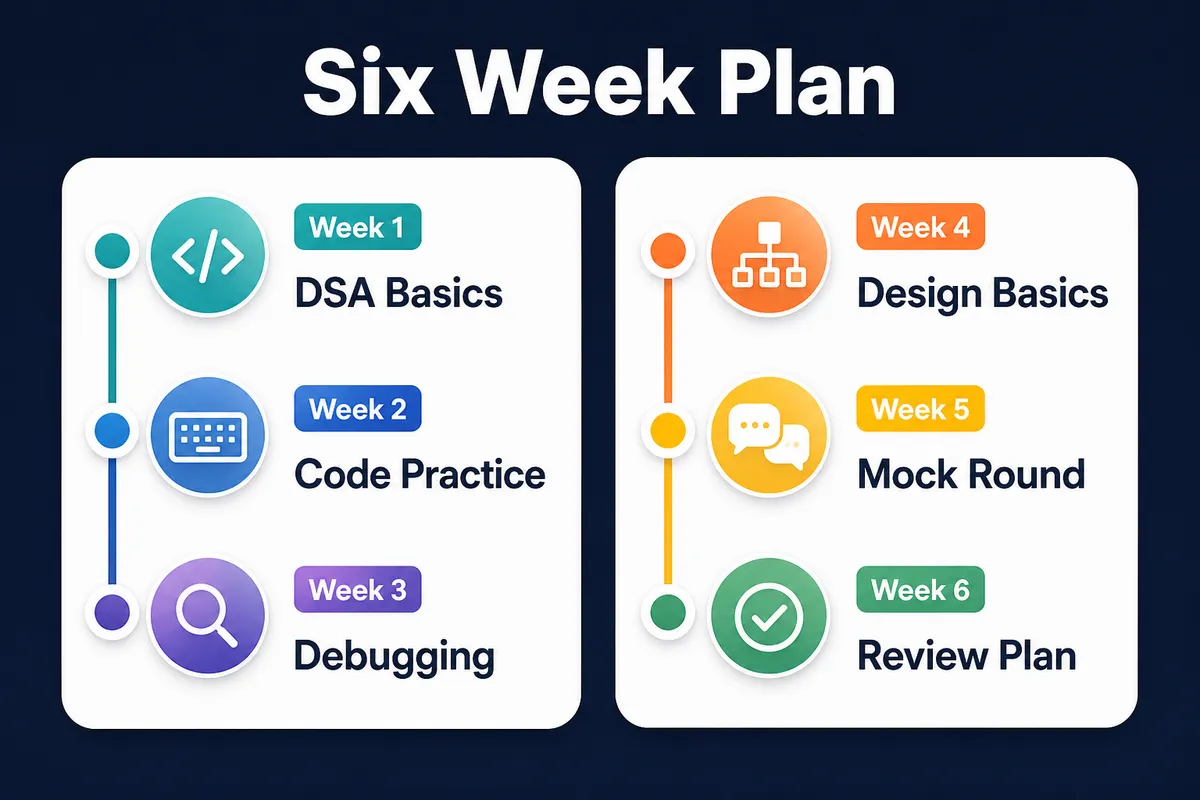
A practical six-week plan for career switchers
Your preparation should run on two tracks at the same time:
- Build the missing knowledge
- Practise explaining and applying it under interview conditions
Studying fundamentals without mock interviews can leave you articulate in notes but hesitant aloud. Doing only DSA can leave you exposed when the conversation shifts to your project, database choices, or system behaviour.
Here is a realistic six-week structure.
Weeks 1 and 2: establish your baseline
Spend the first two weeks finding gaps without judging yourself for having them.
Each study day, do:
- One DSA pattern or two related problems
- One fundamentals topic from OS, DBMS or networks
- Fifteen minutes reviewing a project from your CV
- One short spoken explanation of what you learned
For example, after studying indexes, explain aloud: “In my project, I would add an index to this user lookup because the query happens frequently. The trade-off is slower writes and extra storage.”
Record yourself if necessary. The goal is not polished delivery yet. It is noticing where your explanation becomes vague.
Use a structured preparation plan if you need help fitting this around work. This comparison of 7-day, 30-day and 90-day coding interview preparation plans can help you choose a pace that matches your timeline.
Weeks 3 and 4: combine fundamentals with coding
Now begin linking concepts.
After solving a coding problem, ask yourself:
- What data structure did I choose and why?
- What is the time and space complexity?
- What would break with very large inputs?
- Is there a concurrency issue if several users do this at once?
- Would a database or cache be involved in a real product version?
- Which edge case would I test first?
This is where career switchers often improve quickly. You may not have absorbed this thinking through coursework, but you can practise it deliberately.
Start doing two timed coding sessions each week. Do not just solve the problem; narrate your approach from the beginning. Clarify inputs. State the brute-force approach. Improve it. Test with examples. Explain the final complexity.
If you freeze while speaking, read how to think out loud in coding interviews. Thinking aloud is not performance for its own sake. It lets the interviewer see your reasoning before the final code is complete.
Weeks 5 and 6: simulate the actual round
By this point, replace some passive study with live practice.
A static question list can tell you what might be asked. It cannot ask, “Why did you choose that data structure?” after you have written the code. It cannot notice that your explanation of indexing conflicts with your schema. It cannot change the constraints when you solve the first version quickly.
A live voice AI interview for technical practice can create that pressure without requiring you to find a peer, coordinate schedules, or wait for someone to accept a session. Practise coding, CS fundamentals, system design, low-level design, machine coding, and behavioural questions in separate sessions as your target role requires.
For DSA rounds, use the real code editor to practise in Python, C++, Java, JavaScript, Go or C#. You can practise in six languages, choosing the language that matches your intended interviews. Run code, inspect failing cases, and explain your debugging process instead of silently changing lines until the tests pass.
For system design, start at the level expected for junior roles. You may not need to design a global social network. You may need to explain the components of a URL shortener, notification service, task manager, or booking application. The beginner-friendly system design concepts every engineer should know are a strong place to build that vocabulary.
How to answer when you genuinely do not know
You will eventually get a question you cannot answer fully. Candidates with CS degrees do too.
The goal is not to bluff. The goal is to show useful judgement.
A strong response has four parts:
-
State what you know. “I have not worked deeply with message queues, but I understand they help decouple producers and consumers.”
-
Reason from principles. “If traffic spikes, a queue could buffer work rather than forcing the user-facing service to process everything immediately.”
-
Name uncertainty honestly. “I would need to verify the delivery guarantees and failure handling before choosing a specific implementation.”
-
Ask a useful question. “Is the main priority throughput, ordering, or guaranteeing that a task is processed exactly once?”
This approach is much stronger than saying “I do not know” and stopping, or delivering a confident answer you cannot defend when the interviewer asks one follow-up.
✅ Do use your own projects as evidence of how you learn.
✅ Do say when you would verify a technical detail in documentation.
✅ Do distinguish between what you know, what you infer, and what you would investigate.
❌ Don't pretend every answer needs to sound like a textbook.
❌ Don't over-explain theory before answering the practical question.
❌ Don't assume an unfamiliar term means you have failed the round.
Prepare your story, not just your answers
A career changer has one preparation task that degree candidates may not: making the transition legible.
Interviewers may ask why you moved into technology, how you learned, what you built, and what you would do differently in a project. These are not trick questions. They are opportunities to show persistence, reflection and technical ownership.
Prepare concise answers for:
- Why did you change careers?
- Why software engineering specifically?
- How did you learn your current stack?
- Which project best demonstrates your skills?
- What technical decision did you make and later reconsider?
- What would you improve if you had more time?
- How has your earlier career prepared you for engineering work?
Your previous experience is not irrelevant. Teaching can demonstrate communication. Operations can demonstrate process thinking. Finance can demonstrate attention to detail. Sales can demonstrate customer empathy. Design can demonstrate product judgement.
The strongest answer connects that experience to your current engineering work without pretending the fields are identical.
Frequently asked questions
Can I pass a technical interview without a computer science degree? Yes. Employers assess your ability to solve problems, communicate technical decisions, write code, and learn. You may need to close some fundamentals gaps deliberately, but a degree is not the only route to interview readiness.
What CS fundamentals should career switchers learn first? Start with complexity analysis, data structures, operating system basics, databases, networking, and object-oriented programming. Focus on practical explanations and project examples before going into specialised theory.
How much DSA do I need for a career change into tech interview? For many junior roles, strong comfort with common patterns matters more than advanced competitive programming. Build fluency with arrays, hash maps, trees, graphs, recursion, sorting, binary search, sliding windows and basic dynamic programming.
What should I say if I do not know a technical interview question? Be honest, explain what you do know, reason from first principles, and ask clarifying questions. Interviewers often learn more from your approach to uncertainty than from a memorised definition.
How can a self-taught developer practise interviews realistically? Use timed coding sessions, speak your reasoning aloud, test code under pressure, review your projects, and practise adaptive mock interviews. Static question lists are useful for revision, but they cannot recreate follow-up questions.
Should I study system design for a junior engineering interview? Usually at a basic level. Learn common components such as APIs, databases, caching, queues, authentication and load balancing. Focus on explaining trade-offs rather than designing massive global systems.
How often should I do mock interviews before applying? Aim for one or two mock interviews each week once you have basic DSA and fundamentals coverage. Review feedback after every session and choose one or two specific skills to improve next time.
Start practising the technical round you are actually likely to face
You do not need to know everything a computer science graduate encountered at university. You need to show that you can reason clearly, build working solutions, explain practical trade-offs, and keep learning when the question goes beyond what you have seen before.
That confidence comes from repetitions under realistic conditions.
Start a live AI technical interview practice session to practise coding, CS fundamentals, system design, behavioural questions, and resume-based discussions based on your own experience. Your route into tech may be different. Your preparation can still be rigorous.
If you are reading this as someone hiring rather than interviewing, visit interviews.thita.ai.
Topics
Related on Thita
Your next step
Practise with AI mock interviews
A spoken interview that asks follow-up questions, runs your code and ends with a written report.